
MELU-209 · Lesson 9 of 12 · 19 min
Contracts and mechanics' liens in Florida
▶ Video coming soon A video version of this lesson is on the way.
The Palm Shores Plaza job ended with a phone call nobody wanted. The restaurant tenant, Coastal Taco, had stopped paying its general contractor, and the general contractor had stopped paying Gulfline. Gulfline was owed 38,400 dollars, including retainage. Tanya pulled the job file and checked three dates before she called Frank: when Gulfline had first furnished labor, when it had served its notice to owner, and when it had last worked on the job. "We're fine," she said. "The notice went out on day 12. Last day of work was October 9. We have until early January to record the lien." Marisol, who had always left the paperwork to Tanya, asked her to walk through every step.
This lesson covers Florida contracts for electrical work and the Construction Lien Law, Part I of Chapter 713 of the Florida Statutes. Florida's lien law is detailed and unforgiving: lien rights depend on strict compliance with notices and deadlines, and the business part of the exam tests them heavily. The numbers and section references below come from the statutes; read them yourself, and talk to a construction lawyer before recording or enforcing a real lien.
Contracts
A contract for electrical work should be written and should state the parties, the scope of work by reference to drawings and specifications, the price and how it is calculated, the payment schedule and retainage, the schedule, how changes are priced and approved, warranties, insurance and indemnity terms, and how disputes are resolved. Subcontracts under a general contractor often include flow-down clauses that bind the subcontractor to the prime contract's terms, pay-when-paid or pay-if-paid clauses, notice requirements for claims and delays, and indemnity provisions. Florida limits some construction indemnity clauses, for example by statute requiring certain monetary limits and specific language for indemnities to be enforceable. Read these clauses carefully before signing.
Change orders deserve discipline. On Palm Shores Plaza, the tenant added three menu boards and a walk-in cooler after rough-in. Gulfline priced each change in writing and got the general contractor's signature before doing the work, which turned out to matter: the signed change orders were part of the amount the lien could secure.
Residential contract disclosures
Florida requires direct contracts for improvements to residential property of up to four units, above a set price, to include a statutory disclosure explaining the owner's exposure to liens from unpaid subcontractors and suppliers and how the owner can protect itself. Section 713.015 sets out the required wording and placement. A contractor who fails to include the disclosure may lose lien rights against the owner. The Hendricks service change contract carried the disclosure on its first page in the required type size, and Mrs. Hendricks initialed it.
Who has lien rights
Florida's lien law gives lien rights to contractors in direct contract with the owner, subcontractors, sub-subcontractors, laborers and suppliers of materials who improve real property under a direct contract with the owner. A lienor's rights are limited to the amount owed for the labor, services and materials furnished, and in many cases cannot exceed what the owner owes under the direct contract after proper payments, which is why the owner's payment protections matter.
Liens do not attach to public property. On public projects such as Lakewood Elementary, unpaid subcontractors and suppliers make claims against the payment bond under section 255.05, as Lesson 8 explained.
The notice of commencement
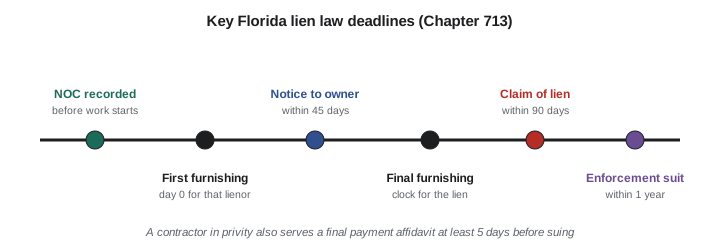
Before improving real property, the owner or the owner's authorized agent must record a notice of commencement in the county's official records under section 713.13, unless the improvement is exempt. Section 713.02(5) exempts improvements with a direct contract price of 2,500 dollars or less from most of the lien law. The notice identifies the property, owner, contractor, surety, lender and the person designated to receive notices. The statutory form warns that it must be recorded and posted on the job site before the first inspection. A notice of commencement is void if the improvement is not actually started within 90 days after recording, and unless it states otherwise it expires one year after recording; for longer contracts it must state the additional period.
Contractors use the notice of commencement as the address book for the lien process: it tells subcontractors and suppliers whom to serve. A contractor who starts work before the notice is recorded or relies on the wrong information can lose important protections, and an owner who pays a contractor before a required notice is recorded may end up paying twice.
The notice to owner
Lienors who are not in privity with the owner, meaning those without a direct contract, such as subcontractors and suppliers, must serve a notice to owner under section 713.06. The statute requires service before commencing, or not later than 45 days after commencing, to furnish labor, services or materials, and before the owner's final payment. Laborers are excepted. Sub-subcontractors and suppliers to subcontractors must also serve the contractor. A subcontractor who misses the notice to owner deadline generally loses its lien rights against the owner's property.
Gulfline, as a subcontractor to the general contractor on Palm Shores Plaza, served its notice to owner 12 days after it started work, well within 45 days. On the Hendricks job, where Gulfline contracted directly with the owner, no notice to owner was needed; Gulfline's own suppliers would serve notices if they wanted to protect their rights.
The claim of lien
A lienor records a claim of lien in the county's official records under section 713.08. The statute sets the deadline: not later than 90 days after the lienor's final furnishing of labor, services or materials, or, if the original contract was terminated, 90 days after termination or final furnishing, whichever comes first. The claim of lien must be served on the owner within the time the statute allows. Final furnishing means the last real work under the contract, not punch-list or warranty work done only to extend the deadline.
A contractor in privity with the owner has one more requirement before enforcing a lien: under section 713.06, the contractor must execute a final payment affidavit stating that all lienors under its contract have been paid, or listing those who have not, and deliver it to the owner at least 5 days before instituting an action to enforce the lien. An action to enforce a lien must generally be filed within one year after the claim of lien is recorded, and the owner can shorten that period by recording a notice of contest of lien.
Waivers and releases
Section 713.20 provides statutory forms for waivers and releases of lien upon progress payment and upon final payment. Contractors and suppliers sign these when they are paid, and owners and general contractors collect them before releasing the next payment. Florida's statutory forms are conditional on payment in the sense that they release lien rights for payment actually received, but a waiver signed before a check clears can still create problems if the check bounces. Gulfline's rule was to sign a release only when the check was in hand or the funds had cleared.
Florida also has a prompt payment statute for private construction, part of Chapter 715, and a separate prompt payment act for local government projects. These set deadlines for paying contractors after a proper invoice and allow interest on late payments. Their details are beyond this lesson, but they are useful tools when a payer is slow.
from datetime import date, timedelta

# Lien deadline calculator for Palm Shores Plaza (study example)
first_furnished = date(2026, 3, 2)
notice_to_owner_served = date(2026, 3, 14)
final_furnished = date(2026, 10, 9)

nto_deadline = first_furnished + timedelta(days=45)
lien_deadline = final_furnished + timedelta(days=90)
print("NTO due by:", nto_deadline, "| served:", notice_to_owner_served,
      "| on time:", notice_to_owner_served <= nto_deadline)
print("Claim of lien due by:", lien_deadline)
recorded = date(2026, 12, 15)
print("Recorded:", recorded, "| on time:", recorded <= lien_deadline)
suit_deadline = date(recorded.year + 1, recorded.month, recorded.day)
print("Suit to enforce generally due by:", suit_deadline)NTO due by: 2026-04-16 | served: 2026-03-14 | on time: True Claim of lien due by: 2027-01-07 Recorded: 2026-12-15 | on time: True Suit to enforce generally due by: 2027-12-15
The calculator confirms that Gulfline's notice to owner was on time and that recording on December 15 met the 90-day deadline of January 7. The suit deadline is one year after recording unless the owner shortens it with a notice of contest.
Worked problem
Did the supplier keep its rights?
Coastal Electric Supply sold Gulfline the switchgear for Palm Shores Plaza. Its first delivery was May 4, it served a notice to owner on June 25, and its last delivery was August 28. Gulfline paid the supplier only half. Did the supplier keep lien rights against the property?
Show solution
- The supplier is not in privity with the owner, so it must serve a notice to owner within 45 days of first furnishing.
- 45 days after May 4 is June 18.
- The notice served June 25 was 7 days late.
- A late notice to owner generally defeats the supplier's lien rights against the owner's property, though it may still sue Gulfline on its contract.
Answer: The notice to owner was late, so the supplier likely lost lien rights against the property; its contract claim against Gulfline remains.
Payment practices that protect everyone
Owners and general contractors protect themselves under Florida's lien law by making payments properly: confirming the notice of commencement is recorded, collecting notices to owner as they arrive, requiring lien releases from the contractor and from each lienor who has served a notice before paying, and obtaining the contractor's final payment affidavit before final payment. A contractor that understands these steps can help customers pay smoothly and get paid faster. Gulfline included a list of its suppliers and subcontractors with each payment application on large jobs, along with releases for the previous payment, so owners and general contractors had what they needed to release funds.
When payment problems start, the order of steps matters: check the contract's notice and dispute provisions, send a written demand, keep working only if the contract and the risk allow it, preserve the lien deadlines, and consider the prompt payment statutes and the contract's dispute resolution process. Recording a lien is a serious step with risks, including liability for a fraudulent lien if the amount is willfully exaggerated, so contractors should calculate the amount carefully and get legal advice for significant claims.
Retainage and final payment
Many Florida contracts hold back part of each progress payment, called retainage, until the job is complete. Retainage gives the owner leverage to get the work finished, but it can strain a subcontractor's cash flow, especially on long projects where the electrical work is done months before the building is complete. Florida law limits retainage on public projects, generally allowing a reduction after the project is half complete, and contract terms govern private projects. Subcontractors should read the retainage clause carefully, bill for its release as soon as the contract allows, and remember that lien deadlines run from final furnishing, not from when retainage is due.
At the end of a job, the owner or general contractor typically requires the contractor's final payment affidavit, final releases from the contractor and each lienor who served a notice, closeout documents such as as-built drawings and warranties, and the final inspection approval. Gulfline assembled these in a closeout package before sending its final invoice, which shortened the time to final payment on most jobs and removed the excuses slow payers often use.
Common mistakes
MistakeWaiting until the job is unpaid to think about the notice to owner.
InsteadServe it early, before or within 45 days of first furnishing, on every job where you are not in privity.
MistakeCounting the 90 days from the last punch-list visit.
InsteadCount from final furnishing of real contract work; trivial work done to extend the deadline does not count.
MistakeLeaving out the residential lien disclosure.
InsteadInclude the section 713.015 disclosure in qualifying residential contracts.
MistakeSigning a release before payment clears.
InsteadSign releases only for payment actually received.
Summary and key terms
- Written contracts should cover scope, price, payment, retainage, changes, warranties, insurance and disputes; read flow-down, payment and indemnity clauses.
- Owners record a notice of commencement before work on improvements over 2,500 dollars; it must be posted before the first inspection and is void if work does not start within 90 days.
- Lienors not in privity serve a notice to owner before or within 45 days after first furnishing.
- A claim of lien must be recorded within 90 days after final furnishing, and a suit to enforce it generally within one year after recording.
- Contractors in privity deliver a final payment affidavit at least 5 days before suing; statutory waiver forms are in section 713.20.
- NOC (notice of commencement)
- The owner's recorded notice identifying the project and parties before work begins.
- NTO (notice to owner)
- A notice that lienors not in privity must serve to preserve lien rights.
- Claim of lien
- The recorded document that creates the lien against the property.
- Final furnishing
- The last labor, services or materials furnished under the contract.
- Privity
- A direct contractual relationship, here with the owner.
Practice problems
Work each problem on paper first, then reveal the answer to check.
What is the deadline to serve a notice to owner?
Show answer
Before commencing, or not later than 45 days after commencing, to furnish labor, services or materials.
A subcontractor's final furnishing was April 20. By when must it record a claim of lien?
Show answer
July 19, 90 days later.
Which improvements are exempt from most of the lien law under section 713.02(5)?
Show answer
Improvements with a direct contract price of 2,500 dollars or less.
How many days before suing must a contractor in privity deliver the final payment affidavit?
Show answer
At least 5 days.
Lesson quiz · 5 questions
Score 60% or more to complete this lesson.
Create a free account to save your progress, take quizzes and earn a certificate.