
MELU-209 · Lesson 12 of 12 · 26 min
Practice exam review and test-day strategy
▶ Video coming soon A video version of this lesson is on the way.
Two weeks before her business exam, Marisol sat a full practice test at the kitchen table with the timer running and her tabbed books stacked beside her. She scored 33 out of 50, five short of passing. Instead of panicking, she sorted her misses by topic: four on lien deadlines, three on workers' compensation, two on financial ratios and the rest scattered. "That's not a knowledge problem," Frank said when she showed him. "That's a tab problem. You know the lien deadlines. You couldn't find them fast." She retabbed the lien chapter, drilled lookups for a week, and scored 41 on her next practice test.
This final lesson pulls the course together. It reviews the Florida content most likely to appear on the business part, connects the technical part back to the master electrician core courses, walks through test day at the testing center, and ends with a practice set covering every lesson. Use it as the last stage of an eight-week study plan.
An eight-week plan
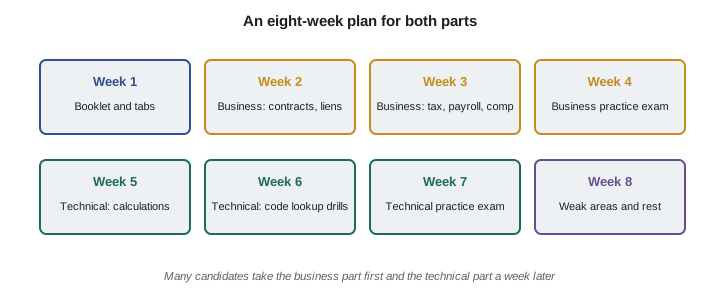
Most candidates prepare for both parts in about two months, often while working full time. A plan that worked for Marisol: week one reading the candidate booklet, buying and tabbing the approved references; weeks two and three on the business manual's licensing, lien, contract, insurance, workers' compensation, tax and payroll chapters; week four a timed business practice exam and review; weeks five and six on technical calculations and code lookup drills using the core courses; week seven a timed technical practice exam; and week eight on weak areas and rest. Many candidates book the business part first and the technical part about a week later.
Florida business content to know cold
These are the Florida-specific facts that appear again and again in this course and in business exam preparation. Know them well enough to answer quickly, and know where each one is in your references for the questions that dig deeper.
| Topic | Key facts from this course |
|---|---|
| Board and law | ECLB under Chapter 489 Part II; rules in 61G6; DBPR administers |
| License types | Certified statewide; registered local; EC covers all electrical and alarm work |
| Eligibility | 18 or older; routes of 3 years in 6, 4 in 8, 6 in 12 and others (s. 489.511) |
| Scores | Valid three years from the exam date, per the board's FAQ |
| Insurance | 300,000 / 500,000 / 100,000 or 800,000 combined, with completed operations |
| Workers' compensation | Required for construction employers; up to three officers may be exempt, not qualifiers |
| NOC (notice of commencement) | Over 2,500 dollars; posted before first inspection; void if no start in 90 days |
| NTO (notice to owner) | Before or within 45 days after first furnishing |
| Claim of lien | Within 90 days after final furnishing; suit generally within 1 year |
| Renewal | August 31 of even years; 11 hours of continuing education |
Connecting the technical part to the core
The technical part is where the master electrician core pays off. Expect code navigation and definitions from the first core course, load calculations for dwellings and commercial occupancies from the second, conductor ampacity, overcurrent protection, voltage drop and raceway fill from the third, grounding and bonding from the fourth, motors and transformers from the fifth, and special occupancies such as health care, pools, solar and emergency systems from the sixth. Remember to work every lookup in the NEC edition on the reference list. When the exam's edition differs from the one you use on the job, the article numbers and some requirements may differ; the 2023 NEC, for example, collected most definitions into Article 100.
Florida technical questions also reach beyond the NEC into safety and installation practice. Review lockout and tagging, approach boundaries and personal protective equipment from NFPA 70E, OSHA's construction electrical rules, and any other technical references on your list. Work calculations step by step and write intermediate results on the scratch paper so a mistake can be found on review.
Test day
Arrive early with the identification the booklet requires and your approved references, tabbed and highlighted only as the rules allow. Expect the test center to inspect your books, store your phone and belongings in a locker, and walk you to a workstation with a basic calculator or the allowed model and scratch materials. Read the tutorial, start the clock, and work the two-pass method from Lesson 4: answer the quick questions, mark the long ones, keep to your checkpoints, and save time for review. Do not leave any question blank. If you finish early, use the time to check marked questions, not to second-guess answers you were sure of.
Take care of the basics. A full night of sleep before each part matters more than a final cram. Eat beforehand, bring a sweater because test rooms are cold, and know the center's policy on breaks. After each part you will receive a score report. If you pass, keep it with your records for the license application. If you do not, use the topic breakdown to plan the retake.
Reading questions carefully
Business questions often hide the key fact in a single word: "before" versus "after," "days" versus "business days," "owner" versus "contractor," "certified" versus "registered." Technical questions turn on similar details: continuous versus noncontinuous load, copper versus aluminum, 60 versus 75 degree terminations, dwelling versus commercial. Underline these on the scratch paper. Answer the question asked, which is not always the question you expected, and check units before choosing an answer.
# Practice test tracker: which topics need work? (study example)
results = {
    "liens and notices": (6, 10),
    "licensing law": (5, 6),
    "workers' compensation": (3, 6),
    "insurance and bonds": (5, 6),
    "contracts": (6, 7),
    "tax and payroll": (5, 7),
    "financial ratios": (3, 5),
    "safety and OSHA": (3, 3),
}
total_right = sum(r for r, n in results.values())
total = sum(n for r, n in results.values())
print(f"Score: {total_right} of {total} ({round(100 * total_right / total)} out of 100)")
for topic, (right, n) in sorted(results.items(), key=lambda kv: kv[1][0] / kv[1][1]):
    flag = "  <- study" if right / n < 0.75 else ""
print(f"{topic:22} {right}/{n}{flag}")Score: 36 of 50 (72 out of 100) workers' compensation 3/6 <- study liens and notices 6/10 <- study financial ratios 3/5 <- study tax and payroll 5/7 <- study licensing law 5/6 insurance and bonds 5/6 contracts 6/7 safety and OSHA 3/3
The tracker turns a disappointing score into a study plan: workers' compensation and financial ratios are weakest, followed by liens and tax and payroll. Ten hours on those four topics will raise the score more than another full practice test.
Practice set
Work these questions with your references. Answers are in the practice section below.
- 1. Which board licenses electrical contractors in Florida, and under which part of Chapter 489?
- 2. A registered contractor with a Sarasota County license wants to work in Manatee County. What is needed?
- 3. How many years of supervisor experience, and within what window, does the supervisor route require?
- 4. A candidate passed the business part on May 10, 2026. Until when is that score valid, per the board's FAQ?
- 5. A 100-question technical part has a passing score of 75 out of 100. How many questions must be answered correctly?
- 6. A permit was applied for in June 2026. Which FBC edition and NEC edition generally apply?
- 7. Who must be the primary qualifying agent of a business, according to the board's FAQ?
- 8. What combined single limit of liability coverage does the board list?
- 9. A supplier first delivered on September 1. By when must it serve a notice to owner?
- 10. A subcontractor's final furnishing was November 30. By when must it record a claim of lien?
- 11. Calculate the incident rate for 3 recordable cases in 150,000 hours.
- 12. How many continuing education hours, and how many technical hours, are required each renewal cycle?
Worked problem
Working a mixed question
A question reads: "A subcontractor not in privity with the owner first furnished labor on March 10 and last furnished labor on August 15. It served a notice to owner on April 30. Which statement is correct?" Choices: (A) its lien rights are preserved, and its claim of lien is due by November 13; (B) its notice to owner was late; (C) it does not need a notice to owner; (D) its claim of lien is due by August 15 of the next year.
Show solution
- The notice to owner deadline is March 10 + 45 days = April 24.
- The notice was served April 30, 6 days late.
- So choice (B) is correct, and (A) is wrong even though its 90-day date (November 13) is computed correctly.
- Choice (C) is wrong because subcontractors not in privity must serve a notice; (D) confuses the claim deadline with the suit deadline.
Answer: (B): the notice to owner was late.
Retakes
Not everyone passes both parts the first time, and many successful contractors needed a second try. A candidate who fails a part retakes only that part, using the re-examination process described in the booklet, and the passing score on the other part remains valid for its validity period. The score report from a failed attempt shows performance by topic, which is the best study guide available. Marisol's plan, had she needed it, was to schedule the retake as soon as the rules allowed, spend most of the time on the two weakest topics, and take one more timed practice exam before the new date. The statute also allows the board to require additional coursework after three unsuccessful attempts, so the first retake deserves full preparation.
After the license
Passing the exam and receiving the license is the beginning of a new responsibility. A new qualifier should set up the systems from this course in the first month: a permit and inspection tracker, a lien deadline calendar, an insurance and workers' compensation compliance file for the business and its subcontractors, a safety program with training records, and a renewal and continuing education calendar. Marisol made a one-page checklist of those systems and reviewed it with Frank and Tanya before the board approved her as Gulfline's qualifier. Frank's only comment was the one he had made on the first day: "Your name is on every job now. Run it like it is."
Managing stress on exam day
Even well-prepared candidates feel nervous on exam day, and nerves can cost points through misread questions and rushed lookups. A few habits help. Arrive early so there is no rush. Use the first minute to breathe and settle, then start with an easy question to build momentum. If a question causes panic, mark it and move on; it will look different on the second pass. Watch the clock at the checkpoints, not after every question. And remember that the passing score is not perfection: on a 100-question part, a candidate can miss 25 questions and still pass.
Between the two parts, rest and review lightly. Marisol spent the day after her business exam on a short lookup drill and a long walk on the beach, and took the technical part rested rather than exhausted. She passed both parts, the technical part by a wider margin than she expected, and later said the practice drills had mattered more than any single fact she memorized.
Common mistakes
MistakeTaking practice tests without reviewing the misses.
InsteadSort misses by topic and fix the weak areas before the next test.
MistakeCramming the night before.
InsteadSleep, eat, arrive early and trust the preparation.
MistakeSkimming question wording.
InsteadUnderline key words such as before, after, owner, contractor, continuous and copper.
MistakeUsing the job-site code edition on the exam.
InsteadUse the edition on the reference list.
Summary and key terms
- An eight-week plan covering both parts, with timed practice exams, prepares most working candidates.
- Florida business facts on the board, licenses, eligibility, insurance, workers' compensation, liens and renewal appear again and again.
- The technical part draws on the master electrician core, worked in the reference-list edition of the NEC, plus safety references.
- On test day, follow the booklet's rules, use the two-pass method, keep checkpoints and never leave a blank.
- Score reports and topic tracking turn misses into a focused study plan.
- Practice exam
- A timed, full-length set of questions used to measure readiness.
- Checkpoint
- A target number of questions completed by a given time.
- Score report
- The vendor's report showing pass or fail and performance by topic.
- Reference-list edition
- The code edition named in the candidate booklet for the exam.
- Topic tracking
- Sorting practice results by subject to plan study.
Practice problems
Work each problem on paper first, then reveal the answer to check.
1. Board and part?
Show answer
The Electrical Contractors' Licensing Board, under Part II of Chapter 489.
2. Registered contractor in another county?
Show answer
A license valid in Manatee County, such as a registered license there or a certified license.
3. Supervisor route?
Show answer
4 years within the 8 years before applying.
4. Score validity?
Show answer
Until May 10, 2029, three years from the exam date.
5. Correct answers needed?
Show answer
75.
6. Code editions?
Show answer
The 8th Edition FBC with the 2020 NEC, assuming the 9th Edition had not yet taken effect.
7. Qualifier position?
Show answer
An officer or supervising employee of the business.
8. Combined single limit?
Show answer
800,000 dollars.
9. Deadline for the notice to owner?
Show answer
October 16, 45 days after September 1.
10. Claim of lien deadline?
Show answer
February 28 of the next year, 90 days after November 30 (in a non-leap year).
11. Incident rate?
Show answer
3 × 200,000 ÷ 150,000 = 4.0.
12. Continuing education?
Show answer
11 hours, including 6 technical hours.
Lesson quiz · 5 questions
Score 60% or more to complete this lesson.
Create a free account to save your progress, take quizzes and earn a certificate.