
MELU-209 · Lesson 5 of 12 · 18 min
The NEC as adopted in Florida and state amendments
▶ Video coming soon A video version of this lesson is on the way.
Ron Whitaker, the Sarasota County electrical inspector who had been failing and passing Gulfline's work for fifteen years, stopped by the Palm Shores Plaza job while Marisol was walking the rough-in. She asked him the question that had been bothering her since she read the reference list. "The exam says 2023 NEC, but you're still inspecting us to 2020. Which one do I learn?" Ron laughed. "Both. You pass the exam with the book they tell you to bring. You pass my inspection with the code that was in effect when you applied for the permit. And after New Year's, you'd better know what changed."
This lesson explains how the National Electrical Code becomes law in Florida, which edition applies to a job, how state and local amendments work, and which Florida conditions most often affect electrical installations. It does not reproduce the NEC; it cites articles and sections by number and explains their effect in plain words, as the core courses did. Use your own copy of the edition that applies.
The Florida Building Code
Florida has a single statewide building code, the Florida Building Code (FBC), created under Chapter 553 of the Florida Statutes and maintained by the Florida Building Commission. The FBC is updated on a three-year cycle and published in several volumes: Building, Residential, Existing Building, Mechanical, Plumbing, Fuel Gas, Energy Conservation, Accessibility and Test Protocols. Electrical work is not written out in its own FBC volume. Instead, the Building volume's electrical chapter adopts the National Electrical Code by reference, with any Florida modifications the Commission approves.
Because the FBC is statewide, local governments generally may not write their own building codes. Florida law allows limited local technical amendments, adopted by ordinance under specific conditions and procedures, and some coastal counties have historically had stricter wind provisions. In practice, a contractor working in several Florida counties finds the electrical rules much more uniform than in states where each city adopts its own code.
Which NEC edition applies
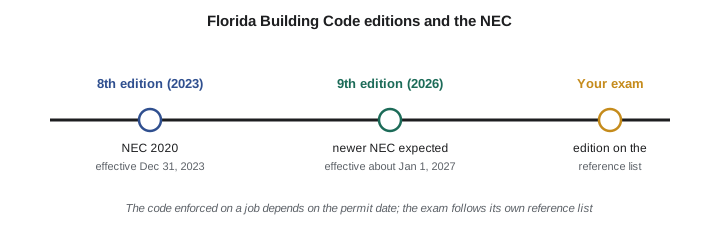
The 8th Edition (2023) of the Florida Building Code took effect on December 31, 2023, and adopted the 2020 NEC; NEMA's code adoption summary reports that Florida enforces the 2020 NEC with no state amendments. The 9th Edition (2026) of the FBC was posted for review in late 2025 and is expected to take effect on or around December 31, 2026; the City of Tampa announced an effective date of January 1, 2027. It is based on the 2024 International Codes and is expected to bring a newer NEC edition, but Florida contractors should confirm which NEC edition the 9th Edition adopts, and its effective date, in the Florida Building Commission's official publication and their local building department's notices.
The edition that applies to a job is generally the one in effect on the date the permit application is submitted. Gulfline's Palm Shores Plaza permit, applied for in February 2026, stayed under the 8th Edition and the 2020 NEC through final inspection, even if the job ran into 2027. A job applied for after the 9th Edition takes effect is designed and inspected under it. Projects that straddle the change need care: drawings designed to the old code must be permitted before the change, or revised.
Changes that came with the 2020 NEC
Contractors moving from the 2017 to the 2020 NEC with the 8th Edition FBC met several changes that matter in Florida homes. Section 230.67 began requiring surge protection for services supplying dwelling units, a welcome rule in the lightning capital of the country. Section 230.85 began requiring an outdoor emergency disconnect for one- and two-family dwellings, readily accessible for first responders. Ground-fault protection requirements in 210.8 expanded in dwellings and other occupancies, including more outdoor outlets and higher-current receptacles. Many Florida service changes after 2023 therefore include an exterior disconnect and a surge protective device as standard items.
The 2023 NEC brought further changes, including the consolidation of most definitions into Article 100, more ground-fault protection, rules for energy storage and electric vehicle equipment, and reorganized limited-energy articles. If the 9th Edition FBC adopts a newer NEC, these become part of everyday work in Florida. Candidates who study the 2023 NEC for the exam will find that preparation useful on the job sooner rather than later.
How Florida-specific requirements arise
Even with no state amendments to the NEC text, Florida electrical work is shaped by other parts of the FBC and Florida law. Rooftop equipment such as solar arrays, disconnects and air conditioning units must be anchored for Florida's design wind speeds under the Building volume, and products used in the building envelope may need Florida product approval. Equipment in flood hazard areas must be elevated or protected according to the flood provisions, which affects where service equipment, panels and outlets go in coastal homes. The Energy Conservation volume sets lighting power and lighting control requirements for commercial buildings. Fire alarm work follows the Florida Fire Prevention Code, which adopts NFPA 1 and NFPA 101, along with NFPA 72.
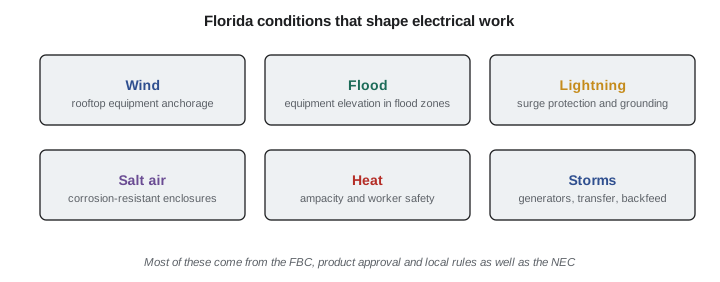
Climate matters in quieter ways too. Salt air near the coast corrodes ordinary enclosures and fittings, so contractors specify suitable enclosure types and materials. High ambient temperatures in attics and on rooftops affect conductor ampacity through the temperature correction factors covered in the core course on conductors, and rooftop conduits exposed to sunlight are a classic exam and inspection item. Lightning and power quality issues make bonding, grounding and surge protection more than paperwork.
Local administration
While the technical code is statewide, administration is local. Each county or city building department adopts the administrative chapter of the FBC with its own permit fees, forms, submission rules and inspection procedures, and interprets the code through its building official. Lesson 6 covers permits and inspections. When a code question has more than one reasonable answer, the building official's interpretation governs locally, and the FBC provides procedures for appeals and for requesting formal interpretations from the Florida Building Commission.
from datetime import date

# Which NEC edition applies to a permit application? (study example)
editions = [
    (date(2023, 12, 31), "8th Edition FBC, 2020 NEC"),
    (date(2027, 1, 1), "9th Edition FBC (confirm the NEC edition it adopts)"),
]
permits = {
    "Palm Shores Plaza fit-out": date(2026, 2, 10),
    "Hendricks service change": date(2026, 10, 2),
    "Bayview Towers EV chargers": date(2027, 2, 15),
}
for job, applied in permits.items():
    rule = "earlier edition"
    for start, name in editions:
        if applied >= start:
            rule = name
print(f"{job}: {rule}")Palm Shores Plaza fit-out: 8th Edition FBC, 2020 NEC Hendricks service change: 8th Edition FBC, 2020 NEC Bayview Towers EV chargers: 9th Edition FBC (confirm the NEC edition it adopts)
The program picks the latest edition whose effective date is on or before the permit application date. The effective date used for the 9th Edition is the one Tampa announced; other jurisdictions may announce the same date differently, which is another reason to check with the local building department.
Worked problem
One crew, two code editions
In March 2027 Gulfline has two jobs in Sarasota County: Palm Shores Plaza, permitted in February 2026 and still under way, and Bayview Towers' EV charger project, permitted in February 2027. Which code applies to each, and what should Marisol tell the crews?
Show solution
- Palm Shores Plaza was applied for under the 8th Edition FBC, so the 2020 NEC applies to that job until it is finished.
- Bayview Towers was applied for after the 9th Edition took effect, so it follows the 9th Edition and the NEC edition it adopts.
- Rules on GFCI, EV equipment and surge protection may differ between the jobs.
- She should mark each job's code edition on its job folder and permit card and brief the foremen on the differences that affect their work.
Answer: Each job follows the code in effect when its permit was applied for; label the edition on each job and brief the crews.
How a code edition is adopted
The Florida Building Commission updates the FBC by starting from the newest International Codes and the NEC, then reviewing proposed Florida modifications through technical advisory committees, including one for electrical. Public comment periods and hearings allow contractors, inspectors, manufacturers and others to propose changes. After the Commission adopts the new edition, it is published, and it takes effect on the date the Commission sets, usually at the end of the year following publication. Contractors who want to influence the electrical provisions can participate through the Commission's meetings and comment periods, and trade associations often submit comments on behalf of their members.
During the transition period before a new edition takes effect, building departments, educators and the trade publish summaries of changes. The FBC advanced module required in continuing education, covered in Lesson 11, is designed to teach licensees what changed. Candidates preparing for the exam during a transition should study the reference-list edition for the exam and the enforced edition for the job, and make a short list of the changes that most affect their work.
Interpretations and the authority having jurisdiction
Code language is not always clear, and two reasonable electricians can read a section differently. The building official is the authority having jurisdiction for the local jurisdiction and decides how the code applies there. The FBC provides a process for appealing a building official's decision to a local board of appeals and for requesting a binding interpretation, called a declaratory statement, from the Florida Building Commission. Contractors who face a disputed interpretation should first discuss it with the inspector and the building official, bring the code text and any manufacturer instructions, and ask for the decision in writing. A written decision protects the contractor on the job and creates a record if an appeal is needed.
Manufacturer instructions matter as well. The NEC requires listed equipment to be installed according to its listing and labeling, and inspectors routinely check installation instructions for torque values, clearances and conductor sizes. Keeping the instructions on site, and following them, prevents many failed inspections.
What changes from one edition to the next
Each NEC edition brings hundreds of changes, but only a few dozen affect most electrical contractors' daily work. Contractors usually learn them through three channels: the FBC advanced module and technical courses in continuing education, change summaries from trade publications and the NFPA, and the building department's own bulletins listing the changes its inspectors will focus on. Gulfline's practice was to have Marisol read a change summary when a new edition was published, pick the ten changes most likely to affect the company's work, and walk the foremen through them before the edition took effect, using Gulfline jobs as examples.
For the 2020 NEC, that list included the dwelling surge protection and outdoor emergency disconnect rules, expanded ground-fault protection, and new requirements for working space and labeling. For any newer edition the 9th Edition FBC adopts, the list would likely include the definition reorganization, energy storage and EV equipment rules and the reorganized limited-energy articles. Building the list early turns a code change from a surprise at inspection into a planned update.
Common mistakes
MistakeAssuming the newest NEC on the shelf applies to every job.
InsteadThe edition in effect when the permit was applied for governs the job.
MistakeUsing the job-site edition on the exam.
InsteadBring and study the edition on the current reference list.
MistakeForgetting wind and flood rules because they are not in the NEC.
InsteadCheck the FBC Building volume's wind and flood provisions for equipment location and anchorage.
MistakeTreating the building official's interpretation as optional.
InsteadIt governs locally unless changed through the appeal or interpretation process.
Summary and key terms
- Florida enforces one statewide Florida Building Code, which adopts the NEC by reference through its electrical chapter.
- The 8th Edition FBC took effect December 31, 2023 with the 2020 NEC; the 9th Edition takes effect around December 31, 2026 to January 1, 2027.
- The code edition in effect on the permit application date governs a job.
- The 2020 NEC added dwelling surge protection (230.67) and outdoor emergency disconnects for one- and two-family dwellings (230.85).
- Wind, flood, energy and fire code provisions shape Florida electrical work beyond the NEC itself.
- Florida Building Code
- Florida's single statewide building code, updated every three years.
- Florida Building Commission
- The state body that develops and adopts the Florida Building Code.
- Local technical amendment
- A limited local change to the FBC adopted under state procedures.
- Building official
- The local officer who administers and interprets the code.
- Product approval
- Florida's process for approving products used in the building envelope.
Practice problems
Work each problem on paper first, then reveal the answer to check.
Which NEC edition did the 8th Edition FBC adopt?
Show answer
The 2020 NEC.
A permit was applied for on December 20, 2026. Which FBC edition generally applies?
Show answer
The 8th Edition, assuming the 9th takes effect after that date; confirm locally.
Name two 2020 NEC changes that affect Florida dwelling services.
Show answer
Surge protection for dwelling services (230.67) and the outdoor emergency disconnect for one- and two-family dwellings (230.85).
Where would you look for rules on anchoring a rooftop disconnect against wind?
Show answer
The FBC Building volume's structural and wind provisions, plus the manufacturer's approved installation.
Lesson quiz · 5 questions
Score 60% or more to complete this lesson.
Create a free account to save your progress, take quizzes and earn a certificate.