
MELU-209 · Lesson 3 of 12 · 19 min
Applying, approval and booking the exam
▶ Video coming soon A video version of this lesson is on the way.
Marisol's approval letter arrived on a Thursday, three weeks after Tanya submitted the application. It contained the line Tanya had been waiting for: an application number to give the testing vendor when scheduling. "Now the clock starts," Tanya said, pinning a copy to the corkboard. "You've got a window to pass both parts, and then another deadline to get the license application in. People lose passing scores because they wait." Marisol booked the business part for a Saturday six weeks out and the technical part for the following Friday, then went back to the shelf of reference books behind Frank's desk.
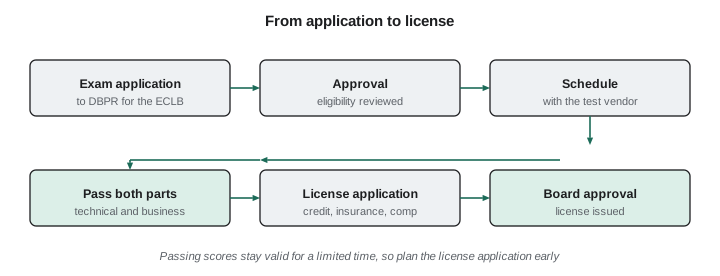
This lesson walks through the process from the first application to the license itself: applying to take the exam, approval, scheduling with the testing vendor, taking and passing both parts, and applying for the license. The order matters, and so do the time limits between steps. The details here come from DBPR's examination information pages and the ECLB's frequently asked questions as of late 2026; the current forms and candidate booklet are the final authority.
Step 1: the examination application
The first application goes to DBPR for the ECLB and asks to take the certification examination. It includes the applicant's personal information, the experience route and its documentation from Lesson 2, answers to background and character questions, and the application fee. Applications can be filed online through the DBPR licensing portal. Incomplete applications are the main cause of delay, so check that every question is answered, every required signature is present and every verification letter shows dates and license numbers.
Board staff review the application for eligibility. If something is missing, the applicant receives a deficiency letter explaining what is needed, and the application stays open while the applicant responds. An applicant who disagrees with a denial can request a hearing under Florida's administrative procedure law, but most problems are simple paperwork issues that a quick response solves.
Step 2: approval and the testing vendor
When the board approves the exam application, the applicant receives an approval letter or email with an application or candidate number. DBPR's examination page states that the exams are computer-based and scheduled through Pearson VUE, and that candidates are eligible to schedule within 72 hours after the application is approved. The candidate pays the testing vendor's exam fee when scheduling and chooses a test center, date and time for each part. The two parts can be taken on different days and in either order, and many candidates take the business part first and the technical part a week or so later, so each gets full attention.
The Candidate Information Booklet for electrical contractors, published for the board, explains the content of each part, the approved references, the rules for bringing and marking books, the identification required at the test center, and the policies for rescheduling, late arrival and missed appointments. Read it before buying books, because the approved editions on the reference list are not always the newest editions on the market.
Step 3: taking and passing both parts
The exam has two parts, a technical and safety part and a business part, each passed separately. Lesson 4 covers the format and references. After each part the candidate receives a score report. A candidate who passes one part and fails the other retakes only the failed part. DBPR's examination information describes a separate re-examination application and fee for retakes, and exam prep providers describe a waiting period before a retake can be scheduled. Candidates should check the booklet for the current retake rules.
Passing scores do not last forever. According to the ECLB's FAQ, passing examination scores are valid for three years from the date of the examination. A candidate must therefore pass both parts and file the license application while both scores are still valid. Some exam prep sources describe a shorter period, which is a good reason to rely on the board's current FAQ and rules rather than older study materials.
from datetime import date

# Gulfline's plan: when do Marisol's passing scores expire? (study example)
business_pass = date(2026, 6, 13)
technical_pass = date(2026, 6, 19)
validity_years = 3          # per the board's FAQ; confirm before relying on it

def add_years(d, n):
    try:
        return d.replace(year=d.year + n)
    except ValueError:      # 29 February
        return d.replace(year=d.year + n, day=28)

earliest = min(business_pass, technical_pass)
print("Business score valid until:", add_years(business_pass, validity_years))
print("Technical score valid until:", add_years(technical_pass, validity_years))
print("File the license application before:", add_years(earliest, validity_years))Business score valid until: 2029-06-13 Technical score valid until: 2029-06-19 File the license application before: 2029-06-13
The calculation shows the earlier of the two scores sets the deadline. Gulfline did not intend to wait anywhere near that long; Tanya planned to file the license application within a month of Marisol's second pass.
Step 4: the license application
Passing the exam does not by itself create a license. The candidate must apply for certification, and if the license will qualify a business, the business information is part of the same process. The ECLB's FAQ and current forms describe what is required. As summarized for study, the license application typically includes:
- Proof of passing both exam parts.
- Credit reports for the applicant and, for a business, the business, each including a public records statement. The board may deny an application based on delinquent accounts, collections, unpaid liens or judgments.
- Information about the business organization being qualified, including its registration with the Florida Division of Corporations and the qualifier's relationship to it.
- A certificate of general liability insurance meeting the board's minimum limits, with the policy number shown; the board's FAQ states that binders are not acceptable.
- Proof of workers' compensation coverage or a valid exemption.
- Financial information the board requires, such as a financial statement for the business.
- The license fee.
Lesson 8 covers the insurance, workers' compensation and financial responsibility requirements in detail. The board reviews certification applications and approves them, after which the license is issued and appears in DBPR's online license lookup. Contractors and customers use that lookup to verify a license, and building departments check it before issuing permits.
Licensure by endorsement
Electricians licensed in another state may be able to obtain a Florida certified license by endorsement without taking all of the Florida exam. The board's FAQ describes two routes: holding a license in another state or territory for 10 years with the license active within the last 2 years, or holding a license in a state whose exam the board has found substantially similar to Florida's. Endorsement applicants must still meet the experience requirements, and the review can take several months. Florida's business and law content still applies once licensed, so endorsement applicants should study Florida's lien, workers' compensation and licensing law even if they skip the exam.
Keeping the process moving
Tanya kept a simple tracker for every step: date filed, date approved, scheduling deadline, exam dates, score report dates, score expiration and the date the license application was filed. She also set calendar reminders for anything with a deadline and checked the DBPR portal every week for deficiency notices. When the license application asked for the business credit report, she already had it, because she had ordered it while Marisol was still studying. The license was approved at the next board meeting after the application was complete.
Worked problem
Spotting the weak link in a plan
Dev wants to take the business part in September 2026, then wait to take the technical part until after the busy storm season, possibly in summer 2029. What is the risk in this plan, assuming three-year score validity?
Show solution
- A business score earned in September 2026 would expire in September 2029.
- If the technical part is delayed until summer 2029 and he fails once, the retake might fall after the business score expires.
- He would also need time after passing to complete the license application before the earlier score expires.
- A safer plan schedules both parts within a few months of each other and leaves time for a retake.
Answer: The business score could expire before he passes the technical part and files; schedule both parts close together.
What the board's approval does not cover
Approval to sit the exam is not approval of the license, and passing the exam is not a promise the license will be granted. The board looks again at the license application, including credit, insurance, workers' compensation and the business information, and can deny or delay a license for problems found at that stage. That is why Tanya ran the license checklist in parallel with Marisol's studying: the business credit report, a current insurance certificate naming the department correctly, the workers' compensation policy showing Marisol as a covered employee, and the corporate records showing her appointment as vice president. When the second exam score arrived, the license application went in within a week.
Fees and the cost of getting licensed
Candidates should budget for several separate costs: the exam application fee paid to DBPR, the testing vendor's fee for each part, retake fees if needed, the initial license fee, the approved reference books and tabs, an exam preparation course if the candidate takes one, credit reports, and for a business the costs of incorporation, insurance and workers' compensation. Fees are published on DBPR's website and in the candidate booklet and change from time to time, so check the current amounts rather than relying on figures from a colleague who was licensed years ago. Gulfline treated the whole cost as an investment in its future, but many candidates pay their own way and plan the timing around their savings.
Checking your status
DBPR's online portal shows the status of an application, any deficiencies, and the final license once issued. Applicants should check it regularly rather than waiting for mail, and keep the email address on file current, because many notices are sent electronically. After the license is issued, the public license search shows the license number, status, expiration date and any public disciplinary history. Customers, general contractors, building departments and suppliers use that search, and a contractor should check it periodically to make sure the information shown is correct.
Rescheduling and test-center policies
The candidate booklet sets the rules for rescheduling, canceling and missing an appointment. Typically, a candidate can reschedule with the vendor up to a set number of days before the exam without losing the fee, while a late cancellation or no-show forfeits the fee and may require a new re-examination application. Candidates should also read the identification rules carefully: the name on the identification usually must match the name on the approval exactly, and a mismatch can mean being turned away. Test centers fill up during busy months, so booking early gives a better choice of dates and locations. Marisol booked both parts the day her approval arrived, choosing the Tampa center for its Saturday hours, and then put the dates on Gulfline's job calendar so no one scheduled her for a weekend storm call.
It also helps to visit or look up the test center ahead of time, check parking and travel time, and plan to arrive early enough for check-in and the inspection of reference books. A rushed arrival costs focus before the first question appears.
Common mistakes
MistakeBuying the newest code book without checking the reference list.
InsteadBuy the editions listed in the current candidate booklet.
MistakeAssuming passing the exam creates a license.
InsteadA separate license application with credit, insurance and workers' compensation is required.
MistakeLetting a passing score age while delaying the other part.
InsteadTrack score expiration dates and schedule both parts close together.
MistakeSubmitting an insurance binder.
InsteadThe board's FAQ states binders are not accepted; provide a certificate with the policy number.
Summary and key terms
- The exam application goes to DBPR for the ECLB with experience documentation and a fee; staff review it for eligibility.
- Approved candidates schedule computer-based exams with Pearson VUE, which DBPR says can be done within 72 hours after approval.
- The technical and business parts are passed separately, and only failed parts are retaken.
- The board's FAQ states passing scores are valid for three years from the exam date.
- The license application adds credit reports, business information, liability insurance, workers' compensation and fees, and the board approves it.
- Approval letter
- The notice that an exam application was approved, giving the number used to schedule.
- Candidate Information Booklet
- The vendor's document describing exam content, references and test-center rules.
- Score validity
- The period during which a passing score can be used to apply for the license.
- Licensure by endorsement
- Obtaining a Florida license based on another state's license without the full Florida exam.
- Deficiency letter
- A notice listing missing items in an application.
Practice problems
Work each problem on paper first, then reveal the answer to check.
What number does a candidate need to schedule the exam with the vendor?
Show answer
The application or candidate number on the board's approval notice.
If a candidate passes the business part and fails the technical part, what must be retaken?
Show answer
Only the technical part.
Name three items commonly required with the license application.
Show answer
Credit reports, a certificate of liability insurance and proof of workers' compensation coverage or exemption.
Business passed March 3, 2026; technical passed May 1, 2026. With three-year validity, which date controls the filing deadline?
Show answer
March 3, 2029, three years after the earlier pass.
Lesson quiz · 5 questions
Score 60% or more to complete this lesson.
Create a free account to save your progress, take quizzes and earn a certificate.