
MELU-209 · Lesson 6 of 12 · 19 min
Permits, inspections and the inspection authority
▶ Video coming soon A video version of this lesson is on the way.
The Hendricks house on Siesta Key had lost its meter can and half its service mast to a falling oak during the October storm. Mrs. Hendricks called Gulfline the morning after, and by noon Marisol was standing in the driveway with a camera and a tape measure. "Can't you just put it back?" Mrs. Hendricks asked. Marisol explained that a damaged service could not be rebuilt and reconnected without a permit and inspection, that the utility would not restore power until the county released the service, and that the new installation would have to meet the current code, including an outdoor emergency disconnect and surge protection. "The good news," she said, "is that the county runs a fast line for storm permits."
This lesson covers how permits and inspections work for electrical contractors in Florida: who issues them, when a permit is required, who may obtain one, the inspection sequence, private provider inspections, and the rules around storm recovery. Administration is local under the statewide code, so the details vary by county and city. The principles are the same everywhere, and they are exactly what the business and technical parts of the exam ask about.
Who issues permits
Florida law makes local governments responsible for enforcing the Florida Building Code within their jurisdictions. Counties enforce it in unincorporated areas, and cities enforce it within their limits, each through a building department headed by a building official. The building official reviews plans, issues permits, schedules inspections, interprets the code and can order work stopped or corrected. Inspectors carry out the inspections under the building official's authority and are certified by the state's building code administrators and inspectors board.
Before issuing a permit, a building department verifies that the contractor is properly licensed, usually by checking DBPR's license lookup, and many departments require contractors to register their license, insurance and workers' compensation information with the department before pulling the first permit. A certified contractor's statewide license is valid everywhere, but each department's registration and permit rules still apply.
When a permit is required
The FBC's administrative chapter, as adopted locally, requires a permit to install, enlarge, alter, repair or replace electrical systems, with limited exemptions for minor repairs and maintenance defined by each jurisdiction. Replacing a lamp or a receptacle like-for-like is often exempt; a new circuit, a service change, a generator transfer switch or a panel replacement is not. Florida law also provides some statewide limits on what local governments may require permits for, which change from time to time. When in doubt, ask the building department and get the answer in writing.
Who may obtain an electrical permit
Generally, electrical permits are issued to licensed electrical contractors, who take responsibility for the work under their license. Florida law also provides an owner-builder exemption that lets property owners do certain work on their own property, typically a single-family home or duplex they will occupy, after signing a disclosure statement acknowledging the responsibilities and limits. An owner-builder may not hire unlicensed people to do the work, and the home generally may not be sold or leased within a set period after completion without raising a presumption that it was built for sale. Exam questions often test these limits.
A licensed contractor who pulls a permit takes responsibility for the work and must supervise it. Pulling permits for unlicensed people, sometimes called permit pulling or license lending, is a disciplinary offense and can be prosecuted as aiding unlicensed contracting.
The inspection sequence
Inspections happen at stages, before each part of the work is covered. A typical commercial fit-out like Palm Shores Plaza had a temporary power inspection, an underground or slab inspection before concrete, a rough-in inspection before walls were closed, an above-ceiling inspection before the ceiling tiles went in, and a final inspection. A service change like the Hendricks job usually needs a service inspection before the utility reconnects. Failed inspections result in a correction notice, sometimes called a red tag; the contractor corrects the work and requests a re-inspection, often with a re-inspection fee.
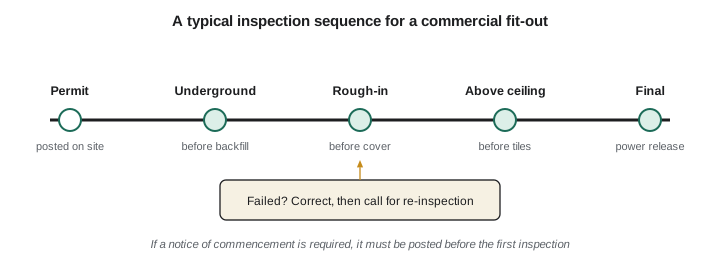
Florida lien law adds one more item to the first inspection. When a notice of commencement is required, which Lesson 9 explains, the statutory form warns that it must be recorded and posted on the job site before the first inspection. Many building departments will not perform the first inspection without seeing the posted notice or a copy of the recorded notice.
Private providers
Florida law allows owners to hire a licensed private provider, a licensed engineer or architect or a qualified building code administrator or inspector, to perform plan review and inspections instead of the local building department, under section 553.791 of the Florida Statutes. The owner must notify the building department, and the department keeps limited authority to audit and to issue the certificate of occupancy. Private providers are common on large commercial projects and became more common after legislative changes made the option easier. The contractor's job does not change: the work must still meet the code, and inspections still happen before work is covered.
Utility release and power
After a service passes inspection, the building department notifies the electric utility, which can then set the meter and energize the service. Florida Power and Light, Duke Energy Florida, Tampa Electric and the cooperative and municipal utilities each have their own service standards for meter location, clearances and equipment, which sit alongside the code. Marisol kept a copy of the local utility's service standards book in the truck, because a service that passed county inspection could still be refused by the utility for a meter set too high or too close to a gas meter.
Storm recovery
After hurricanes, Florida building departments often streamline permitting for storm repairs, extend hours, waive some fees or allow repairs to start before the permit is issued in limited circumstances defined by emergency orders. None of that removes the licensing requirements. Florida law increases penalties for unlicensed contracting during a declared state of emergency, and DBPR runs enforcement sweeps in affected areas. A damaged service must still be repaired by a licensed contractor, inspected, and released before the utility reconnects. Flood-damaged electrical equipment raises its own questions: industry guidance generally calls for replacing many types of equipment that have been submerged rather than drying and reusing them.
# Inspection tracker for the Palm Shores Plaza fit-out (study example)
stages = ["temporary power", "underground", "rough-in", "above ceiling", "final"]
results = {
    "temporary power": ["pass"],
    "underground": ["fail", "pass"],
    "rough-in": ["pass"],
    "above ceiling": ["fail", "fail", "pass"],
    "final": ["pass"],
}
reinspection_fee = 75
total_visits = 0
fees = 0
for stage in stages:
    tries = results[stage]
    total_visits += len(tries)
    fees += reinspection_fee * (len(tries) - 1)
    print(f"{stage:16} attempts: {len(tries)}  passed: {tries[-1] == 'pass'}")
print("Inspection visits:", total_visits)
print("Re-inspection fees (illustrative):", fees, "dollars")temporary power attempts: 1 passed: True underground attempts: 2 passed: True rough-in attempts: 1 passed: True above ceiling attempts: 3 passed: True final attempts: 1 passed: True Inspection visits: 8 Re-inspection fees (illustrative): 225 dollars
The tracker shows three failed inspections costing 225 dollars in illustrative re-inspection fees, plus the lost crew time that does not appear in the total. Marisol used results like these in foremen's meetings: the above-ceiling failures came from unsupported cables and missing box covers, both easy to catch with a pre-inspection walk.
Worked problem
Who can pull the permit?
Three calls come into Gulfline in one week. (1) A homeowner wants to add a circuit in her own home herself. (2) A handyman with no license wants Gulfline to pull the permit for a hot tub circuit he will install. (3) A property manager wants Gulfline to change a service at a rental duplex. Which permits are proper?
Show solution
- Call 1: the owner-builder exemption may let the homeowner pull her own permit after signing the disclosure, if the property qualifies and she does the work herself.
- Call 2: Gulfline may not pull a permit for work it will not perform or supervise; doing so risks discipline for aiding unlicensed contracting.
- Call 3: Gulfline may pull the permit and do the work as the licensed contractor.
- Gulfline should decline call 2, or offer to do the hot tub circuit itself.
Answer: Calls 1 and 3 can be proper; call 2 cannot.
Plan review
Commercial projects and many residential projects require plans for the electrical work to be reviewed before the permit is issued. The reviewer checks the drawings for code compliance: service and feeder calculations, panel schedules, one-line diagrams, grounding, available fault current and equipment short-circuit ratings, emergency and standby systems, and coordination with other trades. Florida law requires some electrical plans to be prepared and sealed by a licensed engineer above certain project sizes or service ratings, while smaller projects may be designed by the contractor. Plan review comments must be answered and corrections made before the permit is issued, and changes during construction may require revised drawings.
The Palm Shores Plaza permit took three weeks to issue because the reviewer asked for an available fault current calculation at the new panelboards and a revised panel schedule showing the walk-in cooler. Dev's estimate had allowed for one round of comments; he added a second round to the schedule for future restaurant fit-outs.
Closing out a permit
A permit is not finished until it passes final inspection and is closed in the building department's records. Open permits cause problems: they can delay a property sale, prevent new permits on the same property, and expose the contractor to complaints years later. Florida law and local rules set time limits after which inactive permits expire, and some departments notify contractors before that happens. Gulfline kept a monthly list of every open permit with its last inspection date, and Marisol made closing old permits a standing item at the foremen's meeting. When a customer canceled a job after the permit was issued, Gulfline asked the department to cancel the permit rather than leave it open under the company's license.
Working with inspectors
Good relationships with inspectors are built on predictable, honest work. Call for inspections only when the work is truly ready, have the permit card, approved plans and manufacturer instructions on site, and have someone available who knows the job. When an inspection fails, read the correction notice carefully, ask questions politely if something is unclear, correct the work, and request re-inspection promptly. Arguing in the field rarely helps; if a disagreement is real, take it to the building official with the code section and any supporting documents. Ron Whitaker told Marisol that he trusted contractors whose work matched what they said, and that he spent less time on their jobs because he rarely found surprises.
Some departments offer virtual inspections, where the contractor walks the inspector through the work on a video call, especially for small residential jobs. Others accept photo documentation for certain items. These options save time, but they depend on clear video, good lighting and honest presentation. A contractor who shows only the good parts of a job risks losing access to the program.
Inspection requests themselves deserve attention. Most departments take requests online or by phone by a cutoff time the day before, and some allow a preferred morning or afternoon window. Gulfline's foremen requested inspections only after completing the pre-inspection checklist and uploading photos to the job folder, so the office could see the work was ready. A canceled or failed inspection costs a crew day on a tight schedule, and a pattern of requests for unready work damages the contractor's reputation with the department.
Common mistakes
MistakeStarting a service change before the permit and assuming the utility will reconnect anyway.
InsteadThe utility waits for the building department's release after inspection.
MistakeCovering work before the inspection.
InsteadEach stage must be inspected before it is covered, or it may have to be opened up.
MistakePulling a permit for an unlicensed installer.
InsteadOnly pull permits for work you perform or supervise.
MistakeAssuming storm emergencies suspend licensing.
InsteadLicensing still applies, and penalties for unlicensed contracting increase during declared emergencies.
Summary and key terms
- Local building departments enforce the statewide FBC through permits, plan review and inspections under a building official.
- Permits are required for most electrical installation, alteration and replacement work, with limited local exemptions.
- Licensed contractors normally pull electrical permits; an owner-builder exemption allows some owners to do their own work after a disclosure.
- Inspections occur at stages before work is covered; a required notice of commencement must be posted before the first inspection.
- Owners may use private providers for plan review and inspection under section 553.791, and the utility energizes services only after release.
- Building official
- The local officer who administers the code, issues permits and orders corrections.
- Owner-builder exemption
- A Florida provision allowing qualifying owners to do certain work on their own property.
- Correction notice
- An inspector's notice that work failed and must be fixed before re-inspection.
- Private provider
- A licensed professional hired by the owner to perform plan review and inspections instead of the building department.
- Utility release
- The building department's notice that allows the utility to energize a service.
Practice problems
Work each problem on paper first, then reveal the answer to check.
What must happen before the utility reconnects a rebuilt service?
Show answer
The work must pass inspection and the building department must release it to the utility.
Name two conditions on the owner-builder exemption.
Show answer
The owner must do the work personally on qualifying property they occupy and sign the disclosure; they may not hire unlicensed workers, and early sale or lease raises a presumption of building for sale.
Under which statute may owners use private providers?
Show answer
Section 553.791 of the Florida Statutes.
Why do many departments check the posted notice of commencement at the first inspection?
Show answer
The statutory form says it must be recorded and posted before the first inspection.
Lesson quiz · 5 questions
Score 60% or more to complete this lesson.
Create a free account to save your progress, take quizzes and earn a certificate.