
MELU-209 · Lesson 10 of 12 · 19 min
Workplace safety law and OSHA for electrical contractors
▶ Video coming soon A video version of this lesson is on the way.
In July, Luis Ortega, Gulfline's second-year apprentice, got dizzy and nauseous in the attic of a Venice home where the crew was running new circuits. The foreman, Andre Wilson, got him down the ladder, into the air-conditioned truck, onto water and cooled off, and called Marisol. Luis was fine by the end of the day, but the incident shook everyone. That evening Marisol and Tanya went through the company's safety program line by line: heat illness, ladders, lockout, arc flash, the OSHA log. "This is on the exam," Tanya said, "but that's the least of it."
This lesson covers the safety laws that apply to Florida electrical contractors: federal OSHA jurisdiction in Florida, the construction and electrical standards most often cited, injury recordkeeping and reporting, NFPA 70E, heat and storm hazards, and the workers' compensation and drug-free workplace connections. The business part of the exam includes workplace safety, and Florida's continuing education requires an hour of it every renewal cycle.
Who enforces safety law in Florida
Florida does not have its own OSHA-approved state plan for private employers. Private-sector workplaces in Florida, including electrical contractors, are covered by federal OSHA, which enforces the Occupational Safety and Health Act through area offices in the state. That means the federal construction standards in 29 CFR Part 1926 and general industry standards in Part 1910 apply directly, along with OSHA's recordkeeping rules in Part 1904. Public employers, such as state agencies and local governments, are outside federal OSHA's jurisdiction and are covered by state law instead.
Contractors on multi-employer sites should know OSHA's multi-employer citation policy, which can hold a creating, exposing, correcting or controlling employer responsible for a hazard. A general contractor can be cited for hazards it controls, and a subcontractor can be cited for exposing its own workers to another trade's hazard if it does not take reasonable steps to protect them.
The standards electricians meet most
Construction work falls under Part 1926. Subpart K covers electrical safety in construction, including ground-fault protection for temporary power through GFCIs or an assured equipment grounding conductor program, and lockout and tagging of circuits. Subpart M covers fall protection, Subpart X ladders, Subpart L scaffolds, and Subpart CC cranes. Maintenance and service work on existing equipment in operating facilities falls under Part 1910, including Subpart S electrical safety-related work practices and the control of hazardous energy standard in section 1910.147. OSHA's most frequently cited construction standards each year usually include fall protection, ladders and scaffolds, all of which electricians use daily.
NFPA 70E, Standard for Electrical Safety in the Workplace, is a consensus standard rather than a regulation, but OSHA uses it as evidence of recognized hazards and feasible protections, and many contracts require it. The core of 70E is establishing an electrically safe work condition before work, with energized work allowed only when justified, with an energized work permit, shock and arc flash risk assessments, approach boundaries and appropriate personal protective equipment.
Recordkeeping and reporting
Employers with more than ten employees at any time in the previous year, outside partially exempt low-hazard industries, must keep OSHA's injury and illness records: the Form 300 log, the Form 301 incident report for each recordable case, and the annual Form 300A summary. Construction is not a partially exempt industry. The 300A summary must be posted from February 1 to April 30 each year, records must be kept for five years, and establishments that meet OSHA's size and industry criteria must submit data electronically by March 2. Every employer, regardless of size, must report a work-related fatality to OSHA within 8 hours and an inpatient hospitalization, amputation or loss of an eye within 24 hours.
A case is recordable if it is work-related and new and results in death, days away from work, restricted work or job transfer, medical treatment beyond first aid, loss of consciousness, or a significant diagnosed injury or illness. Luis's heat illness, treated with water and rest in the truck, was first aid and not recordable. Had he been taken to the emergency room and given intravenous fluids, it would have been.
Incident rates
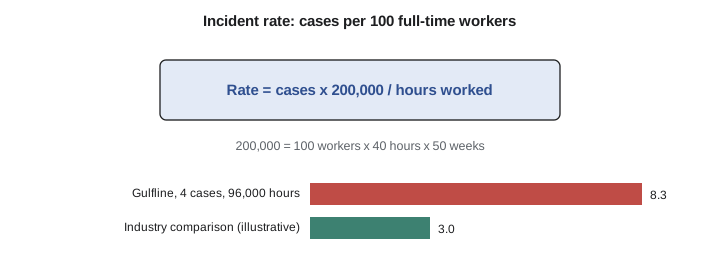
Insurers, general contractors and owners compare safety performance using the total recordable incident rate, which scales recordable cases to 100 full-time workers. The formula is the number of recordable cases multiplied by 200,000 and divided by the total hours worked, where 200,000 represents 100 workers working 40 hours a week for 50 weeks. Many general contractors prequalify subcontractors based on this rate and on the experience modification rate from workers' compensation, so a poor safety record costs bids as well as premiums.
# Total recordable incident rate (study example)
def trir(cases, hours):
    return cases * 200_000 / hours

employees = 48
hours = employees * 2_000          # about 2,000 hours each per year
for cases in (1, 2, 4):
    print(f"{cases} recordable case(s), {hours:,} hours -> rate {trir(cases, hours):.2f}")
# A bigger company with the same number of cases has a lower rate
print(f"4 cases, 400,000 hours -> rate {trir(4, 400_000):.2f}")1 recordable case(s), 96,000 hours -> rate 2.08 2 recordable case(s), 96,000 hours -> rate 4.17 4 recordable case(s), 96,000 hours -> rate 8.33 4 cases, 400,000 hours -> rate 2.00
The example shows why small contractors watch every case: with about 96,000 hours a year, each recordable case adds about 2.1 to the rate, while the same four cases in a company working 400,000 hours give a rate of only 2.0.
Heat and storms
Heat is Florida's daily hazard. OSHA does not yet have a final heat standard; it proposed one in 2024 and held hearings in 2025, and it uses the general duty clause and a national emphasis program to address heat hazards. Florida law adopted in 2024 prevents local governments from requiring their own heat exposure protections for employers, so the federal approach governs. Good practice still includes water, rest and shade, acclimatization for new and returning workers, training workers and supervisors to recognize heat illness, and an emergency plan. Gulfline added a rule after Luis's episode: attic work stopped by early afternoon in summer, and no one worked in an attic alone.
Storm recovery brings its own electrical hazards: downed lines, generator backfeed through improperly connected portable generators, flooded equipment, damaged structures and long hours. A portable generator connected to a house without a transfer switch or approved interlock can energize the utility's lines and kill a line worker. Contractors installing generator connections must use listed transfer equipment and follow the code, and should warn customers about backfeed.
Workers' compensation and drug-free workplaces
Safety and workers' compensation are linked. Florida's workers' compensation law requires construction employers to carry coverage, and a safety program reduces claims and the experience modification rate that adjusts premiums. Florida's drug-free workplace provisions allow employers that implement programs meeting statutory requirements, including testing, policies and employee assistance information, to qualify for a premium credit. Florida law also allows benefits to be denied in some cases where an injury was caused primarily by intoxication or drug use, which gives employers another reason to have a program.
Worked problem
Is it recordable, and must it be reported?
Three incidents at Gulfline in one month: (1) an electrician cuts a finger, gets a bandage and returns to work; (2) an apprentice falls from a ladder, breaks a wrist and is put on light duty for three weeks; (3) a foreman is admitted to the hospital overnight after an arc flash burn. Which are recordable, and which must be reported to OSHA?
Show solution
- Case 1 is first aid only, so it is not recordable.
- Case 2 involves medical treatment and restricted work, so it is recordable; it is not a reportable event unless it involves hospitalization, amputation or loss of an eye.
- Case 3 is recordable and is an inpatient hospitalization, so it must be reported to OSHA within 24 hours.
- Both recordable cases go on the 300 log with 301 reports, and the arc flash event calls for an investigation and a review of the energized work practices.
Answer: Cases 2 and 3 are recordable; case 3 must also be reported within 24 hours.
Building a written safety program
A written safety program turns good intentions into practice and gives a contractor something to show OSHA, insurers and general contractors. For an electrical contractor, the core elements are a management commitment and assigned responsibilities; hazard assessment and job hazard analyses; an electrical safety program following NFPA 70E, with procedures for establishing an electrically safe work condition and for justified energized work; lockout and tagging procedures; fall protection, ladder and scaffold rules; heat illness prevention; personal protective equipment, including arc-rated clothing; training and documentation; incident reporting and investigation; and periodic audits. Many general contractors ask to see the program and the training records during prequalification.
Training records deserve special care. Each employee's file should show safety orientation, NFPA 70E training appropriate to the work and its retraining dates, qualified person designations, fall protection and ladder training, first aid and CPR where required, and any equipment-specific training such as aerial lifts. When an incident happens, the first questions from OSHA and the insurer are about training, and records answer them.
When OSHA visits
OSHA inspections can follow a complaint, a reported injury, a referral or a programmed emphasis such as fall protection or heat. On a construction site, a compliance officer usually holds an opening conference, walks the site, interviews workers, takes photographs and measurements, and reviews records such as the 300 log and training documents. Employers have the right to accompany the officer, to know the scope of the inspection, and in most cases to request a warrant, although many choose to cooperate. Citations, if issued, come with proposed penalties and abatement dates, and the employer can request an informal conference or contest them within the deadline stated in the citation. Fixing hazards immediately and documenting the corrections often reduces the penalties.
Arc flash in daily work
Most of Gulfline's work could be done de-energized, and Marisol's policy was that it should be. When work on or near energized parts was truly unavoidable, such as voltage testing before lockout or troubleshooting a control circuit, the crew followed NFPA 70E: an energized work permit when the standard requires one, an arc flash and shock risk assessment using the equipment labels or the table method, appropriate arc-rated clothing and personal protective equipment, insulated tools, and boundaries to keep unqualified workers away. The first step of establishing an electrically safe work condition is itself energized work, because the worker must test for absence of voltage, so even routine lockouts called for the right protection.
Equipment labeling supports these decisions. The NEC requires certain equipment to be field marked with arc flash warnings, and NFPA 70E describes the information labels should carry. On commercial jobs, Gulfline coordinated with the engineer of record so that new equipment arrived with labels based on a current study, and it updated labels when its work changed the available fault current.
Safety culture is visible in small things: crews who stop to set up a ladder properly, foremen who hold a short safety talk every Monday, and an owner who buys the right protective equipment without argument. After Luis's heat episode, Gulfline added a weekly heat forecast to the Monday talk and bought cooling towels and extra water coolers for every truck. Those steps cost little, and they told every electrician that the company meant what its written program said.
Near misses deserve the same attention as injuries. A dropped tool from a ladder that hits no one, a breaker labeled wrong that is caught before anyone touches the circuit, or a trench wall that sloughs while no one is in it are all warnings. Gulfline asked crews to report near misses without blame, discussed them at the Monday talk, and changed procedures when the same kind of event happened twice.
Common mistakes
MistakeAssuming Florida has its own state OSHA plan for private employers.
InsteadFederal OSHA covers private employers in Florida.
MistakeRecording first aid cases on the 300 log.
InsteadRecord only cases meeting the recording criteria, such as medical treatment beyond first aid.
MistakeTreating NFPA 70E as optional because it is not a regulation.
InsteadOSHA uses it as evidence of recognized hazards, and contracts often require it.
MistakeConnecting a customer's portable generator directly to a panel without transfer equipment.
InsteadUse listed transfer equipment to prevent backfeed.
Summary and key terms
- Federal OSHA covers private employers in Florida; Parts 1926, 1910 and 1904 apply directly.
- Electricians most often meet Subpart K electrical, fall protection, ladders and scaffolds, plus lockout and 1910 Subpart S for maintenance work.
- Employers keep the 300, 301 and 300A forms, post the 300A from February 1 to April 30, keep records five years, and report fatalities in 8 hours and hospitalizations, amputations or eye loss in 24 hours.
- The incident rate equals recordable cases times 200,000 divided by hours worked.
- Heat, storm recovery hazards, workers' compensation and drug-free workplace programs shape Florida contractors' safety programs.
- State plan
- An OSHA-approved state safety program; Florida has none for private employers.
- Subpart K
- The OSHA construction standards on electrical safety.
- Form 300A
- The annual summary of recordable injuries and illnesses, posted February 1 to April 30.
- Total recordable incident rate
- Recordable cases per 100 full-time workers per year.
- Backfeed
- Energizing utility lines from a customer's generator through an improper connection.
Practice problems
Work each problem on paper first, then reveal the answer to check.
Who enforces workplace safety for private electrical contractors in Florida?
Show answer
Federal OSHA.
Calculate the incident rate for 3 recordable cases in 120,000 hours.
Show answer
3 × 200,000 ÷ 120,000 = 5.0.
Within what time must a work-related fatality be reported to OSHA?
Show answer
8 hours.
Name three heat illness controls.
Show answer
Water, rest, shade, acclimatization, training and an emergency plan (any three).
Lesson quiz · 5 questions
Score 60% or more to complete this lesson.
Create a free account to save your progress, take quizzes and earn a certificate.