
MELU-209 · Lesson 7 of 12 · 19 min
Duties and responsibilities of the Certified Electrical Contractor License holder
▶ Video coming soon A video version of this lesson is on the way.
Frank spread three files on the table: a disciplinary case from the board's meeting minutes, a complaint a homeowner had once filed against Gulfline, and the company's license certificate. "When you qualify Gulfline," he told Marisol, "your name goes on every permit and every contract. If a crew cuts a corner in Port Charlotte while you're in Sarasota, the board calls you, not the foreman. You don't have to be on every job. You have to run the system that makes the jobs right." The homeowner complaint had been dismissed, but only because Frank could show the inspection records, the change order the homeowner had signed, and the written warranty.
This lesson covers the legal duties of a certified electrical contractor and, especially, of a qualifying agent under Part II of Chapter 489 and the board's rules: supervision, financial responsibility, keeping the board informed, advertising and contracting rules, and the conduct that leads to discipline. These are core topics on the business part of the exam and the heart of running an electrical company in Florida.
The primary qualifying agent
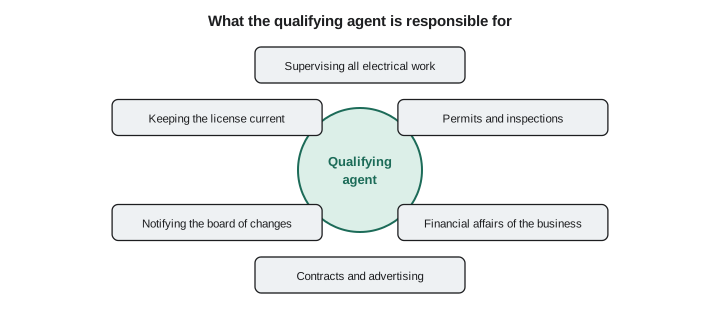
Florida law requires every business that contracts for electrical work to be qualified by a licensed individual. The primary qualifying agent is responsible for supervising, directing, managing and controlling the business's electrical contracting activities, and the board's FAQ states that the agent must be an officer or supervising employee and is jointly and equally responsible for supervising all operations of the business. That responsibility includes the field work and the business side: the contracts the company signs, the permits it pulls and the financial affairs that affect its customers and suppliers.
A business can have more than one qualifier, and a qualifier can, with board approval, qualify more than one business if the qualifier shows the ability to manage each. The board's FAQ describes this as an additional business qualification with its own application and fee. A qualifier who cannot genuinely supervise a business, for example because it is in another part of the state and the qualifier has no real role there, risks discipline for the business's problems.
Supervision in practice
Supervision does not mean standing on every job. It means having the authority and systems to control the work: hiring qualified people, assigning work within their abilities, reviewing plans and calculations, checking installations before inspections, responding to failed inspections, and stepping in when something goes wrong. Marisol planned a routine for Gulfline: a weekly review of every open permit and its inspection status, a pre-inspection checklist each foreman would complete, a site visit to every job at least once a week, and a log of corrections so that recurring problems turned into training.
Local rules may add requirements about who must be on site, such as having a licensed journeyman present when certain work is performed. Check the rules of each jurisdiction where you work and build them into crew assignments.
Keeping the board informed
Florida's construction licensing laws require licensees and qualified businesses to keep their information current with DBPR, including mailing and email addresses and changes in the business's name, organization or qualifying agent. When a qualifier leaves a business, the qualifier and the business must notify the board, and the business must obtain a new qualifier within the time the law allows or stop contracting. The board's FAQ also addresses a qualifier's death: the business should notify the board within 30 days, or immediately if possible, and may request an emergency registration to complete work in progress.
Gulfline's succession plan was built around those rules. Frank would remain primary qualifier until Marisol's certification was approved and her qualification of the business was processed, so the company would never be without a qualifier. Only then would Frank withdraw his qualification of Gulfline, with a letter to the board on the same day.
Contracts and advertising
Florida requires contractors to include their license number in advertising and on contracts and certain documents, so that customers can check the license. The exact rule for electrical contractors is in Part II of Chapter 489; candidates should know that advertising without the license number, or advertising services the license does not cover, can lead to discipline. Contracts should be written and should describe the scope, price, payment terms, schedule and change order procedure clearly, with the lien law disclosures Florida requires for many residential contracts, covered in Lesson 9.
Contractors must also deal honestly with customers and suppliers. Taking a deposit and abandoning a job, failing to pay suppliers and subcontractors from money received for that job, or misrepresenting the work are all grounds for discipline under Chapter 489's lists of prohibited acts. Florida also makes some of these crimes, such as misapplying construction funds.
Grounds for discipline
Section 489.533 lists the acts for which the board may discipline electrical and alarm contractors. As summarized for study, they include:
- Obtaining a license by fraud or misrepresentation.
- Being convicted of a crime related to contracting.
- Aiding or knowingly associating with unlicensed persons, and allowing others to use one's license.
- Performing work outside the scope of the license.
- Willfully violating the building code or failing to obtain required permits and inspections.
- Abandoning a job, or committing fraud, deceit, gross negligence, incompetence or misconduct in contracting.
- Failing to supervise the business's operations as a qualifier.
- Failing to comply with board orders or rules.
Penalties include reprimands, fines, probation, required continuing education, restitution to customers, suspension and revocation. The board considers aggravating and mitigating factors under its disciplinary guidelines, such as the harm caused, prior discipline and whether the licensee made the customer whole. Candidates should know that a complaint starts with DBPR's investigation, that probable cause is decided by a panel, and that the licensee has the right to a hearing before discipline is imposed.
Warranties and service
Florida law and good practice both point toward clear warranties. Many Florida contracts include a one-year warranty on workmanship, and some products carry their own manufacturer warranties. Florida also has statutes on construction defect claims that require owners to give contractors notice and an opportunity to inspect and offer repairs before suing. Gulfline's practice was to answer every warranty call within one business day and document the response, which is what made the dismissed complaint easy to defend.
# Weekly permit and supervision review (study example)
permits = [
    {"job": "Palm Shores Plaza", "next": "above ceiling", "days_since_visit": 2, "open_corrections": 0},
    {"job": "Hendricks service", "next": "final", "days_since_visit": 9, "open_corrections": 1},
    {"job": "Lakewood Elementary", "next": "rough-in", "days_since_visit": 5, "open_corrections": 0},
    {"job": "Bayview Towers", "next": "underground", "days_since_visit": 12, "open_corrections": 2},
]
for p in permits:
    flags = []
    if p["days_since_visit"] > 7:
        flags.append("visit this week")
    if p["open_corrections"]:
        flags.append(f"{p['open_corrections']} correction(s) open")
    status = "; ".join(flags) if flags else "on track"
print(f"{p['job']:20} next: {p['next']:13} {status}")Palm Shores Plaza next: above ceiling on track Hendricks service next: final visit this week; 1 correction(s) open Lakewood Elementary next: rough-in on track Bayview Towers next: underground visit this week; 2 correction(s) open
Simple systems like this are evidence of supervision. If a complaint or inspection problem ever reached the board, Marisol could show not just that she cared about the work, but that she had a documented routine for controlling it.
Worked problem
A qualifier's exposure
A Gulfline crew installs a pool bonding grid at a home in Charlotte County while Marisol is on vacation. The foreman skips the bonding inspection, the pool deck is poured, and the county discovers it at final. The homeowner complains to DBPR. What is Marisol's exposure as qualifier, and how could the company have prevented it?
Show solution
- As qualifier, Marisol is responsible for supervising the company's electrical work, even when she is away.
- Failing to obtain a required inspection is a ground for discipline, and the cost to open the deck and fix the bonding falls on the company.
- Her best defense is evidence of a supervision system: written procedures, a delegated supervisor during her absence, and training on inspection stages.
- Prevention: a rule that no concrete is poured over electrical work without a passed inspection recorded in the job file, and a designated licensed supervisor while she is away.
Answer: Marisol faces possible discipline and the company bears the repair cost; documented procedures and a designated supervisor reduce both the risk and the exposure.
Complaints and how to respond
Most complaints against contractors start with a customer calling DBPR after a dispute over money, delays or workmanship. DBPR's investigators gather information from the complainant and the contractor, may visit the job, and refer the case to a probable cause panel, which decides whether there is enough evidence to file a formal administrative complaint. Many complaints are closed at this stage. A contractor who receives notice of a complaint should respond promptly and in writing, provide the contract, change orders, inspection records, photos and correspondence, and consider consulting a lawyer who handles licensing matters. Fixing a legitimate problem for the customer, even while disputing the complaint, often helps both the customer relationship and the outcome.
If a formal complaint is filed, the licensee can dispute the facts at a hearing before an administrative law judge, accept a settlement, or proceed to an informal hearing before the board if the facts are not disputed. The board then decides the penalty within its disciplinary guidelines. Final orders are public and appear in the license record, which is a strong reason to resolve problems early.
Supervising subcontractors and employees
A qualifier's responsibility extends to work Gulfline subcontracts, such as low-voltage cabling or trenching, as well as to employees. Before hiring a subcontractor, check its license in DBPR's search, its insurance and its workers' compensation coverage or exemption. Put the scope, schedule and safety expectations in a written subcontract, and inspect its work as carefully as your own. For employees, keep records of each person's local certificates, training and safety orientation, and assign work to match their qualifications. These records are what a qualifier relies on to show the business was properly supervised.
Record keeping as protection
A qualifier's best defense against a complaint or a dispute is a complete job file. Gulfline's standard file for every job contained the contract and all change orders, the permit and every inspection result, photos of the work before cover, material submittals and delivery tickets, daily reports, correspondence with the customer, and warranty records. Electronic files were organized by job number and backed up every night. When a customer claimed two years after a job that Gulfline had installed the wrong breaker, the file showed the approved submittal, the delivery ticket and a photo of the panel at final inspection with the correct breaker in place, and the dispute ended there.
Florida law and good business practice both favor keeping these records for years after a job ends, because claims and complaints can arise long afterward. Construction defect claims, insurance claims and disciplinary complaints all depend on records. A qualifier who cannot show what was done is left with nothing but memory.
Supervision also means saying no. Customers sometimes ask a contractor to skip a permit, to cover work before inspection, or to install equipment that does not suit the location. A qualifier who agrees to save a customer money puts the license on the line for someone else's convenience. Frank's rule, which Marisol kept, was that any request to bend the rules went straight to the qualifier, who would explain the reason, offer a compliant alternative, and walk away from the job if the customer insisted.
Common mistakes
MistakeThinking supervision means being on every job.
InsteadSupervision means authority and systems that control the work, documented and enforced.
MistakeLeaving the board's records out of date after a move or reorganization.
InsteadReport address, name, organization and qualifier changes as the law requires.
MistakeAdvertising without the license number.
InsteadInclude the license number where Florida law requires it.
MistakeLending your license to a friend's company.
InsteadAllowing others to use your license is a ground for discipline.
Summary and key terms
- The primary qualifying agent must be an officer or supervising employee and is responsible for supervising all of a business's electrical contracting.
- Qualifying more than one business requires board approval and real ability to supervise each.
- Licensees must keep the board informed of address, organization and qualifier changes; a qualifier's death should be reported within 30 days.
- Section 489.533 lists grounds for discipline, from license lending and abandonment to code and permit violations and failure to supervise.
- Documented supervision systems, clear contracts and prompt warranty service are the qualifier's best protection.
- Primary qualifying agent
- The licensed individual responsible for a business's electrical contracting.
- Additional business qualification
- Board approval for a qualifier to qualify another business.
- Abandonment
- Walking away from a contract without just cause, a ground for discipline.
- Probable cause panel
- The body that decides whether a complaint should proceed to formal discipline.
- Disciplinary guidelines
- The board's rules setting ranges of penalties and factors it considers.
Practice problems
Work each problem on paper first, then reveal the answer to check.
What position must a primary qualifying agent hold in the business, according to the board's FAQ?
Show answer
An officer or supervising employee.
What should a business do within 30 days if its qualifier dies?
Show answer
Notify the board and request emergency registration, as the board's FAQ describes.
Name three grounds for discipline under section 489.533.
Show answer
Any three of: license lending or aiding unlicensed contracting, working outside the license scope, code or permit violations, abandonment, fraud or gross negligence, failure to supervise.
Why is a documented weekly permit review useful?
Show answer
It is evidence of supervision and helps catch problems before inspections fail or complaints arise.
Lesson quiz · 5 questions
Score 60% or more to complete this lesson.
Create a free account to save your progress, take quizzes and earn a certificate.