
MELU-209 · Lesson 11 of 12 · 19 min
Renewal and continuing education
▶ Video coming soon A video version of this lesson is on the way.
Frank's license certificate hung in a frame by the front door, and next to it, in Tanya's handwriting, was a note that had been there for years: "Renew by August 31, even years. CE first." Marisol asked about it on the day her own license was approved. "Everybody's license in Florida expires on the same day," Tanya said. "The week before, the department's phone lines melt. If your continuing education isn't reported, you can't renew active, and if you're not active, you can't pull permits. We do ours in the spring."
This lesson covers how a Florida certified electrical contractor keeps the license active: the renewal cycle, continuing education hours and topics, active and inactive status, reactivation and the consequences of letting a license lapse. These rules appear on the business part of the exam and in every licensee's calendar. The details below come from the ECLB's FAQ as of late 2026; confirm them on the board's website before each renewal.
The renewal cycle
Florida electrical contractor licenses renew every two years. According to the board's FAQ, licenses are renewed by August 31 of every even-numbered year. Renewal is done through DBPR's online portal, where the licensee confirms continuing education, updates information, answers questions and pays the fee. The board's FAQ lists renewal fees for certified active, certified inactive, registered active and registered inactive licenses, and a delinquent fee for late renewal; the certified active renewal fee was listed at 296 dollars, including a small unlicensed activity fee.
A license not renewed by the deadline becomes delinquent. A delinquent licensee may not contract or pull permits until the license is renewed with the delinquent fee and any missing continuing education. A license left delinquent through the end of the next renewal cycle becomes null and void, which means the licensee must start over with a new application and examination. That is a severe result, and it happens every cycle to contractors who move, change email addresses or simply forget.
Continuing education requirements
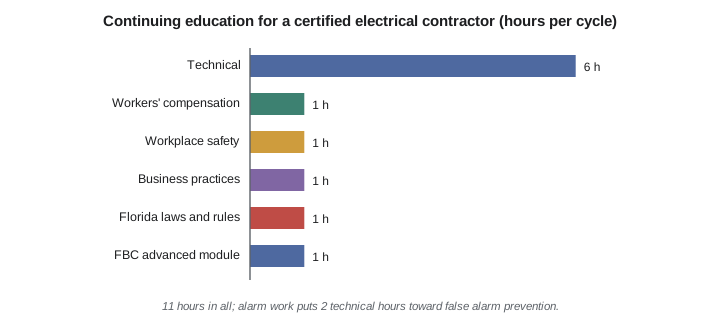
Florida law requires continuing education for each renewal. The board's FAQ, reflecting changes effective July 1, 2020, lists 11 hours for certified and registered electrical contractors each cycle:
- 1 hour of workers' compensation.
- 1 hour of workplace safety.
- 1 hour of business practices.
- 1 hour of Florida laws and rules.
- 1 hour of the Florida Building Code advanced module.
- 6 hours of technical subjects.
Electrical contractors who perform alarm work must devote 2 of their technical hours to false alarm prevention, according to the board's materials. Alarm and specialty contractors have 7-hour requirements with their own topic lists. Before July 2020, these licenses required 14 hours, so older study materials may show the old number.
Approved courses and limits
Continuing education must come from providers and courses approved by the board. Approved providers report completions to DBPR, and licensees can check their transcripts online. The board's FAQ states that up to 7 hours may be taken as home study, and that up to 3 hours may be earned by attending the disciplinary portion of a board meeting. Courses on the FBC advanced module change each code cycle and are tied to the current edition, which makes them a good way to learn what changed.
Licensees in their first renewal cycle owe fewer hours: the board's FAQ lists 5 hours for electrical contractors, and none for those licensed less than 12 months before the August 31 deadline. Marisol's license was issued in August 2026, less than 12 months before the August 31, 2026 renewal date, so her first renewal required no continuing education. Her first full requirement would be due by August 31, 2028.
Active and inactive status
A licensee who is not contracting can place the license in inactive status by renewing inactive and paying the lower inactive fee. An inactive licensee may not contract or pull permits but keeps the license from becoming void. To reactivate, the licensee must meet the reactivation requirements, including continuing education for reactivation set by board rule and proof of the insurance and other requirements for an active license. Contractors who leave the trade for a few years, or who work as employees under another company's license, often keep their own license inactive so they can return.
A certified contractor whose license qualifies a business must keep both the individual license and the business qualification current. If the qualifier's license lapses, the business loses its ability to contract under that license, which affects every open permit. Gulfline's office calendar listed Marisol's license renewal, the business qualification, the general liability policy renewal, the workers' compensation renewal and the exemption renewals for officers, each with a reminder sixty days ahead.
Changes of information
Licensees must keep their addresses and contact information current with DBPR, because renewal notices and disciplinary correspondence go to the address of record. A licensee who misses a complaint notice because of an old address does not get an extension. The same goes for changes in the business: a new name, new entity, new officers or a new qualifier must be reported as the law requires.
# Continuing education tracker for one renewal cycle (study example)
required = {"technical": 6, "workers' compensation": 1, "workplace safety": 1,
            "business practices": 1, "Florida laws and rules": 1, "FBC advanced module": 1}
completed = [("Arc flash and 70E update", "technical", 2),
             ("2023 NEC changes part 1", "technical", 3),
             ("Florida contractor law update", "Florida laws and rules", 1),
             ("Workers' comp for contractors", "workers' compensation", 1),
             ("Jobsite safety and heat", "workplace safety", 1)]
done = {k: 0 for k in required}
for title, topic, hours in completed:
    done[topic] += hours
short = {k: required[k] - done[k] for k in required if done[k] < required[k]}
print("Total completed:", sum(done.values()), "of", sum(required.values()))
for topic, hours in short.items():
print(f"Still needed: {hours} hour(s) of {topic}")Total completed: 8 of 11 Still needed: 1 hour(s) of technical Still needed: 1 hour(s) of business practices Still needed: 1 hour(s) of FBC advanced module
The tracker shows that hours alone are not enough: Marisol's employee Andre has 8 of 11 hours but still needs 1 technical hour, 1 hour of business practices and 1 hour of the FBC advanced module. Each topic is a separate requirement.
Worked problem
A lapsed license
A contractor who renewed in 2022 forgot to renew by August 31, 2024 and did not notice until he tried to pull a permit in November 2024. What is his status, what must he do, and what happens if he waits until after August 31, 2026?
Show solution
- After August 31, 2024 his license became delinquent.
- He may not contract or pull permits until he renews with the delinquent fee and completes any required continuing education.
- If he does not renew before the end of the next cycle, August 31, 2026, the license becomes null and void.
- A void license requires a new application and examination, so he should renew immediately.
Answer: His license is delinquent; he must renew with the late fee and continuing education now, or risk it becoming void after August 31, 2026.
Choosing continuing education that helps
Continuing education is a requirement, but it can also be useful. The 6 technical hours are a chance to learn the parts of the code and the industry that are changing fastest: energy storage, solar and EV charging, the newest NEC changes, arc flash practices, fire alarm updates and lighting controls. The 1-hour courses on workers' compensation, safety, business practices and Florida laws and rules cover changes in law that affect every contractor, such as new lien law amendments, changes to permitting rules or new workers' compensation requirements. The FBC advanced module explains the current code edition. Marisol chose courses that matched Gulfline's work and asked each foreman to take at least one technical course a year even when they did not need it for a license.
Licensees should keep their own record of completed courses, including certificates, dates, provider numbers and hours by topic. Providers report completions to DBPR, but reporting errors happen, and a licensee who discovers a missing course in the last week of August has little time to fix it. Checking the DBPR transcript a few months before the deadline avoids that problem.
Renewing a qualified business
For a qualified business, renewal involves more than the individual license. The qualifier's license must be renewed active, the business qualification must remain valid, and the business must continue to meet the insurance and workers' compensation requirements that applied at licensure. Insurance policies typically renew annually on their own dates, so the business must keep certificates current with the board and with each building department that keeps them on file. Workers' compensation exemptions for officers expire on their own schedule and must be renewed with the Division of Workers' Compensation. A lapse in any of these can stop permits even when the license itself is current.
When the qualifier changes, as it would at Gulfline when Frank stepped back, the new qualifier's license must be in place and the change reported before the old qualifier withdraws. Renewal time is a natural point to review the whole arrangement: who qualifies the business, whether any additional business qualifications are still needed, and whether the business's records with DBPR and the Division of Corporations match.
Moving, retiring and coming back
Contractors who move out of state, retire or take a job outside contracting can keep a Florida license in inactive status by renewing inactive each cycle, which preserves the right to return. A licensee who wants to give up the license completely can let it lapse, but should understand that a license left delinquent through the next cycle becomes void, and getting it back means a new application and examination. Frank planned to renew his own license inactive after Marisol took over as qualifier, so he could step back in if the company needed him during the transition.
The cost of a lapse
A lapsed license costs far more than the late fee. While a license is delinquent, the contractor cannot pull permits, so jobs stall and customers wait. Contracts signed while unlicensed may be unenforceable, so the contractor may be unable to collect payment or file a lien for that work. Building departments may refuse inspections on open permits under the lapsed license. And if the license is the qualifier's license for a business, every job the business has under way is affected. For a contractor of Gulfline's size, a two-week lapse in August could mean dozens of delayed jobs and unhappy customers in the middle of storm season.
Avoiding a lapse is simple: complete continuing education early in the year, check the transcript, renew in early summer instead of the last week of August, and keep insurance and workers' compensation certificates current. Tanya's spring routine took less than a day each renewal cycle and had kept Gulfline's license active for three decades.
Continuing education is also a business opportunity. Contractors who learn about new technologies early, such as battery storage, load management for EV charging and smart panels, can offer those services before competitors do. Gulfline's first energy storage installation came from a customer who asked Marisol a question she could answer because of a technical course she had taken the year before.
Some local jurisdictions and other licenses carry their own education requirements. A contractor who also holds a county certificate of competency, a specialty license or a license in another state must meet each one's requirements, and courses approved for one may not count for another. Keeping a single calendar of every license, its renewal date and its education rules prevents surprises.
Common mistakes
MistakeTaking 11 technical hours and assuming the requirement is met.
InsteadEach topic has its own requirement: 6 technical plus 1 hour each of five required subjects.
MistakeUsing pre-2020 study materials that show 14 hours.
InsteadThe board's current FAQ lists 11 hours for electrical contractors.
MistakeLetting the address of record go out of date.
InsteadKeep contact information current with DBPR.
MistakeContracting while the license is delinquent or inactive.
InsteadRenew active before contracting or pulling permits.
Summary and key terms
- Florida electrical contractor licenses renew by August 31 of every even-numbered year through DBPR.
- Certified and registered electrical contractors need 11 hours of continuing education each cycle: 6 technical and 1 hour each of workers' compensation, workplace safety, business practices, Florida laws and rules, and the FBC advanced module.
- Electrical contractors doing alarm work put 2 technical hours toward false alarm prevention; first-cycle licensees owe fewer hours.
- Up to 7 hours may be home study and up to 3 hours may come from attending a board disciplinary session, according to the board's FAQ.
- A delinquent license cannot be used, and one left delinquent through the next cycle becomes void.
- Renewal cycle
- The two-year period ending August 31 of each even year.
- Delinquent license
- A license not renewed by the deadline, which cannot be used until renewed.
- Null and void
- The status of a license left delinquent too long, requiring a new application.
- Inactive status
- A renewed license that keeps the right to return but may not be used to contract.
- FBC advanced module
- A required continuing education course on the current Florida Building Code.
Practice problems
Work each problem on paper first, then reveal the answer to check.
By what date do Florida electrical contractor licenses renew?
Show answer
August 31 of every even-numbered year.
How many continuing education hours does a certified electrical contractor need each cycle?
Show answer
11 hours.
How many of those hours are technical?
Show answer
6 hours.
What happens to a license left delinquent through the next renewal cycle?
Show answer
It becomes null and void.
Lesson quiz · 5 questions
Score 60% or more to complete this lesson.
Create a free account to save your progress, take quizzes and earn a certificate.