
MELU-209 · Lesson 4 of 12 · 19 min
The exam format and the references allowed
▶ Video coming soon A video version of this lesson is on the way.
The candidate booklet ran to more than twenty pages, and Marisol read it twice. The second time she used a highlighter on every rule about books: which editions were approved, whether she could tab and highlight them, whether handwritten notes in the margins were allowed, and what the test center staff would inspect at check-in. "Half the people who fail this exam know the material," Frank told her. "They just can't find it fast enough, or they show up with the wrong book."
This lesson explains how Florida's certified electrical contractor examination is organized: the two parts, the approved references, the computer-based format and the rules at the test center. It uses figures from DBPR's examination pages and from a recent summary of the electrical contractor Candidate Information Booklet. Exam length, question counts, passing scores and reference editions are exactly the kinds of details that change between booklet editions, so treat the numbers here as a study guide and confirm them in the booklet you receive when you are approved.
Two parts: technical and business
DBPR's examination information states that the electrical examinations are given in two parts: technical and safety, and business. Each part is scored and passed separately. The technical and safety part tests the National Electrical Code, electrical theory and calculations, installation practice, safety rules and related technical references. The business part tests the business and law content every contractor needs: Florida's contractor licensing law, lien law, contracts, insurance and bonding, workers' compensation, tax and payroll, accounting basics, project management and safety regulation.
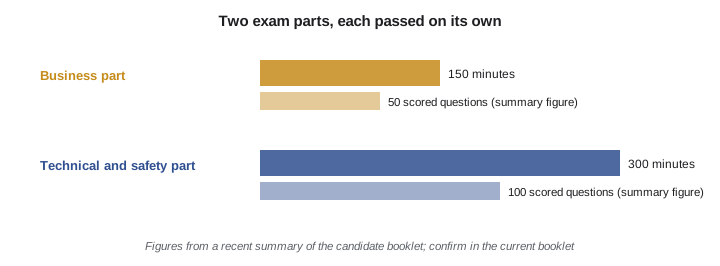
A recent summary of the booklet, effective February 2026, describes the business part as 50 scored questions in 150 minutes and the technical and safety part as 100 scored questions in 300 minutes, each with a passing score of 75 out of 100, and states that both parts are open book. The same summary notes that the booklet allows the vendor to add unscored pilot questions. These figures are the best available for study, but they come from a secondary source; the official booklet is the authority.
The approved references
DBPR's examination page tells candidates they are strongly encouraged to bring the approved reference materials and that no other references are allowed at the exam site. The list of approved references is published for the board and linked from the examination page. For the technical part, the most important reference is the National Electrical Code (NFPA 70) in the edition the list specifies; the February 2026 summary states that the current list names the 2023 NEC. The list also includes other technical references. For the business part, the main reference is a contractors' business and law manual for Florida; the summary names the Florida Contractors Manual, 2021 edition, which covers Florida licensing, lien, workers' compensation and business topics.
Watch the edition question. The 2023 NEC on the reference list is not necessarily the edition being enforced on Florida job sites; Lesson 5 explains that the 8th Edition of the Florida Building Code adopted the 2020 NEC, and the 9th Edition takes effect around the end of 2026. Exams follow their reference list, jobs follow the code in effect when the permit is applied for, and a good contractor keeps both editions straight.
Bringing, tabbing and marking books
Florida's construction exams have long allowed candidates to bring bound reference books that are tabbed and highlighted within limits set in the booklet. Booklets typically allow permanent index tabs and highlighting, and prohibit loose papers, notes written in the books beyond simple markings, and photocopies. Test center staff inspect the books at check-in. A book with forbidden material may be refused, leaving the candidate without it for the whole exam. Read the booklet's rules and follow them exactly, and consider buying the tabs sold for the specific editions on the list, which many candidates find faster than making their own.
Tabbing is a skill. The NEC tabs Marisol found most useful were the major articles from the core courses: Article 100 definitions, 110, 210, 215, 220, 230, 240, 250, 300, 310, 314, 430, 450, 517, 680, 690, 700 and Chapter 9 tables. In the business manual she tabbed the chapters on licensing law, liens, workers' compensation, insurance, tax and payroll, and the formulas section for financial ratios. Then she practiced lookups with a timer until she could find any tab in a few seconds.
Computer-based testing
The exams are taken on a computer at a Pearson VUE test center. Questions appear one at a time with a clock on the screen, and candidates can usually mark questions for review and return to them before ending the section. A basic calculator is usually provided or a specific model is allowed; check the booklet. Scratch paper or an erasable board is provided and collected at the end. Breaks may be allowed but the clock usually keeps running. These details vary, so read the booklet and the vendor's test-day instructions.
Pacing
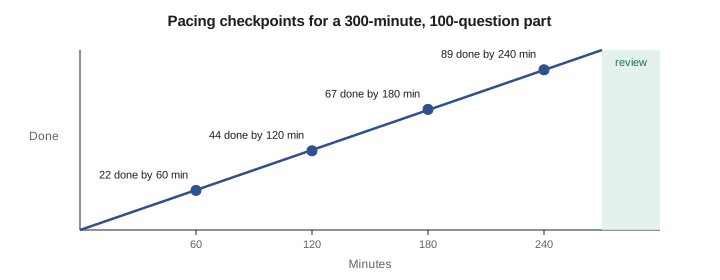
With 100 questions in 300 minutes, the technical part allows an average of three minutes per question. Keeping the last half hour for review leaves 270 minutes for a first pass, or 2.7 minutes per question. The business part, at 50 questions in 150 minutes, works out to the same three minutes on average. Most questions take far less time if the candidate knows where to look; the time goes on long calculations and on hunting through unfamiliar sections. Checkpoints keep the pace honest: on the technical part, about 22 questions done by the first hour, 44 by the second, 67 by the third and all 100 by four and a half hours.
# Pacing and passing math for both parts (figures from a booklet summary)
parts = {"Business": (50, 150), "Technical and safety": (100, 300)}
passing_share = 0.75
review_minutes = {"Business": 15, "Technical and safety": 30}

for name, (questions, minutes) in parts.items():
    needed = -(-questions * 3 // 4)          # round up 75 out of 100
    first_pass = minutes - review_minutes[name]
    print(name)
    print("   correct answers needed:", needed)
    print("   minutes per question on first pass:", round(first_pass / questions, 2))
    for hour in (1, 2, 3, 4):
        if hour * 60 < first_pass:
print(" done by", hour * 60, "min:", round(questions * hour * 60 / first_pass))Business correct answers needed: 38 minutes per question on first pass: 2.7 done by 60 min: 22 done by 120 min: 44 Technical and safety correct answers needed: 75 minutes per question on first pass: 2.7 done by 60 min: 22 done by 120 min: 44 done by 180 min: 67 done by 240 min: 89
The program rounds the required correct answers up, because a score of 37 out of 50 on the business part is 74 out of 100, just short of 75. Thirty-eight correct answers are needed. On the technical part, 75 of 100 is exactly the passing score.
Two passes and educated guesses
A two-pass method works well on long open-book exams. On the first pass, answer every question you can answer quickly or with one lookup, and mark the long calculations and the ones you need to hunt for. On the second pass, work the marked questions, longest last. Unanswered questions score zero, so never leave a question blank; eliminate impossible answers and choose the best remaining option. Changing answers on review is fine when a lookup proves the first answer wrong, but avoid changing answers on a hunch.
Worked problem
Planning the business part
Marisol's business part has 50 questions in 150 minutes. She wants 15 minutes for review. After 60 minutes she has answered 18 questions and marked 4. Is she on pace, and what should she do?
Show solution
- First-pass time is 150 − 15 = 135 minutes, or 2.7 minutes per question.
- At 60 minutes the pace target is 60 ÷ 2.7 ≈ 22 questions.
- She has done 18, about 4 behind, and has marked 4 slow questions.
- She should keep moving, skipping and marking long questions rather than working them now, and come back to all marked questions on the second pass.
Answer: She is about 4 questions behind; skip and mark slow items to catch up, then use the second pass.
Building the tabs
A good tab system is built for speed, not completeness. Marisol used three colors in her NEC: one for the articles she used constantly, one for tables, and one for the articles she used rarely but needed to find fast, such as hazardous locations and emergency systems. She put the tabs for Chapter 9 tables and the Article 310 ampacity tables at the bottom edge so they would not get lost among the article tabs. In the business manual she tabbed by subject rather than chapter number: licensing, liens, contracts, insurance, workers' compensation, payroll and tax, accounting, safety. Then she wrote a one-page index, which she could not bring into the exam, and memorized it.
Highlighting works best when it is sparing. A page covered in yellow is no faster to read than a clean one. Highlight numbers that answer common questions, such as deadlines, thresholds and table titles, and the key words in definitions. Some candidates mark the start of each exception in a section, because exam questions often turn on an exception.
What the business part covers
The business part follows the approved business references. Typical areas include Florida's contractor licensing law and the board's rules; business organization and registration; contracts, bidding, estimating and change orders; lien law and payment bonds; insurance and bonding; workers' compensation; employment law, payroll and tax deposits; accounting and financial statements, including basic ratios such as the current ratio and working capital; project management and scheduling; and safety regulation. Questions range from simple lookups, such as a deadline in days, to calculations, such as payroll tax amounts or a markup, to scenario questions that ask what a contractor should do next.
What the technical part covers
The technical and safety part centers on the NEC: definitions, general requirements, wiring methods, branch circuits and feeders, services, overcurrent protection, grounding and bonding, conductors, raceways and boxes, equipment such as motors, transformers and generators, special occupancies and special equipment, and the Chapter 9 tables. It also includes electrical theory and calculations, such as Ohm's law, power, voltage drop, three-phase relationships and load calculations, and safety topics from OSHA standards and NFPA 70E where those are on the reference list. The master electrician core courses map closely onto this list, and Lesson 12 connects them.
Practicing with the real references
The best practice for an open-book exam is practice with the actual books. Marisol set herself a lookup drill every evening for two weeks: twenty questions, each answered by finding the answer in her tabbed references, with a timer. At first her average was over two minutes a lookup. By the end it was under forty seconds for most questions, and she knew exactly which tabs she reached for most. She kept a list of every question that took more than two minutes and added a tab or a highlight to fix each one. The same approach worked for the business manual, where many questions turn on finding the right table or deadline quickly.
Full-length timed practice exams belong in the last weeks of study. They build stamina for a five-hour technical session and show whether the pacing checkpoints are realistic. Score them honestly, review every miss, and note whether each miss came from not knowing the material, not finding it in time, or misreading the question. Each cause has a different fix: study, tabbing or slowing down to read carefully.
Common mistakes
MistakeBringing the newest NEC instead of the edition on the reference list.
InsteadBring the edition the current booklet lists.
MistakeWriting notes in the margins of a reference book.
InsteadFollow the booklet's marking rules; forbidden notes can get the book refused.
MistakeSpending ten minutes on one calculation early in the exam.
InsteadMark it and return on the second pass.
MistakeLeaving questions blank.
InsteadGuess after eliminating wrong answers; blanks score zero.
Summary and key terms
- The exam has a technical and safety part and a business part, passed separately.
- A recent booklet summary describes 50 business questions in 150 minutes and 100 technical questions in 300 minutes, each passed at 75, with both parts open book.
- Only the approved references on the current list may be brought; the summary names the 2023 NEC and the Florida Contractors Manual among them.
- Booklets set strict rules on tabbing, highlighting and notes, and books are inspected at check-in.
- Pacing checkpoints and a two-pass method help candidates finish and review.
- Technical and safety part
- The exam part on the NEC, theory, calculations and safety.
- Business part
- The exam part on Florida contractor licensing, liens, insurance, workers' compensation and business practice.
- Approved reference list
- The books candidates may bring, published for the board.
- Pilot question
- An unscored question included to test it for future exams.
- Two-pass method
- Answering quick questions first and returning to marked hard ones.
Practice problems
Work each problem on paper first, then reveal the answer to check.
How many correct answers are needed on a 50-question part with a passing score of 75 out of 100?
Show answer
37.5 rounds up to 38.
What is the average time per question on a 100-question, 300-minute part?
Show answer
3 minutes.
Why might the exam use a different NEC edition from the one enforced on your jobs?
Show answer
The exam follows its own reference list, while jobs follow the code adopted when the permit is applied for.
What can happen if a reference book contains forbidden notes?
Show answer
Test center staff may refuse the book, and the candidate must test without it.
Lesson quiz · 5 questions
Score 60% or more to complete this lesson.
Create a free account to save your progress, take quizzes and earn a certificate.