
MELU-209 · Lesson 8 of 12 · 19 min
Contractor licensing, insurance and bonding
▶ Video coming soon A video version of this lesson is on the way.
Tanya had the insurance agent on speaker. "The board wants the certificate holder listed as the department and the Electrical Contractors' Licensing Board, the policy number on the face, completed operations included, and limits at least what they publish," she said, reading from her notes. "And no binders." The agent promised a corrected certificate by the afternoon. Marisol, listening from the next desk, realized that half of the business part of the exam was things Tanya did every week without thinking about them: insurance, workers' compensation, credit, corporate filings and bonds.
This lesson covers the business requirements for a certified electrical contractor in Florida: qualifying a business organization, financial responsibility and credit, general liability insurance, workers' compensation, and the bonds that arise on particular projects. The license application in Lesson 3 asks for most of these; staying in compliance after licensure keeps the license and the business alive.
Qualifying a business organization
A certified contractor who contracts in the name of a business must qualify that business with the board. The board's rule on business organizations requires the business to be registered properly, typically with the Florida Division of Corporations for corporations and limited liability companies, and to identify its qualifying agent and officers. A fictitious name, the trade name a business uses if it differs from its legal name, must be registered with the Division of Corporations before use, and the license should match the name the business uses on contracts and advertising.
The choice of business structure is a business and tax decision covered in the core business course. For the license, what matters is that the qualifier's relationship to the business is real and documented, and that the business name on the license, permits, contracts, insurance certificates and trucks is the same.
Financial responsibility and credit
Florida requires applicants for certification to show financial responsibility. The board's FAQ states that personal and business credit reports are required, each including a public records statement, and that an application may be denied because of delinquent accounts, collections, unpaid liens or judgments. A secondary summary of the current application describes a business financial statement dated within 12 months showing a minimum net worth for a certified electrical contractor; candidates should check the current rule for the figure and the form of statement accepted.
Credit problems are not automatically disqualifying, but they must be addressed. An applicant with an old judgment may be able to show it has been satisfied, or may be asked to provide additional financial assurance. Gulfline ordered its business credit report early so that any surprises could be cleared before the license application was filed.
General liability insurance
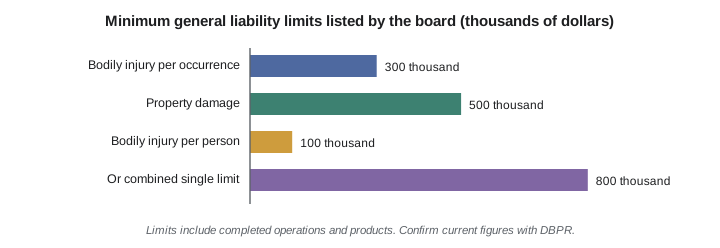
The board's FAQ lists minimum general liability insurance limits for electrical contractors, including completed operations and products coverage: 300,000 dollars per occurrence for bodily injury, 500,000 dollars for property damage and 100,000 dollars per person, or an 800,000 dollar combined single limit. The certificate must show the policy number, and binders are not accepted. Many customers and general contractors require much higher limits, often a million dollars per occurrence or more with an umbrella policy, and require the contractor to name them as additional insureds.
Completed operations coverage deserves attention. Electrical work can cause damage long after the job is finished: a loose connection that starts a fire two years later is a classic completed operations claim. A policy that covers only operations in progress leaves that risk uninsured, which is why Florida requires completed operations in the minimum coverage.
Workers' compensation
Florida's workers' compensation law, Chapter 440 of the Florida Statutes, requires construction employers to carry workers' compensation coverage for their employees, generally from the first employee, which is a stricter rule than for many non-construction businesses. Coverage pays medical care and lost wages for work-related injuries without regard to fault, and in return employees generally cannot sue the employer for those injuries. The Division of Workers' Compensation in the Department of Financial Services enforces the law and can issue stop-work orders and penalties against employers without coverage.
Corporate officers in the construction industry may elect an exemption under limits set by the statute. The board's FAQ states that up to three officers may be exempt and that qualifiers and non-officer employees may not be. Exemptions are filed with the Division of Workers' Compensation and must be renewed. A contractor who hires subcontractors must make sure each subcontractor has its own coverage or valid exemption, because a contractor can be treated as the employer of an uninsured subcontractor's workers.
Florida encourages drug-free workplace programs that meet statutory standards, and employers with qualifying programs may receive a premium credit on their workers' compensation insurance. Many general contractors also require subcontractors to have drug-free workplace programs.
Bonds
Florida's electrical contractor license is not built around a license bond in the way some states' are. Bonds arise instead on particular projects. Section 255.05 of the Florida Statutes requires contractors on many public construction projects to furnish a payment and performance bond, with thresholds and exceptions set by the statute, and local governments may require bonds on their contracts. Private owners and general contractors may require subcontract performance and payment bonds on larger jobs. Some local governments also require a bond or other security to obtain permits or right-of-way approvals.
On public projects, liens cannot attach to public property, so the payment bond is the protection for subcontractors and suppliers who are not paid. Claimants must follow the bond statute's notice and timing requirements, which are similar in purpose to the lien law deadlines in Lesson 9. Gulfline's Lakewood Elementary job was a public school project with a payment bond; Tanya kept a copy of the recorded bond in the job file and the notice deadlines on the calendar.
# Does an insurance certificate meet the board's listed minimums? (study example)
minimums = {"per_occurrence": 300_000, "property_damage": 500_000, "per_person": 100_000}
csl_minimum = 800_000

certificates = {
    "Gulfline (split limits)": {"per_occurrence": 1_000_000, "property_damage": 1_000_000, "per_person": 1_000_000, "completed_ops": True},
    "Sub A (combined single limit)": {"csl": 750_000, "completed_ops": True},
    "Sub B (split limits)": {"per_occurrence": 500_000, "property_damage": 500_000, "per_person": 100_000, "completed_ops": False},
}
for name, c in certificates.items():
    if "csl" in c:
        ok = c["csl"] >= csl_minimum
    else:
        ok = all(c[k] >= v for k, v in minimums.items())
    ok = ok and c["completed_ops"]
print(f"{name:32} meets minimums: {ok}")Gulfline (split limits) meets minimums: True Sub A (combined single limit) meets minimums: False Sub B (split limits) meets minimums: False
The check flags Sub A, whose 750,000 dollar combined single limit is below 800,000, and Sub B, whose limits are high enough but which lacks completed operations coverage. Gulfline would require both subcontractors to correct their coverage before starting work, because a gap in a subcontractor's insurance can become the contractor's problem.
Worked problem
Workers' compensation on a small crew
Gulfline is incorporated, with three officers: Frank (owner), Marisol (vice president and soon qualifier) and Tanya (secretary). Frank and Tanya want to file exemptions to reduce premiums. Can they, and what about Marisol and the field employees?
Show solution
- Florida allows a limited number of construction corporate officers to elect exemptions; the board's FAQ says up to three officers.
- Frank and Tanya may be able to file exemptions if they meet the statute's requirements, such as ownership rules.
- The board's FAQ states qualifiers may not be exempt, so Marisol must be covered once she becomes the qualifier.
- All non-officer employees, including every electrician and apprentice, must be covered.
Answer: Frank and Tanya may be able to file exemptions; Marisol, as qualifier, and all employees must be covered.
Insurance beyond the minimums
The board's minimums are a floor. A typical Florida electrical contractor carries a broader set of coverages: commercial general liability, often with limits of a million dollars per occurrence and two million in the aggregate; an umbrella or excess liability policy above that; commercial auto liability for company vehicles; workers' compensation and employer's liability; inland marine coverage for tools and equipment; and sometimes builder's risk on projects where the contractor is responsible for the work until completion. Contractors who do design-build work may need professional liability, and those with significant data or payment systems may buy cyber coverage. An insurance agent who works with contractors can explain each policy and what customers commonly require.
Customers and general contractors usually require certificates of insurance, additional insured endorsements, waivers of subrogation and primary and noncontributory wording. These requests should be reviewed against the actual policies, because a certificate that promises coverage the policy does not provide can create problems for everyone. Gulfline's agent reviewed every new subcontract's insurance requirements before Frank signed.
The experience modification rate
Workers' compensation premiums are based on payroll by job classification, multiplied by rates set for each classification, and then adjusted by the experience modification rate. The modification compares a contractor's actual claims with the claims expected for a business of its size and type. A rate of 1.00 is average; below 1.00 lowers the premium and above 1.00 raises it. Many general contractors require subcontractors to have a modification below a set level to bid. Safety programs, prompt reporting of injuries and return-to-work programs that bring injured employees back on light duty all help keep the modification low.
Payroll records matter too. Workers' compensation insurers audit payroll after each policy period to calculate the final premium, so payroll must be assigned to the correct classifications and supported by records. Paying electricians as independent contractors to avoid coverage is a serious violation that can lead to stop-work orders and penalties based on the unpaid premium.
Keeping the business in good standing
Florida corporations and limited liability companies must file annual reports with the Division of Corporations to stay active. A business that falls out of active status may face problems with its license qualification, contracts and lawsuits. Gulfline's annual report was filed every January along with the calendar review of license, insurance and exemption renewals. The same review checked that the business name on the license, insurance policies, vehicle lettering, letterhead and contracts still matched.
Checking a subcontractor before work starts
Gulfline used a short checklist before any subcontractor set foot on a job. First, confirm the license in DBPR's search for the right category and status. Second, collect a current certificate of insurance showing general liability with completed operations, auto liability where vehicles will be used on the job, and the additional insured and waiver wording the prime contract required. Third, confirm workers' compensation coverage, or an exemption for each officer who will work on site, in the Division of Workers' Compensation's records. Fourth, sign a written subcontract with the scope, price, schedule, insurance and safety terms. Fifth, put the subcontractor's safety training and site orientation on record before the first day.
The checklist protected Gulfline in several ways. An uninsured subcontractor's injured worker could otherwise claim against Gulfline's workers' compensation policy, raising its premium and experience modification. A subcontractor without completed operations coverage could leave Gulfline exposed for damage from the subcontractor's work. And an unlicensed subcontractor could expose Gulfline's qualifier to discipline for aiding unlicensed contracting.
Insurance certificates should be tracked like any other deadline. Gulfline kept a spreadsheet of every certificate it had issued to customers and every certificate it held from subcontractors, with policy expiration dates, and sent updated certificates before the old ones expired. Some general contractors withhold payment when a subcontractor's certificate lapses, and a building department that keeps certificates on file can refuse permits when one expires.
Common mistakes
MistakeSubmitting a certificate that lists the wrong certificate holder or no policy number.
InsteadFollow the board's instructions exactly; binders are not accepted.
MistakeBuying a policy without completed operations coverage.
InsteadCompleted operations is part of the required minimum coverage.
MistakeHiring a subcontractor without checking its workers' compensation.
InsteadCollect a current certificate or exemption before work starts.
MistakeExpecting to file a lien on a public school project.
InsteadUse the payment bond under section 255.05 instead.
Summary and key terms
- A certified contractor must qualify any business it contracts through, with matching registered names.
- Applicants show financial responsibility with personal and business credit reports and financial information the board requires.
- The board lists minimum liability limits of 300,000 per occurrence, 500,000 property damage and 100,000 per person, or an 800,000 combined single limit, including completed operations.
- Construction employers must carry workers' compensation; up to three corporate officers may be exempt, but not qualifiers or employees.
- Payment and performance bonds arise on public projects under section 255.05 and by contract, and replace liens on public property.
- Completed operations coverage
- Liability insurance for damage caused by finished work.
- Combined single limit
- One limit covering bodily injury and property damage together.
- Officer exemption
- An election by a qualifying corporate officer not to be covered by workers' compensation.
- Payment bond
- A surety bond guaranteeing payment to subcontractors and suppliers.
- Fictitious name
- A trade name different from the business's legal name, registered with the state.
Practice problems
Work each problem on paper first, then reveal the answer to check.
What combined single limit does the board list as the minimum?
Show answer
800,000 dollars.
Why is completed operations coverage important for electricians?
Show answer
Damage from electrical work, such as fires from faulty connections, can occur after the job is finished.
May a qualifier be exempt from workers' compensation, according to the board's FAQ?
Show answer
No.
What protects subcontractors on public projects where liens cannot attach?
Show answer
The payment bond required by section 255.05.
Lesson quiz · 5 questions
Score 60% or more to complete this lesson.
Create a free account to save your progress, take quizzes and earn a certificate.