
MELU-209 · Lesson 2 of 12 · 19 min
Eligibility for the Certified Electrical Contractor License
▶ Video coming soon A video version of this lesson is on the way.
Before Marisol could book anything, she had to prove she was eligible to sit the certification examination. Tanya Brooks, Gulfline's office manager, had been through the process once before when Frank added a second business qualification in the 2000s, and she warned Marisol that the experience paperwork was where most applications stalled. "The board doesn't take your word for it," she said. "They want dates, job titles and somebody licensed to sign that you did the work." Marisol pulled out her old pay stubs, her Manatee County journeyman card and a list of every Gulfline project she had run since 2021.
This lesson works through the eligibility requirements for the certified electrical contractor examination as they appear in section 489.511 of the Florida Statutes and the board's rules. The statute is the place to start, because the exam application asks you to choose and document one of its experience routes. The exact wording matters: each route counts a specific kind of experience within a specific look-back window, and an application that mixes them up gets sent back.
The basic requirements
To take the certification examination, an applicant must be at least 18 years old and of good moral character, and must meet one of the experience requirements described below. Florida defines good moral character in this statute as a personal history of honesty, fairness and respect for the rights of others and for the laws of the state and nation. The board may consider criminal history, past discipline and similar facts, but it must look at whether they relate to the practice of contracting. An applicant with a past problem should answer the application questions fully and honestly; an omission discovered later is usually a bigger problem than the original event.
Look at what is not on the list. The eligibility test for the exam does not include insurance, a credit report or a business entity. Those belong to the license application after the exam, covered in Lessons 3 and 8. Marisol could sit the exam while still an employee, and only needed the business pieces in place when Gulfline applied to have her qualify the company.
The experience routes
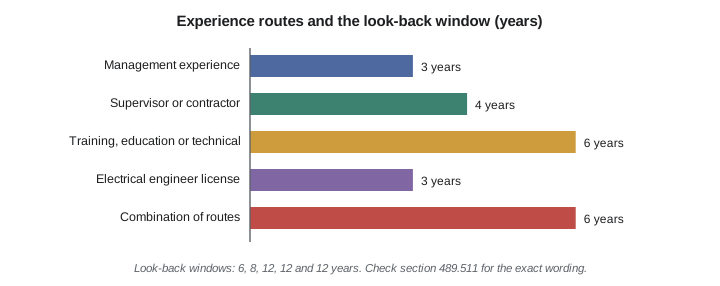
Section 489.511 lists several alternative ways to meet the experience requirement. In plain terms, as summarized from the statute:
- Management experience: at least 3 years of proven management experience in the trade within the 6 years before applying, with no more than half of it made up by education equivalent.
- Supervisor or contractor experience: at least 4 years as a supervisor or contractor in the trade within the 8 years before applying, or 4 years as a supervisor in electrical or alarm work in the U.S. Armed Forces.
- Training, education and supervisory experience: at least 6 years of comprehensive training, technical education or supervisory experience associated with an electrical or alarm contracting business, or 6 years of technical experience with the Armed Forces or a government entity, within the 12 years before applying.
- Engineering: licensure as a professional engineer qualified in electrical engineering for 3 years, within the 12 years before applying.
- Combination: a combination of the management, supervisor and training routes totaling 6 years.
The statute defines a supervisor as a person who has the general duty of overseeing the technical duties of the trade and who gained that experience while able to perform those duties without supervision. That definition matters for applicants like Marisol. Her four years as an apprentice and early journeyman do not count as supervisor experience, because she was being supervised. Her five years as a Gulfline field supervisor, running crews and making the technical decisions on site, do.
Management experience, under the first route, means more than running a crew. It generally refers to managing the business side of contracting work: estimating, purchasing, scheduling across jobs, hiring and handling contracts. Some applicants have both kinds of experience and choose whichever route their paperwork supports best.
Documenting experience
The application asks for the applicant's work history and for verification of the claimed experience by people who can attest to it, usually a licensed contractor, an engineer, a building official or an employer who supervised the applicant. The board looks for specific dates, the type of work, the applicant's role and the size of the projects. Vague statements such as "worked in electrical for many years" do not meet the requirement. Tanya's advice was to make the verification easy to check: list each employer with start and end dates, the job title, the license number of the verifying person, and two or three representative projects with their size and the applicant's responsibility on each.
Experience gained outside Florida counts if it meets the statute's description. Military experience is specifically mentioned in two routes. Experience as an owner of an unlicensed business does not help an applicant and may raise questions, because performing contracting without the required license is itself unlawful.
Look-back windows
Each route counts experience within a window measured back from the date the application is filed. A supervisor who ran crews from 2012 to 2016 and then left the trade would not meet the 4-year supervisor route in 2026, because that experience falls outside the 8-year window. The windows reward recent experience, on the idea that a qualifier should know current practice. They also mean timing matters: an applicant who is close to a threshold should calculate carefully before filing.
from datetime import date

# Marisol's supervisor experience at Gulfline (study example)
periods = [(date(2021, 3, 1), date(2026, 3, 1))]
filing = date(2026, 4, 15)
window_years = 8
needed_years = 4

start_window = date(filing.year - window_years, filing.month, filing.day)
days = 0
for start, end in periods:
    s = max(start, start_window)
    e = min(end, filing)
    if e > s:
        days += (e - s).days
years = days / 365.25
print("Window starts:", start_window)
print("Supervisor experience in window:", round(years, 2), "years")
print("Meets the 4-year supervisor route:", years >= needed_years)Window starts: 2018-04-15 Supervisor experience in window: 5.0 years Meets the 4-year supervisor route: True
The calculation shows Marisol has about five years of supervisor experience inside the 8-year window, comfortably above the 4 required. If she had started supervising only in late 2022, she would have been under the threshold and would have needed to wait or rely on a different route.
Worked problem
Choosing a route for a mixed history
Dev Patel, Gulfline's estimator, is also thinking about the exam. His history: 2014 to 2018 as an electrician (supervised), 2018 to 2021 as a crew lead running small service jobs, and 2021 to 2026 as estimator and project manager handling bids, purchasing and contracts. He plans to file in May 2026. Which routes might fit?
Show solution
- Supervisor route: his crew lead years (2018 to 2021, about 3 years) are within the 8-year window but short of 4 years on their own.
- Management route: his estimator and project manager years (2021 to 2026, about 5 years) fall within the 6-year window and exceed the 3 years required.
- Training route: 2014 to 2026 is 12 years of training and supervisory experience associated with an electrical contracting business, within the 12-year window, well over the 6 required.
- The management route is the cleanest fit if his duties were truly managerial; the training route is a backup that counts the whole history.
Answer: Dev's best documented route is probably the management route, with the training route as an alternative; the supervisor route alone falls short.
After three failed attempts
The statute lets the board set by rule how often an applicant may take the exam and allows the board to require additional college-level or technical courses in the areas where an applicant was weak after three unsuccessful attempts. Exam prep providers describe a requirement for added continuing education before a fourth attempt. Candidates should check the current rule and candidate booklet, but the practical lesson is simple: prepare well for the first attempt, and use the score report from any failed attempt to focus the next one.
Planning the application
Eligibility questions are easier to settle before money is spent. Marisol made a short checklist: confirm her route and its window, collect her employment dates, ask Frank to sign as her verifying licensed contractor, find her old Manatee County records for the earlier years in case the board asked, and answer the character questions completely. Tanya scanned everything into one folder so that a request for more information could be answered the same day. The application went in on a Tuesday in April, and the approval letter arrived about three weeks later.
Character questions in practice
The application asks about criminal history, past discipline in Florida or any other state, and other matters bearing on good moral character. Florida law directs licensing boards to consider whether a crime relates to the practice of the profession, and it limits how some older or unrelated offenses may be used. An applicant with a record should gather court documents showing the outcome, proof that any sentence was completed, and evidence of rehabilitation such as steady employment and letters from employers. Disclosing a matter and explaining it is almost always better than leaving it out, because an omission discovered in a background check can itself be treated as evidence of poor character. If an application is denied, the applicant has the right to request a hearing, and many denials are resolved by providing missing information.
Education and military service
Two parts of the statute help applicants with education or military backgrounds. Under the management route, up to half of the required experience may be satisfied by an educational equivalent, such as relevant college or technical school coursework, as the board's rules define it. Under the training route, technical education associated with electrical contracting counts toward the six years. Military applicants can count supervision of electrical or alarm work in the armed forces toward the supervisor route, and technical experience in the armed forces toward the training route. Veterans should collect their service records, evaluations and training certificates that describe their electrical duties in specific terms, since military job titles do not always make the work obvious to a civilian reviewer.
Applicants who already hold a Florida specialty license or a local certificate of competency often have well-documented experience, because they had to prove it once before. Their earlier applications, exam records and license histories can make the verification for the certified license straightforward. Marisol's Manatee County journeyman file, for example, confirmed her apprenticeship and early journeyman years, even though those years did not count toward the supervisor route.
A checklist before filing
Before Tanya pressed submit, she and Marisol went through a short checklist that any applicant can use. Is the chosen route the strongest one the records support? Does every period of claimed experience fall inside the route's window, counted from the planned filing date? Does each verification letter give the verifier's name, license number, the applicant's dates and title, and specific duties and projects? Are all character questions answered, with documents attached for anything disclosed? Is the applicant's name exactly the same on the application, identification and supporting documents? And is there a copy of everything in one folder, so any deficiency letter can be answered the same day? That last step saved them a week when the board asked for one more project description from 2022.
The checklist also included a calendar check. If an applicant is a few weeks short of a threshold, filing a little later may turn a likely deficiency into a clean approval. Marisol's numbers were comfortable, but Dev, who was close to the line on the supervisor route, decided to file under the management route instead, where his experience was well above the requirement.
Common mistakes
MistakeCounting apprentice years as supervisor experience.
InsteadSupervisor experience must be gained while able to do the work without supervision.
MistakeIgnoring the look-back window.
InsteadCount only experience inside the route's window measured back from the filing date.
MistakeSubmitting vague verification letters.
InsteadGive dates, titles, duties, project examples and the verifier's license number.
MistakeLeaving out an old criminal or disciplinary matter.
InsteadAnswer fully; the board weighs relevance, and an omission can be treated as a character problem.
Summary and key terms
- Applicants must be at least 18, of good moral character and meet one experience route in section 489.511.
- Routes include 3 years of management experience in 6 years, 4 years as a supervisor or contractor in 8 years, 6 years of training, education or supervisory experience in 12 years, 3 years as an electrical engineer, or a 6-year combination.
- A supervisor oversees the technical duties of the trade while able to do them without supervision.
- Experience must be documented with specific dates, roles and verification by qualified people.
- Insurance, credit and business entity requirements come with the license application, not the exam application.
- Good moral character
- A history of honesty, fairness and respect for others' rights and the law, as Florida defines it for licensing.
- Supervisor
- A person who oversees the technical duties of the trade while able to perform them without supervision.
- Look-back window
- The period before filing within which experience must have been gained.
- Verification
- A statement by a qualified person confirming the applicant's experience.
- Experience route
- One of the alternative ways the statute lets an applicant meet the experience requirement.
Practice problems
Work each problem on paper first, then reveal the answer to check.
How many years of supervisor or contractor experience does the supervisor route require, and within what window?
Show answer
4 years within the 8 years before applying.
Why do apprentice years usually not count toward the supervisor route?
Show answer
An apprentice works under supervision, while supervisor experience must be gained while able to work without supervision.
An applicant has 6 years of training and technical experience at an electrical contractor, all within the past 10 years. Which route fits?
Show answer
The training, education and supervisory route, which requires 6 years within 12.
Is a credit report required to take the exam?
Show answer
No. Financial responsibility is shown with the license application after passing.
Lesson quiz · 5 questions
Score 60% or more to complete this lesson.
Create a free account to save your progress, take quizzes and earn a certificate.