
MELU-209 · Lesson 1 of 12 · 19 min
How electrical licensing works in Florida
▶ Video coming soon A video version of this lesson is on the way.
Frank Castellano started Gulfline Electric in Sarasota in 1994 with one van and a state certified electrical contractor license he had passed on his second try. Thirty-two years later the company has fourteen electricians, two service trucks, a steady list of restaurant and retail fit-outs along the Gulf coast, and a backlog of storm repairs that never seems to shrink. On a humid Monday in March, Frank called his field supervisor, Marisol Vega, into the office. "I'm sixty-eight," he said. "Gulfline runs on my license. If you want this company to keep going after me, you need to sit the state exam and become our qualifier." He handed her a printout of the Electrical Contractors' Licensing Board's application checklist and a list of reference books with half of them already crossed off, because they were sitting on the shelf behind him.
Marisol had nine years in the trade: four as an apprentice and journeyman in Manatee County, then five running crews for Gulfline on commercial jobs. She had worked through the master electrician core courses on the National Electrical Code, load calculations, grounding, motors and special occupancies, and the business and law course. This course takes that preparation and applies it to Florida: who licenses electrical contractors, how the state exam works, which code edition applies, how permits and inspections are handled, and the Florida law on contracts, liens, insurance, workers' compensation, safety and renewal that the business part of the exam tests.
The agency and the board
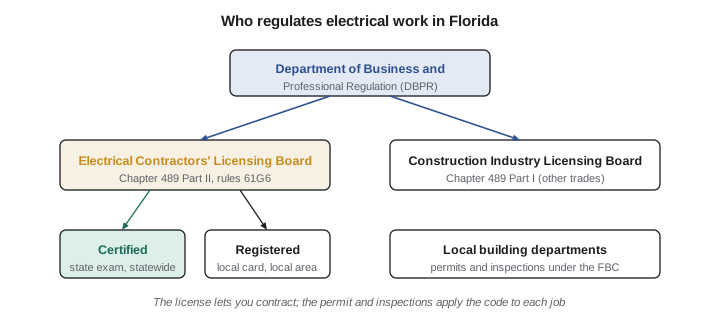
Florida regulates contractors through the Department of Business and Professional Regulation, a state agency that handles applications, collects fees, issues licenses, investigates complaints and prosecutes unlicensed activity for many professions. Electrical contracting has its own board within DBPR: the Electrical Contractors' Licensing Board, usually called the ECLB. The ECLB is created by Part II of Chapter 489 of the Florida Statutes, and its detailed rules are in Chapter 61G6 of the Florida Administrative Code. The board is made up mostly of licensed electrical and alarm contractors plus consumer members, and it meets regularly to approve license applications, set rules and decide disciplinary cases.
Most other construction trades in Florida, such as general, building, residential, roofing, plumbing, mechanical and air conditioning contractors, are licensed by a different board, the Construction Industry Licensing Board or CILB, under Part I of Chapter 489. The two boards share staff and some procedures but have separate statutes, rules, exams and fees. This matters on the exam and in practice: a rule that applies to CILB contractors, such as some recovery fund and disclosure provisions, does not automatically apply to electrical contractors, and the reverse is also true. When you read a Florida construction law article or exam prep book, check which part of Chapter 489 it is talking about.
Certified and registered licenses
Florida has two ways to hold an electrical contractor license, and the difference is geographic. A certified contractor has passed the state examination and been certified by the ECLB. According to the board, certified licensees can work anywhere in Florida. A registered contractor holds a certificate of competency issued by a county or municipality after passing a local or approved exam, and registers that local license with the ECLB. A registered contractor may work only in the counties or municipalities where the local license is held. A person can hold both types only if they are in different license categories.
For a company like Gulfline that works in Sarasota, Manatee and Charlotte counties and sometimes takes jobs as far away as Tampa or Fort Myers, the certified license is the practical choice. It removes the need to keep a separate local license in each place, although each local building department still requires its own permits and may require the contractor to register its license with the department before pulling the first permit. Frank held his certified license from the start, and Marisol planned to do the same.
| Feature | Certified | Registered |
|---|---|---|
| Exam | State examination for the ECLB | Local or approved exam for a county or city |
| Where you may work | Statewide | Only where the local license is held |
| Issued by | ECLB certification | Local certificate registered with the ECLB |
| Common users | Contractors working across several counties | Contractors who stay in one local market |
License categories
The ECLB licenses several categories of contractor. The certified electrical contractor license, often abbreviated EC, covers all electrical work and also alarm system work, which is why it is sometimes described as the unlimited electrical license. Separate alarm system contractor licenses cover fire and burglar alarm work without general electrical work. Specialty electrical contractor licenses cover narrower scopes: residential electrical work, utility line work, lighting maintenance, sign work, limited energy systems and two-way radio communication enhancement systems. According to the board, the residential specialty covers one- to four-family residences up to two stories with single-phase services up to 400 amperes, and the limited energy specialty covers circuits not exceeding 98 volts RMS, excluding alarm system components.
This course is about the certified electrical contractor license. Specialty licenses have their own exams and scopes, and contractors sometimes start with a specialty license and later move up. Exam questions about scope often describe a job and ask whether a given license may perform it, so it helps to remember the main boundaries: a residential specialty contractor may not wire a strip mall, a limited energy contractor may not install a 120-volt branch circuit, and an alarm contractor may not run a feeder.
Journeymen and the local level
Florida does not issue a statewide journeyman electrician license the way some states do. Many counties and cities issue journeyman and master certificates of competency and set rules for supervision on local jobs, and the state has a journeyman reciprocity program that lets a journeyman who meets its requirements have that status recognized in jurisdictions that participate. In practice, the electricians who work under a certified contractor are supervised by the contractor's qualifier and must meet any local requirements where they work. Marisol's own journeyman card came from Manatee County, and Gulfline's office kept a spreadsheet of each electrician's local cards and expiration dates.
The qualifying agent and the business
A certified license is issued to an individual. A company that wants to contract under that license must be qualified by a licensed person, called the qualifying agent. Florida law and the board's rules treat the primary qualifying agent as responsible for supervising all of the company's electrical contracting operations and require the agent to be an officer or supervising employee of the business, not someone who lends a name. The business itself is registered with the board through the qualifier, and the license certificate lists both. Lesson 7 covers the qualifier's duties in detail, and Lesson 8 covers the financial responsibility, insurance and workers' compensation requirements that the business must meet.
At Gulfline, Frank was both the owner and the primary qualifying agent. Marisol would become the qualifier when she passed and was approved, while Frank stayed on as owner until he decided to sell. That separation of ownership and qualification is common in Florida electrical companies, and the law cares mainly that the qualifier has real authority over the work.
Unlicensed contracting
Contracting for electrical work without the required license is a crime in Florida, and the penalties increase for repeat offenses and for offenses during a declared state of emergency, when storm-damaged homeowners are most vulnerable. Contracts by unlicensed contractors may also be unenforceable, so an unlicensed contractor may be unable to collect payment or file a lien. Licensed contractors also face discipline if they help an unlicensed person by pulling permits for work they do not supervise, which Florida treats as aiding unlicensed activity. After every hurricane season Frank told the same story about a homeowner in Venice who paid cash to a storm chaser for a new service, failed inspection, and then paid Gulfline to do the work again.
# Which Florida license category fits a job? (simplified study aid)
jobs = [
    ("Rewire a two-story duplex, 200 A single-phase service", "residential"),
    ("New 800 A three-phase service for a strip center", "unlimited"),
    ("Install a fire alarm panel and devices in a restaurant", "alarm"),
    ("Pull Cat 6 data cable for a dental office", "limited energy"),
    ("Replace lamps and ballasts in parking lot poles", "lighting maintenance"),
]
scopes = {
    "residential": {"EC", "residential specialty"},
    "unlimited": {"EC"},
    "alarm": {"EC", "alarm contractor"},
    "limited energy": {"EC", "limited energy specialty"},
    "lighting maintenance": {"EC", "lighting maintenance specialty"},
}
for job, kind in jobs:
    allowed = ", ".join(sorted(scopes[kind]))
    print(job)
print(" allowed:", allowed)Rewire a two-story duplex, 200 A single-phase service allowed: EC, residential specialty New 800 A three-phase service for a strip center allowed: EC Install a fire alarm panel and devices in a restaurant allowed: EC, alarm contractor Pull Cat 6 data cable for a dental office allowed: EC, limited energy specialty Replace lamps and ballasts in parking lot poles allowed: EC, lighting maintenance specialty
The calculator shows a pattern worth remembering for the exam: the certified electrical contractor license appears on every line, because it covers all electrical and alarm work, while each specialty license appears only within its own scope. Real scope questions can be more detailed, so the board's rules and FAQ are the final word.
Worked problem
Choosing the right license path
Marisol's cousin Rafael runs a two-person company in Charlotte County doing only house rewires and service changes on homes up to two stories. He never works outside Charlotte County. Which license options fit his business, and what would change if he started bidding small commercial jobs in Lee County?
Show solution
- Rafael's work is residential, single-phase and limited to one county.
- A registered license based on a Charlotte County certificate of competency would allow him to work in Charlotte County only.
- A certified residential specialty license would let him do the same residential work anywhere in Florida.
- Small commercial jobs are outside the residential specialty scope, and Lee County is outside a Charlotte County registered license.
- To bid commercial work in Lee County he would need a certified electrical contractor license, or a registered license in Lee County with a scope that covers commercial work.
Answer: Today a Charlotte County registered license or a certified residential specialty license fits; commercial work in another county points to the certified electrical contractor license.
Where the rules live
Florida electrical contractors work under several layers of law, and the exam expects candidates to know which layer answers which question. Statutes passed by the Legislature set the framework: Chapter 489 Part II for electrical licensing, Chapter 713 for liens, Chapter 440 for workers' compensation and Chapter 553 for the building code. Board rules in Chapter 61G6 of the Florida Administrative Code fill in details such as application requirements, continuing education and disciplinary guidelines. DBPR's forms and FAQs explain procedures. The Florida Building Code and the NEC it adopts govern the technical work. Local ordinances and building department policies handle permits, fees and inspections. When a question comes up on a job or the exam, start by asking which layer it belongs to.
Common mistakes
MistakeAssuming a CILB rule automatically applies to electrical contractors.
InsteadCheck whether the provision is in Part I (CILB) or Part II (ECLB) of Chapter 489.
MistakeThinking a registered license allows work anywhere in Florida.
InsteadA registered license is limited to the local jurisdictions where it is held; only certified licenses are statewide.
MistakeTreating the qualifier as a name on paper.
InsteadThe qualifying agent must supervise the company's electrical operations and be an officer or supervising employee.
MistakePulling a permit for a friend's job you will not supervise.
InsteadThat can be aiding unlicensed contracting, which exposes your license to discipline.
Summary and key terms
- Florida licenses electrical contractors through the Electrical Contractors' Licensing Board within DBPR, under Chapter 489 Part II and rules in Chapter 61G6.
- Most other construction trades are licensed by the separate Construction Industry Licensing Board under Part I.
- Certified contractors pass the state exam and may work statewide; registered contractors hold local licenses and work only where those licenses are held.
- The certified electrical contractor license covers all electrical and alarm work; specialty licenses cover narrower scopes.
- A company contracts through a qualifying agent who must actually supervise its electrical operations, and unlicensed contracting carries criminal penalties.
- ECLB
- The Electrical Contractors' Licensing Board, which licenses and disciplines electrical and alarm contractors in Florida.
- DBPR
- The Department of Business and Professional Regulation, the state agency that houses the licensing boards.
- Certified contractor
- A contractor who passed the state exam and may work anywhere in Florida.
- Registered contractor
- A contractor whose local license is registered with the board and who may work only where that license is held.
- Qualifying agent
- The licensed individual responsible for supervising a business's electrical contracting.
Practice problems
Work each problem on paper first, then reveal the answer to check.
Which part of Chapter 489 creates the ECLB?
Show answer
Part II. Part I covers the Construction Industry Licensing Board.
A registered contractor from Sarasota County wants to bid a job in Polk County. What is the problem?
Show answer
A registered license is limited to the jurisdictions where the local license is held, so Polk County is outside its scope unless the contractor holds a license valid there.
Which license covers both general electrical work and alarm system work?
Show answer
The certified electrical contractor license.
Why can unlicensed contracting hurt the unlicensed person even if they are never prosecuted?
Show answer
Their contracts may be unenforceable, so they may be unable to collect payment or file a lien.
Lesson quiz · 5 questions
Score 60% or more to complete this lesson.
Create a free account to save your progress, take quizzes and earn a certificate.