
MELU-208 · Lesson 9 of 12 · 19 min
Contracts and mechanics' liens in Delaware
▶ Video coming soon A video version of this lesson is on the way.
In the spring of 2025, Kent Meadow finished the electrical work on a small strip center outside Milford for a general contractor that then stopped paying its subcontractors. Kent Meadow was owed about 38,000 dollars. Russ had been through this before and knew that the company's strongest tool was a mechanics' lien on the building, but only if it acted within the statute's deadline. Gail filed the statement of claim with the Prothonotary in Sussex County with three weeks to spare, the owner withheld the amount from the general contractor, and Kent Meadow was paid within two months. This lesson covers the law that made that possible: what makes a good electrical contract, Delaware's mechanics' lien statute in Chapter 27 of Title 25, the special rule for owner-occupied homes, the Building Construction Payments Act and payment bonds on public work.
Contracts first
A lien is a remedy for a contract that went wrong. The best protection is a contract that sets out the work, the price and the payment terms clearly. A Delaware electrical contract should name the parties and the owner of the property, describe the property, describe the scope of work and the drawings or specifications it follows, state the price and how it may change, set the payment schedule and any retainage, say who obtains the inspections, state the warranty, and explain how change orders are approved and priced. Change orders are where most disputes start. A written, signed change order before the extra work begins is worth more than any lien filing.
The contract also determines which lien deadline applies, because Delaware treats contractors who contract with the owner differently from everyone else. Kent Meadow's strip center contract was with the general contractor, so it was a subcontractor under the statute. Its contracts directly with homeowners and businesses make it a contractor. The job file should always record which it is.
Who may claim a lien
Section 2702 of Title 25 gives a lien to anyone who performs or furnishes labor or material worth more than 25 dollars for the erection, alteration or repair of a structure, under a contract with the owner, the owner's agent, a contractor or a subcontractor. The lien attaches to the structure and the land it stands on. Electrical work on a new building, a renovation or a repair qualifies. Section 2722 adds a limit: work ordered by a tenant does not create a lien on the owner's property unless the owner gave prior written consent. That rule catches tenant fit-out contractors who assume the landlord's building secures their bill.
The filing deadlines
Section 2711 sets the deadline to file the statement of claim, and it differs by the claimant's position.
| Claimant | Deadline | Measured from |
|---|---|---|
| Contractor that contracted with the owner | 180 days | Completion of the structure, or another event listed in section 2711(a) such as the agreed completion date, final invoice, certificate of occupancy or owner acceptance |
| Subcontractor, supplier or other claimant | 120 days | Completion of its labor or last delivery of materials, or the alternatives in section 2711(b) such as when final payment including retainage was due |
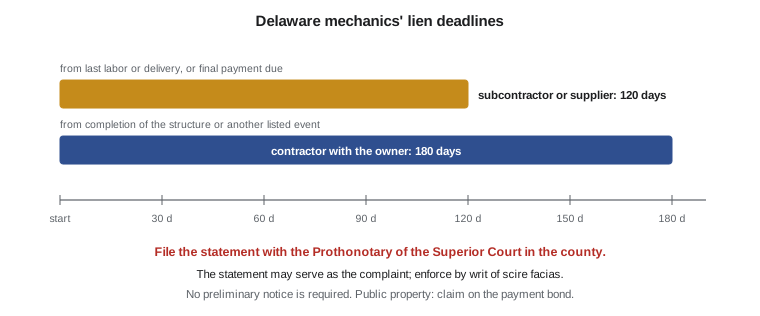
Delaware does not require a preliminary notice to the owner before a lien can be filed, which sets it apart from many states. The tradeoff is that the deadlines are firm and the statement must be complete. Kent Meadow's strip center claim was a subcontractor claim, so it had 120 days from the last day its crew worked on the job. Gail counted from the date of the last inspection-related correction, the last real work the crew did, and filed on day 99.
Filing the statement of claim
Section 2712 says the statement of claim is filed with the Prothonotary of the Superior Court in the county where the structure is located. The statement may also serve as a complaint, so filing it begins the court case. It must contain, in summary, the names of the claimant, the owner or reputed owner and the contractor, and whether the claimant contracted with the owner, the owner's agent or the contractor; the amount claimed, with a bill of particulars if the price was not fixed by contract or a copy of the contract and amendments if it was; the dates the work started and finished, or for a contractor the completion date and the event relied on; the location and a description of the structure; a statement that the labor or materials were furnished on the credit of the structure; and a statement that the amount, which must exceed 25 dollars, has not been paid. The claimant must support it with an affidavit that the facts are true and correct. Section 2713 adds that a claim against several structures owned by the same person must state the amount due on each.
Errors in the statement can defeat the lien. A wrong owner name, a missing affidavit or a description that does not identify the property gives the owner a defense. Many contractors have a construction attorney prepare or review the statement, and the cost is small compared with the claim.
Enforcing the lien
Delaware enforces mechanics' liens through a writ of scire facias, an old form of court order that requires the owner to show why the lien should not be enforced. Under sections 2714 and 2715, the writ is issued and served under the Superior Court's rules; if the structure is occupied as a residence, a copy is left with a resident, and otherwise the sheriff posts it on the structure. Under section 2716, the claimant may obtain a default judgment unless the defendant files an affidavit of defense, and a defendant with a partial defense must state the amount actually owed. Under section 2718, the judgment becomes a lien on the structure and land that relates back to when the labor began or the materials were first furnished, or to the recording of a qualifying first mortgage if that is later. The judgment is executed by a writ of levari facias under section 2719, and if the sale proceeds are not enough, claimants share them ratably under section 2720.
Because the statement serves as the complaint, Delaware has no separate deadline to start a foreclosure suit after filing in the way many states do. The court's own rules govern how fast the case moves, and a claimant who files and then does nothing may see the case dismissed for lack of prosecution.
Owner protections
The statute protects owners in several ways that a contractor should understand. Under section 2705, an owner may demand a list of everyone who furnished labor or material on the job. A contractor or subcontractor that does not provide the list within ten days receives no further payments until it does and loses the chapter's lien protections. Under section 2723, an owner may withhold from the contractor the amount needed to cover subcontractors' liens, which is what happened on the strip center. Under section 2729, an owner may discharge a lien by depositing the amount claimed with the court or posting approved security, after paying the undisputed portion, and the court may award damages of up to twice the disputed amount if the lien was grossly overstated. That last rule is a reason never to pad a lien claim.
Section 2706 governs waivers. Granting credit or taking a note does not waive a lien unless the note is accepted as payment or the lien is expressly waived. Advance waivers of lien rights, signed before the work is done or paid for, are void as against public policy. Written waivers given with or after payment, and agreements to subordinate or release a lien after it is filed, are allowed. Delaware does not prescribe statutory waiver forms, so a contractor should read each waiver it signs to see what payment and period it covers.
The owner-occupied residence rule
Section 2707 gives homeowners a strong protection. No lien attaches to a residence used solely as the owner's residence if the owner has made full or final payment to the contractor in good faith. Before or with that payment, the contractor must give the owner either a notarized certification that all labor and materials have been paid for, or signed releases of liens from all potential claimants with a notarized certification that they are all of them. A contractor who fails to provide this can have its licenses suspended or revoked.
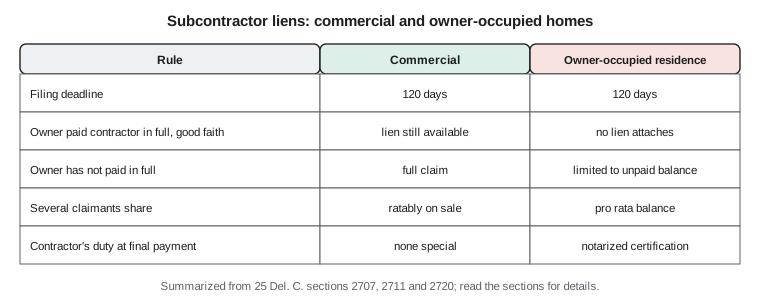
If the owner has not paid in full in good faith, the lien is limited to the unpaid balance the owner still owes the contractor, and that balance is shared pro rata among the claimants who perfect their liens. Payments the owner makes after being served with the writ are not in good faith. For an electrical subcontractor on a custom home, the lesson is clear: once the homeowner pays the builder in full, the lien right is gone, so a subcontractor that is not being paid must move quickly and check how much the homeowner still owes.
The Building Construction Payments Act
Chapter 35 of Title 6, the Building Construction Payments Act, works alongside the lien law. It treats payments to a contractor as trust funds that must first pay subcontractors and suppliers, and failing to pay lawful claims within thirty days after receiving the funds is prima facie evidence of misuse, which can carry a fine of up to 1,000 dollars, up to three years in prison or both. Under section 3506, owner contracts must require payment within thirty days after the billing period, and contractor contracts must require payment to subcontractors within thirty days out of what the contractor receives. Section 3507 says that if the contract does not set subcontractor payment terms, the prime contractor must pay within fifteen days after it is paid. Late payments carry interest at the legal rate, compounded each thirty days.
The Act also controls disputes. Under section 3508, a party that disputes an invoice must give written notice within seven days of receiving it and identify the disputed items, or the invoice is deemed accepted. Withholding retainage or other amounts requires written notice of the reason within seven days of the payment due date. Section 3507(e) voids contract terms that shift the risk of the owner's nonpayment to the subcontractor, waive the subcontractor's right to sue until the prime is paid, or require disputes to be governed by another state's law. Some sections do not apply to public works, to contracts for six or fewer residential units built at once, or to single-unit residential alteration or repair, so check the exclusions before relying on them.
| Rule | Building Construction Payments Act |
|---|---|
| Owner pays contractor | Within 30 days after the billing period |
| Contractor pays subcontractor, terms in contract | Within 30 days, out of amounts received |
| No subcontractor terms in contract | Within 15 days after the contractor is paid |
| Dispute an invoice | Written notice within 7 days, or the invoice is accepted |
| Late payment | Interest at the legal rate, compounded each 30 days |
Public work and payment bonds
Public property cannot be liened. On a state, school district or municipal project, an unpaid electrical subcontractor's remedy is the contractor's payment bond, required on larger public works contracts by Chapter 69 of Title 29. A claimant must follow the bond's notice and suit requirements, which can be short, so a subcontractor on a public job should read the bond as soon as it gets the subcontract. Public works in Delaware may also carry prevailing wage requirements, which Lesson 10's discussion of the Department of Labor touches on.
Common mistakes
MistakeWaiting for the general contractor's promised payment past 120 days.
InsteadA subcontractor's statement must be filed within 120 days of its last work.
MistakeFiling a lien for a tenant's fit-out without the owner's written consent.
InsteadSection 2722 requires the owner's prior written consent.
MistakeSigning a waiver of lien rights before starting work.
InsteadAdvance waivers are void, but do not rely on that to sign careless documents.
MistakeLiening a home after the owner paid the builder in full in good faith.
InsteadSection 2707 bars the lien on an owner-occupied residence in that case.
MistakePadding the lien amount to gain leverage.
InsteadSection 2729 allows damages up to twice the disputed amount for a grossly overstated lien.
# Delaware lien deadlines from a last-work date (illustrative)
from datetime import date, timedelta
last_work = date(2025, 3, 14)
print("Subcontractor statement due by:", last_work + timedelta(days=120))
completion = date(2025, 3, 28)
print("Contractor statement due by:", completion + timedelta(days=180))Subcontractor statement due by: 2025-07-12 Contractor statement due by: 2025-09-24
Summary and key terms
- Anyone furnishing more than 25 dollars of labor or materials may claim a lien under section 2702.
- Contractors who contract with the owner file within 180 days of completion; others within 120 days of their last work or delivery.
- The statement is filed with the Prothonotary of the Superior Court in the county and may serve as the complaint; enforcement is by scire facias.
- No lien attaches to an owner-occupied residence if the owner paid the contractor in full in good faith.
- Advance lien waivers are void; grossly overstated liens can cost up to twice the disputed amount.
- The Building Construction Payments Act sets 30-day and 15-day payment terms, a 7-day dispute notice and trust fund duties.
- Statement of claim
- The document filed with the Prothonotary to claim a mechanics' lien.
- Prothonotary
- The clerk of the Superior Court in each Delaware county.
- Scire facias
- The writ used to enforce a mechanics' lien, requiring the owner to show cause.
- Levari facias
- The writ used to execute a lien judgment by sale of the property.
- Trust funds
- Construction payments that the Building Construction Payments Act requires to be used first to pay subcontractors and suppliers.
Practice problems
Work each problem on paper first, then reveal the answer to check.
Kent Meadow's last day of work as a subcontractor was June 2. When is its statement due?
Show answer
Within 120 days, by September 30.
Where is the statement filed for a job in Kent County?
Show answer
With the Prothonotary of the Superior Court in Kent County.
Must Kent Meadow send the owner a preliminary notice before filing?
Show answer
No. Delaware does not require a preliminary notice.
The contract sets no subcontractor payment terms. When must the prime pay Kent Meadow?
Show answer
Within fifteen days after the prime is paid.
Can Kent Meadow lien a public school?
Show answer
No. It must use the payment bond.
Lesson quiz · 5 questions
Score 60% or more to complete this lesson.
Create a free account to save your progress, take quizzes and earn a certificate.