
MELU-208 · Lesson 10 of 12 · 20 min
Workplace safety law and OSHA for electrical contractors
▶ Video coming soon A video version of this lesson is on the way.
On a humid August afternoon in 2024, a second-year apprentice on a Kent Meadow crew stepped off a stepladder in a Dover warehouse, caught his heel and broke his wrist. It was a routine injury by construction standards, but it set several legal clocks running at once. Russ had to make sure the apprentice got care, decide whether the injury had to be reported to OSHA, notify the workers' compensation insurer, file the state's first report of injury and record the case on the company's OSHA log. Keisha watched him do it and realized she did not know half the rules. This lesson covers them: who enforces workplace safety for a Delaware contractor, the OSHA standards that matter most to electricians, the federal reporting deadlines, Delaware's workers' compensation law and the new place of NFPA 70E in the state's regulations.
Who enforces safety
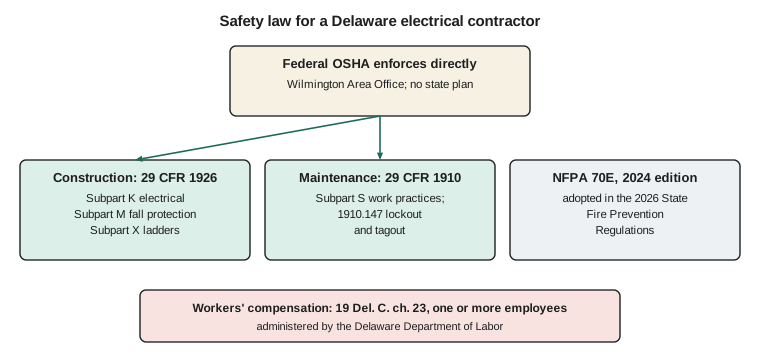
Delaware does not operate a state OSHA plan for private employers. Workplace safety for private contractors is enforced by the federal Occupational Safety and Health Administration through its Wilmington Area Office, which covers private sector employers and workers in New Castle, Kent and Sussex counties. That office inspects job sites, investigates accidents and complaints, and issues citations under the federal standards. Delaware also has an on-site consultation program, run separately from enforcement, that offers free and confidential safety consultations to small businesses. A consultation visit does not lead to citations, and many small contractors use it before a large project.
Other state agencies have roles that touch safety. The State Fire Marshal enforces the fire regulations, which now include NFPA 70E. The Department of Labor administers workers' compensation, labor standards and prevailing wage on public works. The Board of Electrical Examiners can discipline a licensee whose negligent work endangers the public. But for questions about hard hats, ladders, trenching, fall protection and electrical safe work practices on a private job, the agency is federal OSHA.
The OSHA standards that matter most
Two sets of federal standards apply to electrical contractors. The construction standards in 29 CFR Part 1926 apply to construction, alteration and repair work, and Subpart K of Part 1926 covers electrical safety on construction sites: ground-fault protection for temporary power, assured equipment grounding conductor programs where used, and safe work around energized parts. The general industry standards in 29 CFR Part 1910 apply to maintenance and service work in existing facilities, and Subpart S of Part 1910 covers electrical safety-related work practices, including the rule that live parts be de-energized before work unless de-energizing creates greater hazards or is infeasible. The control of hazardous energy standard, 29 CFR 1910.147, known as lockout and tagout, governs servicing and maintenance in general industry.
Beyond the electrical subparts, the standards that cite electrical contractors most often are the general ones: fall protection and ladders, which caught Kent Meadow's apprentice; scaffolds; personal protective equipment; hazard communication for chemicals such as cutting oils and solvents; trenching and excavation for underground services; and the requirement that employers train workers in the hazards of their work. A master should know which standards apply to each kind of job the company does and make sure training records show that crews were taught them.
| Standard | Where it applies | Typical electrical concern |
|---|---|---|
| 29 CFR 1926 Subpart K | Construction sites | Temporary power, GFCI protection, working near energized parts |
| 29 CFR 1910 Subpart S | Existing facilities and maintenance | Safety-related work practices, de-energizing before work |
| 29 CFR 1910.147 | Servicing and maintenance in general industry | Lockout and tagout of hazardous energy |
| 29 CFR 1926 Subparts M and X | Construction sites | Fall protection and ladders |
| NFPA 70E | Workplaces under the fire regulations, and as a consensus standard OSHA relies on | Arc flash and shock risk assessment, PPE, energized work permits |
NFPA 70E in the 2026 regulations
The 2026 edition of the State Fire Prevention Regulations, effective January 1, 2026, adopted NFPA 70E, Standard for Electrical Safety in the Workplace, 2024 edition, for the first time. NFPA 70E is not an OSHA standard, but OSHA has long treated it as the recognized consensus standard for how to meet the general duty and Subpart S requirements on electrical hazards. Its core tools are the electrically safe work condition, risk assessments for shock and arc flash, approach boundaries, labeling and personal protective equipment selection, and energized electrical work permits for the rare cases when energized work is justified.
For a Delaware master, the adoption means NFPA 70E is now part of the state's fire regulations as well as the industry's safety practice. Kent Meadow already trained its crews in 70E because its commercial customers required it. After January 2026, Keisha updated the company's written electrical safety program to reference the 2024 edition and reviewed the energized work permit form with every foreman.
Reporting serious injuries to OSHA
Federal rule 29 CFR 1904.39 requires every employer to report the most serious work injuries to OSHA directly, whether or not the employer is otherwise required to keep injury records. A work-related fatality must be reported within eight hours of the employer learning of it. A work-related inpatient hospitalization, amputation or loss of an eye must be reported within twenty-four hours. Reports can be made by phone to the area office, to OSHA's central number or online.
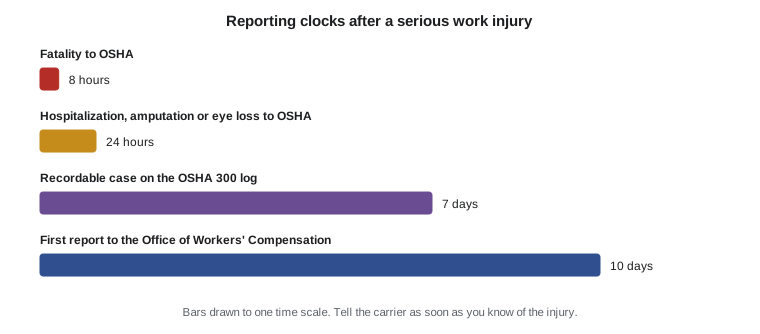
The broken wrist did not need to be reported to OSHA directly: it was treated in an emergency room and the apprentice went home the same day, so there was no inpatient hospitalization. But it was a recordable case, because it involved medical treatment beyond first aid and restricted the apprentice's work. Employers that must keep OSHA records enter recordable cases on the OSHA 300 log within seven calendar days of learning of them, and post the annual summary from February through April. Construction contractors with more than ten employees at any time in the prior year generally must keep the log, and Kent Meadow, with eleven people, does.
Workers' compensation in Delaware
Delaware's workers' compensation law is in Chapter 23 of Title 19. The Department of Labor's guidance says employers with one or more employees must carry workers' compensation insurance through a licensed carrier or an approved self-insurance program. For a contractor the requirement also has a second edge: as Lesson 8 explained, the Division of Revenue will not issue a contractor business license without proof of workers' compensation coverage.
When an employee is hurt, the employer's duties are prompt and specific. The Department of Labor tells employers to file the first report of injury with the insurance carrier as soon as they become aware of the injury, and to file the first report of occupational injury or disease with the Office of Workers' Compensation within ten days of being notified. The employee should notify the employer immediately. An employee's petition for benefits must generally be filed within two years from the date of the accident, or within one year from the diagnosis of an occupational disease. Filing a first report does not admit fault; it is a record that an injury was reported.
| Clock | Deadline | Source |
|---|---|---|
| Fatality to OSHA | 8 hours | 29 CFR 1904.39 |
| Inpatient hospitalization, amputation or eye loss to OSHA | 24 hours | 29 CFR 1904.39 |
| Recordable case on the OSHA 300 log | 7 calendar days | 29 CFR 1904.29 |
| First report to the carrier | As soon as the employer is aware | Department of Labor guidance |
| First report to the Office of Workers' Compensation | Within 10 days of notice | Department of Labor guidance |
| Employee's petition | 2 years from accident; 1 year from occupational disease diagnosis | Department of Labor guidance |
Employees and independent contractors
Construction is an industry where misclassifying workers as independent contractors is a recurring problem, and Delaware has a specific law aimed at it in the construction trades, the Workplace Fraud Act in Chapter 35 of Title 19. In general terms, it presumes that a person performing services for a construction contractor is an employee unless the contractor can show the person meets the statute's tests for an independent contractor or a sole proprietor, and it provides penalties for misclassification. This course does not set out the tests or the penalty amounts; read the statute or the Department of Labor's guidance before treating any worker as a contractor.
The electrical licensing law points the same way. Section 1423 requires a business to verify licenses and report unlicensed workers, and the Board's insurance rules assume licensed electricians work either as employees covered by the employer's policy or independently with their own. A master who calls his crew independent contractors to avoid workers' compensation premiums risks penalties under the labor laws, trouble with the Division of Revenue license and liability when someone is hurt.
Worked problem
The broken wrist
An apprentice falls from a stepladder and breaks his wrist. He is treated in the emergency room and released the same day, and returns to light duty the next week. Which reports are due?
Show solution
- OSHA direct report: not required, because there was no fatality, inpatient hospitalization, amputation or eye loss.
- OSHA 300 log: the injury involved medical treatment and restricted work, so it is recordable; enter it within seven calendar days.
- Workers' compensation carrier: report as soon as the employer is aware.
- Office of Workers' Compensation: file the first report within ten days of notice.
Answer: Log the case within seven days, notify the carrier at once and file the state first report within ten days. No direct OSHA report is required.
Common mistakes
MistakeCalling a Delaware state OSHA office about a private jobsite.
InsteadDelaware has no state plan for private employers; federal OSHA's Wilmington Area Office enforces.
MistakeReporting a hospitalization to OSHA three days later.
InsteadInpatient hospitalizations must be reported within twenty-four hours.
MistakeSkipping workers' compensation for a two-person shop.
InsteadDelaware requires coverage for employers with one or more employees.
MistakeTreating the crew as independent contractors to save premiums.
InsteadThe Workplace Fraud Act targets misclassification in construction; check its tests.
MistakeIgnoring NFPA 70E because it is not an OSHA rule.
InsteadThe 2026 fire regulations adopted the 2024 edition, and OSHA relies on it as the consensus standard.
# Reporting clocks from the time an employer learns of an injury (illustrative)
from datetime import datetime, timedelta
learned = datetime(2026, 8, 13, 15, 30)
print("Fatality report due by:", learned + timedelta(hours=8))
print("Hospitalization report due by:", learned + timedelta(hours=24))
print("OSHA 300 log entry due by:", (learned + timedelta(days=7)).date())
print("State first report due by:", (learned + timedelta(days=10)).date())Fatality report due by: 2026-08-13 23:30:00 Hospitalization report due by: 2026-08-14 15:30:00 OSHA 300 log entry due by: 2026-08-20 State first report due by: 2026-08-23
A written safety program
Federal OSHA does not require every contractor to have a single written safety program, but many standards require written elements, such as a hazard communication program, an energy control program for servicing in general industry and training records. General contractors and commercial owners usually require a written program before a subcontractor starts work. Kent Meadow's program has sections on electrical safe work practices under NFPA 70E, lockout and tagout, ladders and fall protection, temporary power and ground-fault protection, personal protective equipment, hazard communication, injury reporting and return to work.
Keisha's job as a future master is to make the program real on site. That means toolbox talks at the start of each job, checking that every energized work permit is justified and signed, inspecting ladders and cords, and making sure every new hire is trained before working near energized equipment. A program that sits in a binder does not prevent injuries or satisfy an OSHA inspector who asks a crew member how the company handles lockout.
Summary and key terms
- Federal OSHA's Wilmington Area Office enforces safety for private employers in Delaware; there is no state plan.
- 29 CFR 1926 Subpart K and 1910 Subpart S are the core electrical standards; lockout and tagout is 1910.147.
- The 2026 fire regulations adopted NFPA 70E, 2024 edition.
- Report fatalities to OSHA within 8 hours and inpatient hospitalizations, amputations and eye losses within 24 hours.
- Employers with one or more employees must carry workers' compensation; file the first report with the Office of Workers' Compensation within 10 days.
- The Workplace Fraud Act addresses misclassification of construction workers.
- State plan
- An OSHA-approved state program that enforces workplace safety in place of federal OSHA; Delaware has none for private employers.
- Recordable case
- A work injury or illness that must be entered on the OSHA 300 log.
- NFPA 70E
- The consensus standard for electrical safety in the workplace, adopted in Delaware's 2026 fire regulations.
- First report of injury
- The employer's report of a work injury to its carrier and to the Office of Workers' Compensation.
- Lockout and tagout
- Procedures under 29 CFR 1910.147 for controlling hazardous energy during servicing.
Practice problems
Work each problem on paper first, then reveal the answer to check.
Which OSHA office covers Delaware?
Show answer
The Wilmington Area Office.
How soon must an amputation be reported to OSHA?
Show answer
Within twenty-four hours.
How soon must the employer file the state first report of injury?
Show answer
Within ten days of being notified.
How long does an injured worker generally have to file a petition after an accident?
Show answer
Two years.
Does a two-employee contractor need workers' compensation?
Show answer
Yes. Employers with one or more employees must carry it.
Lesson quiz · 5 questions
Score 60% or more to complete this lesson.
Create a free account to save your progress, take quizzes and earn a certificate.