
MELU-208 · Lesson 6 of 12 · 20 min
Permits, inspections and the inspection authority
▶ Video coming soon A video version of this lesson is on the way.
Electricians who move to Delaware from other states often ask the same question in their first week: where do I pull the electrical permit? The answer surprises them. For the electrical inspection itself, there is no city or county electrical inspector to call. Delaware requires electrical work to be inspected by a private electrical inspection agency licensed by the Board of Electrical Examiners, and the contractor chooses the agency. The town or county may still issue a building permit for the project, and some towns publish their own electrical permit applications, but the electrical inspection and the approval that lets the utility energize a service come from the agency. This lesson covers how that system works, the deadlines in sections 1420 and 1421, the rules agencies must follow and how a master should manage inspections on every job.
The basic rule
Section 1420(a) of Chapter 14 says all electrical work in Delaware must receive a certificate of inspection from an electrical inspection agency licensed by the Board, unless the work is specifically exempt. Regulation 705's electrical chapter says the same from the fire safety side: it covers all occupancies, including one- and two-family dwellings, requires all electrical conductors and wiring to be inspected, and requires the inspection and approval to happen before occupancy. The agency must be approved by the Board and recognized by the State Fire Marshal.
The exemptions are narrow. Section 1419 lists who may do electrical work without a Delaware license, such as certain in-plant engineers and technicians, the Department of Transportation on its own signals and drawbridges, regulated utilities on their own plant, persons working on agricultural structures beyond a main of 200 amperes or less, and homeowners under section 1417. Exemption from licensing is not the same as exemption from inspection: the agricultural exemption, for example, says the section 1420 inspection rules still apply to new installations, and homeowners must obtain a final inspection of their work.
The deadlines
Sections 1420 and 1421 set four clocks that every master should know.
| Clock | Deadline | Section |
|---|---|---|
| Inspection application | Within 5 working days after the work begins | 1420(b) |
| Agency inspects | Within 5 working days of receiving the application | 1420(c) and 1421(f) |
| Certificate of approval | Within 15 days after the final inspection | 1421 |
| Correcting violations | Within 15 days, reinspected by the same agency | 1421(g) |
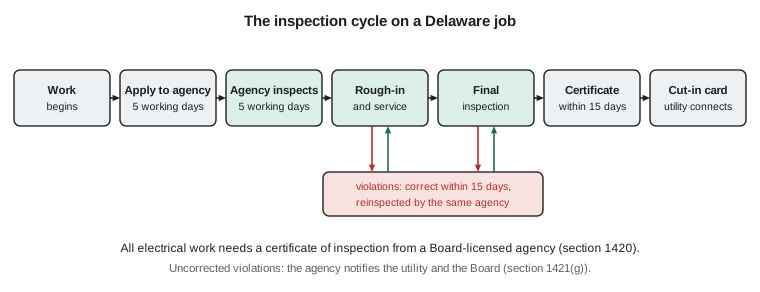
The first clock is the one contractors miss. The application to the agency is due within five working days after the work begins, not after the work is finished and not when the contractor gets around to it. A job that starts on a Monday needs its application in by the following Monday. Kent Meadow's practice is to file the application before the crew arrives, so the clock never becomes an issue.
The second clock binds the agency. Once it receives the application, it must perform the inspection within five working days. In practice an agency schedules several visits on a larger job: an underground or slab inspection where needed, a rough-in inspection before walls are closed, a service inspection and a final. The agency's reports tell the contractor what passed and what must be corrected.
The third and fourth clocks deal with the end of the job. After the final inspection, the agency must issue a certificate of approval within fifteen days. If the agency finds violations, the contractor must correct them within fifteen days, and the same agency must reinspect. The rule that the same agency reinspects prevents a contractor from shopping a failed job to a different agency in hopes of a friendlier result.
The utility and the cut-in card
Section 1420(d) gives the inspection system its teeth. A power company may not connect power to a property without a permanent or temporary cut-in card from an inspection agency. A temporary card allows construction power or a temporary service; a permanent card follows a passed service inspection. There is an exception for emergencies, when a licensed electrician may restore service first and arrange the inspection afterward.
Section 1421(g) adds the enforcement step. If violations are not corrected, the agency must notify the utility and the Board, and the utility must not provide service until the violation is corrected. The utility in most of Delaware is Delmarva Power, but municipal utilities such as Dover's and cooperatives such as Delaware Electric Cooperative serve parts of the state, and each has its own service requirements on top of the cut-in card. Kent Meadow keeps each utility's current service guide in its job binder.
Who the agencies are and what they must do
The State Fire Marshal publishes a list of licensed electrical inspection agencies. The list dated 2024 named eight: American Inspection Agency, Bay Area Inspection Agency, Building Inspection Underwriters, Code Solutions International, Eagle Inspection Agency, First State Inspection Agency, Middle Department Inspection Agency and United Inspection Agency. Agencies are added and dropped, so check the current list before choosing one.
Section 1421 sets strict rules for the agencies themselves, and an exam can ask about them. An agency must be licensed by the Board and have at least one office in Delaware serving all three counties. Its inspectors need at least seven years of wiring experience and must pass exams in one- and two-family dwelling, general electrical and plan review inspection. A new agency may receive conditional approval for up to six months and must have at least one full-time, nationally certified inspector before it inspects. Owners, officers and employees may not have financial interests in Delaware electrical contracting, electrical equipment manufacturing or sales, or electric utilities. Agencies must carry at least 1,000,000 dollars each in general liability and errors and omissions insurance, and inspectors must be paid salary only, not commissions or bonuses based on volume. Agency licenses renew every year.
| Requirement for agencies | Rule in section 1421 |
|---|---|
| Office | At least one in Delaware, serving all three counties |
| Inspector experience | At least 7 years of wiring experience |
| Inspector exams | One- and two-family dwelling, general electrical and plan review |
| Independence | No financial interest in contracting, equipment or utilities |
| Insurance | 1,000,000 dollars general liability and 1,000,000 errors and omissions |
| Pay | Salary only, no commissions or volume bonuses |
| License term | Renews annually |
The independence and pay rules exist because the contractor chooses and pays the agency. Without them, an agency might be tempted to go easy on a contractor that sends it many jobs. With them, the agency's only business is inspection, and its inspectors have no stake in how many jobs pass.
The contractor's responsibilities
Rule 12.3 of the Board's rules says a licensee who signs an inspection request is responsible for the work it describes. This is one of the most important sentences in the rules for a master. Signing the request is not a formality. It ties the master's license to the work, and if the work is unsafe or the description is false, it is the signer who answers to the Board. Russ signs only for jobs Kent Meadow is actually performing under his supervision, and he reads the scope before he signs.
The master also manages the paperwork: the agency's application, the inspection reports, the certificate of approval, the cut-in card information and any correction notices. Section 1425 lets Division agents visit job sites during business hours without notice to check licenses, and the job file is the first thing an agent or inspector will ask to see. Kent Meadow keeps a copy of every inspection document in the job's folder and scans it into the company's system the same day.
Building permits and local offices
The agency system covers the electrical inspection, but other permits still apply. The county or town where the job sits usually issues a building permit for construction, and the building permit office may want to see proof that the electrical work will be inspected by a licensed agency. Some towns also publish an electrical permit application of their own, as the Town of Odessa does for 2026, to track electrical work within town limits. The Division's and the State Fire Marshal's rules do not replace these local requirements. Before starting in a new jurisdiction, call the town or county permit office and ask what it requires in addition to the agency's inspection.
Larger and specialized jobs bring the State Fire Marshal in directly. Plan review by the Fire Marshal may be required for some occupancies and systems, and the Fire Marshal's office publishes guidance on items such as electrical plans for fire pumps. A master working on a fire alarm, fire pump or other life safety system should check both the agency's requirements and the Fire Marshal's.
Homeowner permits
Section 1417 allows a homeowner to do electrical work in or about the homeowner's own home under a homeowner's permit from the Division. The home must not be for sale or rent, swimming pools and hot tubs are excluded, and the permit is valid for one year. The applicant submits photo identification and a copy of the deed, or for a mobile home the title or contract of sale. Failing to obtain a final inspection is grounds for the Board to cancel the permit. A contractor cannot work under a homeowner's permit, and a master should not let a customer pull one to avoid the contractor's inspection paperwork.
Worked problem
Keeping the clocks
Kent Meadow's crew starts a dental office fit-out in Dover on Tuesday, March 3, 2026. The inspection application has not been filed. The agency receives it on Wednesday, March 11. The final inspection finds two violations on April 20. What deadlines apply?
Show solution
- Application: due within five working days after work began, which is by Tuesday, March 10. Filing on March 11 is one working day late.
- Inspection: the agency must inspect within five working days of receiving the application, by Wednesday, March 18.
- Violations: the contractor must correct them within fifteen days of April 20, by May 5, and the same agency must reinspect.
- Certificate: after a passing final, the agency must issue the certificate of approval within fifteen days.
Answer: The application was late; file before work starts next time. Corrections are due by May 5 and must be reinspected by the same agency.
Common mistakes
MistakeCalling the county for an electrical inspection.
InsteadElectrical inspections are done by Board-licensed private agencies.
MistakeFiling the inspection application at the end of the job.
InsteadIt is due within five working days after work begins.
MistakeSending a failed job to a different agency.
InsteadViolations must be reinspected by the same agency.
MistakeAsking the utility to connect without a cut-in card.
InsteadThe utility may not connect without the agency's card, except in an emergency.
MistakeSigning inspection requests for work the master does not supervise.
InsteadRule 12.3 makes the signer responsible for the described work.
Choosing and working with an agency
Because the contractor chooses the agency, the choice is a business decision. Kent Meadow uses two agencies for most of its work and chooses between them by location, scheduling and the inspector's familiarity with the type of job. A pole barn in Sussex County and a medical office in New Castle County may go to different agencies. Whatever agency it uses, Kent Meadow treats the inspector as a partner in getting the job right: the crew is on site at the scheduled time, the work is ready, the panel schedules are filled in and the job's drawings are available.
A master should also understand what an agency cannot do. It cannot design the installation, cannot waive a code requirement the regulations impose and cannot ignore a violation because the contractor is a good customer. If a master disagrees with an inspector's reading of the code, the right path is to ask for the code section in writing, discuss it with the agency's chief inspector and, if needed, raise it with the Board or the State Fire Marshal. Arguing on site or moving the job to another agency is not an option, because the same agency must reinspect.
Summary and key terms
- All electrical work needs a certificate of inspection from a Board-licensed agency unless exempt.
- Apply within 5 working days after work begins; the agency inspects within 5 working days.
- The certificate of approval issues within 15 days after the final; violations are corrected within 15 days and reinspected by the same agency.
- The utility may not connect without a cut-in card, except in an emergency.
- Agencies must be independent, insured for 1,000,000 dollars in each of two coverages, and pay inspectors salary only.
- Under Rule 12.3, the licensee who signs the inspection request is responsible for the work.
- Certificate of inspection
- The agency's document showing electrical work has passed inspection.
- Certificate of approval
- The agency's approval issued within fifteen days after a passing final inspection.
- Cut-in card
- The agency's authorization, permanent or temporary, for the utility to connect power.
- Homeowner's permit
- A one-year permit under section 1417 for a homeowner's own work on a home not for sale or rent.
- Working day
- A business day, used for the application and inspection clocks.
Practice problems
Work each problem on paper first, then reveal the answer to check.
Who chooses the inspection agency?
Show answer
The contractor or owner, from the Board-licensed agencies.
Can the utility energize a new service without a cut-in card?
Show answer
No, except in an emergency when a licensed electrician restores service.
What insurance must an agency carry?
Show answer
At least 1,000,000 dollars in general liability and 1,000,000 dollars in errors and omissions.
Who reinspects corrected violations?
Show answer
The same agency that found them.
How long is a homeowner's permit valid?
Show answer
One year.
Lesson quiz · 5 questions
Score 60% or more to complete this lesson.
Create a free account to save your progress, take quizzes and earn a certificate.