
MELU-208 · Lesson 2 of 12 · 20 min
Eligibility for the Master Electrician License
▶ Video coming soon A video version of this lesson is on the way.
Keisha's first question to Russ was simple: do I qualify yet? Russ did not know the answer offhand. He had earned his own master license almost thirty years earlier under rules that have since been rewritten several times. So the two of them sat down with section 1408 of Chapter 14 and the Division's application page and worked through it line by line. This lesson follows that reading. It covers the three experience routes to the master license, the character requirements every applicant must meet, how experience and education are proved, how the master compares with the other license classes and how applicants licensed in other states may qualify by reciprocity.
The knowledge requirement
Section 1408(a)(1) begins with a requirement that is easy to skim past: a master electrician applicant must have knowledge of the electrical trade in residential, commercial and industrial work. That breadth is what separates the master from the limited electrician, whose license is built on residential knowledge, and from the special licenses, which are built on one specialty. The exam tests the breadth, as Lesson 4 shows, but the experience rules expect it too. An applicant who has spent every year in single-family homes will meet the hour count but may struggle with the motors, services and special occupancies on the exam. Keisha's years on commercial and agricultural jobs, with residential service work mixed in, are the kind of record the statute has in mind.
Three experience routes
Section 1408(a)(1) then gives three ways to meet the experience requirement. The Division's application page summarizes them the same way.
| Route | Experience | Education or training |
|---|---|---|
| A | Six years of full-time work under the supervision of a licensed master electrician | None required beyond the experience |
| B | 8,000 hours of work under a licensed master electrician | Plus 576 hours of related classroom instruction, or a certificate of completion from an approved apprenticeship |
| C | Four years of work under a licensed master electrician | Plus two years of technical training, shown by an official transcript |
The routes trade time on the job against time in a classroom. Route A asks only for experience, but a lot of it: six years of full-time work. Route B is the apprenticeship route. 8,000 hours is about four years of full-time work at 2,000 hours a year, and 576 hours of instruction is about the classroom load of a four-year registered apprenticeship at 144 hours a year. Route C trades two years of field work for two years of technical training, such as a two-year electrical technology program, documented by an official transcript.
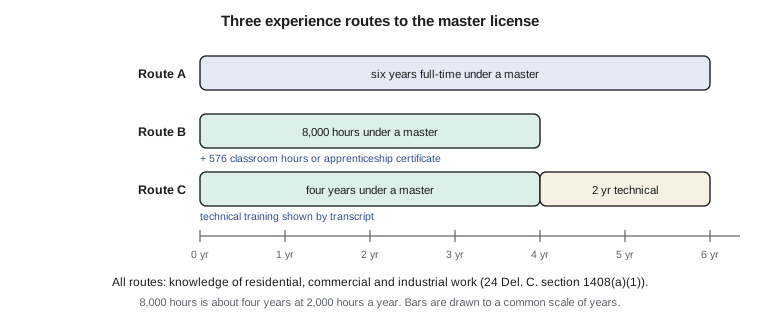
In every route the experience must be under a licensed master electrician. That phrase matters. Work done under a journeyperson's direction on a job where no master was responsible may not count, and work done in a state without licensing may need extra proof. The safest records are those signed by the master who supervised the work, and the Division's process is built around exactly that, as the section on proof explains below.
Worked problem
Keisha's routes
Keisha started as an apprentice in 2015, completed a four-year registered apprenticeship in 2019 and has worked full time under Russ, a licensed master, ever since. Which routes does she meet?
Show solution
- Route A needs six years of full-time work under a master. Her work from 2015 to late 2026 under Russ is more than eleven years, so she meets it if Russ verifies it.
- Route B needs 8,000 hours under a master plus 576 classroom hours or an apprenticeship certificate. Her apprenticeship alone logged about 8,000 hours, and she holds the certificate of completion.
- Route C needs two years of technical training with a transcript. She does not have that, so it does not apply.
Answer: She meets Routes A and B. She will apply under Route B because the apprenticeship certificate is the simplest proof, and include Russ's verification to show the full record.
What full-time and supervised mean in practice
Neither the statute nor the Board's rules give a long definition of full-time work, so the Board judges each record. The Board's rule for apprentice progress gives a useful benchmark: for an apprentice who is not registered with the Department of Labor, Rule 7.2.3.1 expects 144 classroom hours a year over four years and 2,000 hours of on-the-job training a year, for 8,000 hours in all. An applicant whose record shows something close to 2,000 hours a year under a master is on solid ground. Part-time work, seasonal work and long gaps should be explained on the forms.
Supervision is a separate question. Section 1422 requires apprentices to work under direct onsite supervision by a licensed electrician, and the supervising electrician is responsible for the apprentice's work. For master eligibility, what matters is that a licensed master was responsible for the work the applicant did. Keisha's records are clean because Russ was the master on every job she worked and signed her apprenticeship paperwork each year.
The character requirements
Experience is not the whole test. Sections 1408(a)(9) through (13) add conditions that apply to every license class. In summary, an applicant must not have unresolved disciplinary matters in Delaware or elsewhere, must not have had a license in another jurisdiction revoked or suspended without it being restored, must not be impaired in a way that affects safe practice, and must not have a criminal conviction substantially related to electrical work. The statute lets the Board waive some convictions, other than sexual offenses, if it finds the applicant does not pose an unreasonable risk to public safety. The application asks about each of these, and a false answer is itself a ground for discipline under section 1412.
These questions rarely stop an applicant, but they can delay one. An applicant with an old conviction or an out-of-state license issue should gather court records or the other state's orders before applying, so the Board can decide at its first review rather than tabling the application for a later meeting.
Proving experience and education
Section 1408(b) and (c) require experience to be documented on the Board's affidavit forms and education to be certified by the institution. The Division's application page explains how this works in DELPROS. An applicant who completed a registered or approved apprenticeship uploads the certificate of completion. Otherwise, the applicant submits a Verification of Employment form for each employer, and the supervisor must submit the form directly, not hand it to the applicant. For Route C, an official transcript showing two years of technical training is required. Forms that need a supervisor's signature, a seal or a notary may have to be mailed unless the form itself says it can be uploaded.
This is where many applications stall. A supervisor who has retired, moved out of state or closed the business can be hard to find. Keisha has one advantage: she has worked for one master the whole time. An applicant with several employers should start collecting forms early and keep copies of pay stubs, apprenticeship records and job lists in case a supervisor cannot be reached.
Common mistakes
MistakeAsking the supervisor to give the signed Verification of Employment to the applicant to upload.
InsteadThe supervisor submits the form directly to the Division, as the application page requires.
MistakeCounting hours worked under a journeyperson with no master responsible.
InsteadThe master routes count work under a licensed master electrician.
MistakeAssuming a two-year technical program alone qualifies.
InsteadRoute C still needs four years of work under a master.
MistakeLeaving an old out-of-state license problem off the application.
InsteadThe application asks about discipline elsewhere, and a false answer is a ground for discipline.
How the master compares with the other classes
Understanding the other classes helps on exam questions and in planning a career. The limited electrician license, in section 1408(a)(2), requires residential knowledge plus either three years of work under a licensed master or limited electrician, or 4,000 hours under one plus 288 hours of instruction or an apprenticeship certificate. The special licenses in sections 1408(a)(3) and (4) follow the same patterns but require experience in the specialty, with six years or 8,000 hours plus 576 hours at the master special level and three years or 4,000 hours plus 288 hours at the limited special level. The journeyperson license in section 1408(a)(5) requires the applicant to be at least twenty and either to complete a Board-approved apprenticeship that includes a final examination or to have more than 8,000 hours of full-time electrical work under a licensed master, master special, limited or limited special electrician. The residential electrician license in section 1408(a)(6) requires a residential exam plus either more than 4,000 hours of full-time electrical work or an approved residential apprenticeship.
| License | Experience in brief | Classroom or training |
|---|---|---|
| Master | 6 years, or 8,000 hours, or 4 years | None, or 576 hours or apprenticeship, or 2 years technical training |
| Limited | 3 years, or 4,000 hours | None, or 288 hours or apprenticeship |
| Master special | 6 years, or 8,000 hours, in the specialty | None, or 576 hours in the specialty or apprenticeship |
| Limited special | 3 years, or 4,000 hours, in the specialty | None, or 288 hours or apprenticeship |
| Journeyperson | Approved apprenticeship with final exam, or more than 8,000 hours | Age 20 or older |
| Residential | More than 4,000 hours, or residential apprenticeship | Residential exam |
Look at what the table implies. A journeyperson who finished an apprenticeship already meets the hours for Route B of the master license, so in Delaware the step from journeyperson to master is largely a matter of passing the master exam and carrying the insurance. That is one reason the Delaware master exam deserves serious preparation: it is the main gate.
The rules also limit what a limited electrician may do. Rule 3.4.4 says a limited electrician may not supervise apprentices or journeypersons on commercial or industrial work. A residential contractor whose owner holds a limited license and who wants to bid a commercial job needs a master.
Reciprocity
Section 1409 lets the Board license an applicant who holds a license in another state with standards substantially similar to Delaware's. The Division's application page lists Maryland and New Jersey as substantially similar, so an applicant licensed as a master in either state does not need to submit separate proof of experience. For several other states, the page asks for a Verification of Employment showing at least five years of experience after licensure. Reciprocity applicants still go through DELPROS, still answer the character questions and still need the liability insurance before a license issues. The list of states changes, so check the current page.
Reciprocity runs the other way too. A Delaware master who wants to work in Pennsylvania, Maryland or New Jersey must meet that state's or locality's rules. Lesson 11 returns to this.
Keisha's eligibility checklist
By the end of their reading, Keisha and Russ had a short checklist: the apprenticeship certificate of completion, Russ's Verification of Employment covering 2015 to the present sent directly to the Division, a list of major jobs showing residential, commercial and industrial work, clean answers to the character questions, and a plan to obtain a liability certificate in her own name once she passed. Lesson 3 turns that checklist into an application.
# Checking Keisha's hours against Route B (illustrative records)
apprenticeship_hours = {2015: 1980, 2016: 2050, 2017: 2010, 2018: 1990}
classroom_hours = {2015: 144, 2016: 144, 2017: 144, 2018: 144}
field = sum(apprenticeship_hours.values())
school = sum(classroom_hours.values())
print("Field hours under a master:", field, "needed 8000:", field >= 8000)
print("Classroom hours:", school, "needed 576:", school >= 576)Field hours under a master: 8030 needed 8000: True Classroom hours: 576 needed 576: True
Summary and key terms
- A master applicant needs knowledge of residential, commercial and industrial work.
- Route A is six years of full-time work under a licensed master.
- Route B is 8,000 hours under a master plus 576 classroom hours or an apprenticeship certificate.
- Route C is four years under a master plus two years of technical training shown by transcript.
- Supervisors send Verification of Employment forms directly; apprentices upload their certificate.
- Section 1409 allows reciprocity; the Division lists Maryland and New Jersey as substantially similar.
- Route B
- The master route of 8,000 supervised hours plus 576 instruction hours or an apprenticeship certificate.
- Verification of Employment
- The Division's form on which a supervisor confirms an applicant's experience, sent directly by the supervisor.
- Limited electrician
- A Delaware license for residential work, below the master level.
- Substantially similar
- The reciprocity standard in section 1409 for licenses from other states.
- Character requirements
- The conditions in section 1408(a)(9) to (13) on discipline, impairment and convictions.
Practice problems
Work each problem on paper first, then reveal the answer to check.
An applicant has five years under a master and a two-year technical diploma. Which route?
Show answer
Route C, which needs four years under a master plus two years of technical training.
Who sends the Verification of Employment?
Show answer
The supervisor, directly to the Division.
Can a limited electrician supervise a journeyperson on a commercial job?
Show answer
No. Rule 3.4.4 forbids it.
What minimum age does section 1408 set for the journeyperson license?
Show answer
Twenty.
A Maryland master applies by reciprocity. Must she send experience proof?
Show answer
The Division lists Maryland as substantially similar, so experience proof is not required; she still needs insurance and a complete application.
Lesson quiz · 5 questions
Score 60% or more to complete this lesson.
Create a free account to save your progress, take quizzes and earn a certificate.