
MELU-208 · Lesson 12 of 12 · 20 min
Practice exam review and test-day strategy
▶ Video coming soon A video version of this lesson is on the way.
Six weeks before her planned test date in February 2027, Keisha will sit down at the kitchen table on a Saturday morning, set a timer for three hours and take her first full 80-question practice exam with her tabbed code book, her handbook and a four-function calculator. That is the plan she and Russ have built, and this lesson explains why each piece of it is there. A practice exam is not just a score. Used well, it is a map of what to study next. This lesson covers how to set up realistic practice, how to review every missed question with an error log, how to use the content outline to decide where to spend the remaining weeks, how to pace a timed open book exam with a three-pass method and what to do in the days before and the morning of the test.
Practice under real conditions
Practice is only useful if it resembles the exam. The Delaware master exam, as the June 2025 bulletin describes it, has 80 questions in three hours, is open book with a limited list of references, allows only permanent tabs, highlighting and pen underlining, and allows only a simple four-function calculator. Keisha's practice sessions follow the same rules: the same books with the same tabs, no notes in the margins, the same cheap calculator, a three hour timer and no phone. She takes the full-length practice tests at the same time of day she expects to test, so her concentration is used to the hour.
Short, untimed practice still has a place, especially early. Working through a set of twenty load calculation questions with the book open and no clock builds the method. But the last month before the exam should include at least three full timed practice exams, spaced a week or more apart, so that pacing, fatigue and the feel of the clock are not surprises.
The source of practice questions matters. The vendor's bookstore sells an official practice exam, listed at 25 dollars in the June 2025 bulletin, and commercial prep books and online banks offer many more. Questions written to the wrong edition of the code are worse than no questions, because they train the wrong answers. Before using a question bank, check which edition it is written to and match it to the edition your bulletin names.
The error log
After each practice exam, the score is the least useful number. The useful information is why each question was missed. Keisha keeps an error log with one line for every missed or guessed question, sorted into five causes: did not know the rule; knew the rule but could not find it in time; misread the question; made a calculation error; and ran out of time. Each cause has a different cure.
| Cause | What it looks like | The cure |
|---|---|---|
| Did not know | Never seen the rule or concept | Study the article, then do ten questions on it |
| Could not find | Knew it existed but lost time in the book | Add or fix a tab; practice index lookups |
| Misread | Answered for a dwelling when the question said commercial, or missed a word like minimum | Underline conditions in your head; read twice |
| Calculation | Right method, wrong arithmetic or wrong constant | Write each step; check units; practice on the four-function calculator |
| Time | Left blank or guessed at the end | Use the three-pass method; skip long questions on the first pass |
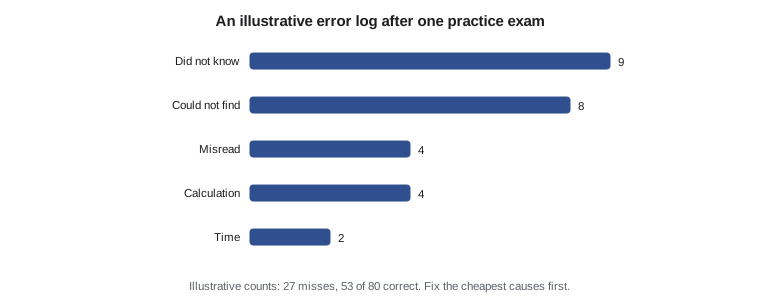
The illustrative log in the figure shows a common pattern for an experienced journeyperson: most misses are not from ignorance but from lookups that took too long and from misreading. Those are the cheapest misses to fix. Two weeks of tab work and index drills can turn most of the eight could-not-find misses into correct answers, and each question on an 80-question exam is worth one and a quarter points.
Using the outline to plan the last weeks
Lesson 4 showed the master exam's content outline: 19 questions on general electrical knowledge, 15 on wiring and protection, 15 on wiring methods and materials, 7 on motors and controls, and smaller numbers on equipment for general use, plan reading, special conditions, special equipment, special occupancies and communication systems. Combined with the error log, the outline tells Keisha where each hour of study is worth the most.
The method is simple. For each area, estimate how many questions she is missing per practice exam. Multiply by how easily those misses could be fixed. Spend the next week on the area with the largest product. If she misses four of the fifteen wiring methods questions and most are could-not-find misses, wiring methods comes first. If she misses two of the four special occupancies questions and they are did-not-know misses on Article 517, that is real but smaller, and it goes later in the plan.
# Where to study next: misses per area times how fixable they are (illustrative)
areas = {
    "General knowledge": (4, 0.6),
    "Wiring and protection": (3, 0.7),
    "Wiring methods": (4, 0.8),
    "Motors and controls": (3, 0.7),
    "Special occupancies": (2, 0.5),
}
ranked = sorted(areas.items(), key=lambda kv: kv[1][0] * kv[1][1], reverse=True)
for name, (misses, fixable) in ranked:
print(f"{name}: expected gain {misses * fixable:.1f} questions")Wiring methods: expected gain 3.2 questions General knowledge: expected gain 2.4 questions Wiring and protection: expected gain 2.1 questions Motors and controls: expected gain 2.1 questions Special occupancies: expected gain 1.0 questions
The three-pass method
With 180 minutes for 80 questions, the average is two and a quarter minutes per question. Some questions take twenty seconds and some take six minutes. The three-pass method protects the easy points first. On the first pass, answer every question you can answer from memory or with one quick lookup, and flag the rest; this pass should take about an hour. On the second pass, return to the flagged questions that need a lookup or a short calculation and work them. On the third pass, take on the long calculations and the questions that still seem hard, and make sure every question has an answer before time runs out, because a blank is always wrong.
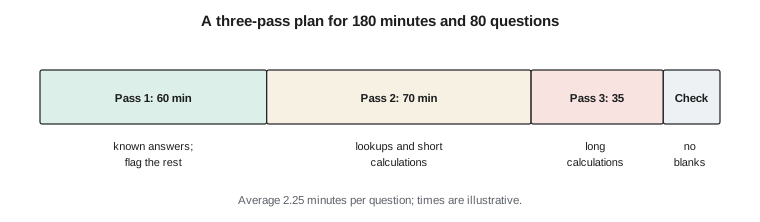
The computer-based format supports this. The candidate can flag questions and move among them, and the screen shows which questions are unanswered. Keisha practices the method on every timed practice exam so that on test day she does not have to think about it.
| Pass | Time | What to do |
|---|---|---|
| First | About 60 minutes | Answer from memory or one quick lookup; flag the rest |
| Second | About 70 minutes | Lookups and short calculations on flagged questions |
| Third | About 35 minutes | Long calculations and remaining hard questions |
| Check | Last 15 minutes | Make sure every question has an answer |
Lookup technique
The fastest lookups start with the right chapter. A question about conductors in a raceway starts in Chapter 3, a question about a motor branch circuit in Article 430, a question about a swimming pool in Article 680, a question about a hospital in Article 517. The index is the next tool: look up the key noun, not the verb, and look for the most specific entry. The tabs Keisha placed in Lesson 4 are designed for the outline's heaviest areas. When a lookup takes more than two minutes on the first pass, she flags it and moves on.
Calculation questions reward a consistent method. Write the formula, put in the numbers with their units, compute on the four-function calculator, and check that the answer is reasonable. A 75 kVA transformer at 208 volts three-phase has a full-load current around two hundred amperes, not two thousand. Most calculation errors on exams are dropped constants, such as forgetting the 1.732 for three-phase, or a misplaced decimal.
The days before and the morning of
The last week is for review, not new material. Keisha will take her last full practice exam about a week before the test, review the error log one last time, and spend the final days on short drills in her weakest areas. She will check her books against the bulletin's rules: no handwritten notes, no movable tabs, no sticky notes, no photocopies. She will confirm the test site, the time and the identification the bulletin requires, and drive the route to the Dover site once so there are no surprises.
On the morning of the test, she will eat, arrive early with her books, her calculator and her identification, and let the administrator check the books. In the room, she will read the first question twice and start the first pass. If she meets a question she cannot answer, she will flag it and move on. If she finishes early, she will check flagged questions and unanswered ones, not change answers she was confident in without a clear reason.
If the first attempt falls short
Failing the exam once is common and recoverable. The score report shows performance by area, which goes straight into the error log. The bulletin allows a retake after seven days, and for most electrician candidates it sets no limit on retakes. A candidate who fails twice and scores within ten points of passing may request a review session. Keisha's plan in Lesson 1 included a month for a possible retake, and section 1408(f) gives her twelve months after passing to submit insurance and the license fee, so a retake does not threaten the timeline.
Worked problem
Planning the final six weeks
Keisha's first full practice exam score is 66. That is 53 of 80 correct. Her error log shows 9 did-not-know, 8 could-not-find, 4 misread, 4 calculation and 2 time misses, 27 in all. How should she spend the six weeks?
Show solution
- She needs 75, which is 60 of 80 questions, so she must gain seven questions.
- The eight could-not-find misses are the cheapest: two weeks of tab and index work.
- The four misread and four calculation misses respond to method practice on every set.
- The nine did-not-know misses need targeted study in the areas the outline weights heavily.
- Two more timed practice exams, three weeks and one week before the test, will measure progress.
Answer: Weeks 1 and 2: tabs and index drills. Weeks 3 and 4: content study on the weakest high-weight areas. Weeks 5 and 6: timed practice and light review.
Common mistakes
MistakePracticing with notes in the book margins.
InsteadPractice with books that meet the bulletin's rules, so test day is the same.
MistakeLooking only at the practice score.
InsteadLog why each question was missed and fix the cause.
MistakeSpending the last week on new topics.
InsteadUse the last week for review and short drills.
MistakeLeaving hard questions blank.
InsteadAnswer every question; a blank is always wrong.
MistakeUsing a question bank written to the wrong edition.
InsteadMatch practice materials to the edition the bulletin names.
Keeping the plan realistic
Study plans fail most often because they ask for more hours than a working electrician has. Keisha works full days running crews and has a family. Her plan asks for about six hours a week: two weeknight sessions of an hour and a half and a three-hour Saturday session. The Saturday session is where the full practice exams go. The weeknights are for short sets of questions in the area the error log says needs work. If a week goes badly, the plan has room to catch up the following week, and the month allowed for a possible retake in Lesson 1 gives a second cushion.
Russ helps in a practical way. Once a week he gives her five questions from his own experience, the kind of real situations the code covers, and asks her to find the answer in the book while he watches the clock. The habit of finding answers quickly under mild pressure is exactly what the exam rewards.
Summary and key terms
- Practice under the exam's real conditions: 80 questions, three hours, approved books, four-function calculator.
- Keep an error log sorted by cause: did not know, could not find, misread, calculation, time.
- Combine the content outline and the error log to decide where to study next.
- Use three passes: answer what you know, then lookups, then long calculations, and leave nothing blank.
- Spend the last week on review; check books against the bulletin's rules.
- A failed attempt can be retaken after seven days, with no limit for most electrician candidates.
- Error log
- A record of missed practice questions sorted by the cause of each miss.
- Three-pass method
- A pacing method that answers easy questions first and hard ones last.
- Flag
- A marker on a computer-based exam question to return to it later.
- Content outline
- The bulletin's list of question counts by subject area.
- Review session
- A post-exam session allowed after two failures within ten points of passing.
Practice problems
Work each problem on paper first, then reveal the answer to check.
How many minutes per question on average does the master exam allow?
Show answer
2.25 minutes.
What is the cheapest kind of miss to fix?
Show answer
Could-not-find misses, fixed with tabs and index practice.
When should the last full practice exam be?
Show answer
About a week before the test.
How soon may a candidate retake after failing?
Show answer
After at least seven days.
What should a candidate do with a question she cannot answer on the first pass?
Show answer
Flag it and move on.
Lesson quiz · 5 questions
Score 60% or more to complete this lesson.
Create a free account to save your progress, take quizzes and earn a certificate.