
MELU-208 · Lesson 11 of 12 · 20 min
Renewal and continuing education
▶ Video coming soon A video version of this lesson is on the way.
Russ has renewed his master license fifteen times. The renewal itself takes a few minutes in DELPROS. What takes planning is everything behind it: ten hours of approved continuing education with half of it on the code, a liability certificate with his name on it, and the knowledge that if his name comes up in the Board's random audit, he will have to prove both. He told Keisha that the single most common way good electricians lose their licenses is not discipline but a missed renewal. This lesson covers the Delaware renewal cycle, the continuing education rules, the audit, late renewal and reinstatement, inactive status, the new rules for apprentice licenses and what a Delaware master needs to work in neighboring states.
The renewal cycle
Delaware electrician licenses renew every two years on a fixed statewide cycle. Rule 7.1 of the Board's rules says renewal is due by June 30 of even-numbered years, and licenses expire on July 1 if not renewed. The continuing education page describes full licensure periods as running from July 1 to June 30 of even-numbered years, such as 2024 to 2026. The current period runs from July 1, 2026 to June 30, 2028, so the next renewal deadline for every master is June 30, 2028.
Section 1411(b) says biennial renewal requires proof of insurance and continuing education. Rule 7.2 makes renewal the licensee's own responsibility and says the Board does not send expiration reminders. The Division usually sends courtesy emails, but a licensee who has not updated an email or mailing address may never see them, and the deadline does not move. Kent Meadow puts every license's renewal date on the company calendar with reminders at ninety, sixty and thirty days.
Continuing education hours
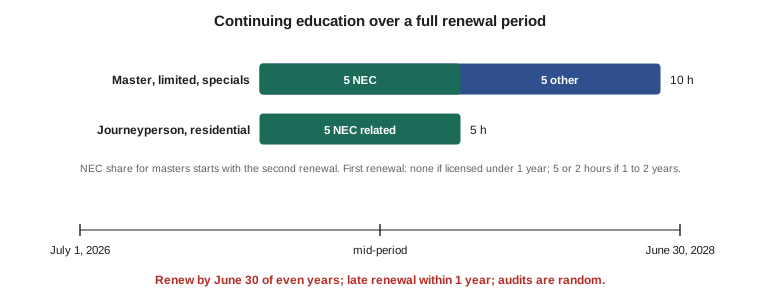
Rule 8.3 sets the hours for masters, master specials, limited electricians and limited specials. Over a full renewal period, they must complete ten hours of Board-approved continuing education. Beginning with the second renewal, five of those ten hours must be on the National Electrical Code. A licensee who was licensed less than one year before the first renewal needs no continuing education for that renewal. A licensee licensed between one and two years before the first renewal needs five hours.
| License | Licensed under 1 year | Licensed 1 to 2 years | Full renewal period |
|---|---|---|---|
| Master, master special, limited, limited special | None | 5 hours | 10 hours, 5 on the NEC from the second renewal |
| Journeyperson, residential, apprentice | None | 2 hours | 5 hours, NEC related |
Rule 8.4 sets the hours for journeypersons, residential electricians and apprentices: five hours over a full period, NEC related, with the same reduced amounts for the first renewal. Enrollment in a Board-approved apprenticeship counts toward continuing education for the period in which the training was completed, so most apprentices meet the requirement through their classes.
Worked problem
Keisha's first renewal
Suppose Keisha's master license issues in March 2027. The renewal deadline is June 30, 2028. How many hours of continuing education will she need for her master license at that first renewal?
Show solution
- The license issues in March 2027 and the first renewal is June 30, 2028.
- That is more than one year but less than two years before the renewal.
- Rule 8.3.2 requires five hours for a licensee licensed between one and two years.
- The NEC requirement begins with the second renewal, so the five hours need not be NEC hours, though NEC courses are a sensible choice.
Answer: Five hours for the 2028 renewal; ten hours, five on the NEC, for the 2030 renewal.
Keisha's journeyperson license raises a practical question. When her master license issues, the master becomes the license she renews, and the master's continuing education rules apply to it. If she needs to keep a journeyperson license active for any reason, she should ask the Division how the two interact rather than assume.
Approved courses and the rules for credit
Rule 8.2 requires courses to be approved by the Board, and the Division posts the list of approved courses on its website. A provider asks for approval by submitting a course outline, the instructor's resume and a fee at least sixty days before the course, and approvals expire every three years on September 1. A licensee should check that a course is on the approved list before paying for it, because hours from an unapproved course do not count.
Rule 8.1 adds three limits. Continuing education is due by June 30 of the renewal year. Extra hours do not carry over to the next period, so a licensee who takes twenty hours in one period still needs ten in the next. And retaking the same course within the same period earns no additional credit. Rule 8.3.3 allows a master to count time spent preparing and presenting an approved NEC course, which suits experienced masters who teach apprentice classes. Rule 8.5 lets the Board waive continuing education or accept partial completion on a written, documented request based on hardship.
| Rule | What it says |
|---|---|
| 8.1 | Due by June 30 of the renewal year; no carryover; no extra credit for a repeated course in the same period |
| 8.2 | Courses must be Board approved; providers apply at least 60 days ahead; approvals expire every 3 years on September 1 |
| 8.3.3 | A master's preparation and presentation of an approved NEC course may count |
| 8.5 | Hardship waiver or partial completion on written, documented request |
The audit
The Board audits renewals at random. Rule 7.2.1 and the Division's audit page say a licensee selected for audit must verify the required bond and liability insurance, the continuing education completed and any other information the Board requests. The Division's page is direct about one point: do not upload continuing education documentation into DELPROS unless you are notified that you have been selected. When selected, the licensee uploads a certificate of attendance for each course entered in the DELPROS tracker. Active masters and limited electricians must also show proof of at least 300,000 dollars in general liability insurance covering the audited period.
The audit is why good records matter. A certificate lost in a truck is worth nothing when the audit letter arrives. Gail keeps a folder for each licensed electrician at Kent Meadow with every certificate of attendance and each year's insurance certificate, and she scans them as they come in. An audit that would take a careless licensee weeks to answer takes her an hour.
Late renewal, expiration and reinstatement
Rule 7.3 lets a licensee renew within one year after the June 30 deadline by paying a late fee, and late renewals are audited for continuing education and insurance. During the late period the license is expired, so the licensee may not work under it until it is renewed. Rule 7.7 says that a license expired for more than one year cannot simply be renewed. The person must reapply as a new applicant and pass the exam, unless the person previously passed an approved NEC-based test.
The consequences reach the business. If Russ's license expired, Kent Meadow would have lost its license holder, and section 1418 would require notice to the Board within seven days. A missed renewal can put a company's work at risk as quickly as a resignation.
Inactive status
Rule 7.5 lets a licensee who is not working in Delaware place the license on inactive status by written request. An inactive license renews every two years by attesting to continuing education completion. To reactivate, the licensee submits a written request, proof of insurance and the fee. Rule 7.6 is the important limit: a licensee on inactive status may not work as a licensed electrician in Delaware. Inactive status suits a master who moves out of state for a few years or takes a job outside the trade and wants to come back without retesting.
Apprentice licenses after July 1, 2026
Section 1411(b), as amended, changed the rules for apprentice licenses. Apprentice licenses issued on or after July 1, 2026 expire five years after issue. Apprentice licenses issued before that date with less than five years of validity are extended to five years from issue, and those with five or more years cannot be renewed past expiration. In each case, the Board may grant one-year extensions for good cause if the request is made at least sixty days in advance. School apprentice licenses do not need renewal. For a master who employs apprentices, the change means tracking each apprentice's license end date and pushing apprentices to finish their programs on time.
Working in other states
A Delaware license is valid only in Delaware. Many Delaware contractors also work in Maryland, Pennsylvania and New Jersey, each of which handles electrical licensing differently. Maryland licenses master electricians at the state level through its State Board of Master Electricians. New Jersey licenses electrical contractors at the state level through its Board of Examiners of Electrical Contractors. Pennsylvania has no statewide electrician license, and licensing is local, with Philadelphia and other cities running their own programs. Each state sets its own rules for reciprocity or endorsement.
From the Delaware side, section 1409 and the Division's application page show which states Delaware treats as substantially similar, and the list includes Maryland and New Jersey. That does not mean those states treat Delaware licenses the same way in return. Before bidding work across a state line, a master should check that state's current rules and expect to apply, pay fees and possibly test there.
# Tracking continuing education for the 2026-2028 period (illustrative)
courses = [("2023 NEC changes, part 1", 4, True), ("2023 NEC changes, part 2", 4, True), ("Business and law update", 2, False)]
total = sum(h for _, h, _ in courses)
nec = sum(h for _, h, n in courses if n)
print("Total hours:", total, "| NEC hours:", nec)
print("Meets 10 hours with 5 NEC:", total >= 10 and nec >= 5)Total hours: 10 | NEC hours: 8 Meets 10 hours with 5 NEC: True
Common mistakes
MistakeWaiting for a renewal reminder from the Board.
InsteadRule 7.2 says the Board does not send reminders; renewal is the licensee's job.
MistakeUploading every certificate to DELPROS at renewal.
InsteadUpload only if notified of selection for audit.
MistakeBanking extra hours for the next period.
InsteadHours do not carry over.
MistakeWorking on a license during the late renewal period.
InsteadAn expired license may not be used until renewed.
MistakeAssuming a Delaware license works in Maryland.
InsteadEach state licenses separately; check its rules first.
Choosing continuing education that helps
Continuing education is a requirement, but it can also be an advantage. Keisha plans to use her first period's hours on courses about the 2023 code changes, because those are the changes the crews meet every day and the ones inspectors cite most. In later periods, she intends to mix code courses with courses on topics Kent Meadow is growing into, such as energy storage, electric vehicle charging and photovoltaic systems. The Board's approved list includes classroom and online courses; she will check each course's approval and hours before she pays for it.
She will also record each course in the DELPROS tracker as she completes it, rather than all at once in June of the renewal year. That way, if she is selected for audit, the list of courses already matches the certificates in her folder.
Finally, she will keep her contact details current. Rule 1.5 requires a change of address to be reported by certified mail within sixty days, and renewal notices, audit letters and continuing education confirmations all depend on the Division having the right address and email. A licensee who moves house in the middle of a renewal period should update the record the same week, not wait for the next renewal.
Summary and key terms
- Licenses renew by June 30 of even-numbered years and expire July 1; the next deadline is June 30, 2028.
- Masters and limited electricians need 10 hours per period, 5 on the NEC from the second renewal; journeypersons need 5.
- Courses must be Board approved; hours do not carry over and repeated courses earn no extra credit.
- Audits are random; selected masters must show their continuing education and 300,000 dollars of liability coverage.
- A license may be renewed late within one year; after more than a year the person reapplies and tests unless an exception applies.
- Inactive licensees may not work; apprentice licenses issued on or after July 1, 2026 expire after five years.
- Renewal period
- The two-year period ending June 30 of an even-numbered year.
- Continuing education
- Board-approved courses required for renewal.
- Audit
- A random check of a licensee's continuing education and insurance.
- Inactive status
- A license held without the right to work, renewable by attesting to continuing education.
- Late renewal
- Renewal within one year after the deadline, with a late fee and an audit.
Practice problems
Work each problem on paper first, then reveal the answer to check.
When is the next renewal deadline for Delaware masters?
Show answer
June 30, 2028.
How many of a master's ten hours must be on the NEC from the second renewal?
Show answer
Five.
A master's license expired fourteen months ago. Can he renew with a late fee?
Show answer
No. After more than one year he must reapply and pass the exam unless he previously passed an approved NEC-based test.
Should Keisha upload her course certificates at renewal?
Show answer
Only if she is selected for audit.
May an inactive master supervise a job?
Show answer
No. Inactive licensees may not work as licensed electricians in Delaware.
Lesson quiz · 5 questions
Score 60% or more to complete this lesson.
Create a free account to save your progress, take quizzes and earn a certificate.