
MELU-208 · Lesson 7 of 12 · 20 min
Duties and responsibilities of the Master Electrician License holder
▶ Video coming soon A video version of this lesson is on the way.
A few years ago, a former Kent Meadow foreman who had started his own small company called Russ with an offer. His new business had plenty of work but no master, and he wanted to list Russ as the company's license holder for a monthly fee. Russ would not need to visit the jobs; the foreman would handle everything. Russ said no in about ten seconds. When Keisha asked him later why he was so quick, he walked her through the duties that come with a Delaware master license and the ways a master can lose it. This lesson covers those duties: what the license authorizes, how it ties a person to a business, the supervision rules, the records and signage the Board requires, the deadlines when a business loses its license holder, and the grounds and procedures for discipline.
A license in the individual's name
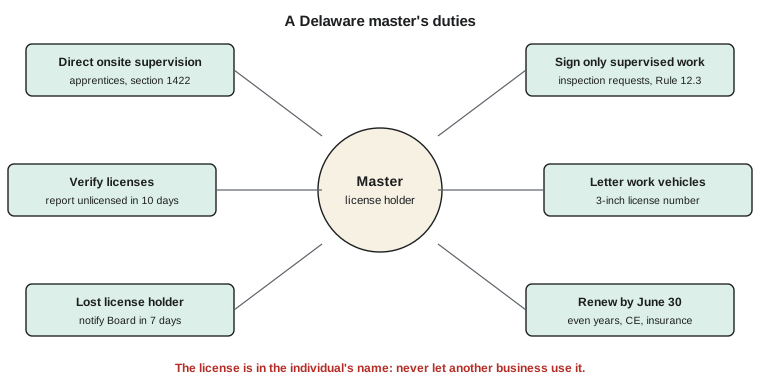
Rule 2.1 of the Board's rules says applications must be filed in the individual's name, not a company's. A Delaware master license belongs to the person who earned it. The person may work for a business, own a business or both, but the license does not transfer with the business and cannot be sold, rented or lent. When a master leaves, the license leaves too.
That is why the foreman's offer was dangerous. A master whose name is used to cover work he does not supervise is responsible for that work under the Board's rules, because his license is the one on the paperwork. Rule 12.3 makes a licensee who signs an inspection request responsible for the work described. Section 1412 lists grounds for discipline that include obtaining a license by fraud, incompetent or negligent work, practicing outside the licensed category and violating the chapter or the rules. A master who lets an unsupervised business work under his license risks all of them, plus the liability that follows any accident on a job he never saw. Delaware's statute and rules do not use the phrase license lending in the way some states do, but the duties they impose leave no room for it.
What the master license authorizes
The master license is the broadest Delaware license. Its holder may perform and supervise residential, commercial and industrial electrical work, sign inspection requests for that work, and serve as the license holder a business relies on. The limited license, by contrast, is built on residential work, and Rule 3.4.4 forbids a limited electrician from supervising apprentices or journeypersons on commercial or industrial work. The special licenses are limited to their specialty. A master who takes on work outside the scope of the license, or who lets a limited or special licensee take on work beyond theirs, risks discipline for practicing outside the licensed category.
Supervising apprentices and crews
Section 1422 says apprentices and school apprentices must work under the direct onsite supervision of a licensed electrician, and lists the licenses that may supervise: master, master special, limited, limited special, residential and journeyperson. The supervising electrician is responsible for the apprentice's work. Direct onsite supervision means the licensed electrician is on the same job, available to direct and check the work, not reachable by phone from another site.
Neither section 1422 nor the Board's rules set a numeric ratio of apprentices to licensed electricians, which is unusual; many states set one-to-one or one-to-two. The absence of a number does not mean any ratio is acceptable. A licensed electrician who cannot actually watch and direct every apprentice on the site is not providing direct onsite supervision, and if an apprentice's work is unsafe, the supervisor answers for it. Registered apprenticeship programs and federal apprenticeship standards may also set their own ratios that bind participating employers. Kent Meadow's practice is two apprentices at most per licensed electrician on any site, and one to one on service changes and energized work.
The rules also keep apprentices moving forward. Rule 7.2.3.1 sets a progress benchmark for apprentices not registered with the Department of Labor: 144 classroom hours a year over four years and 2,000 on-the-job hours a year, for 8,000 hours in total. Rule 7.2.3.2 lets the Board terminate an apprentice license if the apprentice fails to maintain progress without good cause. A master who employs apprentices should track their hours and classes as carefully as the apprentices do.
Verifying licenses and reporting unlicensed workers
Section 1423 puts a duty on every business that does electrical work. The business must verify that a person holds the proper license before allowing that person to do electrical work, and must report to the Board, within ten days, any unlicensed person it finds doing electrical work for it. For a master who runs crews, this means checking every new hire's license in the Division's online lookup before the first day, keeping a copy in the personnel file and checking again when licenses come up for renewal.
The check matters because section 1424 makes unlicensed electrical work a misdemeanor, with fines of 500 to 1,500 dollars for a first offense and 1,500 to 2,300 dollars for later offenses, and section 1425 lets Division agents visit work sites during business hours without notice to check. An agent who finds an unlicensed worker on a Kent Meadow job will ask why the company did not catch it.
| Duty | Deadline or detail | Source |
|---|---|---|
| Verify licenses before work | Before the person does electrical work | Section 1423 |
| Report unlicensed workers | Within 10 days | Section 1423 |
| Report change of address | By certified mail within 60 days | Rule 1.5 |
| Vehicle lettering | "Licensed Electrician" and license number, at least 3 inches tall | Rule 1.3 |
| Loss of license holder | Written notice to the Board within 7 days | Section 1418 |
| Renewal | By June 30 of even-numbered years | Rule 7.1 |
Vehicles and addresses
Rule 1.3 requires vehicles used for electrical work to show the words Licensed Electrician and the license number on the exterior, in letters and numbers at least three inches tall. A recognized abbreviation such as Lic. Elec. is acceptable. Journeyperson, residential and apprentice electricians are exempt from the lettering rule, so it falls on masters, limited electricians and the special licenses, whose licenses businesses rely on. Kent Meadow's trucks carry Russ's number; when Keisha is licensed, Gail plans to add hers to the service vans she supervises.
Rule 1.5 requires licensees to report a change of address by certified mail within sixty days. Rule 7.2 adds that renewal is the licensee's responsibility and the Board does not send reminders. A master who moves and forgets to update the address may miss renewal notices from other sources, audit letters and discipline notices, and still be held to every deadline.
When a business loses its license holder
Section 1418 is the rule every owner of an electrical business should know by heart, because it decides whether the business survives the loss of its master. If a business loses its license holder through death, departure, retirement or any other reason, it must notify the Board in writing, with supporting documentation, within seven days. The Board must schedule an emergency meeting within ten days. Until that meeting, the business may continue to operate without a license holder if it keeps the same personnel, minus the license holder.
At the meeting, the Board may issue a temporary license valid for one hundred days from the date of the business's notification. The temporary license ends early when the Board receives the examination results of the person who will become the new license holder. If the hundred days run out without a licensed person in place, the business must immediately stop all work that requires a license. Rules 9.1 and 9.2 add that temporary practice is allowed to avoid business interruption, with documentation of the business relationship.
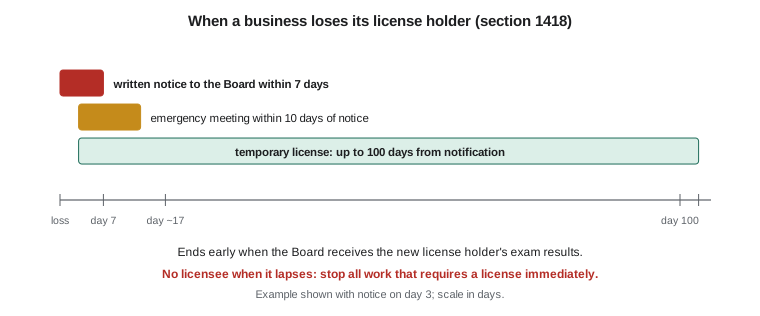
A hundred days is not long. It is enough for a qualified employee who has already applied to sit the exam and pass, but not enough for someone starting from scratch to gather verification forms, wait for Board approval, study and pass. That is the real reason Russ wants Keisha licensed before he steps back: Kent Meadow should never have to rely on section 1418.
Worked problem
The section 1418 clock
Suppose a business's only master retires unexpectedly and the business notifies the Board on day 3. The Board meets on day 11 and issues a temporary license. When does the temporary license end if no exam results arrive?
Show solution
- The notice deadline is seven days, so notice on day 3 is on time.
- The temporary license runs one hundred days from the date of notification, day 3.
- One hundred days from day 3 is day 103.
- If no licensed person is in place by then, all work requiring a license must stop immediately.
Answer: The temporary license ends on day 103, or earlier if the Board receives the new license holder's exam results.
Grounds for discipline
Section 1412 lists the grounds on which the Board may discipline a licensee. In summary they include fraud or deceit in obtaining a license; illegal, incompetent or negligent conduct in the practice of the trade; work outside the category the license covers; conviction of a crime substantially related to electrical work; misuse of drugs or alcohol affecting practice; consumer fraud; violation of the chapter or the Board's rules; and discipline in another jurisdiction on grounds that would justify discipline in Delaware.
Section 1414 sets the sanctions: a letter of reprimand, censure, probation, suspension, revocation and monetary penalties, alone or in combination. The statute sets dollar limits for monetary penalties that vary with the ground, with the most serious grounds, such as fraud in obtaining a license, treated more severely. The current amounts should be read in section 1414 itself before relying on a figure. The Board may also temporarily suspend a license before a hearing when it finds a clear and immediate danger to the public, and such a suspension generally cannot last more than sixty days unless the licensee asks for a continuance.
The process protects the licensee too. Under sections 1412(b) and 1415, no sanction may be imposed without notice and an opportunity to be heard. Hearings follow Delaware's Administrative Procedures Act, and a licensee may appeal the Board's decision to the Superior Court within thirty days.
Common mistakes
MistakeLetting another business use your license for a fee.
InsteadThe license is in the individual's name; the master is responsible for work done under it and risks discipline.
MistakeAssuming no ratio means unlimited apprentices.
InsteadDirect onsite supervision must be real, and programs may set their own ratios.
MistakeDiscovering an unlicensed worker and saying nothing.
InsteadSection 1423 requires a report to the Board within ten days.
MistakeWaiting a month to tell the Board the company's master has left.
InsteadSection 1418 requires written notice within seven days.
MistakeLettering a truck with the company name only.
InsteadRule 1.3 requires Licensed Electrician and the license number, at least three inches tall.
# Section 1418: dates from a notification date (illustrative)
from datetime import date, timedelta
loss = date(2027, 3, 1)
notice_deadline = loss + timedelta(days=7)
notified = date(2027, 3, 4)
temp_license_end = notified + timedelta(days=100)
print("Board notice due by:", notice_deadline, "| notified:", notified, "| on time:", notified <= notice_deadline)
print("Temporary license ends no later than:", temp_license_end)Board notice due by: 2027-03-08 | notified: 2027-03-04 | on time: True Temporary license ends no later than: 2027-06-12
Summary and key terms
- A Delaware master license is in the individual's name and cannot be lent or transferred.
- Apprentices must work under direct onsite supervision of a licensed electrician; no numeric ratio is set in the statute or rules.
- Businesses must verify licenses before work and report unlicensed workers within ten days.
- Work vehicles must show Licensed Electrician and the license number in letters at least three inches tall.
- A business that loses its license holder must notify the Board within seven days; a temporary license may run up to one hundred days.
- Sanctions range from reprimand to revocation and fines; appeals go to the Superior Court within thirty days.
- Direct onsite supervision
- Supervision by a licensed electrician present on the same job, required for apprentices under section 1422.
- License holder
- The licensed master or limited electrician a business relies on to perform electrical work.
- Temporary license
- A Board-issued license of up to one hundred days after a business loses its license holder.
- Section 1423
- The rule requiring businesses to verify licenses and report unlicensed workers within ten days.
- Censure
- A formal Board sanction that is more serious than a reprimand and less serious than suspension.
Practice problems
Work each problem on paper first, then reveal the answer to check.
May Russ list himself as license holder for a business he never visits?
Show answer
No. He would be responsible for work he does not supervise and would risk discipline.
Must a journeyperson's truck show a license number?
Show answer
No. Rule 1.3 exempts journeyperson, residential and apprentice electricians.
How long does a business have to report an unlicensed worker?
Show answer
Ten days.
When does a section 1418 temporary license end early?
Show answer
When the Board receives the exam results of the new license holder.
Where does a licensee appeal a Board decision?
Show answer
To the Superior Court, within thirty days.
Lesson quiz · 5 questions
Score 60% or more to complete this lesson.
Create a free account to save your progress, take quizzes and earn a certificate.