
MELU-208 · Lesson 8 of 12 · 18 min
Contractor licensing, insurance and bonding
▶ Video coming soon A video version of this lesson is on the way.
Every January, Gail Szymanski opens a folder labeled Keep the Doors Open. It holds the documents Kent Meadow needs to operate as a business in Delaware: the Division of Revenue contractor business license, Russ's master license, the certificate of general liability insurance naming him, the workers' compensation policy, the company's surety bond file and a list of the gross receipts filings due through the year. Keisha had never looked inside. When she asked what would change once she was licensed, Gail opened the folder and walked her through it. This lesson follows that walk: the difference between the electrician's license and the business's license, the Division of Revenue contractor license and its conditions, the license fee on gross receipts, the rules for hiring nonresident contractors, the liability insurance the Board requires, and the bonds that public and some private work demand.
Two kinds of license
Delaware separates the person from the business. The Board of Electrical Examiners licenses individuals: masters, limited electricians, journeypersons and the rest. It does not issue a separate electrical contractor license to companies. A business that does electrical work relies on a license holder, the master or limited electrician whose license covers the work, and section 1418 governs what happens if that person leaves, as Lesson 7 explained.
The business itself is licensed for a different purpose by a different agency. Chapter 25 of Title 30 requires every person who does business in Delaware as a contractor to hold a contractor business license from the Division of Revenue. This is a business and tax license, not a test of electrical skill, and it applies to general contractors, subcontractors and trade contractors alike.
The Division of Revenue contractor license
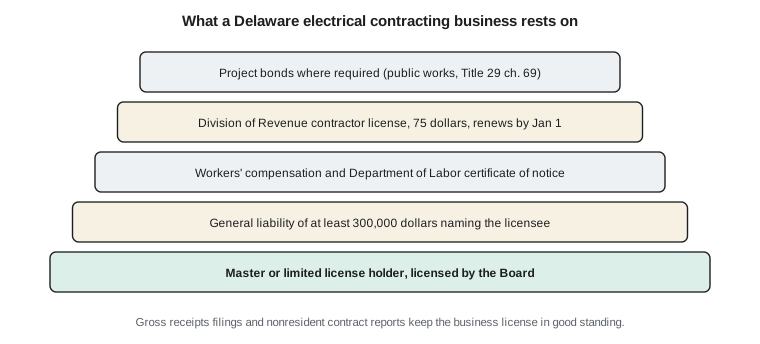
Section 2502(a) of Title 30 sets the main rules. Any person who wants to do business in Delaware as a contractor must apply to the Division of Revenue and pay a 75 dollar fee. The license must be obtained, and proof of compliance made, before or with the execution of a contract. For competitively bid contracts over 50,000 dollars, the application must be started before or with the bid; for a subcontractor, that means before the general contractor submits its bid. The license is valid until January 1 and renews each year for the 75 dollar fee plus the license fee on gross receipts described below.
Section 2502(b) adds conditions that tie the business license to other obligations. The Division may not issue a contractor license until the applicant complies with section 375 of Title 30, files a certificate of notice from the Department of Labor and files proof of workers' compensation insurance or a certificate as a qualified self-insurer. In practice, this means a contractor cannot get its Division of Revenue license without first setting up its unemployment and labor accounts and its workers' compensation coverage. The workers' compensation rules are covered in Lesson 10.
| Item | Rule in 30 Del. C. section 2502 |
|---|---|
| Who needs it | Any person doing business in Delaware as a contractor |
| Fee | 75 dollars, plus the gross receipts license fee |
| When | Before or with executing a contract; before the bid on competitive bids over 50,000 dollars |
| Term | Valid until January 1; renews annually |
| Conditions | Section 375 compliance, Department of Labor certificate of notice, proof of workers' compensation |
The license fee on gross receipts
Delaware has no general sales tax. Instead, it charges businesses a license fee measured on their gross receipts, and contractors pay at the rate set in section 2502(c). Most contractors pay monthly, by the twentieth day of the following month, with a monthly deduction of 100,000 dollars of receipts before the rate applies. A contractor whose taxable gross receipts in the lookback period were 1,500,000 dollars or less pays quarterly instead, with a quarterly deduction of 300,000 dollars. Affiliated businesses under common ownership share a single deduction. The rate and thresholds are adjusted from time to time, so the business should check the Division of Revenue's current figures.
For a master, the point is less the arithmetic than the discipline. A contractor license that lapses because the gross receipts filings fell behind stops the business from signing contracts just as surely as a lapsed electrical license stops it from doing the work. Gail files Kent Meadow's returns monthly and keeps the confirmations in the January folder.
# Illustrative monthly gross receipts calculation with the 100,000 dollar deduction
# (use the current rate published by the Division of Revenue; this rate is illustrative)
rate = 0.006472
months = {"January": 165000, "February": 92000, "March": 210000}
for month, receipts in months.items():
    taxable = max(receipts - 100000, 0)
print(month, "taxable:", taxable, "fee:", round(taxable * rate, 2))January taxable: 65000 fee: 420.68 February taxable: 0 fee: 0.0 March taxable: 110000 fee: 711.92
Hiring nonresident contractors
Chapter 25 also reaches contractors who come from out of state. A resident contractor is one that regularly maintains a place of business in Delaware; a site trailer or a facility used only for one construction contract does not count. Everyone else is a nonresident contractor. Section 2503 requires architects, engineers, contractors and construction managers who contract with a nonresident contractor or subcontractor to send the Department of Finance a statement within ten days after contracting, listing the total contract value and the names and addresses of the parties. The civil penalty for not filing is up to 10,000 dollars per occurrence, and willful noncompliance is a misdemeanor punishable by a fine of up to 3,000 dollars, up to six months in prison or both.
This matters to Kent Meadow whenever it brings in a specialty subcontractor from Maryland or Pennsylvania, such as a fire alarm or controls firm. Before the first payment goes out, Gail files the statement and checks that the subcontractor has its own Division of Revenue license. Older sources describe a surety bond that nonresident contractors once had to post; the current text of Chapter 25 reviewed for this course does not include it, so check with the Division of Revenue before assuming any bond is or is not required.
The Board's insurance requirement
The Board's rules set the insurance an electrician must carry. Rule 6.1 requires licensees other than journeyperson, residential and apprentice electricians to carry general liability coverage of at least 300,000 dollars. Section 1411(a) says a license may issue only on proof of the insurance the Board requires, and section 1411(b) makes proof of insurance a condition of each biennial renewal. The Division's application page adds that the applicant's own name must appear on the insurance document, even if the employer holds the policy.
Rule 6.2 explains how employees are covered. A licensee who works for an employer is covered if the employer insures the work, but a licensee who does independent work, such as side jobs outside the employer's business, must carry separate coverage. Rule 6.3 makes a narrow exception for elevator specialists employed by elevator companies with at least 300,000 dollars of coverage. The insurance must stay in force. The Board audits licensees at random, and Lesson 11 explains that selected masters must show proof of the 300,000 dollar coverage for the audited period.
| License | General liability required by Rule 6.1 |
|---|---|
| Master and master special | At least 300,000 dollars |
| Limited and limited special | At least 300,000 dollars |
| Journeyperson | Not required by Rule 6.1 |
| Residential | Not required by Rule 6.1 |
| Apprentice | Not required by Rule 6.1 |
| Inspection agency | 1,000,000 dollars general liability and 1,000,000 errors and omissions (Rule 15.2) |
Many customers, general contractors and lenders require far more than the Board's minimum. A commercial general contractor may ask for 1,000,000 dollars per occurrence and 2,000,000 dollars aggregate, an umbrella policy, and an additional insured endorsement naming the general contractor and owner. Kent Meadow carries higher limits than the Board requires for that reason. The Board's figure is a floor, not a business plan.
Insurance and bonds are different tools
Insurance and bonds are often confused, and exam questions like to test the difference. General liability insurance protects the contractor against claims by third parties for bodily injury and property damage caused by the contractor's work. Workers' compensation insurance protects the contractor's employees. A surety bond is different: it is a three-party promise in which the surety guarantees the contractor's obligation to someone else, and if the surety pays, the contractor must repay the surety.
| Instrument | Who it protects | Who ultimately pays a claim |
|---|---|---|
| General liability insurance | The contractor, against third-party injury and property damage claims | The insurer, within the policy |
| Workers' compensation | The contractor's employees | The insurer or qualified self-insurer |
| Performance bond | The project owner, if the contractor does not finish the work | The contractor, who must repay the surety |
| Payment bond | Subcontractors and suppliers, if the contractor does not pay them | The contractor, who must repay the surety |
The Board's rules reviewed for this course do not require a license bond from individual electricians, although the Division's audit page refers to required bond and insurance for selected licensees, so confirm whether any bond applies to your license class. Bonds become important on public work. Delaware's procurement law in Chapter 69 of Title 29 requires performance and payment bonds on larger public works contracts, and because public property cannot be liened, the payment bond is how an unpaid subcontractor on a public job gets paid. Lesson 9 covers payment bond claims. Private owners and general contractors may also require bonds by contract. A master who bids public work should talk to a surety agent long before the first bid, because the surety will want financial statements and a work history.
Keisha's changes to the folder
When Keisha is licensed, three things in Gail's folder will change. The liability certificate will add Keisha's name, because the Division requires the licensee's own name on the document. The trucks Keisha supervises will add her license number. And Gail will note Keisha as a second license holder so that, if Russ is ever unavailable, the company does not need a section 1418 temporary license. The Division of Revenue license stays with the company and does not change.
Common mistakes
MistakeExpecting the Board to issue Kent Meadow an electrical contractor license.
InsteadThe Board licenses individuals; the business needs a Division of Revenue contractor license.
MistakeSigning a contract before obtaining the Division of Revenue license.
InsteadThe license must be obtained before or with the execution of a contract.
MistakeBidding a 75,000 dollar competitive job before applying.
InsteadFor competitive bids over 50,000 dollars, apply before or with the bid.
MistakeUsing the employer's policy for side jobs.
InsteadRule 6.2 requires separate coverage for independent work.
MistakeTreating a payment bond as the contractor's insurance.
InsteadA bond protects others, and the contractor must repay the surety.
Insurance certificates in practice
Kent Meadow receives a request for a certificate of insurance almost every week. A general contractor wants to see the liability and workers' compensation coverage before the company starts work, a property manager wants to be named as an additional insured, or a lender's inspector wants proof for the file. Gail keeps a standing arrangement with the company's agent so that certificates can be issued the same day. She checks each certificate before it goes out: the right insured name, the right policy dates, the limits the contract requires and the endorsements the customer asked for.
For the Board, the certificate has one more requirement. The licensee's own name must appear on it. When Keisha is licensed, the certificate the company files with the Board for her will name her, even though the policy belongs to Kent Meadow. If she ever does work outside the company, Rule 6.2 requires her to carry her own policy for that work.
Summary and key terms
- The Board licenses individuals; businesses need a Division of Revenue contractor business license under 30 Del. C. section 2502.
- The contractor license costs 75 dollars plus a gross receipts license fee, must precede the contract and renews by January 1.
- It requires a Department of Labor certificate of notice and proof of workers' compensation.
- Contracts with nonresident contractors must be reported to the Department of Finance within ten days.
- Masters and limited electricians must carry at least 300,000 dollars of general liability insurance in their own name.
- Bonds protect others and are required on larger public works; the contractor repays the surety.
- Contractor business license
- The Division of Revenue license every contractor doing business in Delaware must hold.
- Gross receipts license fee
- Delaware's business license fee measured on a business's gross receipts.
- Nonresident contractor
- A contractor that does not regularly maintain a place of business in Delaware.
- Additional insured
- A party added to a liability policy by endorsement, often required by general contractors.
- Surety
- The company that issues a bond and guarantees the contractor's obligation to others.
Practice problems
Work each problem on paper first, then reveal the answer to check.
Which agency issues a contractor business license in Delaware?
Show answer
The Division of Revenue.
What minimum general liability does Rule 6.1 require of a master?
Show answer
300,000 dollars.
Must a journeyperson carry the 300,000 dollar coverage under Rule 6.1?
Show answer
No. Journeyperson, residential and apprentice electricians are excluded.
Within how many days must a contract with a nonresident contractor be reported?
Show answer
Ten days after contracting.
Who protects a subcontractor on a public job where liens are not allowed?
Show answer
The payment bond.
Lesson quiz · 5 questions
Score 60% or more to complete this lesson.
Create a free account to save your progress, take quizzes and earn a certificate.