
MELU-208 · Lesson 5 of 12 · 19 min
The NEC as adopted in Delaware and state amendments
▶ Video coming soon A video version of this lesson is on the way.
In February 2026, an inspector from the agency Kent Meadow uses for most of its work flagged an item on the Camden clinic rough-in. The rule he cited was in the 2023 edition of the National Electrical Code, and the crew foreman, who had learned on the 2020 edition, had never seen it. Keisha checked the job file. The permit package had been submitted in January 2026, after the new State Fire Prevention Regulations took effect, so the 2023 code applied. The foreman fixed the item the same afternoon, but the episode made a point Keisha has repeated to every crew since: in Delaware, the edition that applies to a job depends on state regulations and dates, not on what the crew is used to. This lesson explains how Delaware adopts the code, what the 2026 regulations changed, how state modifications work and why the exam edition may differ from the field edition.
Statewide adoption through the fire regulations
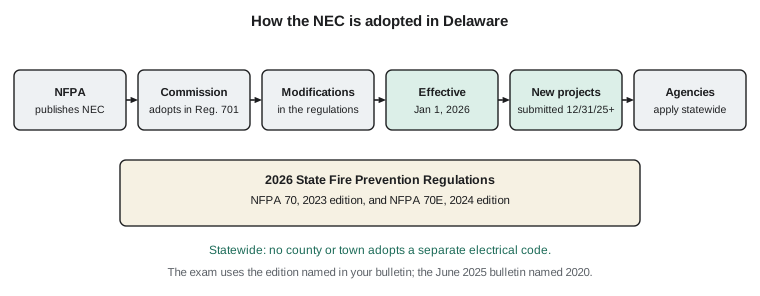
In many states, the electrical code is adopted by a licensing board or a building code council, or by each city and county. Delaware adopts it through the State Fire Prevention Regulations. The State Fire Prevention Commission writes the regulations under Title 16 of the Delaware Code, the Office of the State Fire Marshal enforces them, and they appear in the Delaware Administrative Code in the 700 series of Title 1. Regulation 701 lists the codes and standards the state adopts, and Regulation 705 includes the chapter titled Electrical Inspection Required.
Because the regulations are statewide, the electrical code is the same in Wilmington, Dover and Rehoboth Beach. Counties and towns adopt their own building codes for structural, energy and other matters, but they do not adopt a separate electrical code that competes with the state's. For a contractor that works in all three counties, as Kent Meadow does, this is a real convenience. The edition question becomes a question of dates rather than places.
What the 2026 edition did
The State Fire Marshal's notice on the 2026 regulations explains the change in a few points. The 2026 edition of Regulation 701 took effect on January 1, 2026. It lists NFPA 70, the National Electrical Code, 2023 edition, among the commonly used codes. It also adopts, for the first time, NFPA 70E, Standard for Electrical Safety in the Workplace, 2024 edition. And the notice says projects submitted on or after December 31, 2025 must comply with the 2026 edition of the regulations.
The project submission date is the key to most edition questions. A job whose plans or applications went in before the cutover was reviewed under the earlier edition of the regulations, which used the 2020 NEC, and it generally finishes under that edition. A job submitted on or after the cutover follows the 2026 edition and the 2023 NEC. In the field, both editions will be in use for a while as older projects finish. The inspection agency will tell you which edition it is applying to a job, and the job file should record the submission date.
| Question | Answer for Delaware | Where to check |
|---|---|---|
| Who adopts the electrical code? | The State Fire Prevention Commission, in Regulation 701 | The State Fire Marshal's regulations page |
| Which NEC edition is current? | 2023, in the 2026 edition of the regulations | Regulation 701, Chapter 7 list of codes |
| When did it take effect? | January 1, 2026 | The State Fire Marshal's notice |
| Which projects follow it? | Projects submitted on or after December 31, 2025 | The notice and the job's submission date |
| Who applies it to a job? | The licensed inspection agency | The agency's inspection reports |
State modifications
Adopting a code by reference does not mean adopting every word unchanged. Regulation 705's electrical chapter says that conductors and equipment installed after the regulations were adopted must conform to the applicable NFPA codes and standards as adopted or modified by the regulations. In other words, the state may adopt the NEC with modifications, and where it does, the modification controls. Some modifications are administrative, such as which occupancies need a plan review or how inspections are arranged. Others may change a technical requirement.
This course does not list Delaware's specific modifications to the 2023 code, for two reasons. First, they are set by regulation and can change between editions; a list in a course would go stale. Second, the exam is written to a published edition of the NEC, as the next section explains, and state modifications rarely appear on it. In the field, the rule is simple: before relying on a code section that seems to have been changed, read the current Regulation 701 and Regulation 705 text, or ask the inspection agency. Agencies see the state's modifications every day and will say which ones apply.
The regulations also reach electrical work through fire protection systems. Regulation 705's electrical chapter says the parts of fire protection systems that carry electrical current, and their devices, must be inspected. The State Fire Marshal also publishes guidance on items such as electrical plans for fire pumps, which may need the Fire Marshal's own review in addition to the agency's inspection. Fire alarm and fire pump work is a place where a Delaware master must read both the NEC and the fire regulations.
The exam edition and the field edition
A national exam is written to a published edition of the code, and a state that updates its code does not update the exam on the same day. The vendor's June 2025 Delaware bulletin names the 2020 NEC as the master exam reference, while the Division's examination page says the exam uses the most up to date NEC adopted in Delaware. After January 1, 2026, the adopted edition is 2023. The vendor may have updated its exam and bulletin since June 2025, or may do so on a schedule of its own.
The practical answer is to bring the edition named in the bulletin you receive and to answer from that edition. If your bulletin names 2020, answer from 2020 even if you work under 2023 every day. If it names 2023, use 2023. Never answer from a state modification on a national exam unless the bulletin says the exam includes Delaware rules. Keisha is preparing with both editions and marking the changes that affect common exam topics, so she can switch to whichever her bulletin names.
| Topic | Why the edition matters |
|---|---|
| Ground-fault circuit-interrupter protection | The 2023 code expanded where GFCI protection is required in dwellings and other occupancies compared with 2020. |
| Surge protection | Requirements for surge-protective devices have grown across recent editions. |
| Emergency disconnects | Rules for outdoor emergency disconnects at one- and two-family dwellings were added in 2020 and revised in 2023. |
| Article numbering | Some articles were reorganized in 2023, so tabs from an older book may point to the wrong place. |
The table is a guide to where to look, not a statement of the rules. Each row points to an area the core courses cover; read the sections in your edition to see what changed.
Applying the code on a job
On every Kent Meadow job, the project file starts with three facts: the submission date, the inspection agency and the edition the agency will apply. The submission date decides the edition. The agency is the one that will inspect, and agencies differ in how they schedule and report. The edition decides which book the crew carries. When a foreman calls with a code question, Keisha asks which job it is before she opens the book.
Worked problem
Which edition applies?
Kent Meadow is wiring two jobs in spring 2026. The Smyrna townhouse service upgrades were submitted in November 2025. The Felton pole barn was submitted in February 2026. Which NEC edition applies to each?
Show solution
- The 2026 regulations apply to projects submitted on or after December 31, 2025.
- The Smyrna job was submitted in November 2025, before the cutover, so it was reviewed under the earlier regulations, which used the 2020 NEC.
- The Felton job was submitted in February 2026, after the cutover, so the 2026 regulations and the 2023 NEC apply.
- Confirm both with the inspection agency, which applies the edition in force for each job.
Answer: Smyrna: 2020 NEC under the earlier regulations. Felton: 2023 NEC under the 2026 regulations.
Agricultural buildings such as the Felton pole barn raise another point. Section 1419(a)(3) of the licensing law exempts persons working beyond a main breaker or fuse of 200 amperes or less on structures used only for agriculture, but the same subsection says the certificate of inspection rules in section 1420 still apply to new installations. The licensing exemption does not exempt the installation from the code or from inspection. Kent Meadow, as a licensed contractor, wires the barn to the code and gets it inspected regardless.
Common mistakes
MistakeAssuming each Delaware county adopts its own NEC edition.
InsteadThe NEC is adopted statewide through the State Fire Prevention Regulations.
MistakeApplying the 2023 code to a job submitted in November 2025.
InsteadProjects submitted before December 31, 2025 generally follow the earlier edition.
MistakeAnswering a national exam question from a Delaware modification.
InsteadAnswer from the published edition the bulletin names.
MistakeIgnoring the fire regulations on fire alarm or fire pump work.
InsteadRead the NEC and the fire regulations, and check whether the Fire Marshal must review plans.
MistakeThinking the agricultural licensing exemption removes the inspection.
InsteadSection 1419 says section 1420 inspection rules still apply to new installations.
# Which edition applies? (based on the submission-date rule in the 2026 notice)
from datetime import date
cutover = date(2025, 12, 31)
jobs = {"Smyrna townhouses": date(2025, 11, 14), "Felton pole barn": date(2026, 2, 9), "Camden clinic": date(2026, 1, 12)}
for name, submitted in jobs.items():
    edition = "2023 NEC (2026 regulations)" if submitted >= cutover else "2020 NEC (earlier regulations)"
print(name, "->", edition)Smyrna townhouses -> 2020 NEC (earlier regulations) Felton pole barn -> 2023 NEC (2026 regulations) Camden clinic -> 2023 NEC (2026 regulations)
Reading the regulations themselves
The regulations are not hard to find. The State Fire Marshal's website links to the current State Fire Prevention Regulations and to notices about each new edition, and the Delaware Administrative Code publishes the text of each regulation. A master should know how to look up three things: the list of adopted codes in Regulation 701, the electrical inspection chapter in Regulation 705, and any notice explaining which projects follow a new edition.
When a new edition is announced, Keisha's routine is to read the State Fire Marshal's notice, note the effective date and the project submission rule, and check whether NFPA 70 or NFPA 70E changed editions. She then tells the foremen which jobs are affected and orders new code books for the crews that will need them. When the 2026 edition arrived, Kent Meadow bought 2023 code books for every truck, kept two 2020 books in the office for jobs submitted before the cutover, and held a two-hour training on the changes the crews were most likely to meet.
The inspection agencies are a second source. Agencies usually publish guidance or bulletins when the state adopts a new edition, explaining how they will handle projects that straddle the cutover and which changes they expect to cite most often. A master who reads those guides before the first inspection under a new edition avoids the kind of surprise Kent Meadow had on the Camden clinic rough-in.
Summary and key terms
- Delaware adopts the NEC statewide through the State Fire Prevention Regulations, not county by county.
- The 2026 edition of Regulation 701 took effect January 1, 2026 and lists the 2023 NEC and the 2024 NFPA 70E.
- Projects submitted on or after December 31, 2025 follow the 2026 regulations.
- Regulation 705 requires installations to meet the NFPA codes as adopted or modified by the regulations.
- The exam is written to the edition named in the bulletin; the June 2025 bulletin named 2020.
- Licensing exemptions for agricultural work do not remove inspection of new installations.
- State Fire Prevention Regulations
- Delaware's statewide fire regulations, which adopt the NEC and other NFPA codes.
- Regulation 701
- The part of the regulations that lists the adopted codes and standards.
- Regulation 705
- The part of the regulations that includes the chapter requiring electrical inspection.
- Modification
- A state change to an adopted code, which controls where it applies.
- Submission date
- The date a project's plans or applications were submitted, which decides the edition.
Practice problems
Work each problem on paper first, then reveal the answer to check.
Which NEC edition does the 2026 edition of Regulation 701 list?
Show answer
The 2023 edition.
A job was submitted on January 5, 2026. Which regulations apply?
Show answer
The 2026 edition, because it was submitted on or after December 31, 2025.
Does Sussex County adopt a separate electrical code?
Show answer
No. The electrical code is adopted statewide.
What new standard did the 2026 regulations adopt for workplace electrical safety?
Show answer
NFPA 70E, 2024 edition.
Your bulletin names the 2020 NEC but you work under 2023. Which do you use on the exam?
Show answer
The 2020 edition the bulletin names.
Lesson quiz · 5 questions
Score 60% or more to complete this lesson.
Create a free account to save your progress, take quizzes and earn a certificate.