
MELU-208 · Lesson 1 of 12 · 19 min
How electrical licensing works in Delaware
▶ Video coming soon A video version of this lesson is on the way.
Keisha Danforth has spent eleven years in the electrical trade in Kent County. She started in 2015 as a first-year apprentice with Kent Meadow Electric, LLC, a contractor in Dover with eleven people on the payroll, finished a four-year registered apprenticeship in 2019 and has held a Delaware journeyperson electrician license ever since. Today she runs the company's commercial crews: a dialysis clinic tenant fit-out in Camden, a pole barn and shop for a poultry grower near Felton, service upgrades for a row of townhouses in Smyrna. The company is invented for this course, but the questions it faces are real. Its owner, Russ Pomeroy, has held a Delaware master electrician license since 1996, and his license is the one the company relies on. Russ is sixty-three and plans to step back at the end of 2027. He has asked Keisha to earn her own master license so the business does not depend on a single person, and this course follows her from her first question in the autumn of 2026 to exam day.
This is the Delaware course in the HSM University master electrician exam prep series. The core courses, MELU-101 through MELU-107, teach the National Electrical Code skills that every master-level exam tests: navigating the code, load calculations, conductors and overcurrent protection, grounding and bonding, motors and transformers, special occupancies, and business and law. This course adds what is specific to Delaware: who licenses electricians, how the master license is earned and kept, which code edition applies, how the state's unusual third-party inspection system works, what a contracting business needs, and how Delaware's lien, payment, safety and workers' compensation laws affect an electrical contractor.
Two cautions apply to every lesson. First, licensing rules change. The facts in this course were checked in November 2026 against Title 24, Chapter 14 of the Delaware Code, the Rules and Regulations of the Board of Electrical Examiners, the Division of Professional Regulation's application, examination and continuing education pages, the examination vendor's candidate information bulletin, the State Fire Marshal's notices about the State Fire Prevention Regulations, Title 25 on mechanics' liens, Title 30 on contractor business licenses, Title 6 on construction payments, Title 19 on workers' compensation and federal OSHA's pages for Delaware. Where sources disagree or a detail could not be confirmed, the lesson says so. Before you apply, pay a fee or book an exam, check the current pages yourself. Second, electrical codes are copyrighted. This course cites code articles and sections by number and explains them in plain words, but it never reproduces their text, tables or figures. Keep your own copy of the code your exam uses open beside you.
One state, one board
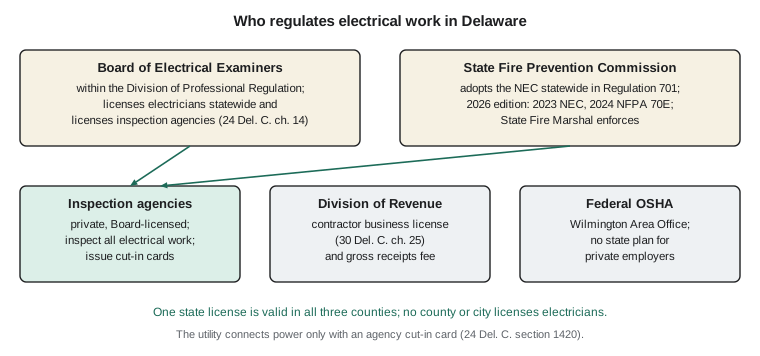
Delaware licenses electricians at the state level. The licensing body is the Board of Electrical Examiners, which works within the Division of Professional Regulation in Dover. The Division handles the administrative work: it takes applications through its online system, DELPROS, collects fees, issues licenses, runs audits and keeps the public register. The Board sets the professional standards, reviews applications, approves continuing education courses, licenses electrical inspection agencies and hears discipline cases. The Board's authority comes from Chapter 14 of Title 24 of the Delaware Code, and its detailed requirements are in the Board's Rules and Regulations, which carry the number 1400 in the state's administrative code. The Board meets on the first Wednesday of each month except August and December, which matters for timing because applications are approved at those meetings.
Because the license is a state license, it is good everywhere in Delaware. A master licensed through the Board can supervise work in Wilmington, in the beach towns of Sussex County and in every farm field in between, and no city or county issues a competing electrician license. This is a sharp contrast with states such as Kansas or Pennsylvania, where licensing is local. It also means the Board's rules are the single source to read on the questions an exam asks most often: who may do electrical work, who may supervise whom, what insurance a licensee must carry and how a license is renewed.
The license classes
Section 1408 of Chapter 14 sets out the license classes and what each requires. The master electrician license is the broadest. It covers residential, commercial and industrial work, and an applicant must show knowledge across all three. The master electrician special license covers one specialty, such as elevator work, and is earned with experience in that specialty. The limited electrician license covers residential work, and the limited electrician special license covers a specialty at the limited level. The journeyperson electrician license is for the experienced worker who has finished an approved apprenticeship or logged the required hours, and the residential electrician license is a narrower credential for residential work. Finally, apprentice and school apprentice licenses cover people in training: an apprentice must be at least eighteen and enrolled in an approved program, and a school apprentice is enrolled in an approved program at a Delaware vocational high school.
| License | Scope in brief | Exam |
|---|---|---|
| Master electrician | Residential, commercial and industrial | Yes, master exam |
| Master electrician special | One specialty at the master level | Yes |
| Limited electrician | Residential work | Yes, limited exam |
| Limited electrician special | One specialty at the limited level | Yes |
| Journeyperson electrician | Works under the licensing structure; no supervisor's role over a business | Yes, unless the apprenticeship ends with an approved final exam |
| Residential electrician | Residential work within limits set in section 1422A | Yes, residential exam |
| Apprentice and school apprentice | Training under direct onsite supervision | No |
The master and limited licenses are the ones that carry responsibility for a business. Under section 1418, a business that does electrical work relies on a license holder, and if it loses that person it must act quickly, as Lesson 7 explains. A journeyperson can do the work, and can supervise apprentices on site, but a company cannot operate on a journeyperson license alone. That is the gap Keisha is training to fill: Kent Meadow's ability to pull inspections, bid commercial work and keep its trucks rolling depends on having a master on the books.
The code and the inspection system
Delaware does not leave code adoption to each town. The National Electrical Code applies statewide through the State Fire Prevention Regulations, which the State Fire Prevention Commission adopts and the State Fire Marshal enforces. The 2026 edition of those regulations took effect on January 1, 2026, and lists the 2023 edition of NFPA 70 among its adopted codes, along with the 2024 edition of NFPA 70E for electrical safety in the workplace. Lesson 5 explains how that adoption works and why your exam may still be based on an earlier edition.
Inspection is the part of the Delaware system that surprises people from other states. With narrow exceptions, all electrical work in Delaware must receive a certificate of inspection from an electrical inspection agency licensed by the Board. These agencies are private companies, independent of contractors, manufacturers and utilities. The contractor applies to an agency, the agency inspects the rough-in and the finished work, and when the work passes it issues the approvals that let the electric utility connect power. A utility may not connect a service without the agency's cut-in card, except in an emergency. The State Fire Marshal's list of licensed agencies from 2024 named eight companies, from American Inspection Agency to United Inspection Agency, and the contractor or owner chooses among them. Lesson 6 covers the deadlines that go with this system.
The business side
A Delaware master license belongs to a person. The business that employs the master needs separate paperwork. Under Chapter 25 of Title 30, any person who does business in Delaware as a contractor must hold a contractor business license from the Division of Revenue, and the Division will not issue one until the applicant files proof of workers' compensation insurance and a certificate of notice from the Department of Labor. The same chapter imposes a license fee measured on gross receipts and requires anyone who hires a nonresident contractor to report the contract to the state. Insurance is the other piece: the Board requires masters and limited electricians to carry general liability coverage of at least 300,000 dollars, as Lesson 8 explains.
Kent Meadow's office manager, Gail Szymanski, keeps a one-page checklist for the business that she reviews every January: the Division of Revenue contractor license renewed, Russ's master license current, the liability certificate naming him on file, the workers' compensation policy in force, and the trucks lettered with Russ's license number as the Board's rules require. When Keisha earns her license, the checklist will gain a second name.
Other laws that reach the job
Several other bodies of law shape an electrical contractor's work in Delaware, and the business and law portion of any master's preparation should cover them. Mechanics' liens are governed by Chapter 27 of Title 25, which gives contractors and subcontractors a lien on a structure for unpaid labor and materials if they file on time. The Building Construction Payments Act in Chapter 35 of Title 6 sets payment deadlines and treats construction payments as trust funds. Workers' compensation is governed by Chapter 23 of Title 19. Workplace safety for private employers is enforced by federal OSHA through its Wilmington Area Office, because Delaware does not run a state OSHA plan for private workplaces. Lessons 9 and 10 take these one at a time.
Enforcement
The Board and the Division enforce the licensing law in several ways. Section 1425 lets Division agents enter electrical work sites during business hours without prior notice to check licenses. Section 1423 requires a business to verify that the people it sends to do electrical work hold the right licenses and to report unlicensed workers to the Board within ten days. Section 1424 makes unlicensed electrical work a misdemeanor, with fines of 500 to 1,500 dollars for a first offense and 1,500 to 2,300 dollars for later offenses. And sections 1412 and 1414 let the Board reprimand, fine, suspend or revoke a licensee for grounds that include fraud, negligent or incompetent work and work outside the licensed category. Lesson 7 returns to these.
Russ has told Keisha that the best protection is plain paperwork: a current license, insurance on file, an inspection application filed as soon as work starts, inspection reports and certificates kept with each job, and every apprentice working beside a licensed electrician. Inspection agencies, Division agents and the Board all look at the same things.
How this course is organized
The lessons follow Keisha's path. Lesson 2 covers eligibility for the master license and Lesson 3 the application and exam booking. Lesson 4 covers the exam format and the references allowed. Lesson 5 explains how the National Electrical Code is adopted in Delaware and Lesson 6 the permit and inspection system. Lesson 7 covers the duties of a master license holder, Lesson 8 contractor licensing, insurance and bonding, and Lesson 9 contracts and mechanics' liens. Lesson 10 covers safety law, OSHA and workers' compensation, Lesson 11 renewal and continuing education, and Lesson 12 practice review and test-day strategy. Every lesson ends with a quiz that mixes multiple choice, true or false, number, ordering and matching questions, and the course ends with a final exam.
The calculator below shows the first planning Keisha did. Russ wants to step back in about thirteen months. Keisha needs time to gather her experience verification, submit an application at least forty-five days before her chosen test date, wait for Board approval at a monthly meeting, study, sit the exam, possibly retake it and then show proof of insurance so the license can issue. Change the numbers to fit your own plan.
# Keisha's planning check (illustrative months)
months_until_russ_steps_back = 13
steps = {
    "gather verification forms and apprenticeship certificate": 1,
    "submit in DELPROS and wait for Board approval": 2,
    "study for the master exam": 3,
    "sit the exam": 1,
    "retake allowance, if needed": 1,
    "proof of insurance and license issued": 1,
}
needed = sum(steps.values())
for step, months in steps.items():
    print(f"{step}: {months} months")
print(f"Total: {needed} months; margin: {months_until_russ_steps_back - needed} months")gather verification forms and apprenticeship certificate: 1 months submit in DELPROS and wait for Board approval: 2 months study for the master exam: 3 months sit the exam: 1 months retake allowance, if needed: 1 months proof of insurance and license issued: 1 months Total: 9 months; margin: 4 months
Common mistakes
MistakeAssuming each Delaware county licenses electricians.
InsteadDelaware licenses electricians statewide through the Board of Electrical Examiners.
MistakeExpecting a county or city inspector to inspect the wiring.
InsteadElectrical work is inspected by Board-licensed third-party inspection agencies, which issue the certificate and the cut-in card.
MistakeTreating the master license as the company's license.
InsteadThe license belongs to the individual; the business also needs a Division of Revenue contractor business license and the required insurance.
MistakeAssuming federal OSHA does not apply because Delaware regulates electricians.
InsteadDelaware has no state OSHA plan for private employers, so federal OSHA enforces workplace safety.
MistakeThinking a journeyperson license lets a business operate on its own.
InsteadA business relies on a master or limited license holder and must act within the section 1418 deadlines if it loses one.
Summary and key terms
- Delaware licenses electricians statewide through the Board of Electrical Examiners within the Division of Professional Regulation.
- The master license covers residential, commercial and industrial work; other classes cover specialties, residential work, journeypersons and apprentices.
- The National Electrical Code applies statewide through the State Fire Prevention Regulations; the 2026 edition lists the 2023 NEC.
- All electrical work needs a certificate of inspection from a Board-licensed third-party inspection agency, and the utility needs a cut-in card before connecting.
- Contracting businesses also need a Division of Revenue contractor business license, workers' compensation and liability insurance.
- Check current statutes, rules and Division pages before relying on any detail.
- Board of Electrical Examiners
- The Delaware board that licenses electricians and electrical inspection agencies under 24 Del. C. ch. 14.
- Division of Professional Regulation
- The state division that administers the Board's licensing, fees, audits and records.
- DELPROS
- The Division's online system for applications, renewals and continuing education tracking.
- Electrical inspection agency
- A private company licensed by the Board to inspect electrical work and issue certificates of inspection.
- Cut-in card
- The inspection agency's authorization that lets the utility connect power to an installation.
Practice problems
Work each problem on paper first, then reveal the answer to check.
Does Kent Meadow need a separate license from the City of Dover for Keisha to work there as a master?
Show answer
No. The master license is issued by the state Board and is valid throughout Delaware.
Who inspects the wiring on the Camden clinic job?
Show answer
A Board-licensed electrical inspection agency that the contractor or owner chooses.
Which agency issues the contractor business license?
Show answer
The Division of Revenue, under 30 Del. C. ch. 25.
What is the fine range for a first offense of unlicensed electrical work under section 1424?
Show answer
500 to 1,500 dollars.
Who enforces safety standards at a private Delaware jobsite?
Show answer
Federal OSHA, through its Wilmington Area Office.
Lesson quiz · 5 questions
Score 60% or more to complete this lesson.
Create a free account to save your progress, take quizzes and earn a certificate.