
MELU-208 · Lesson 4 of 12 · 19 min
The exam format and the references allowed
▶ Video coming soon A video version of this lesson is on the way.
When the vendor's email arrived with the Candidate Information Bulletin, Keisha printed it and read it twice with a highlighter. The bulletin is the contract between the candidate and the exam. It says how many questions there are, how long she has, what score passes, which books she may bring, how those books may be marked and what calculator she may use. Every one of those details shapes how she should study. This lesson works through the Delaware master exam as the June 2025 bulletin describes it, notes where the bulletin and the Board's rules do not line up exactly, and turns the format into a study plan.
A caution before the details. The vendor revises its bulletin from time to time, and Delaware adopted a new edition of the National Electrical Code in its 2026 fire prevention regulations. The figures below are from the bulletin dated June 24, 2025. Always read the bulletin the vendor sends you, and follow it over anything in this course.
The numbers
The June 2025 bulletin lists five exams for the Division's electrical licenses: journeyperson, residential, limited, master and elevator mechanic. The master exam has 80 questions and a three hour time limit. All exams are computer based, open book and timed. The passing score for the electrician exams is 75, and Rule 4.0 of the Board's rules and the Division's examination page both state the same 75 minimum.
| Exam | Questions | Time |
|---|---|---|
| Journeyperson electrician | 70 | 3 hours |
| Residential electrician | 60 | 3 hours |
| Limited electrician | 70 | 3 hours |
| Master electrician | 80 | 3 hours |
| Elevator mechanic | 50 | 2 hours |
Three hours for 80 questions is 180 minutes, or two and a quarter minutes per question on average. That is tighter than it sounds for an open book exam. A candidate who looks up every answer from scratch will run out of time. The candidates who pass are the ones who know the code well enough to go straight to the right article, and who answer the questions they know without opening the book at all. Lesson 12 builds a pacing plan around this.
What the master exam covers
The bulletin gives a content outline as the number of questions in each subject area. For the master exam it lists the following areas. The largest single block is general electrical knowledge, which covers theory, definitions and calculations. Wiring and protection, covering services, feeders, branch circuits, overcurrent protection and grounding, and wiring methods and materials together make up another large share. Motors and controls, plan reading, equipment for general use, special conditions, special equipment, special occupancies and communication systems fill out the rest.
| Subject area | Master questions |
|---|---|
| General electrical knowledge | 19 |
| Wiring and protection | 15 |
| Wiring methods and materials | 15 |
| Motors and controls | 7 |
| Equipment for general use | 5 |
| Plan reading | 4 |
| Special conditions | 4 |
| Special equipment | 4 |
| Special occupancies | 4 |
| Communication systems | 3 |
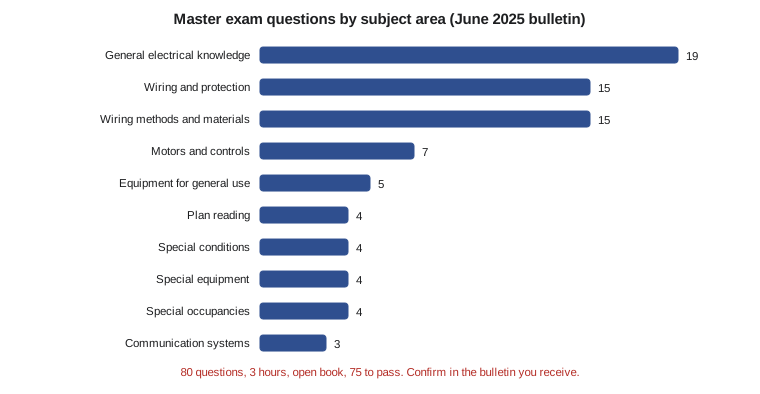
The outline lines up with the structure of the National Electrical Code. Wiring and protection corresponds to Chapter 2 of the code: branch circuits, feeders, services, overcurrent protection and grounding and bonding, Articles 210 through 250. Wiring methods and materials corresponds to Chapter 3, which includes the general rules in Article 300, conductor ampacity in Article 310, boxes in Article 314 and the raceway and cable articles that follow. Equipment for general use is Chapter 4, which includes Article 430 on motors, broken out separately in the outline as motors and controls. Special occupancies, special equipment and special conditions are Chapters 5, 6 and 7, and communication systems is Chapter 8. General electrical knowledge draws on Chapter 1 and on the theory and calculations that run through the whole code, the kind of material covered in MELU-101 and MELU-102.
The weighting tells Keisha where to spend her hours. Nearly half the master exam, 49 of 80 questions, comes from general knowledge, wiring and protection and wiring methods. Motors and controls, at seven questions, is the largest of the smaller areas and is worth focused practice on motor branch circuit and feeder calculations. The four special areas together are 12 questions; she will review the high-yield articles in each rather than reading them cover to cover.
The references allowed
The bulletin lists the references a master candidate may bring: the American Electrician's Handbook, 17th edition; NFPA 70, the National Electrical Code, 2020 edition; and Ugly's Electrical References, 2020 edition. The journeyperson, residential and limited exams allow the handbook and the code, without Ugly's. Each listing gives an ISBN so candidates bring the right printing.
Two points need care. First, Rule 4.0 of the Board's rules says only the NEC book may be used as a reference, while the vendor's bulletin lists additional books for the master exam. The bulletin is what the test site enforces on exam day, but a rule and a bulletin that differ is a reason to call the Division before buying books. Second, the edition. The June 2025 bulletin names the 2020 NEC. The Division's examination page says the exam is based on the most up to date NEC adopted in Delaware, and the State Fire Prevention Regulations that took effect on January 1, 2026 list the 2023 NEC. A candidate testing in 2027 should check the bulletin the vendor sends for the edition named there, and bring that edition. This course flags the 2020 and 2023 differences that matter in the core courses.
| Rule | June 2025 bulletin |
|---|---|
| Highlighting | Allowed |
| Underlining | Allowed, in pen only |
| Permanent tabs | Allowed |
| Handwritten notes | Not allowed |
| Movable tabs or sticky notes | Not allowed |
| Photocopied pages or books | Not allowed |
| Study guides and practice exams | Not allowed in the testing center |
| Marking books during the test | Not allowed |
| Calculator | Simple four-function only; no phones, tablets or special calculators |
The rules shape how Keisha prepares her code book. Permanent tabs are allowed, so she will tab the articles the outline weights most heavily: 90, 100, 110, 210, 215, 220, 225, 230, 240, 250, 300, 310, 314, 334, 358, 430, 450, 500, 517, 680 and 700, plus the annexes and the index. Highlighting is allowed, so she will highlight the key sentence in the sections she looks up most. Handwritten notes are not, so she must not write formulas or reminders in the margins, which the administrator will find when the books are checked. Underlining must be in pen.
The calculator
The bulletin allows only a simple four-function calculator. That rules out the scientific and construction calculators many electricians carry, and it means square roots and powers must come from memory or simple arithmetic. In practice, the master exam's calculations rarely need more than multiplication, division and the constant 1.732 for three-phase work, which the candidate can type in. Keisha bought the cheapest four-function calculator she could find and used it for every practice question for a month so that it would feel normal on test day.
# Three-phase current on a four-function calculator: multiply by 1.732 by hand
kva = 75
volts = 208
amps = kva * 1000 / (volts * 1.732)
print(round(amps, 1), "amperes")208.2 amperes
Reading the questions
Master exam questions come in a few common types. Code lookup questions ask what a given section requires: a minimum clearance, a maximum number of conductors, a required rating. Calculation questions ask for a load, a conductor size, an overcurrent device rating or a voltage drop. Theory questions ask about Ohm's law, power, transformers and circuits. Plan reading questions give a drawing or schedule and ask what it shows. On a computer-based exam, the candidate can flag questions and return to them, which supports the three-pass method in Lesson 12.
Every question has one best answer. Many wrong choices are close: the right number from the wrong table, the answer for a dwelling when the question is about a commercial building, or the rule from a different edition. Reading the question twice, and underlining the words that set the conditions in your head, prevents most of these errors.
Worked problem
Spending the time
Keisha has 180 minutes for 80 questions. She expects to answer about 40 quickly from memory at about one minute each. How much time does she have per question for the rest, keeping 15 minutes at the end for review?
Show solution
- Quick questions: 40 questions at 1 minute each uses 40 minutes.
- Reserve for final review: 15 minutes.
- Remaining time: 180 minus 40 minus 15 leaves 125 minutes.
- Questions left: 80 minus 40 leaves 40 questions.
Answer: About 3.1 minutes per remaining question, enough for most lookups and calculations if she knows where to look.
Common mistakes
MistakeBringing a code book with handwritten formulas in the margins.
InsteadHandwritten notes are not allowed; the administrator checks the books before entry.
MistakeUsing sticky notes to mark articles.
InsteadOnly permanent tabs are allowed.
MistakeBringing a scientific calculator.
InsteadOnly a simple four-function calculator is allowed.
MistakeAssuming the edition from an old prep book.
InsteadBring the edition named in the bulletin you receive.
MistakeLooking up every answer.
InsteadAt about two and a quarter minutes a question, answer what you know first.
Preparing the reference books
Because the bulletin allows permanent tabs, highlighting and pen underlining but forbids notes, the work of preparing the books has to be done with those tools alone. Keisha's method takes about three evenings. On the first, she places tabs at the start of each code chapter and at each high-weight article, labeling them with the article number and a one- or two-word name. On the second, she works through twenty practice questions and highlights the exact sentence that answered each one, building a trail of the rules she actually uses. On the third, she tabs the index, the tables she uses most often, such as the conductor ampacity tables in Article 310 and the conduit fill tables in Chapter 9, and the motor tables in Article 430.
She keeps the tab count reasonable. A book with two hundred tabs is as hard to search as a book with none. Her rule is no more than about fifty tabs in the code book and a dozen in each other reference. Tabs go on the edge in a consistent order, so that Chapter 2 tabs sit above Chapter 3 tabs, and so on, and the fingers learn where to go.
The other references deserve the same care if the bulletin you receive allows them. The American Electrician's Handbook is useful for theory, motor and transformer data and practical installation questions, and Ugly's Electrical References gathers formulas, conversion factors and common tables in one small book. Neither replaces the code for a code question. On exam day, a candidate who opens the handbook to answer a question about a code requirement is wasting time; the answer to what the code requires is always in the code.
Reading the bulletin's fine print
Every bulletin contains rules that are easy to overlook until test day. The identification rule is one: the name on the identification must match the registration exactly, and the bulletin lists which documents are acceptable. The arrival rule is another: candidates who arrive late may be turned away and lose the fee. The remote testing rules are a third, covering the room, the desk, the camera angle and what may be within reach. Keisha highlighted each of these in her printed copy and put the bulletin in the folder with her admission details, so she would read it again the night before the test.
The bulletin also explains how a candidate may comment on a question believed to be flawed and how to request a hand score. These are rarely used, but a candidate who scores just below 75 should know they exist and know the deadlines.
Summary and key terms
- The Delaware master exam has 80 questions in three hours, and 75 passes.
- It is computer based, open book and timed.
- The June 2025 bulletin weights general knowledge at 19 questions and wiring and protection and wiring methods at 15 each.
- The bulletin lists the American Electrician's Handbook, the 2020 NEC and Ugly's for the master exam; Rule 4.0 mentions only the NEC, so confirm.
- Highlighting, pen underlining and permanent tabs are allowed; handwritten notes, sticky notes and photocopies are not.
- Only a simple four-function calculator is permitted.
- Content outline
- The bulletin's list of question counts by subject area.
- Open book
- An exam on which approved references may be used.
- Permanent tab
- A tab fixed to a page that cannot be moved, allowed in approved references.
- Four-function calculator
- A calculator that only adds, subtracts, multiplies and divides.
- Edition
- The year of the National Electrical Code that the exam is written to.
Practice problems
Work each problem on paper first, then reveal the answer to check.
How many minutes per question does the master exam allow on average?
Show answer
180 minutes divided by 80 questions is 2.25 minutes.
May Keisha bring a photocopied table from the code?
Show answer
No. Photocopied pages are not allowed.
Which code chapter answers most wiring methods and materials questions?
Show answer
Chapter 3.
What should a candidate do if the Board rule and the bulletin list different references?
Show answer
Call the Division to confirm before buying books, and bring what the current bulletin allows.
How many master questions does the outline give to motors and controls?
Show answer
Seven.
Lesson quiz · 5 questions
Score 60% or more to complete this lesson.
Create a free account to save your progress, take quizzes and earn a certificate.