
MELU-208 · Lesson 3 of 12 · 20 min
Applying, approval and booking the exam
▶ Video coming soon A video version of this lesson is on the way.
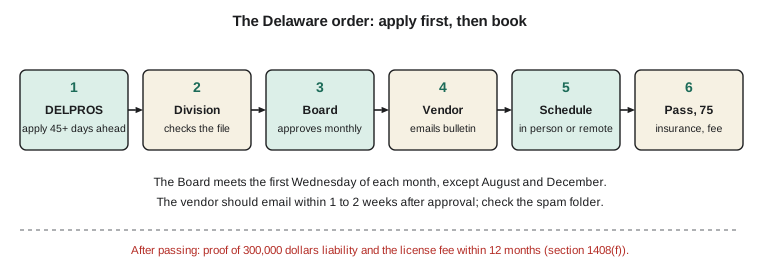
Many states let a candidate book the exam first and apply for the license afterward. Delaware works the other way. The candidate applies to the Board through the Division of Professional Regulation, the Board approves the application, and only then does the testing company invite the candidate to schedule. Keisha learned this from Gail, who handled Russ's insurance paperwork for years and knew that the Board's monthly meeting calendar drives everything. This lesson walks through the sequence: the DELPROS application, the forty-five day rule, Board approval, the examination vendor's invitation, scheduling in person or online, and what happens after the score comes back.
Step one: the DELPROS application
Every Delaware electrician application starts in DELPROS, the Division's online licensing system. The applicant creates an account or logs in, chooses the master electrician application and fills in the personal, education, experience and character sections. The application page asks the applicant to review the License Law and the Board's Rules and Regulations before starting and to gather the documents first, because the attachments page is where the application succeeds or fails.
On the attachments page, the applicant uploads the documents that can be uploaded, such as an apprenticeship certificate of completion, and acknowledges the items that someone else will send, such as a Verification of Employment that the supervisor submits directly or a transcript that a school sends. Forms that require a supervisor's signature, a professional seal or a notary may have to be mailed unless the form says it can be uploaded. The applicant then submits the application with the application fee. The Division's page says an applicant has six months from starting an application to submit it; after that, the draft is lost and the applicant must start again.
Fees are set in the Division's fee schedule and change from time to time, so this course does not quote them. Keisha budgeted for the application fee, the exam fee charged by the testing company, a possible retake and the license fee due after she passes.
The forty-five day rule
Rule 4.0 of the Board's rules and the Division's application page both say the complete application, the fee and the supporting documents must be submitted at least forty-five days before the test date. The point is to give the Division time to check the file and the Board time to approve it at a meeting. Because the Board meets once a month, except in August and December, an application that arrives just after a meeting may wait almost a month for the next one. An application missing a verification form waits longer still.
Keisha's plan works backward from a test window in February 2027. She intends to submit in early December 2026, which gives the Division time to collect Russ's verification and lets the Board consider the file at its first meeting of the new year, since there is no December meeting. If the Board approves it in January, the vendor's invitation should arrive within a couple of weeks and she can book a February date.
Step two: review and Board approval
The Division's staff check the application for completeness: the forms are signed, the verification forms have arrived from the supervisors, the transcript is official and the character questions are answered. A complete file goes to the Board, which decides whether the applicant meets section 1408. If something is missing, the Division contacts the applicant, and the application waits until it is fixed. When the Board approves, the applicant receives an email of approval.
Approval is not the license. It is permission to take the exam. Section 1408(f) and Rule 4.0 make clear that the license issues only after the applicant passes the exam, submits proof of the required insurance and pays the license fee.
Step three: the vendor's invitation
The Division uses an outside vendor for all electrical licensing exams. As of November 2026 the Division's examination page names that vendor as ProV. After the Board approves an application, the Board liaison sends the candidate's information to the vendor, and the vendor should contact the candidate within one to two weeks by email, with the Candidate Information Bulletin and registration instructions. The Division's page reminds candidates to check spam folders, because the email comes from the vendor's address rather than the state's.
The bulletin is the most important document in the process after the license law itself. It lists the exams, the number of questions and time for each, the passing score, the references allowed and how they may be marked, the calculator rule, the scheduling process, fees, cancellation rules, retake rules and how scores are reported. Lesson 4 works through the exam details. This lesson covers the logistics.
Step four: scheduling
The June 2025 bulletin explains two ways to schedule. Online, the candidate goes to the vendor's scheduler, enters the Application ID from DELPROS, including any leading zeros, and the candidate's last name, chooses either an in-person site or the remote option and picks a date and time. By phone, the candidate calls the vendor during business hours with the candidate ID and zip code ready. The bulletin listed in-person sites in Dover and Wilmington; the Division's page also mentions Newark. Sites and days change, so check what the scheduler offers.
The remote option, called Examroom in the bulletin, lets a candidate test at home under a live remote proctor. It requires a current operating system, a supported browser, a working webcam and microphone and a reliable upload speed, and the bulletin tells candidates to run the system check before scheduling. The room must meet the proctor's rules. For an open book exam with a stack of tabbed references, Keisha decided an in-person seat in Dover was the simpler choice: no worries about the webcam angle or a family member walking through the room.
| Item | June 2025 bulletin |
|---|---|
| Exam fee | 100 dollars per exam |
| Free cancellation or reschedule | At least three business days before the test date |
| Late cancellation or no-show | Exam fee forfeited |
| Wait between attempts | At least 7 days |
| Limit on electrician retakes | None stated for most candidates |
| Score report | At the test site, and by email within minutes |
| Division notified | Automatically by the vendor |
Step five: test day and the score
The bulletin explains the identification required at check-in and the inspection of reference books before the candidate enters the room. Scores are given at the test site and emailed within minutes, and the vendor reports results to the Division automatically. The Division's examination page tells passing candidates to allow up to two weeks for the Board office to receive the official score.
A failing candidate may retake after waiting at least seven days. The bulletin says the three-attempt limit that applies to some other trades does not apply to the electrician exams, so most candidates may retake as often as needed, paying the fee each time. A candidate who fails the same exam at least twice and scores within ten points of passing may request a review session, a one-and-a-half hour look at the missed areas under exam security. A candidate who believes the computer scored the exam incorrectly may request a hand score for a 25 dollar fee, with the signed request and score letter received within ninety days of the exam.
Step six: insurance and the license
Passing the exam does not finish the process. The Division's page says the applicant may take the exam before submitting proof of insurance but must submit it after passing, and the license cannot issue until the Board receives it. The proof must show general liability coverage of at least 300,000 dollars, and the applicant's own name must appear on the document even if the employer holds the policy. Lesson 8 covers the insurance rules in detail.
Section 1408(f) gives a passing candidate up to twelve months to pay the license fee and submit the insurance. If the candidate does not, the exam must be taken again. This rule protects the public record: a passing score from years earlier does not sit waiting while the candidate's knowledge goes stale. For Keisha the issue is simple. Kent Meadow's liability policy already covers its employees, and Gail will ask the insurance agent to issue a certificate naming Keisha as soon as she passes.
Worked problem
Working backward from a test date
Keisha wants to test in the second half of February 2027. The Board meets on the first Wednesday of each month except August and December. When must her complete application be in?
Show solution
- The forty-five day rule means the complete file must be in by early January for a mid-February test.
- There is no December meeting, so the first chance for approval is the January meeting on the first Wednesday of January.
- The vendor may take up to two weeks after approval to send the bulletin, leaving early to mid-February to book.
- To be safe, the complete file, with Russ's verification received, should be in during early December 2026.
Answer: Submit in early December 2026, confirm the Division has every document before the holidays and plan to book as soon as the vendor's email arrives in January.
Common mistakes
MistakeBooking the exam before applying to the Board.
InsteadIn Delaware the Board approves first, and the vendor then invites the candidate to schedule.
MistakeSubmitting the application three weeks before the desired test date.
InsteadThe complete application must be in at least forty-five days before the test.
MistakeForgetting that the Board does not meet in August or December.
InsteadPlan around the monthly meeting calendar.
MistakeAssuming a passing score is the license.
InsteadThe license issues after proof of insurance and the license fee; there is a twelve-month limit.
MistakeLetting a DELPROS draft sit for months.
InsteadAn application must be submitted within six months of starting it.
# Counting back from a target test date (illustrative)
import calendar
from datetime import date, timedelta
target = date(2027, 2, 22)
latest_complete_file = target - timedelta(days=45)
print("Latest date for a complete file:", latest_complete_file)
print("Weekday:", calendar.day_name[latest_complete_file.weekday()])Latest date for a complete file: 2027-01-08 Weekday: Friday
The calculation shows the absolute latest date, which in practice is too late because it leaves no room for a missing form or a meeting that falls the wrong way. Gail's rule of thumb is to add one full meeting cycle, about a month, to whatever the forty-five day count gives.
Common reasons an application stalls
Gail has helped three Kent Meadow electricians through the Delaware process, and she has seen the same problems each time. The most common is a missing Verification of Employment: a former supervisor promises to send the form and never does, or sends it to the applicant instead of the Division. The second is an apprenticeship certificate from a program the Division cannot readily identify, which leads to a request for the program's registration details. The third is a character question answered too briefly, such as a yes to an old conviction with no explanation or court record attached. Each problem costs at least one Board meeting cycle, and in a year with no August or December meeting, two missed cycles can push a test date back by a season.
The cure is to treat the application like a job file. Before submitting, Keisha will make a list of every document the application asks for, note who is sending each one and on what date, and call the Division a week after submitting to ask whether anything is missing. She will keep copies of everything she uploads and the confirmation email from DELPROS. If the Division asks for more information, she will answer the same day.
A last practical point concerns names and contact details. The name on the application must match the name on the identification she will show at the test site, and the email address must be one she checks daily, because the vendor's invitation, the approval notice and any request for documents all arrive by email. A candidate who used an old work address may wait weeks for an invitation that is sitting in an inbox nobody reads.
Summary and key terms
- Delaware applicants apply in DELPROS first; the Board approves before the candidate schedules.
- The complete application must be in at least forty-five days before the test date.
- The Board meets on the first Wednesday of each month except August and December.
- After approval, the examination vendor emails the bulletin within about one to two weeks.
- Candidates may test in person or remotely; the bulletin sets fees, cancellation and retake rules.
- After passing, proof of at least 300,000 dollars in liability insurance and the license fee are due within twelve months.
- DELPROS
- The Division's online system for license applications and renewals.
- Candidate Information Bulletin
- The vendor's document listing exam content, references, rules, fees and scheduling steps.
- Application ID
- The DELPROS number the candidate uses to schedule with the vendor.
- Examroom
- The bulletin's name for remote proctored testing at home.
- Hand score
- A manual rescoring of an exam, requested within ninety days for a fee.
Practice problems
Work each problem on paper first, then reveal the answer to check.
Can Keisha book the exam before the Board approves her application?
Show answer
No. The vendor invites candidates after Board approval.
How long must a candidate wait between attempts?
Show answer
At least seven days.
How long does a passing candidate have to submit insurance and pay the license fee?
Show answer
Up to twelve months under section 1408(f).
What happens to a DELPROS draft left unsubmitted for seven months?
Show answer
It expires after six months and the applicant must start again.
What is the deadline for a hand score request?
Show answer
The signed form and score letter must be received within ninety days of the exam.
Lesson quiz · 5 questions
Score 60% or more to complete this lesson.
Create a free account to save your progress, take quizzes and earn a certificate.