
MELU-205 · Lesson 9 of 12 · 19 min
Contracts and mechanics' liens in California
▶ Video coming soon A video version of this lesson is on the way.
Contract requirements are the single largest area on CSLB's Law and Business exam, about 21 of every 100 questions, and insurance and liens add about 12 more. California's rules for home improvement contracts are detailed and strictly enforced, and its mechanics' lien law has deadlines that, once missed, cannot be recovered. This lesson covers home improvement contracts, service and repair contracts, commercial contract basics, mechanics' liens and lien releases, and public works. Statutes are cited by section; confirm current dollar limits and forms in CSLB's publications and the Civil Code before relying on them.
Home improvement contracts
A home improvement contract is a contract with a homeowner, or a tenant, for work on a residence or its surroundings. Business and Professions Code section 7159 sets out what such a contract must contain, and CSLB's consumer guide summarizes the main points. Projects over 500 dollars in combined labor and materials must be in a written contract, and changes to the price must be made by written change order that becomes part of the contract. The contract must identify the contractor and license number, describe the work and materials, list a schedule of payments showing what work each payment covers, and include the notices the statute requires, among them the statutory mechanics lien warning and information about commercial general liability and workers' compensation coverage.
The money rules are the ones most often tested. The down payment may not exceed the lesser of 1,000 dollars or 10 of every 100 dollars of the contract price, excluding finance charges, and the limit applies to special-order materials too. The only exception is for contractors with qualifying blanket performance and payment bonds listed on CSLB's website. Progress payments may not exceed the value of the work performed or materials delivered. The homeowner has three business days to cancel a home improvement contract signed outside the contractor's place of business, or five business days if the buyer is 65 or older, and the contractor must return payments within 10 days of receiving a cancellation. A home improvement salesperson must be registered with CSLB to sign contracts for the contractor; the registration fee on CSLB's schedule is 200 dollars.
| Rule | Requirement (summarized from CSLB guidance) |
|---|---|
| Written contract | Required for projects over 500 dollars in labor and materials |
| Down payment | No more than the lesser of 1,000 dollars or 10 of every 100 dollars of the price |
| Progress payments | Not more than the value of work performed or materials delivered |
| Right to cancel | 3 business days, or 5 business days if the buyer is 65 or older |
| Refund after cancellation | Within 10 days of receiving the cancellation |
| Changes | By written change order made part of the contract |
| Salespersons | Must be registered home improvement salespersons to sign contracts |
# Maximum down payment on a home improvement contract: the lesser of 1,000 dollars or 10 in 100 of the price
def max_down_payment(price):
    return min(1000.0, price * 0.10)

for price in [4_800, 9_500, 10_000, 28_400]:
print(f"contract price {price:>7,} -> maximum down payment {max_down_payment(price):>8,.2f}")contract price 4,800 -> maximum down payment 480.00 contract price 9,500 -> maximum down payment 950.00 contract price 10,000 -> maximum down payment 1,000.00 contract price 28,400 -> maximum down payment 1,000.00
The crossover is at 10,000 dollars: below that, the 10 in 100 rule controls; at or above it, the 1,000-dollar cap controls. Exam questions often use prices on either side of 10,000 to test whether you apply the lesser of the two.
Worked problem
A panel upgrade for Mrs. Okafor
Capitol Valley quotes 6,400 dollars to replace a 100-ampere panel with a 200-ampere panel at the home of Mrs. Okafor, who is 71. The estimator meets her at her kitchen table, and she signs on a Monday. The estimator asks for a 1,000-dollar deposit to order the panel. What is wrong, and how long does she have to cancel?
Show solution
- The down payment limit is the lesser of 1,000 dollars or 10 of every 100 dollars of 6,400, which is 640 dollars.
- Asking for 1,000 dollars exceeds the limit, and the limit applies even to special-order materials.
- The contract was signed at her home, not at Capitol Valley's office, so the cancellation right applies.
- Because she is 65 or older, she has five business days to cancel, and any payment must be refunded within 10 days of her cancellation.
Answer: The deposit may be at most 640 dollars, and she has five business days to cancel.
Service and repair contracts
The Business and Professions Code has a separate, simpler form for small service and repair contracts, such as an electrician called out to fix a tripping circuit, as long as the job stays within the statute's conditions, including a price limit. The service and repair rules allow a shorter contract and, in emergencies requested by the customer, can affect the cancellation right. The CSLB consumer guide notes that emergency or short-notice service and repair contracts are excepted from the cancellation right and that the right is voided once the contract is signed and the work begins. Check the current price limit and conditions in section 7159.10 and following before using the service and repair form.
Commercial contracts
Contracts with businesses, developers and general contractors are not home improvement contracts, and they are governed mostly by their own terms and general contract law. The NASCLA business guide on the exam reference list covers the elements every construction contract should address: scope of work, plans and specifications, schedule, price and payment terms, retention, change orders, insurance and indemnity, warranties, dispute resolution and termination. California's Civil Code adds prompt payment requirements for private works, setting deadlines for progress payments and the release of retention, with penalties for late payment. Public works have their own statutes, covered below. As a C-10 subcontractor, Capitol Valley reads every subcontract for pay-when-paid clauses, retention terms and insurance requirements before signing.
Mechanics' liens: who and why
California's constitution gives people who improve real property the right to a lien on that property for the value of their work. The statutes that carry out that right are in the Civil Code, starting at section 8000. A mechanics' lien lets an unpaid contractor, subcontractor, supplier or laborer record a claim against the property and, if necessary, sue to foreclose on it. Because the lien attaches to the property rather than the person who hired you, a subcontractor can enforce it against an owner who paid the general contractor in full but whose general contractor never paid the subcontractor. That is also why owners and lenders insist on lien releases.
Liens cannot be recorded against public property. On public works, unpaid parties use stop payment notices and claims against the contractor's payment bond instead.
Preliminary notice
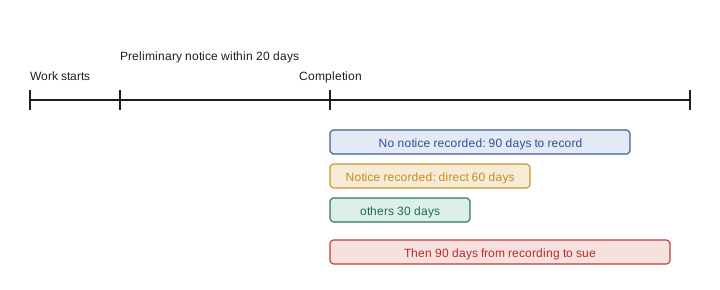
Subcontractors, suppliers and others who do not contract directly with the owner must serve a preliminary notice, often called the 20-day notice, to preserve their lien and related rights. It goes to the owner, the direct (general) contractor and the construction lender, if any. It should be served within 20 days of first furnishing labor or materials. A late notice is still allowed, but it protects only work furnished in the 20 days before it was served and afterward. A direct contractor, one who contracts with the owner, generally does not need to serve a preliminary notice on the owner but must give notice to the construction lender. The required wording of the notice is set by statute.
When Capitol Valley works as a subcontractor to a general contractor, Elena's office manager sends a preliminary notice on every job within a week of starting, by a method that produces proof of service. It costs little and protects lien rights worth thousands.
Recording and enforcing a lien
A lien must be recorded with the county recorder within strict time limits after completion of the work of improvement. If the owner records a notice of completion or notice of cessation, a direct contractor has 60 days after that recording to record a lien, and a subcontractor, supplier or laborer has 30 days. If no notice is recorded, everyone has 90 days after completion. A lien recorded too early, before completion, can be invalid. After recording, the claimant must file a lawsuit to foreclose the lien within 90 days; otherwise the lien becomes unenforceable. The owner can petition to release a lien that was not timely enforced.
| Claimant | No notice recorded | With a recorded notice of completion or cessation |
|---|---|---|
| Direct contractor | 90 days after completion | 60 days after recording of the notice |
| Subcontractor, supplier or laborer | 90 days after completion | 30 days after recording of the notice |
| All claimants: foreclosure suit | Within 90 days after recording the lien | Within 90 days after recording the lien |
# Lien deadlines from a notice of completion (dates are examples)
from datetime import date, timedelta
completion_notice_recorded = date(2027, 5, 14)
deadlines = {
    "Direct contractor: record lien by": completion_notice_recorded + timedelta(days=60),
    "Subcontractor: record lien by": completion_notice_recorded + timedelta(days=30),
}
for who, d in deadlines.items():
    print(f"{who:<36} {d}")
lien_recorded = date(2027, 6, 10)
print(f"{'Foreclosure suit must be filed by':<36} {lien_recorded + timedelta(days=90)}")Direct contractor: record lien by 2027-07-13 Subcontractor: record lien by 2027-06-13 Foreclosure suit must be filed by 2027-09-08
Lien releases
Owners, lenders and general contractors protect themselves by collecting lien releases with each payment. California requires the use of four statutory release forms, set out in the Civil Code: a conditional waiver and release on progress payment, an unconditional waiver and release on progress payment, a conditional waiver and release on final payment, and an unconditional waiver and release on final payment. A conditional release is effective only if the payment is actually received; an unconditional release is effective when signed, so a contractor should sign an unconditional release only after the payment has cleared. Releases not substantially in the statutory form are generally not enforceable.
Marcus adopts a simple rule: Capitol Valley gives conditional releases with each invoice, and unconditional releases only after the money is in the bank.
Public works
Public works projects, generally construction paid for in whole or part with public funds, bring a separate set of requirements. Contractors and subcontractors must register with the Department of Industrial Relations before bidding or working on most public works, must pay prevailing wages set by DIR for each craft and county, must keep and submit certified payroll records, and must employ apprentices in the ratios the Labor Code requires on qualifying projects. Public agencies require payment and performance bonds from the prime contractor on most contracts above statutory thresholds, and unpaid subcontractors and suppliers claim against the payment bond or serve stop payment notices on the agency. Public works make up about 5 of every 100 questions on the Law and Business exam, and DIR's Public Works Manual is on the reference list.
Change orders on a home improvement job
Mrs. Okafor's panel upgrade shows how change orders work in practice. When the old panel is removed, the crew finds a damaged service entrance cable that the utility requires to be replaced before it will reconnect. The extra work costs 850 dollars. Under section 7159, the change must be made by a written change order, signed by the homeowner, describing the work, the price change and any change in schedule, and it becomes part of the contract. Capitol Valley's foreman writes the change order on a tablet, explains it to Mrs. Okafor, and she signs before the crew proceeds. The new contract price is 7,250 dollars, but the down payment limit was set by the original contract and has already been satisfied, so no further deposit is due; the extra is billed with the next progress payment once the work is done.
Common mistakes
MistakeTaking a 1,000-dollar deposit on a 6,000-dollar home improvement job.
InsteadThe limit is the lesser of 1,000 dollars or 10 of every 100 dollars of the price, here 600 dollars.
MistakeGiving a 70-year-old homeowner three business days to cancel.
InsteadBuyers 65 or older have five business days.
MistakeWaiting for a payment problem before sending a preliminary notice.
InsteadServe it within 20 days of first furnishing; a late notice covers only the prior 20 days and later work.
MistakeSigning an unconditional release before the check clears.
InsteadUse a conditional release until payment is actually received.
Summary and key terms
- Home improvement contracts over 500 dollars must be written and include the statutory notices, payment schedule and license number.
- The down payment is limited to the lesser of 1,000 dollars or 10 of every 100 dollars of the price; progress payments may not exceed work performed.
- Buyers have 3 business days to cancel, or 5 if 65 or older; refunds are due within 10 days.
- Subcontractors and suppliers serve a preliminary notice within 20 days of first furnishing.
- Liens are recorded within 90 days of completion, or 60 days (direct contractor) or 30 days (others) after a notice of completion, and foreclosed within 90 days of recording.
- California requires four statutory lien release forms; public works use prevailing wage, DIR registration, certified payroll, payment bonds and stop payment notices.
- Home improvement contract
- A contract with a homeowner or tenant for work on a residence, regulated by section 7159.
- Preliminary notice
- The notice subcontractors and suppliers serve to preserve lien rights.
- Completion notice
- A notice of completion: a document an owner records that shortens lien recording deadlines.
- Conditional release
- A lien release effective only when the stated payment is received.
- Stop payment notice
- A notice to an owner, lender or public agency to withhold funds owed to a contractor.
Practice problems
Work each problem on paper first, then reveal the answer to check.
What is the maximum down payment on a 7,500-dollar home improvement contract?
Show answer
750 dollars (the lesser of 1,000 or 10 of every 100 dollars of 7,500).
An owner records a notice of completion on June 1. By when must a subcontractor record a lien?
Show answer
Within 30 days, by July 1.
A lien is recorded on August 20. By when must the foreclosure suit be filed?
Show answer
Within 90 days, by November 18.
Why can a supplier not record a mechanics' lien on a public school project?
Show answer
Liens cannot attach to public property; the supplier uses a stop payment notice or a payment bond claim.
Lesson quiz · 5 questions
Score 60% or more to complete this lesson.
Create a free account to save your progress, take quizzes and earn a certificate.