
MELU-205 · Lesson 5 of 12 · 19 min
The NEC as adopted in California and state amendments
▶ Video coming soon A video version of this lesson is on the way.
Marcus learned the NEC in a state that adopted it almost word for word. In California, the NEC arrives inside a larger system: Title 24 of the California Code of Regulations, the California Building Standards Code, published every three years by the California Building Standards Commission. Part 3 of Title 24 is the California Electrical Code (CEC). This lesson explains how that code is made, which edition is in force, how state agencies and local governments amend it, and what that means on the job and on the exam. As always, the NEC and CEC are cited only by article and section and described in our own words; no code text or tables are reproduced. Confirm editions and amendments with the Building Standards Commission and your local building department.
Title 24 and its parts
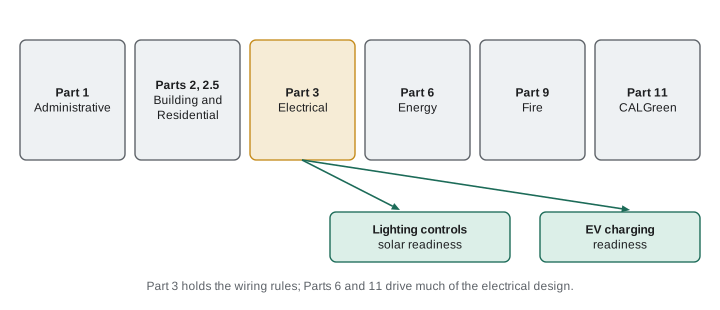
Title 24 is not one book but a set of parts, each covering a discipline. Part 1 is the administrative code; Part 2 the California Building Code; Part 2.5 the Residential Code; Part 3 the Electrical Code; Part 4 the Mechanical Code; Part 5 the Plumbing Code; Part 6 the Energy Code; Part 9 the Fire Code; Part 11 the Green Building Standards Code, known as CALGreen; and several others for existing buildings, historical buildings and referenced standards. An electrical contractor touches several of them. The Electrical Code governs the wiring itself, the Energy Code sets lighting control and solar and storage readiness rules, CALGreen sets electric vehicle charging readiness, and the Building, Residential and Fire Codes govern things like fire-rated penetrations, smoke alarms and equipment access.
| Part | Name | Why it matters to a C-10 contractor |
|---|---|---|
| 1 | Administrative Code | Who adopts and enforces each part |
| 2 and 2.5 | Building and Residential Codes | Fire ratings, penetrations, smoke alarms, access |
| 3 | Electrical Code | The wiring rules: the NEC with California amendments |
| 6 | Energy Code | Lighting controls, solar and battery readiness, efficiency |
| 9 | Fire Code | Fire alarm, emergency systems, storage and access |
| 11 | CALGreen | Electric vehicle charging readiness and other green measures |
Which edition is in force
The Building Standards Commission publishes a full edition of Title 24 every three years, on a triennial cycle; recent editions are 2016, 2019, 2022 and 2025. Each edition takes effect on January 1 of the following year. The current edition is the 2025 California Electrical Code, which is based on the 2023 NEC and took effect statewide on January 1, 2026. The previous edition, the 2022 California Electrical Code, was based on the 2020 NEC and applied to projects whose permits were applied for before 2026.
California deliberately adopts an NEC edition that is a cycle old. The NFPA published the 2026 NEC in 2025, but California's 2025 code integrates the 2023 NEC. The next full edition of Title 24 is expected on the regular three-year cycle; whether it adopts the 2026 NEC is a decision for the commission and its agencies, so watch for the official announcement rather than assuming. Between full editions, the commission can publish intervening supplements and errata; one set of errata for Part 3 took effect January 1, 2026. Always use the edition and errata that apply to the permit you are working under.
Which edition applies to a particular job is set by the date of the permit application, not the date the work is done. A project whose permit was applied for in December 2025 is generally governed by the 2022 code, even if the electricians pull wire in March 2026. Local building departments publish their exact transition rules.
# Which California Electrical Code edition applies? (based on the permit application date; confirm local transition rules)
from datetime import date
editions = [
    (date(2020, 1, 1), "2019 CEC (based on the 2017 NEC)"),
    (date(2023, 1, 1), "2022 CEC (based on the 2020 NEC)"),
    (date(2026, 1, 1), "2025 CEC (based on the 2023 NEC)"),
]
def edition_for(applied):
    current = None
    for start, name in editions:
        if applied >= start:
            current = name
    return current
for d in [date(2025, 12, 15), date(2026, 1, 2), date(2026, 11, 9)]:
print(d, "->", edition_for(d))2025-12-15 -> 2022 CEC (based on the 2020 NEC) 2026-01-02 -> 2025 CEC (based on the 2023 NEC) 2026-11-09 -> 2025 CEC (based on the 2023 NEC)
The function picks the latest edition whose effective date is on or before the application date. It is a planning aid only; local departments can have special rules for plan-check submittals and phased projects.
How state agencies amend the code
Title 24 is adopted by the Building Standards Commission, but several state agencies propose the amendments that apply to the buildings they regulate. The Department of Housing and Community Development proposes rules for housing; the Division of the State Architect for public schools, community colleges and state-owned buildings; the Department of Health Care Access and Information (HCAI, formerly OSHPD) for hospitals and certain health facilities; the State Fire Marshal for fire and life safety in specific occupancies; and the California Energy Commission for the Energy Code. The commission itself proposes rules for state buildings and for buildings not covered by another agency.
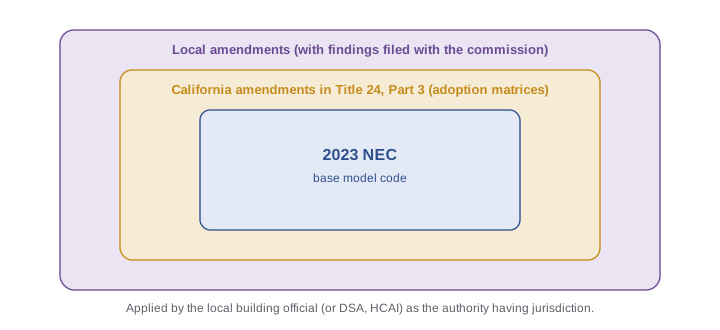
The printed California Electrical Code shows which agency adopted each chapter and article through matrix adoption tables at the start of each chapter. Those tables are how you tell, for example, whether an article applies to a hospital project under HCAI's adoption or to an apartment building under HCD's. California amendments are marked in the text. When you study, look at the adoption matrix for the chapters you use most, because it tells you whether a California amendment is in play for your building type.
| Agency | Buildings it adopts rules for |
|---|---|
| Building Standards Commission | State buildings and buildings not covered by another agency |
| Housing and Community Development (HCD) | Hotels, motels, apartments, dwellings and related housing |
| Division of the State Architect (DSA) | Public schools, community colleges, accessibility for public buildings |
| Health Care Access and Information (HCAI) | Hospitals, skilled nursing and certain clinics |
| State Fire Marshal (SFM) | Fire and life safety in specific occupancies such as high-rise and assembly |
| California Energy Commission | The Energy Code (Part 6) |
Local amendments and findings
Cities and counties must enforce Title 24, but they can adopt local amendments that are more restrictive, under the Health and Safety Code. To amend a building standard, a local government must make express findings that the change is reasonably necessary because of local climatic, geological or topographical conditions, and it must file the amendment and findings with the Building Standards Commission before the amendment can be enforced. Typical local electrical amendments deal with things like requirements in wildfire zones, all-electric building ordinances, additional EV charging, permit and inspection procedures, and administrative provisions.
Administrative provisions, such as permit fees, inspection scheduling and who may obtain a permit, are local rules and do not need the climatic, geological or topographical findings. Technical changes to the wiring rules do. On the job, this means two cities a few miles apart can have slightly different electrical rules. Capitol Valley works in Sacramento, Elk Grove and unincorporated Sacramento County, and Elena keeps a binder with each jurisdiction's adopting ordinance and amendments.
Worked problem
Which rule governs?
Capitol Valley is wiring a new single-family home in a city that has adopted a local amendment requiring a dedicated EV-ready circuit in every new garage, more than CALGreen requires. The plans meet CALGreen's minimum but not the local rule. The amendment was adopted with findings and filed with the Building Standards Commission. Which rule must the installation meet?
Show solution
- Title 24, including CALGreen and the Electrical Code, sets the statewide minimum.
- A local government may adopt more restrictive building standards with proper findings filed with the commission.
- This amendment was adopted and filed properly, so it is enforceable in that city.
- The installation must meet the stricter local rule; the plans need revising.
Answer: The local amendment governs because it is more restrictive and properly adopted.
Energy Code and CALGreen pressures on electrical design
Much of what makes California electrical work distinctive comes from Parts 6 and 11 rather than Part 3. The Energy Code has long required lighting controls such as occupancy sensors, daylighting controls and automatic shutoff in nonresidential spaces, and recent editions have added solar photovoltaic requirements for many new buildings and readiness requirements for batteries and heat pumps in new homes. CALGreen requires EV-capable spaces, EV-ready circuits or installed chargers in new construction, with numbers that depend on the building type and size. Electrical contractors must coordinate with the designer's compliance documents, and inspectors check that the installation matches them.
The C-10 exam reference list includes the 2025 California Energy Code, so expect questions on concepts such as lighting controls and on the electrical side of solar and storage. Learn the concepts and the general requirements rather than every number; the exam is closed book, and the questions focus on what a contractor needs to know to install the work correctly.
Reading the CEC like the NEC
Because the California Electrical Code is the NEC with amendments, everything from MELU-101 still applies: the chapter structure, the 90.3 arrangement, mandatory and permissive language, Article 100 definitions and Chapter 9 tables. The section numbers are the same as the 2023 NEC. When someone says 'the code' on a California job, they mean the CEC, and the numbering you learned in the core courses works. The differences are the California amendments, the adoption matrices, and the administrative chapter, which in California is replaced or supplemented by Title 24's own administrative provisions. Marcus is relieved. 'So I am not learning a new code,' he says. 'I am learning which parts California changed, and memorizing what I used to look up.'
Existing buildings and other related parts
Much electrical work in California is in existing buildings: service upgrades, panel replacements, tenant improvements, EV chargers in older garages and solar on existing roofs. Title 24 includes Part 10, the California Existing Building Code, which governs repairs, alterations, additions and changes of occupancy in existing buildings, and the Electrical Code itself addresses existing installations in several articles. Local departments decide how much of an existing system must be brought up to current code when it is altered; a typical approach is that new work must meet the current code while untouched existing work may remain if it is not hazardous. Ask the department before bidding, because the answer can change the scope dramatically.
How to study California's changes
Marcus cannot memorize every California amendment, and the closed-book trade exam does not expect him to. What he can do is know where California tends to differ, recognize the marking that identifies a California amendment in the printed code, and learn the requirements that come up on real jobs: the Energy Code's lighting control concepts, solar and storage readiness, EV charging readiness from CALGreen, and the local rules in the jurisdictions where he works. He reads the preface of the 2025 California Electrical Code, the adoption matrices for the chapters he uses most, and the summary of changes published with the code, and he adds anything that affects daily work to his memory list. 'Study the code you will install,' Dana tells him, 'not every footnote in it.'
Common mistakes
MistakeAssuming California adopts the newest NEC as soon as it is published.
InsteadThe 2025 California Electrical Code is based on the 2023 NEC; California adopts on its own triennial schedule.
MistakeApplying the code edition in force on the day the work is done.
InsteadThe edition is generally set by the permit application date; check local transition rules.
MistakeIgnoring the adoption matrix at the start of each chapter.
InsteadThe matrix shows which state agency adopted each part for which buildings.
MistakeTreating local technical amendments as optional.
InsteadProperly adopted local amendments with filed findings are enforceable and usually more restrictive.
Summary and key terms
- The California Electrical Code is Part 3 of Title 24, the California Building Standards Code.
- The 2025 CEC is based on the 2023 NEC and took effect January 1, 2026; the 2022 CEC was based on the 2020 NEC.
- Title 24 is republished every three years by the Building Standards Commission, with supplements and errata between editions.
- State agencies such as HCD, DSA, HCAI and the State Fire Marshal propose amendments for the buildings they regulate; adoption matrices show which apply.
- Local governments may adopt more restrictive technical amendments with findings filed with the commission.
- The Energy Code (Part 6) and CALGreen (Part 11) drive lighting controls, solar and storage readiness and EV charging requirements.
- Title 24
- The California Building Standards Code, published in parts every three years.
- Building Standards Commission
- The state body that adopts and publishes Title 24.
- Adoption matrix
- The table at the start of each code chapter showing which agency adopted which sections.
- Findings
- The local government's statement that an amendment is needed because of local climatic, geological or topographical conditions.
- CALGreen
- Part 11 of Title 24, the Green Building Standards Code.
Practice problems
Work each problem on paper first, then reveal the answer to check.
A permit was applied for on November 20, 2025, and the work begins in February 2026. Which CEC edition most likely applies?
Show answer
The 2022 CEC, based on the 2020 NEC, because the edition is generally set by the permit application date.
Which Title 24 part sets EV charging readiness requirements?
Show answer
Part 11, CALGreen.
What must a city do before it can enforce a technical amendment to the electrical code?
Show answer
Make express findings based on local climatic, geological or topographical conditions and file the amendment and findings with the Building Standards Commission.
Which agency adopts Title 24 rules for hospitals?
Show answer
The Department of Health Care Access and Information (HCAI), formerly OSHPD.
Lesson quiz · 5 questions
Score 60% or more to complete this lesson.
Create a free account to save your progress, take quizzes and earn a certificate.