
MELU-205 · Lesson 8 of 12 · 19 min
Contractor licensing, insurance and bonding
▶ Video coming soon A video version of this lesson is on the way.
A pass report on the CSLB exams is followed by a bond and fee letter, and the license is not issued, renewed or kept active until the bonds and insurance are on file. This lesson covers the bonds California requires of contractors, the special rules for limited liability companies, workers' compensation and the employee-versus-independent-contractor question, general liability insurance, and the payroll basics the Law and Business exam tests. Amounts and dates are from CSLB and other official sources as of November 2026; bond and insurance rules are changed by statute from time to time, so confirm them before you file.
The contractor bond
Every active California contractor license must have a contractor bond on file with CSLB. CSLB's bond requirements page sets the amount at 25,000 dollars and requires the bond before CSLB can issue an active license, reactivate an inactive license, or renew an active license. The bond must be received at CSLB headquarters within 90 days of its effective date to avoid a gap. It is a surety bond, not insurance for the contractor: it is there to compensate people damaged by the contractor's violations of the License Law, such as homeowners harmed by defective or abandoned work, workers owed wages, and suppliers in certain cases. When a surety pays a claim, it expects to be reimbursed by the contractor, and an unpaid bond claim or a canceled bond can lead to suspension.
Most contractors buy the bond from a surety company and pay an annual premium that depends on the owners' credit and history; a strong applicant might pay a small fraction of the bond amount each year. CSLB's rules also allow a cash deposit in place of a surety bond in some circumstances; check the current procedure if that is relevant.
# Annual premium for a 25,000-dollar contractor bond at a few illustrative premium rates
bond = 25_000
for credit, rate_per_1000 in [("excellent", 4.0), ("good", 8.0), ("fair", 20.0)]:
    premium = bond / 1000 * rate_per_1000
print(f"{credit:<10} {rate_per_1000:>5.1f} per 1,000 -> {premium:>7.2f} dollars a year")excellent 4.0 per 1,000 -> 100.00 dollars a year good 8.0 per 1,000 -> 200.00 dollars a year fair 20.0 per 1,000 -> 500.00 dollars a year
The rates are illustrative; actual premiums come from the surety. The point is that the premium is a small yearly cost, while the bond amount is the most the surety will pay on claims before the contractor must replace it.
The bond of qualifying individual
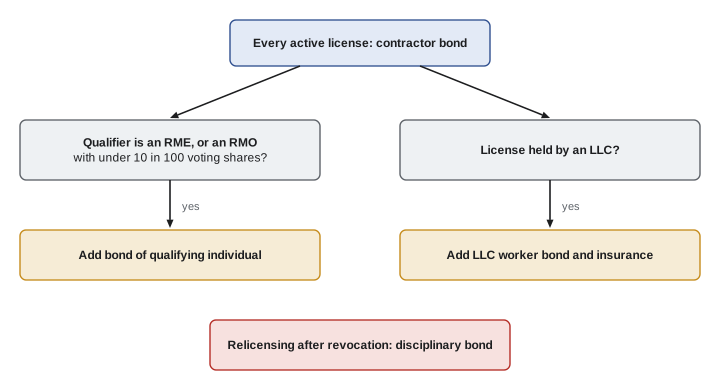
A second 25,000-dollar bond, the bond of qualifying individual, is required when the license is qualified by a Responsible Managing Employee, or by a Responsible Managing Officer who owns less than 10 of every 100 shares of the corporation's voting stock. An RMO who owns 10 or more of every 100 voting shares files a bond of qualifying individual exemption certification instead. Each qualifier must meet the requirement separately. The qualifier's bond exists because the law wants an extra layer of protection when the person with the expertise is not also a substantial owner of the business.
Marcus will be Capitol Valley's RMO and owns no shares, so the corporation must file a bond of qualifying individual for him in addition to the contractor bond already on file. If Elena later sells him a stake of at least 10 of every 100 voting shares, the corporation can file the exemption certification instead.
| Bond | Amount | When required |
|---|---|---|
| Contractor bond | 25,000 dollars | To issue, reactivate or renew any active license |
| Bond of qualifying individual | 25,000 dollars | When the qualifier is an RME, or an RMO owning under 10 of every 100 voting shares |
| Disciplinary bond | Set by the Registrar: at least 25,000 dollars and up to ten times the contractor bond | To reinstate or reissue a license revoked for a License Law violation |
| LLC worker bond | Set by statute (confirm current amount) | For licenses held by limited liability companies |
Disciplinary bonds
A contractor whose license was revoked for a License Law violation must file a disciplinary bond to have the license reinstated or reissued. CSLB's page says the Registrar sets the amount based on the seriousness of the violation, not less than 25,000 dollars and not more than ten times the contractor bond amount. The disciplinary bond is filed in addition to, not instead of, the other required bonds; it must stay on file for at least two years, and the license must remain active while it is on file.
Limited liability companies
California allows contractor licenses to be held by limited liability companies, but because LLC members are shielded from personal liability, the law requires extra protection. An LLC license must carry liability insurance, with minimum coverage that rises with the number of people listed on the license, and must file a special LLC worker bond, separate from the contractor bond, for the benefit of employees owed wages and benefits. The amounts are set in the Business and Professions Code and have been changed over time; read CSLB's current LLC requirements before forming an LLC for contracting. Capitol Valley is a corporation, so these rules do not apply to it.
Workers' compensation
California requires every employer to carry workers' compensation insurance or be approved as self-insured. For contractors, CSLB adds licensing consequences: a license cannot be issued, renewed or reactivated without either a current certificate of workers' compensation insurance or self-insurance on file, or a certificate of exemption stating that the licensee has no employees. A licensee that files an exemption and then hires anyone must obtain coverage and file it with CSLB. Failure to have coverage when required leads to automatic suspension of the license, and local building departments, as Lesson 6 explained, require a workers' compensation declaration before issuing a permit.
California has been moving toward requiring workers' compensation for every contractor, with or without employees. Senate Bill 216 (2022) removed the exemption first for higher-risk classifications such as roofing, concrete, HVAC, asbestos abatement and tree service, and set a later date for the rest. Reporting on later legislation states that the date for all remaining classifications was pushed back to January 1, 2028. Confirm the current status on CSLB's website; for a C-10 contractor with employees, coverage is required now in any case.
Workers' compensation premiums are calculated from payroll by job classification. The insurer applies a rate per 100 dollars of payroll for each class, then adjusts for the contractor's claims history through an experience modification. Electricians are in a construction class with a meaningful rate, and office staff are in a much cheaper clerical class. Misclassifying employees into cheaper classes to lower the premium is fraud.
# Illustrative workers' compensation premium: rate per 100 dollars of payroll, times an experience modifier
classes = [
    ("Electrical wiring (field)", 620_000, 6.10),
    ("Clerical office", 140_000, 0.35),
]
emod = 0.92            # better-than-average claims history
total = 0.0
for name, payroll, rate in classes:
    premium = payroll / 100 * rate
    total += premium
    print(f"{name:<26} payroll {payroll:>8,}  rate {rate:>5.2f} per 100  -> {premium:>10,.2f}")
print(f"{'Manual premium':<26} {total:>40,.2f}")
print(f"{'After modifier 0.92':<26} {total * emod:>40,.2f}")Electrical wiring (field) payroll 620,000 rate 6.10 per 100 -> 37,820.00 Clerical office payroll 140,000 rate 0.35 per 100 -> 490.00 Manual premium 38,310.00 After modifier 0.92 35,245.20
All rates here are invented for the example; real class codes and rates come from the insurer and California's rating bureau. A modifier below 1.00 means the contractor's claims have been better than average for its size and type.
Employee or independent contractor?
Many small contractors try to treat helpers as independent contractors to avoid payroll taxes and workers' compensation. California makes that hard. Labor Code section 2750.5 creates a presumption that a worker performing services for which a contractor's license is required is an employee rather than an independent contractor, and a person who hires an unlicensed worker for licensed work is treated as that worker's employer. On top of that, California's ABC test, in the Labor Code, generally treats a worker as an employee unless the hiring business shows the worker is free from its control, does work outside the usual course of its business, and is customarily engaged in an independently established trade or business. The construction industry has specific provisions, but the practical rule for a C-10 contractor is simple: the electricians and helpers who do your work are your employees.
Worked problem
Can Capitol Valley pay a helper on a 1099?
A friend of one of the electricians offers to help pull wire on weekends and asks to be paid as an independent contractor with no taxes withheld. He has no contractor's license and no business of his own. What does California law say?
Show solution
- Pulling wire for a C-10 contractor is work that requires a license or must be done by the licensee's employees.
- Labor Code section 2750.5 presumes he is an employee, and hiring an unlicensed person for licensed work makes Capitol Valley his employer.
- He also fails the ABC test: he works under Capitol Valley's direction, in its usual business, with no independent trade.
- He must be an employee, covered by workers' compensation and payroll, and as an uncertified worker he cannot do electrical work for a C-10 contractor unless he registers as a trainee in an approved program.
Answer: No. He would be an employee, and he cannot do electrical work at all without certification or trainee registration.
Liability insurance and other coverage
Apart from LLCs, CSLB does not require contractors to carry commercial general liability insurance, but California requires contractors to disclose to home improvement customers whether they carry it, and most commercial customers and general contractors require it by contract with specified limits and additional insured endorsements. Commercial auto insurance covers the company's vehicles, and many contractors carry an umbrella policy above the primary limits. Builders risk insurance, usually bought by the owner or general contractor, covers the work during construction. Lesson 9 covers the contract clauses where these requirements appear.
Payroll basics for the Law and Business exam
Employment requirements are about one in five questions on the Law and Business exam, so the basics of California payroll are worth knowing. An employer registers with the Employment Development Department (EDD) and reports wages and withholds state income tax and State Disability Insurance from employees' pay, while paying Unemployment Insurance and Employment Training Tax as the employer. The EDD's California Employer's Guide (DE 44) explains the rules and is on the exam's reference list. Federal obligations include withholding federal income tax, Social Security and Medicare, paying the employer's share and federal unemployment tax, and verifying eligibility to work on Form I-9; IRS Publication 15 covers the federal side. California also requires itemized wage statements with each paycheck, minimum wage and overtime compliance, meal and rest breaks, and paid sick leave. Public works projects add prevailing wage and certified payroll, covered in Lesson 9.
| Payroll item | Who pays | Agency |
|---|---|---|
| State income tax withholding | Employee (withheld) | EDD |
| State Disability Insurance (SDI) | Employee (withheld) | EDD |
| Unemployment Insurance (UI) | Employer | EDD |
| Employment Training Tax (ETT) | Employer | EDD |
| Federal income tax, Social Security and Medicare | Employee withheld; employer matches Social Security and Medicare | IRS |
| Federal unemployment tax (FUTA) | Employer | IRS |
Checking another contractor's coverage
The same rules that apply to Capitol Valley protect it when it hires others. CSLB's online license lookup shows whether a contractor's license is active, its classifications, its bond and its workers' compensation status. For general liability and auto coverage, contractors exchange certificates of insurance naming the hiring party as certificate holder and, where the contract requires it, as additional insured. A certificate is only evidence of coverage at the time it is issued, so Capitol Valley requests new certificates when policies renew and keeps them with each subcontract.
Common mistakes
MistakeTreating the contractor bond as insurance that protects the contractor.
InsteadThe bond protects people harmed by License Law violations; the surety expects to be repaid by the contractor.
MistakeForgetting the bond of qualifying individual for an RMO with little or no ownership.
InsteadAn RME, or an RMO owning under 10 of every 100 voting shares, needs a 25,000-dollar bond of qualifying individual.
MistakeFiling a workers' compensation exemption and then hiring a helper.
InsteadOnce there is any employee, coverage must be obtained and filed with CSLB, or the license is suspended.
MistakePaying an unlicensed helper as an independent contractor.
InsteadLabor Code section 2750.5 and the ABC test make such workers employees.
Summary and key terms
- Every active license needs a 25,000-dollar contractor bond on file, received within 90 days of its effective date.
- A 25,000-dollar bond of qualifying individual is needed for an RME or an RMO owning under 10 of every 100 voting shares.
- A disciplinary bond of at least 25,000 dollars, up to ten times the contractor bond, is needed to relicense after revocation.
- LLC licenses need liability insurance and an LLC worker bond in addition to the contractor bond.
- A license needs a workers' compensation certificate or an exemption; any employee requires coverage, and lapses suspend the license.
- Labor Code section 2750.5 and the ABC test generally make workers on licensed work employees.
- Surety bond
- A three-party guarantee in which a surety pays valid claims and seeks repayment from the contractor.
- Bond of qualifying individual
- A bond required when the qualifier is an employee or a small shareholder.
- Experience modification
- A multiplier applied to workers' compensation premiums based on claims history.
- ABC test
- California's three-part test for whether a worker is an employee or an independent contractor.
Practice problems
Work each problem on paper first, then reveal the answer to check.
An RMO owns 15 of every 100 voting shares. Does the corporation need a bond of qualifying individual?
Show answer
No; it files a bond of qualifying individual exemption certification instead.
What is the contractor bond amount?
Show answer
25,000 dollars.
What happens if a licensee's workers' compensation policy lapses while it has employees?
Show answer
The license is suspended.
Using an illustrative rate of 6.10 per 100 dollars of payroll, what is the manual premium on 200,000 dollars of electrical payroll?
Show answer
200,000 / 100 x 6.10 = 12,200 dollars.
Lesson quiz · 5 questions
Score 60% or more to complete this lesson.
Create a free account to save your progress, take quizzes and earn a certificate.