
MELU-205 · Lesson 2 of 12 · 19 min
Eligibility for the C-10 Electrical Contractor License
▶ Video coming soon A video version of this lesson is on the way.
Before Marcus spends a single evening on exam practice, he needs to know whether CSLB will let him sit the exams at all. Eligibility for a California contractor license comes down to four things: the right kind of experience, enough of it, a person who can verify it, and a clean background check. On top of that, the license needs a qualifying individual in a role that fits the business structure. This lesson works through each requirement using CSLB's published rules as of November 2026. Confirm the details on the CSLB website or by phone before you apply, because CSLB updates its forms and guidance.
Four years of qualifying experience
CSLB requires at least four years of experience in the classification you are applying for. For the C-10, that means four years of electrical work at journey level or above. CSLB gives credit only for work as a journeyman, foreman, supervising employee, contractor or owner-builder. A journeyman, in CSLB's terms, is a person who has completed an apprenticeship or who is fully qualified to perform the trade without supervision. Time spent as an apprentice or trainee, learning the trade under supervision, does not count as journey-level experience, although a completed apprenticeship can earn credit in its own right, as described below.
CSLB's guidance does not set a strict window on its general experience page, but its applications ask about recent experience and its reviewers look for experience that is current and well documented. If your best electrical years were long ago, call CSLB or read the current application instructions before you rely on them.
Marcus completed a four-year electrical apprenticeship in his home state and has worked as a journeyman since then, including two years as a foreman running service upgrades and tenant improvement jobs for Lakeside Electric. On paper he has six years at journey level or above, so he does not need any training credit.
Credit for training and education
CSLB may grant up to three years of credit toward the four-year requirement for technical training, apprenticeship training or education, but at least one year must be practical, hands-on experience. The amount of credit depends on the credential: a completed apprenticeship certificate in the trade can earn up to three years, a relevant four-year degree up to three years, other four-year degrees and related coursework up to two years, and an associate degree in building or construction management up to one and a half years. The wording is permissive: CSLB may grant credit, so it is not guaranteed, and transcripts must be sent directly to CSLB in sealed envelopes or through the issuing school.
| Credential | Maximum credit CSLB may grant |
|---|---|
| Completed apprenticeship in the classification | Up to 3 years |
| Relevant four-year degree (for example, electrical engineering) | Up to 3 years |
| Other four-year degree or substantial related coursework | Up to 2 years |
| Associate degree in building or construction management | Up to 1.5 years |
| Any combination | Never more than 3 years; at least 1 year must be practical experience |
Worked problem
Does Tyler Brooks qualify yet?
Tyler Brooks, the apprentice from Brightwater Electric in the core courses, finishes his apprenticeship this year and then works three more years as a journeyman before moving to California. He would like to apply for a C-10 as soon as possible. How much credit can his apprenticeship earn, and when could he qualify?
Show solution
- The apprenticeship completion certificate can earn up to 3 years of credit, at CSLB's discretion.
- At least 1 year must be practical journey-level experience, and Tyler will have 3.
- If CSLB grants the full 3 years, Tyler needs only 1 year of journey-level work to reach 4 years; he would qualify after his first year as a journeyman.
- If CSLB grants less credit, his 3 journey-level years plus any credit granted must still reach 4.
Answer: With full apprenticeship credit, after one year as a journeyman; without credit, after four.
# Experience calculator: credit for training is capped at 3 years and at least 1 year must be practical
def qualifies(practical_years, credit_years):
    credit = min(credit_years, 3.0)
    total = practical_years + credit
    ok = practical_years >= 1 and total >= 4
    return total, ok

for who, practical, credit in [("Marcus", 6.0, 0.0), ("Tyler after 1 year", 1.0, 3.0),
                               ("Engineer, no field time", 0.0, 3.0), ("Journeyman with AA degree", 2.0, 1.5)]:
    total, ok = qualifies(practical, credit)
print(f"{who:<26} total {total:.1f} years -> {'eligible' if ok else 'not yet'}")Marcus total 6.0 years -> eligible Tyler after 1 year total 4.0 years -> eligible Engineer, no field time total 3.0 years -> not yet Journeyman with AA degree total 3.5 years -> not yet
The engineer line is the trap: three years of credit plus no field time totals three years, and even with more education, CSLB still requires at least one year of practical experience.
Who can verify the experience
Every experience claim must be certified by someone with firsthand knowledge of the work. CSLB accepts a wide range of verifiers: employers, fellow employees, other journeymen, contractors, foremen or supervisors, union representatives, building inspectors, architects, engineers and homeowners for owner-builder work. The verifier completes the certification section of the application, describing the work and the dates. CSLB can ask for documentation, such as pay stubs, W-2s, union records, permits or tax returns, and an application can be returned, voided or denied if the applicant cannot back up the claim.
Marcus asks Ray Ochoa, the owner of Brightwater Electric, to verify his foreman years, because Ray inspected Marcus's work on several joint jobs, but Dana points out that Ray did not employ him. 'Ask your own boss at Lakeside,' she says. 'Ray only saw a few jobs. Your employer saw six years.' Marcus's Lakeside supervisor signs the certification, and Marcus keeps copies of his W-2s and union dispatch records in case CSLB asks.
Owner-builders who claim experience from building their own projects must submit a construction project experience form for each project. Honesty matters here: falsifying experience is grounds for denial and later revocation, and CSLB does audit applications.
The qualifying individual and business structure
Every California contractor license has at least one qualifying individual. The qualifier is the person whose experience and exam results qualify the license for a classification, and who must exercise direct supervision and control over the work. The qualifier's role depends on how the business is organized.
| Business type | Qualifier role | Notes |
|---|---|---|
| Sole ownership | Sole owner or RME | The owner can qualify personally or employ an RME |
| Partnership | Qualifying partner or RME | A general partner can qualify |
| Corporation | RMO or RME | An RMO is an officer; an RME is an employee |
| Limited liability company | Responsible managing manager, member, officer or RME | LLCs also have special insurance and bond requirements |
| Joint venture | Through the licensed member firms | Each member must hold a license |
A Responsible Managing Officer (RMO) is a bona fide officer of a corporation. A Responsible Managing Employee (RME) is an employee who must be permanently employed by the licensee and actively engaged in its work. Business and Professions Code section 7068 defines 'actively engaged' for an RME as working the lesser of 32 hours per week or 80 out of every 100 hours the business is in operation each week. CSLB also restricts how many licenses one person can qualify at the same time; the conditions, which depend on common ownership between the firms, are in section 7068.1. A retiree who lends a name to a corporation for a monthly fee, with no real involvement, is exactly what the law forbids, and CSLB treats such 'absentee qualifier' arrangements as an enforcement priority.
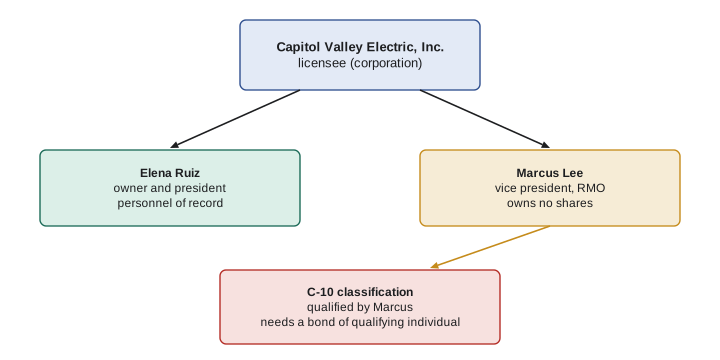
Capitol Valley Electric is a corporation, and Elena owns all of it. Marcus will not own shares, so he can qualify either as an RMO, if Elena appoints him a corporate officer, or as an RME, as a full-time employee. Elena decides to make him vice president of field operations and the RMO. Because Marcus will own less than 10 of every 100 voting shares, Lesson 8 explains that a bond of qualifying individual is required.
Fingerprints and background
All applicants and all personnel of record must be fingerprinted through the Live Scan system and pass a criminal background check through the California Department of Justice and the FBI. CSLB's fee schedule lists a Department of Justice processing fee of 32 dollars and an FBI fee of 17 dollars, plus whatever the Live Scan site charges for the scan itself. Out-of-state applicants who cannot reach a California Live Scan site can use fingerprint cards. A conviction does not automatically disqualify an applicant; CSLB considers whether the offense is substantially related to the duties of a contractor, how long ago it occurred and evidence of rehabilitation. Applicants must disclose convictions honestly; a failure to disclose is itself grounds for denial.
Personnel of record include the qualifier and the owners or officers listed on the license. When Marcus joins Capitol Valley as an officer and qualifier, he must be fingerprinted even though Elena already was.
Other eligibility points
Applicants must be at least 18 years old and must have a Social Security number or individual taxpayer identification number. A corporation or LLC must be registered and in good standing with the California Secretary of State. There is no education requirement to qualify for a contractor license; the exams, not a diploma, test competence. And unlike the DIR certification, which counts hours, CSLB's experience test is measured in years at a level of responsibility.
Some applicants can skip the exams. CSLB may waive the exams for an applicant who has been a qualifier on a California license in the same classification within the past five years for at least five of the previous seven years, and in a few other situations set out in Business and Professions Code section 7065.1. Marcus has never been a California qualifier, so he will sit both exams.
Describing the work so CSLB can credit it
Experience is credited on the strength of what the application says and what the verifier confirms, so the description matters. CSLB reviewers want to see that the work was electrical work within the C-10 scope, done at journey level or above, over continuous, clearly dated periods. A vague line such as 'electrical work, 2019 to 2025' invites questions. A description that names the kinds of installations, the systems involved and the level of responsibility makes the claim easy to verify.
Marcus's first draft read 'journeyman electrician at Lakeside Electric.' Dana pushes him to rewrite it. His final version describes installing services and feeders up to 800 amperes, branch circuits and lighting in tenant improvements, motor circuits and controls for small industrial clients, and two years as a foreman laying out work, ordering material, supervising a crew of four and scheduling inspections. Each period has start and end dates by month, and the dates match his W-2s. Experience gained in another state counts if it is verifiable, which matters for out-of-state candidates like Marcus.
| Weak description | Stronger description |
|---|---|
| Electrical work | Services and feeders to 800 A, tenant improvement branch circuits and lighting |
| Foreman | Foreman: layout, material orders, crew of four, inspection scheduling |
| 2019 to 2025 | March 2019 to June 2025, full time, matching W-2 records |
Common reasons applications come back include an unsigned or incomplete experience certification, a verifier who cannot have seen the work, overlapping or inconsistent dates, experience in a different trade, and missing answers to the background questions. Each return costs weeks, so check every page before mailing or submitting online.
Common mistakes
MistakeCounting apprenticeship time as journey-level experience.
InsteadApprenticeship time is not journey level, but a completed apprenticeship can earn up to three years of credit at CSLB's discretion.
MistakeAssuming education alone can qualify an applicant.
InsteadCredit for education is capped at three years and at least one year must be practical experience.
MistakeAsking a friend who never saw the work to sign the experience certification.
InsteadThe verifier must have firsthand knowledge of the claimed work.
MistakeTreating an RME as a part-time consultant.
InsteadAn RME must be permanently employed and actively engaged for the lesser of 32 hours a week or 80 of every 100 operating hours.
Summary and key terms
- CSLB requires four years of journey-level or higher experience in the classification.
- Up to three years of credit may be granted for apprenticeship, training or education; at least one year must be practical.
- A verifier with firsthand knowledge must certify the experience, and CSLB can ask for documentation.
- Every license has a qualifying individual whose role (sole owner, partner, RMO, RME and so on) depends on the business structure.
- An RME must work the lesser of 32 hours a week or 80 of every 100 operating hours.
- All personnel of record must complete Live Scan fingerprinting and a background check.
- Journey level
- Able to perform the trade without supervision, or having completed an apprenticeship.
- RMO
- Responsible Managing Officer: a corporate officer who qualifies the license.
- RME
- Responsible Managing Employee: a permanent employee who qualifies the license.
- Personnel of record
- The owners, officers, partners and qualifiers listed on a license.
- Live Scan
- The electronic fingerprinting system used for California background checks.
Practice problems
Work each problem on paper first, then reveal the answer to check.
An applicant has 2 years at journey level and a completed apprenticeship certificate. What is the most total experience CSLB could recognize?
Show answer
5 years: 2 practical plus up to 3 years of credit.
Can an applicant with a four-year electrical engineering degree and six months of field work qualify?
Show answer
No. Even with 3 years of credit, at least 1 year must be practical, and 3.5 years is short of 4.
What two roles can qualify a corporation's license?
Show answer
An RMO (an officer) or an RME (an employee).
Name two government agencies that run the background check on CSLB applicants.
Show answer
The California Department of Justice and the FBI.
Lesson quiz · 5 questions
Score 60% or more to complete this lesson.
Create a free account to save your progress, take quizzes and earn a certificate.