
MELU-205 · Lesson 7 of 12 · 21 min
Duties and responsibilities of the C-10 Electrical Contractor License holder
▶ Video coming soon A video version of this lesson is on the way.
Passing the exams makes Marcus eligible to qualify Capitol Valley's license. Becoming the qualifier makes him responsible for it. California law puts real duties on the qualifying individual and on the licensed business, and it holds the qualifier accountable for the license's conduct even when someone else made the mistake. This lesson covers the qualifier's duty of direct supervision and control, the business's duty to use certified electricians, the obligations that come with holding a license, and the grounds on which CSLB can discipline a licensee. Section numbers refer to the Business and Professions Code unless stated otherwise; confirm current wording in CSLB's License Law book.
Direct supervision and control
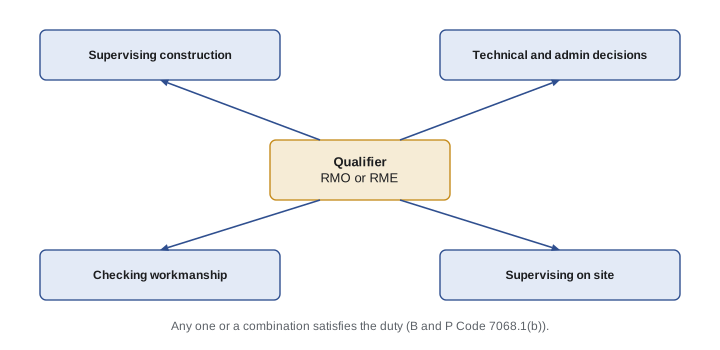
Section 7068.1 requires the qualifying individual to be responsible for exercising the direct supervision and control of the licensee's construction operations to secure compliance with the License Law and the board's rules. CSLB has explained, citing section 7068.1(b), that direct supervision and control includes any one or a combination of these activities: supervising construction, managing construction activities by making technical and administrative decisions, checking on jobs for proper workmanship, or direct supervision on construction sites. The qualifier does not have to stand on every job, but must genuinely run the work.
That is why CSLB warns against the arrangement where a retired licensee serves as a corporation's RMO 'for a monthly fee' without any real involvement. CSLB treats these absentee qualifier arrangements as an enforcement priority. Walt Kessler, Capitol Valley's retiring qualifier, has always come in three days a week, reviewed every bid over a set size, and visited every service upgrade; that is the standard Marcus intends to keep.
An RME, as Lesson 2 explained, must also be permanently employed and actively engaged for the lesser of 32 hours a week or 80 of every 100 hours the business operates. An RMO must be a real officer of the corporation. CSLB limits one person's ability to qualify more than one license at a time, with exceptions tied to common ownership in section 7068.1; check those conditions before agreeing to qualify a second company.
The qualifier is answerable for the license
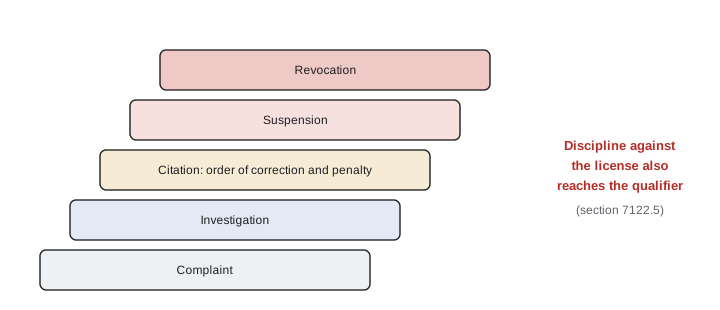
Section 7122.5 provides that an act or omission by the licensee that is grounds for discipline is also grounds for discipline against the qualifying individual, regardless of whether the qualifier knew about or took part in it. That rule surprises many candidates. If Capitol Valley's estimator diverts a customer's deposit, or a foreman covers work without a permit, Marcus's own record is exposed even if he never heard about it. The law gives the qualifier a strong incentive to build systems: permit checks, job close-out checklists, deposit controls and training.
The reverse also applies. A qualifier who commits a disciplinable act exposes the license and the other personnel of record. When CSLB revokes a license, the personnel of record can be barred from serving on another license for a period, and a disciplinary bond may be required to be relicensed, as Lesson 8 explains.
Worked problem
Who is exposed?
Without telling Marcus or Elena, a Capitol Valley foreman connects a homeowner's new subpanel and covers it with drywall before the rough-in inspection, then never calls for the inspection. The homeowner later complains to CSLB. Who can face discipline?
Show solution
- The licensee, Capitol Valley Electric, is responsible for work done under its license and its permit.
- Under section 7122.5, Marcus, as qualifier, can be disciplined for the licensee's act even though he did not know about it.
- Elena, as an officer and personnel of record, is also connected to the license and its record.
- The foreman is not a licensee, but Capitol Valley must deal with the employment issue and correct the work.
Answer: The license and its qualifier, regardless of the qualifier's knowledge; personnel of record share the consequences.
Using certified electricians
Labor Code section 108 and the regulations behind it put a duty on C-10 contractors themselves: the people who perform electrical work for a C-10 contractor must hold a current DIR certification, be indentured apprentices in an approved program, or be registered electrician trainees enrolled in an approved curriculum and working under the constant supervision of a certified electrician. Foremen who work with tools must be certified. Out-of-state electricians must be certified before working in California; DIR states that there is no grace period. Employers using uncertified electricians can be found in violation of Labor Code section 108.2, and CSLB enforces the certification law against licensees.
The certification categories have scopes. A residential electrician may work only on residential projects within that certification's limits; a fire/life safety technician on fire and life safety systems; a voice data video technician on low-voltage communication work; and a non-residential lighting technician on lighting retrofits and controls within that scope. Assigning a residential electrician to a commercial tenant improvement can be a violation even if the work is done well. Capitol Valley's scheduling system now records each worker's certification type and expiration date, and it will not assign a person to a job outside their certification.
| Worker status | May do electrical work for a C-10 contractor? | Condition |
|---|---|---|
| Certified general electrician | Yes | Within the general scope, with current certification |
| Certified residential electrician | Yes, residential work only | Within the residential scope |
| Indentured apprentice | Yes | In a state or federally approved program |
| Registered electrician trainee | Yes | Enrolled in an approved curriculum, under constant supervision of a certified electrician |
| Uncertified, unregistered worker | No | Not unless an exemption applies |
There are exemptions, covered in Lesson 1: the sole owner contractor licensed in their own name, the C-10 qualifying individual for work under that license, workers for C-7 and C-45 contractors within those scopes, and certain minor, theatrical and stationary-engineer work. Marcus is exempt as qualifier, but he decides to earn the General Electrician certification anyway. It lets him work with the crews without any question about his status, it shows the electricians he supervises that he meets the same standard, and it is portable if his role changes.
# Certification audit: flag anyone whose credential does not fit the job or has expired (illustrative data)
from datetime import date
today = date(2027, 3, 1)
crew = [
    ("Ana", "general", date(2028, 5, 1)),
    ("Ben", "residential", date(2027, 9, 1)),
    ("Chris", "trainee", date(2027, 6, 30)),
    ("Dev", "general", date(2027, 2, 1)),
]
job_type = "commercial"
for name, cert, expires in crew:
    issues = []
    if expires < today:
        issues.append("expired")
    if cert == "residential" and job_type != "residential":
        issues.append("outside residential scope")
    if cert == "trainee":
        issues.append("needs constant supervision by a certified electrician")
print(f"{name:<6} {cert:<12} {', '.join(issues) if issues else 'ok'}")Ana general ok Ben residential outside residential scope Chris trainee needs constant supervision by a certified electrician Dev general expired
Duties that come with any license
Holding a license brings routine duties that the Law and Business exam tests. The license number must appear on contracts, bids and advertising, under section 7030.5, and commercial vehicles used in the business must display the business name and license number, under section 7029.5; check the current wording and exceptions. The licensee must report changes in personnel, business name, address and similar information to CSLB within the time the law sets, generally 90 days, under section 7083. A licensee must not let an unlicensed person use its license, must not aid or abet unlicensed contracting (section 7114), and must work only within the classifications on the license, apart from work incidental and supplemental to that classification.
Unsatisfied judgments matter too. If a contractor fails to pay a final court judgment related to its construction activities, CSLB can suspend the license until the judgment is satisfied, and the suspension can extend to other licenses connected to the same personnel. Licensees also must keep records of their construction projects for the period the law requires and make them available to CSLB on request. Section numbers and exact periods should be confirmed in the current License Law book.
Common grounds for discipline
The License Law lists many acts that are grounds for discipline. The ones that appear most often on the exam, and in CSLB complaints, are worth knowing by name. Abandoning a project without legal excuse (section 7107). Diverting funds received for a specific project to another use (section 7108). Willfully departing from accepted trade standards or from plans and specifications without the owner's consent (section 7109). Willfully disregarding building laws, including failing to obtain required permits (section 7110). Aiding or abetting an unlicensed person (section 7114). Willful or fraudulent acts that injure another (section 7116). Contracting outside one's classification, failing to have workers' compensation coverage when required, and failing to comply with home improvement contract rules are also disciplinable.
| Act | Section (confirm in the License Law book) |
|---|---|
| Abandoning a project without legal excuse | 7107 |
| Diverting project funds | 7108 |
| Departing from trade standards or plans without consent | 7109 |
| Willful disregard of building laws, including permits | 7110 |
| Aiding or abetting unlicensed contracting | 7114 |
| Willful or fraudulent acts causing injury | 7116 |
CSLB's tools range from a citation with an order of correction and a civil penalty, to suspension, to revocation. Citations become part of the public license record for a period. Consumers can check a license and its disciplinary history on CSLB's website, and many do before hiring. For a small firm, a public citation can cost more in lost work than the penalty itself.
Marcus's first-week system
Marcus writes a one-page procedure for Capitol Valley and has Elena sign off on it. No job starts without a permit number. Every bid over a set amount crosses his desk. Deposits on home improvement jobs follow the legal limit, and all customer payments go into the operating account with job tracking, never to personal accounts. Each job file holds the permit, approved plans, inspection records and change orders. The scheduling system checks certifications. Marcus visits every job at least once a week and every service upgrade before the final inspection. Walt reads it and nods. 'That's the job,' he says. 'Now you have to actually do it.'
Subcontractors and unlicensed persons
A licensee that hires subcontractors must make sure they are licensed in the right classification. Contracting with an unlicensed person for work that requires a license is grounds for discipline, and as Lesson 8 explains, an unlicensed worker on licensed work may be treated as the hiring contractor's employee for workers' compensation and payroll purposes. Before Capitol Valley hires a subcontractor, for example a C-7 contractor to install a structured cabling system or a concrete contractor to pour equipment pads, the office checks the license on CSLB's website: the classification, the status, the bond and the workers' compensation coverage. The check takes two minutes and is saved to the job file.
Home improvement salespersons are another area where the licensee answers for others. A salesperson who signs home improvement contracts must be registered with CSLB, and the contractor is responsible for the salesperson's conduct and for the contracts signed in its name. Capitol Valley's estimator is registered, and Marcus reviews every home improvement contract form once a year against CSLB's current requirements.
Worked problem
Checking a sub before signing
Capitol Valley needs a trenching subcontractor for a 300-foot underground feeder. A company offers a low price, but its owner says his license is 'being renewed.' What should the office check, and what should Marcus decide?
Show solution
- Look up the license on CSLB's website: classification, status, bond and workers' compensation.
- If the license is expired or suspended, the company cannot contract for the work.
- Hiring it anyway exposes Capitol Valley to discipline and to employer liability for its workers.
- Marcus should wait for the license to show active, or hire a different licensed subcontractor.
Answer: Verify an active license with the right classification before signing; otherwise do not hire.
Common mistakes
MistakeThinking the qualifier is only accountable for work they personally supervised.
InsteadSection 7122.5 makes the qualifier answerable for the licensee's disciplinable acts regardless of knowledge.
MistakeLetting a registered trainee work alone because the job is simple.
InsteadTrainees must work under the constant supervision of a certified electrician.
MistakeAssigning a residential electrician to commercial work.
InsteadCertification categories have scopes; residential certification covers residential work only.
MistakeLeaving the license number off bids and advertising.
InsteadThe license number must appear on contracts, bids and advertising.
Summary and key terms
- The qualifier must exercise direct supervision and control: supervising construction, making technical and administrative decisions, checking workmanship or supervising on site.
- Absentee qualifier arrangements are an enforcement priority for CSLB.
- Under section 7122.5, the qualifier can be disciplined for the licensee's acts regardless of knowledge or participation.
- C-10 contractors must use certified electricians, approved apprentices, or registered trainees under constant supervision.
- Licenses carry duties: license numbers on bids and ads, reporting changes, staying within classifications and paying construction judgments.
- Common grounds for discipline include abandonment, diversion of funds, departing from plans, permit violations and aiding unlicensed contractors.
- Direct supervision and control
- The qualifier's duty to genuinely run the licensee's construction operations.
- Absentee qualifier
- A qualifier who lends a license without real involvement in the business.
- Personnel of record
- The owners, officers and qualifiers listed on a license.
- Citation
- A CSLB enforcement action that can include an order of correction and a civil penalty.
Practice problems
Work each problem on paper first, then reveal the answer to check.
List the four activities CSLB describes as direct supervision and control.
Show answer
Supervising construction; managing construction by making technical and administrative decisions; checking jobs for proper workmanship; direct supervision on construction sites.
Can a registered electrician trainee work alone on a C-10 job?
Show answer
No. Trainees must work under the constant supervision of a certified electrician.
A licensee spends a homeowner's deposit on another job's materials. Which ground for discipline applies?
Show answer
Diversion of funds (section 7108).
Does the C-10 qualifying individual need DIR certification to do work under that license?
Show answer
No; DIR treats the qualifier as exempt for work under the license, though certification is still useful.
Lesson quiz · 5 questions
Score 60% or more to complete this lesson.
Create a free account to save your progress, take quizzes and earn a certificate.