
MELU-205 · Lesson 3 of 12 · 19 min
Applying, approval and booking the exam
▶ Video coming soon A video version of this lesson is on the way.
Marcus has confirmed his experience and chosen his role. Now he has to put it on paper, get CSLB to accept it, and get himself into a testing center. This lesson walks through the application, the fees, what happens while CSLB reviews it, how a replacement qualifier is handled on an existing license, how to schedule the exams with PSI, and the deadlines that start running once the application is accepted. Every figure here comes from CSLB's published information as of November 2026; fees and procedures change, so check the CSLB website and the current application instructions before you file.
Choosing the right application
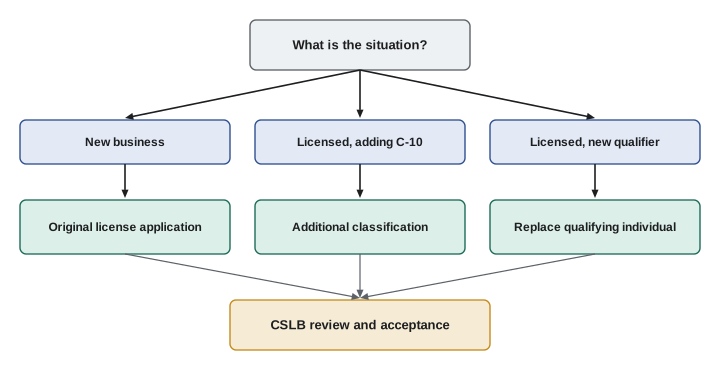
CSLB uses different applications for different situations, and choosing the wrong one costs weeks. A new business applying for its first license files the Application for Original Contractor License, with the exam path or the waiver path. A licensed business adding a classification files an application for an additional classification. And a licensed business replacing its qualifier files an application to replace the qualifying individual. Marcus's situation is the third one: Capitol Valley already holds a corporate C-10 license qualified by Walt Kessler, and Marcus will become the new RMO.
The application asks for the business information, the personnel of record, the qualifier's experience with a signed certification from a verifier, and the qualifier's history: prior licenses, disciplinary actions, and criminal convictions. Each personnel member must sign. Incomplete applications are returned, and a returned application has to be corrected and resubmitted, so it is worth reading every instruction twice.
The fees
CSLB's fee schedule, current when this course was written, lists 450 dollars for an original application, whether by exam or waiver, for one classification. After the exams are passed, the initial license fee is 200 dollars for a sole owner or 350 dollars for any other business type. An additional classification costs 230 dollars on an existing license. Live Scan fingerprinting adds a Department of Justice fee of 32 dollars and an FBI fee of 17 dollars per person, plus the Live Scan site's own rolling fee. Exam fees are paid to PSI, the testing vendor; CSLB's examination FAQ notes that each exam is a separate fee and that a retake requires a re-examination fee paid to PSI. Replacement-qualifier applications have their own fee; read the current application for the amount.
| Item | Fee (CSLB schedule, November 2026) |
|---|---|
| Original application, one classification (exam or waiver) | 450 dollars |
| Initial license fee, sole owner | 200 dollars |
| Initial license fee, other business types | 350 dollars |
| Additional classification on an existing license | 230 dollars |
| Department of Justice fingerprint processing | 32 dollars |
| FBI fingerprint processing | 17 dollars |
| Live Scan rolling fee | Varies by site |
# What would a brand-new corporation pay to get one C-10 license? (fees from the CSLB schedule, November 2026)
fees = {
    "original application": 450,
    "initial license fee (non-sole owner)": 350,
    "DOJ fingerprint processing, 2 people": 32 * 2,
    "FBI fingerprint processing, 2 people": 17 * 2,
}
for item, cost in fees.items():
    print(f"{item:<40} {cost:>5}")
print(f"{'total before exam, Live Scan site and bond costs':<40} {sum(fees.values()):>5}")original application 450 initial license fee (non-sole owner) 350 DOJ fingerprint processing, 2 people 64 FBI fingerprint processing, 2 people 34 total before exam, Live Scan site and bond costs 898
The total leaves out several real costs: PSI's exam fees, the Live Scan site's charge, the bond premium (Lesson 8), and workers' compensation insurance. Budget for all of them.
What happens during review
After CSLB receives an application, a licensing technician reviews it for completeness and checks the experience claim. CSLB may contact the verifier, ask for more documentation, or refer the application for an investigation of the experience. If something is missing, CSLB returns or rejects the application with a letter explaining what to fix. When the application is complete and CSLB is satisfied, it is accepted and the applicant is scheduled for, or authorized to schedule, the exams. CSLB publishes current processing times on its website; they vary through the year, so check before you plan around them.
Background checks run in parallel. If Live Scan results reveal a conviction, CSLB reviews it under its criteria for substantial relationship and rehabilitation. That review can add time, so applicants with a record should submit any evidence of rehabilitation with the application rather than waiting to be asked.
The 18-month clock
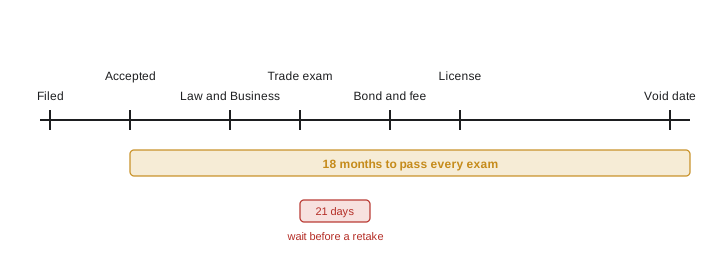
Once CSLB accepts an application, the applicant has 18 months from the acceptance date to take and pass every required exam. CSLB's examination FAQ is blunt about it: if you fail to take and pass the exams within 18 months, your examination eligibility expires, and you must file a new application and pay the fees again. The last day is called the void date, and it is printed on your paperwork.
Retakes are allowed, but not immediately. A candidate who fails must wait 21 calendar days before retaking an exam, and the retake must happen before the void date. The FAQ points out the consequence: if you took an exam within three weeks of your void date and failed, that was your last opportunity. No maximum number of attempts is stated, so the real limit is the 18-month window and the 21-day gap.
# How many attempts fit before the void date? (21-day wait between attempts, 18-month window)
from datetime import date, timedelta

accepted = date(2027, 1, 11)
void_date = date(2028, 7, 11)          # 18 months after acceptance, as an example
first_try = accepted + timedelta(days=30)
attempts = []
d = first_try
while d <= void_date:
    attempts.append(d)
    d += timedelta(days=21)
print("first attempt:", attempts[0], " last possible attempt:", attempts[-1])
print("maximum attempts if every one failed:", len(attempts))first attempt: 2027-02-10 last possible attempt: 2028-06-28 maximum attempts if every one failed: 25
The arithmetic is generous, but the lesson is that waiting until late in the window removes the safety net. Marcus plans to sit the Law and Business exam within six weeks of acceptance and the trade exam two weeks later.
Scheduling with PSI
CSLB contracts with PSI Exams to deliver its examinations on computer at PSI testing centers in California. After acceptance, the candidate receives instructions for scheduling each exam with PSI. Each exam is scheduled separately, and the Law and Business exam and the C-10 trade exam can be taken on different days. To reschedule without losing the fee, the candidate must contact PSI at least two days before the appointment; a missed appointment forfeits the fee.
On test day, the candidate must present valid, non-expired, government-issued photo identification, such as a driver license, state ID card, passport, permanent resident card, U.S. military ID or employment authorization card, and the name on the application must match the ID exactly. Marcus updates his driver license to California before booking, because his application lists his new Sacramento address and a mismatch could cause trouble at check-in.
Language support is limited. CSLB offers Spanish versions of ten commonly taken exams, including the Law and Business exam, but not the C-10 trade exam. For other exams and languages, an approved translator may accompany the candidate under CSLB's rules.
After passing
At the end of each exam, PSI gives the candidate a printed report showing pass or fail. A passing report does not show the score; a failing report shows the overall score and the number of items answered correctly. CSLB does not release results by phone and does not let candidates review questions or answer keys. A pass report is not a license. After passing all required exams, the candidate receives a bond and fee letter by mail, explaining what to file: the contractor bond, any bond of qualifying individual, proof of workers' compensation insurance or a certificate of exemption, and the initial license fee. Lesson 8 covers those requirements. The license is issued once everything is on file.
Replacing a qualifier on time
For an existing license like Capitol Valley's, timing is critical. When a qualifier disassociates from a license, the licensee must notify CSLB and replace the qualifier within the period the law allows; Business and Professions Code section 7068.2 sets that period, commonly 90 days from disassociation, and if no qualified replacement is in place by the deadline the license is suspended. Because a replacement must pass the exams before qualifying, the replacement should file well before the current qualifier leaves.
Elena, Walt and Marcus agree on a plan: Marcus files now, sits the exams while Walt is still the qualifier, and Walt disassociates only after Marcus's exams are passed and the replacement paperwork is ready. That way, the license never depends on the 90-day window at all. 'Never let a deadline be your plan,' Walt tells Marcus. 'Let it be your backup.'
Worked problem
Working back from a retirement date
Walt plans to disassociate on December 31, 2027. CSLB has accepted Marcus's application on January 11, 2027. Marcus wants to pass both exams with enough time for one retake of each before Walt leaves, and he estimates six weeks to get the bond, fee and replacement paperwork processed. What is the latest date he should plan to take his first attempts?
Show solution
- Walt leaves December 31, 2027; subtract six weeks for paperwork, giving about November 19, 2027.
- Allow one retake of each exam: a 21-day wait, so subtract another three weeks for a retake, giving about October 29, 2027.
- Sitting the two exams on different days adds a few days; plan the first attempts by about mid-October 2027.
- Everything is well inside the void date of July 2028.
Answer: First attempts by about mid-October 2027, though earlier is better.
Waivers and reciprocity
Two routes can reduce the number of exams. The first is the waiver path described in Lesson 2: an applicant who has served as a qualifier on a California license in the same classification for the required period can ask CSLB to waive the exams under Business and Professions Code section 7065.1. The second is reciprocity. CSLB has reciprocity agreements with a small number of states for certain classifications, which can waive the trade exam for a contractor licensed in good standing in the other state for a set period. Reciprocity does not waive the Law and Business exam, because that exam tests California law. Check CSLB's current list of reciprocal states and classifications before relying on it; Marcus's home state is not on the list, so he takes both exams.
A pre-submission checklist
Elena's office manager has filed several CSLB applications over the years, and she keeps a checklist to avoid returns. The application type matches the situation. Every personnel member has signed. The qualifier's experience section is complete, with month-by-month dates and a detailed description. The verifier has firsthand knowledge and has signed and dated the certification, with contact information. All background questions are answered, with explanations attached for any yes answers. Live Scan forms are ready for each person who needs them. The corporation's Secretary of State registration is active and the name matches exactly. The fee is enclosed or paid online. A copy of everything goes into the file.
| Check | Done? |
|---|---|
| Correct application type | Replace qualifying individual |
| All signatures | Elena and Marcus |
| Experience dates and description | Month by month, detailed |
| Verifier with firsthand knowledge | Lakeside supervisor |
| Background questions answered | Yes, all |
| Live Scan | Scheduled for Marcus |
| Corporate status and exact name | Active, matches |
| Fee and copies | Paid and filed |
If CSLB returns an application, read the letter carefully, fix every item it lists, and resubmit promptly with the letter. If CSLB denies an application, for example on background grounds, the letter explains the applicant's rights to request a hearing. A denial is not the same as a return for missing information, and it calls for a different response.
Common mistakes
MistakeFiling an original license application when the business only needs to replace its qualifier.
InsteadUse the application to replace the qualifying individual; an original application is for a new license.
MistakeWaiting until late in the 18-month window to take the exams.
InsteadA failure within 21 days of the void date leaves no chance to retake; schedule early.
MistakeAssuming the pass report is the license.
InsteadThe pass report is followed by a bond and fee letter; the license issues only after the bond, insurance and fee are filed.
MistakeShowing up with an ID whose name does not match the application.
InsteadThe name on the application must match the government photo ID exactly.
Summary and key terms
- Choose the correct CSLB application: original, additional classification, or replace the qualifying individual.
- CSLB lists 450 dollars for an original application and 200 or 350 dollars for the initial license fee; exam fees are paid to PSI.
- An accepted application gives 18 months to pass every exam; the last day is the void date.
- A failed exam can be retaken after 21 calendar days, but only before the void date.
- PSI administers the computer-based exams; candidates need matching government photo ID.
- A pass report leads to a bond and fee letter; the license issues after the bond, workers' compensation proof and fee are filed.
- Void date
- The date 18 months after acceptance when exam eligibility expires.
- PSI
- The testing vendor CSLB contracts to deliver its exams.
- Bond and fee letter
- The CSLB letter sent after passing that lists what must be filed before a license issues.
- Disassociation
- A qualifier leaving a license, which starts the deadline to replace them.
Practice problems
Work each problem on paper first, then reveal the answer to check.
How long after a failed CSLB exam must a candidate wait to retake it?
Show answer
21 calendar days.
How long does an accepted application remain valid for passing the exams?
Show answer
18 months from acceptance.
What does a failing score report show that a passing report does not?
Show answer
The overall score and the number of items answered correctly.
Which CSLB exam has a Spanish version: Law and Business or C-10 trade?
Show answer
Law and Business; the C-10 trade exam is not on the list of Spanish versions.
Lesson quiz · 5 questions
Score 60% or more to complete this lesson.
Create a free account to save your progress, take quizzes and earn a certificate.