
MELU-205 · Lesson 12 of 12 · 23 min
Practice exam review and test-day strategy
▶ Video coming soon A video version of this lesson is on the way.
This final lesson pulls the course together for exam day. It reviews the facts most likely to appear on CSLB's Law and Business exam and on the C-10 trade exam, works a set of mixed practice problems of the kind both exams use, and lays out a study plan and a test-day routine built for closed-book exams. Practice questions here are original and written from CSLB's published exam outlines; they are not actual exam questions. Values from the electrical code are the ones taught in the MELU core courses; check them against your own copy of the 2025 California Electrical Code.
Six weeks out: the plan
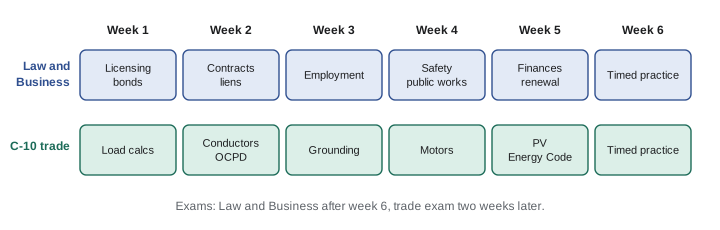
Marcus's CSLB application was accepted in January, and he has booked the Law and Business exam for late February and the C-10 trade exam for early March. Dana helps him build a six-week plan around the exam weights. Because contracts and employment are about 41 of every 100 Law and Business questions, and planning, estimating and rough wiring are about 55 of every 100 trade questions, those areas get most of the time. Because both exams are closed book, every study session ends with a short recall drill: write down the key numbers from memory, then check them.
| Week | Law and Business focus | C-10 trade focus |
|---|---|---|
| 1 | Licensing, qualifiers, bonds (Lessons 1, 2, 7, 8) | Load calculations and Ohm's law refresh (MELU-102) |
| 2 | Home improvement contracts and liens (Lesson 9) | Conductors, overcurrent protection, voltage drop (MELU-103) |
| 3 | Employment, payroll and workers' compensation (Lesson 8) | Grounding and bonding (MELU-104) |
| 4 | Safety and Cal/OSHA (Lesson 10); public works | Motors, transformers, troubleshooting (MELU-105) |
| 5 | Business finances; renewal (Lesson 11) | Special occupancies, PV and Energy Code concepts (MELU-106, Lesson 5) |
| 6 | Full timed practice and weak areas | Full timed practice, memory list and weak areas |
Law and Business: the numbers to know cold
Most Law and Business questions turn on a rule, a deadline or a limit. Here are the ones this course has covered that are most likely to appear, gathered in one place for recall drills.
| Topic | Rule or number |
|---|---|
| Experience | 4 years at journey level or above; up to 3 years of credit; at least 1 year practical |
| RME activity | Lesser of 32 hours a week or 80 of every 100 operating hours |
| Exam eligibility | 18 months from acceptance; retake after 21 days |
| Contractor bond | 25,000 dollars |
| Bond of qualifying individual | 25,000 dollars for an RME or an RMO with under 10 of every 100 voting shares |
| Home improvement contract | Written over 500 dollars; down payment the lesser of 1,000 dollars or 10 in 100 |
| Right to cancel | 3 business days, or 5 for buyers 65 or older; refund within 10 days |
| Preliminary notice | Within 20 days of first furnishing |
| Lien recording | 90 days after completion; 60 (direct contractor) or 30 (others) after a notice of completion |
| Lien foreclosure | Suit within 90 days after recording |
| Serious injury report | Cal/OSHA within 8 hours |
| Renewal | Active license every 2 years; inactive every 4; DIR certification every 3 with 32 hours |
Business finances: markup, margin and overhead
Business finances are about 15 of every 100 Law and Business questions, and the most common calculation is the difference between markup and margin. Markup is profit expressed as a share of cost; margin is profit expressed as a share of the selling price. A contractor who confuses them underprices every job.
# Markup versus margin
def price_from_markup(cost, markup):
    return cost * (1 + markup)

def margin(price, cost):
    return (price - cost) / price

cost = 10_000
for m in [0.20, 0.25, 0.50]:
    p = price_from_markup(cost, m)
    print(f"markup {m:.2f} -> price {p:,.0f}, margin {margin(p, cost):.4f}")

# Price needed to earn a target margin
target = 0.20
print(f"for a 0.20 margin on cost {cost:,}, price = {cost / (1 - target):,.0f}")markup 0.20 -> price 12,000, margin 0.1667 markup 0.25 -> price 12,500, margin 0.2000 markup 0.50 -> price 15,000, margin 0.3333 for a 0.20 margin on cost 10,000, price = 12,500
A 25 in 100 markup on a 10,000-dollar cost gives a 12,500-dollar price and a margin of 20 in 100. To earn a 20 in 100 margin, divide the cost by 0.80. The exam may also ask about overhead allocation, break-even, cash flow and the difference between job costs and overhead; the NASCLA guide on the reference list covers them.
Worked problem
Pricing a tenant improvement
Capitol Valley's estimate for an office tenant improvement shows 18,000 dollars in materials and 22,000 dollars in labor, including payroll burden. The company applies a markup of 15 of every 100 dollars of direct cost for overhead and then 10 of every 100 dollars for profit, applied to cost plus overhead. What is the bid price, and what share of the price is profit?
Show solution
- Direct cost is 18,000 plus 22,000, which is 40,000 dollars.
- Overhead at 15 in 100 of 40,000 is 6,000, so cost plus overhead is 46,000.
- Profit at 10 in 100 of 46,000 is 4,600, so the price is 50,600.
- Profit as a share of the price is 4,600 divided by 50,600, about 0.091, or about 9 of every 100 dollars.
Answer: Bid 50,600 dollars; profit is about 9 of every 100 dollars of the price.
C-10 trade: the memory list
The trade exam is mostly NEC knowledge applied to installation, estimating and troubleshooting, without the book. Lesson 4 started a memory list; here it is expanded with formulas. Practice writing it from memory until you can do it in ten minutes.
| Item | Value or formula taught in the core courses |
|---|---|
| Power, single phase | P = V x I (resistive); with power factor, P = V x I x PF |
| Power, three phase | P = 1.732 x V x I x PF |
| Continuous loads | Size the circuit at 125 of every 100 of the continuous load |
| Small-conductor limits (copper) | 14 AWG at 15 A, 12 AWG at 20 A, 10 AWG at 30 A |
| Motor branch-circuit conductors | 125 of every 100 of the motor full-load current from the code table |
| Voltage drop, single phase | VD = 2 x K x I x L / CM, with K about 12.9 for copper |
| Box fill (per conductor) | 14 AWG 2.00, 12 AWG 2.25, 10 AWG 2.50 cubic inches |
| Working space | At least 30 in wide, 6.5 ft high; depth depends on voltage and condition |
# Two quick trade calculations of the kind the C-10 exam uses
# 1) Voltage drop on a 120-volt branch circuit: 12 AWG copper (6,530 circular mils), 16 A, 90 ft one way
K, I, L, CM = 12.9, 16, 90, 6530
vd = 2 * K * I * L / CM
print(f"voltage drop {vd:.2f} V = {vd / 120:.4f} of 120 V")

# 2) Box fill: four 12 AWG conductors, two 12 AWG grounds counted once, one device yoke counted as two 12 AWG
volume_12 = 2.25
count = 4 + 1 + 2
print(f"required box volume {count * volume_12:.2f} cubic inches")voltage drop 5.69 V = 0.0474 of 120 V required box volume 15.75 cubic inches
The voltage drop is about 5.7 volts, about 4.7 of every 100 volts of 120. That is above the common informational recommendation of no more than 3 in 100 for a branch circuit, so a designer would usually upsize to 10 AWG, and an exam question might ask exactly that. The box needs 15.75 cubic inches. Both calculations rely on values you must remember, because the book will not be there.
A mixed practice set
Work these without notes, then check the answers at the end of the lesson in the practice section. They mix the two exams the way your study sessions should.
- A homeowner's contract price is 14,200 dollars. What is the most Capitol Valley may collect as a down payment?
- A subcontractor first delivers materials on April 3. By when should it serve its preliminary notice to protect all of its work?
- An RMO owns 5 of every 100 voting shares. Which bond is needed besides the contractor bond?
- An electrician is hospitalized overnight for surgery after a fall at 9 a.m. By what time must Cal/OSHA be notified?
- A 30-ampere continuous load is supplied by a branch circuit. What is the minimum ampacity required before any other adjustment?
- A registered electrician trainee is sent alone to replace receptacles. Is this allowed?
- An owner records a notice of completion on September 10. By when must Capitol Valley, as a direct contractor, record a lien?
- Capitol Valley's license expired eight days ago because the renewal arrived late. May the crew keep working until CSLB processes the renewal?
Test day
The day before, Marcus stops studying at dinner time, packs his government photo ID and confirmation, and checks the route to the PSI center. He arrives early on exam day, because late arrivals can lose their appointment and fee. The testing room allows no books, notes or phones; a calculator is provided on the computer. With three and a half hours for each exam, he budgets about a minute and a half per question, keeps half an hour for review, and, where the testing software allows it, marks questions he wants to revisit.
His question routine is the one Dana taught him for open-book exams, adjusted for closed book: read the last sentence first to see what is being asked; underline words like 'not', 'except', 'minimum' and 'maximum'; predict the answer before reading the options; read all four choices, because the exam asks for the best answer; eliminate the clearly wrong ones; and if still unsure, choose, mark and move on. There is no penalty for guessing, so nothing is left blank. On the trade exam, if scratch paper or a board is provided, he writes the recall list on it as soon as he is allowed to, before the first question, so the numbers are in front of him for the whole exam. He checks PSI's candidate bulletin beforehand to see what is allowed.
| Phase | Time (of 210 minutes) | What to do |
|---|---|---|
| First pass | About 150 minutes | Answer every question; mark doubtful ones |
| Review marked questions | About 45 minutes | Rework calculations; reread wording |
| Final check | About 15 minutes | Confirm nothing is blank |
Marcus's results
Marcus passes the Law and Business exam on his first attempt. The printed report says only 'pass', which annoys him for a minute and then delights him. Two weeks later he walks out of the trade exam with another pass. Capitol Valley receives the bond and fee letter, files the bond of qualifying individual and the replacement-qualifier paperwork, and Walt disassociates at the end of the year with Marcus already on the license. That summer Marcus also passes the DIR General Electrician exam, open book with the code provided, and calls Dana from the parking lot. 'After the CSLB exams,' he says, 'having the book felt like cheating.'
If you do not pass the first time
A failing report shows the overall score and the number of items answered correctly, which tells you how far you were from passing but not which questions you missed. Use the exam weights to guess where the points went: if you felt weak on liens or employment, start there. Book the retake for at least 21 days later, and well before the void date. Many candidates pass on a second attempt once the closed-book format is no longer a surprise.
Common mistakes
MistakeCramming new material the night before.
InsteadUse the last evening for a light review of the recall list and logistics.
MistakeChoosing the first plausible answer.
InsteadRead all four choices; the exam asks for the best answer.
MistakeLeaving hard questions blank to come back to and then running out of time.
InsteadAnswer every question on the first pass and mark it; there is no penalty for guessing.
MistakeStudying all topics equally.
InsteadWeight study time by CSLB's published exam weights.
Summary and key terms
- Plan study time by the CSLB exam weights: contracts and employment on Law and Business; planning, estimating and rough wiring on the trade exam.
- Both CSLB exams are closed book, so end every study session with a recall drill.
- Know the key deadlines and limits: down payments, cancellation, preliminary notice, lien deadlines, bonds, injury reporting and renewal cycles.
- Know markup versus margin: margin equals profit divided by price.
- On test day, bring matching photo ID, arrive early, budget time, read all choices and answer every question.
- A pass report leads to the bond and fee letter; the license or qualifier change follows once filings are complete.
- Recall drill
- Writing key rules and numbers from memory, then checking them.
- Markup
- Profit as a share of cost.
- Margin
- Profit as a share of the selling price.
- Scratch paper
- Material the testing center may provide for working calculations; check the candidate bulletin.
Practice problems
Work each problem on paper first, then reveal the answer to check.
A homeowner's contract price is 14,200 dollars. What is the maximum down payment?
Show answer
1,000 dollars, because 10 in 100 of 14,200 is 1,420, and the lesser amount controls.
A subcontractor first delivers materials on April 3. By when should it serve its preliminary notice?
Show answer
Within 20 days, by April 23.
An RMO owns 5 of every 100 voting shares. Which bond is needed besides the contractor bond?
Show answer
A 25,000-dollar bond of qualifying individual.
An electrician is hospitalized overnight for surgery after a fall at 9 a.m., and the company learns of it immediately. By when must Cal/OSHA be notified?
Show answer
Within 8 hours, by about 5 p.m.
What is the minimum ampacity for a branch circuit supplying a 30-ampere continuous load, before other adjustments?
Show answer
37.5 amperes (125 of every 100 of 30).
May a registered electrician trainee work alone replacing receptacles for a C-10 contractor?
Show answer
No. Trainees must be under the constant supervision of a certified electrician.
An owner records a notice of completion on September 10. By when must a direct contractor record a lien?
Show answer
Within 60 days, by November 9.
Capitol Valley's license expired eight days ago. May the crew keep working until the renewal is processed?
Show answer
No. Contracting while expired is unlicensed contracting; a retroactive reinstatement within 90 days restores the record but does not authorize work during the gap in advance.
Lesson quiz · 5 questions
Score 60% or more to complete this lesson.
Create a free account to save your progress, take quizzes and earn a certificate.