
MELU-205 · Lesson 1 of 12 · 23 min
How electrical licensing works in California
▶ Video coming soon A video version of this lesson is on the way.
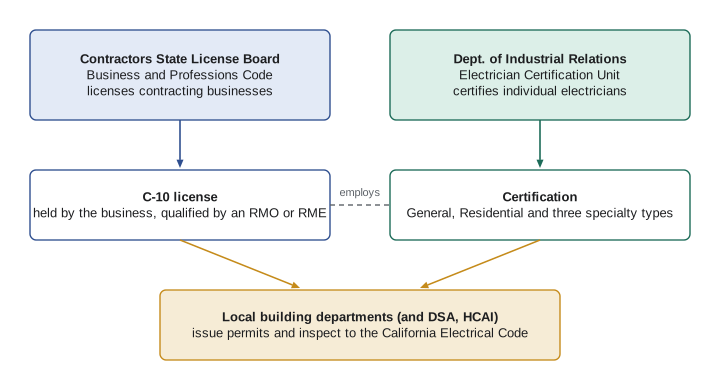
Most of the state courses in this program prepare you for a master electrician exam. California is different, and the difference is the first thing a candidate has to understand. California has no state master electrician license. Instead it splits electrical licensing into two separate systems run by two separate agencies. The Contractors State License Board (CSLB) licenses electrical contracting businesses through the C-10 Electrical Contractor classification. The Department of Industrial Relations (DIR), through its Electrician Certification Unit, certifies the individual electricians who work for those contractors. A person who wants to run an electrical contracting business in California, or to be the licensed person behind one, is aiming at the C-10, and that is what this course prepares you for.
This lesson maps the whole system: who licenses what, which exams belong to which credential, which codes apply, and who enforces them. The rest of the course works through each piece in detail. Licensing rules, fees and exam details change, so treat every number in this course as current when it was written (November 2026) and confirm it with CSLB, DIR and your local building department before you rely on it. The National Electrical Code and the California Electrical Code are cited only by article and section number and explained in our own words; no code text or tables are reproduced.
Marcus heads west
If you studied MELU-101 through MELU-107, you know Marcus Lee: Dana Whitfield's study partner at Lakeside Electric in Harlow, fast with the code index and occasionally careless with the word 'shall'. Marcus has news. His cousin Elena Ruiz owns Capitol Valley Electric, a small electrical contractor in Sacramento with six electricians, two trainees, an estimator and an office manager. Elena is an excellent business owner, but she is not an electrician. For years her firm's license was qualified by an older electrician, Walt Kessler, who is retiring at the end of next year. Elena has asked Marcus to move to Sacramento, join the company as a full-time employee and become its new qualifying individual for the C-10 classification.
Marcus calls Dana on the drive out. 'I assumed California would have a master license like everywhere else,' he says. 'It does not. There is a contractor license from one agency and an electrician certification from another, and they have completely different exams. The contractor exams are closed book. Closed book! I have been tabbing code books for two years.' Dana laughs and offers to study with him by video call twice a week. Their conversations run through the rest of this course.
Two agencies, two credentials
The Contractors State License Board is part of the California Department of Consumer Affairs. Its job is consumer protection in construction: it licenses contractors, investigates complaints, and disciplines licensees and unlicensed operators. The governing law is the Contractors State License Law in the Business and Professions Code, Division 3, Chapter 9, starting at section 7000, together with the board's regulations in Title 16 of the California Code of Regulations, Division 8. CSLB licenses businesses: a sole owner, a partnership, a corporation, a limited liability company or a joint venture. Each license lists one or more classifications, and the electrical classification is C-10.
The Department of Industrial Relations is a different department altogether, focused on workers rather than consumers. Its Electrician Certification Unit runs the program created by Labor Code sections 108 through 108.5, which requires people who perform electrical work for C-10 contractors to be certified electricians, registered trainees or apprentices. The certification regulations are in Title 8 of the California Code of Regulations, sections 290 and following. Certification is a credential for individuals, not businesses, and it has its own exam, open book with the NEC provided at the test site.
| C-10 Electrical Contractor | Certified General Electrician | |
|---|---|---|
| Agency | Contractors State License Board (CSLB) | DIR Electrician Certification Unit |
| Who holds it | A business, through a qualifying individual | An individual worker |
| What it allows | Contracting for electrical work | Performing electrical work for a C-10 contractor |
| Experience | Four years at journey level or above (credit possible) | 8,000 hours of on-the-job experience |
| Exams | Law and Business exam plus C-10 trade exam, closed book | General Electrician exam, open book with NEC provided |
| Renewal | Every two years (active license) | Every three years, with 32 hours of continuing education |
What 'contractor' means in California
California defines contractor very broadly. Under Business and Professions Code section 7026, a contractor is anyone who undertakes, offers to undertake, or submits a bid to construct, alter, repair, add to, subtract from, improve, move, wreck or demolish any building, highway, road, parking facility, railroad, excavation or other structure, project, development or improvement, or any part of one. The definition covers people who do the work themselves and people who arrange for others to do it. Section 7028 makes contracting without a license a crime, and section 7031 bars an unlicensed contractor from suing to collect payment for work that required a license and lets the customer recover what was paid. These are some of the strongest unlicensed-contractor rules in the country, and they explain why a business like Capitol Valley cannot simply keep working after Walt retires: without a qualifier, the license cannot stay active.
There is a minor work exception. Section 7048 exempts work where the total contract price for labor, materials and all other items is under a small threshold, provided the work does not require a building permit and the person does not advertise as a contractor. The threshold was raised by statute in recent years; confirm the current figure in section 7048 before you rely on it. For a professional electrical contractor, the exception is almost irrelevant, because nearly all electrical work requires a permit.
The C-10 classification
CSLB issues three broad license types: Class A General Engineering Contractor, Class B General Building Contractor, and Class C Specialty Contractor, with more than 40 specialty classifications. C-10 Electrical is one of them. The scope of the C-10 classification is set out in the board's regulations (Title 16, CCR section 832.10). In our own words, it covers placing, installing, erecting or connecting any electrical wires, fixtures, appliances, apparatus, raceways, conduits, solar photovoltaic cells or any part of them that generate, transmit, transform or use electrical energy in any form or for any purpose. That last clause matters: solar installations, battery storage and EV chargers all fall within a C-10 contractor's scope.
Other classifications overlap with electrical work. A C-7 Low Voltage Systems contractor installs communication and low-voltage systems, a C-45 contractor installs electric signs, and a C-46 Solar contractor installs solar energy systems. A Class B general building contractor may take a contract involving electrical work only under specific conditions set out in section 7057, generally when the project involves at least two unrelated building trades or the general contractor holds the specialty license or subcontracts the work to an appropriately licensed specialty contractor. In 2024 CSLB also resolved a long-running dispute about which classifications may install battery energy storage systems; check the board's current position before bidding storage work under a classification other than C-10.
Electrician certification for the workforce
Labor Code section 108 and the rules behind it require anyone who performs work as an electrician for a C-10 contractor to be certified, unless an exemption applies. There are five certification categories: General Electrician, Residential Electrician, Fire/Life Safety Technician, Voice Data Video Technician and Non-residential Lighting Technician. People who are not yet certified may work only if they are indentured apprentices in a state or federally approved program, or registered electrician trainees enrolled in a state-approved curriculum, working under the constant supervision of a certified electrician.
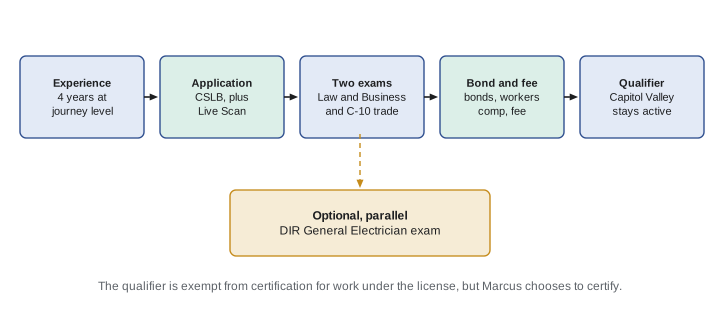
There are exemptions. A sole owner contractor who holds the C-10 license in their own name does not need certification to do work under that license, and the DIR's guidance treats the C-10 qualifying individual the same way. Electricians working for C-7 low voltage or C-45 sign contractors within those classifications' scope are exempt, as is very small work under 100 volt-amperes and certain theatrical, stationary-engineer and similar work. Marcus will be Capitol Valley's qualifier, so he will not strictly need certification for work under the license. He plans to get the General Electrician certification anyway, partly because he wants to work in the field and partly because it helps him supervise. That choice is covered in Lesson 7.
Worked problem
Who needs what at Capitol Valley?
Capitol Valley employs Elena Ruiz (owner, not an electrician), Walt Kessler (current qualifier), Marcus Lee (incoming qualifier), four certified general electricians, one certified residential electrician, two registered electrician trainees and an estimator. Which people need which credential to keep the company working?
Show solution
- The business needs an active C-10 license, which requires a qualifying individual who has passed the exams or qualified by waiver. Walt is the qualifier now; Marcus will replace him.
- The four general electricians and the residential electrician need current DIR certifications, and the residential electrician may work only within the residential scope of that certification.
- The two trainees need current trainee registrations, enrollment in an approved curriculum, and constant supervision by a certified electrician.
- Elena and the estimator do no electrical work and need no electrical credential; Elena, as an owner, appears on the license as personnel of record.
Answer: One C-10 license with a qualifier, plus certifications or trainee registrations for everyone who performs electrical work.
The codes: California Electrical Code and Title 24
California adopts its building codes as Title 24 of the California Code of Regulations, the California Building Standards Code. Part 3 of Title 24 is the California Electrical Code, which is the NEC with California amendments. The California Building Standards Commission publishes Title 24 every three years. The current edition is the 2025 California Electrical Code, which is based on the 2023 NEC and took effect statewide on January 1, 2026. When this course or an exam refers to 'the code' for California work, it means that edition, plus any local amendments a city or county has adopted with the required findings.
Other parts of Title 24 matter to electrical contractors too. Part 6, the California Energy Code, sets lighting control, solar-ready and other energy rules that drive many electrical designs. Part 11, the California Green Building Standards Code (CALGreen), includes the electric vehicle charging readiness requirements. Part 2 (the California Building Code), Part 2.5 (the Residential Code) and Part 9 (the Fire Code) all contain rules that touch electrical installations. The CSLB's C-10 study guide lists the 2025 California Building, Electrical, Energy and Fire Codes among its references. Lesson 5 covers the Electrical Code in detail.
Enforcement: who checks the work
The code is enforced locally. Each city and county building department issues electrical permits and inspects the work in its jurisdiction, and its building official is the authority having jurisdiction. Some kinds of buildings are handled by state agencies instead: the Division of the State Architect for public schools and community colleges, the Department of Health Care Access and Information (formerly OSHPD) for hospitals and certain health facilities, the Department of Housing and Community Development for factory-built housing and some residential matters, and the State Fire Marshal for specific occupancies. Lesson 6 covers permits and inspections.
Worker safety is enforced by Cal/OSHA, the Division of Occupational Safety and Health within DIR. California runs its own state plan, so electrical contractors work under the Title 8 safety orders, including the Electrical Safety Orders and Construction Safety Orders, rather than directly under federal OSHA standards. Lesson 10 covers safety law.
Business conduct is enforced by CSLB, which handles consumer complaints, runs sting operations against unlicensed contractors, and can cite, suspend or revoke licenses. Payroll and wage rules are enforced by the Labor Commissioner (DIR's Division of Labor Standards Enforcement) and by the Employment Development Department for payroll taxes.
The path in outline
For a candidate like Marcus, the path to qualifying a C-10 license runs like this, and each step has its own lesson. First, confirm the experience: at least four years at journey level or above in the electrical trade, with up to three years of credit possible for training or education (Lesson 2). Second, file the application with CSLB, either as a new license or as a replacement qualifier on an existing license, and complete Live Scan fingerprinting (Lessons 2 and 3). Third, once CSLB accepts the application, schedule and pass the Law and Business exam and the C-10 trade exam at a PSI testing center (Lessons 3 and 4). Fourth, file the contractor bond, any qualifier bond, and proof of workers' compensation coverage or an exemption, and pay the initial license fee (Lesson 8). Then the license is issued or updated, and the qualifier takes on legal duties (Lesson 7) and renewal obligations (Lesson 11).
Marcus's case has one twist. Because Capitol Valley already holds a license, Elena does not need a new license; she needs to replace the qualifier. That is done by filing an application to replace the qualifying individual, and the replacement must happen within the deadline the law allows after Walt disassociates. Lesson 3 covers the timing. If Marcus had prior California contracting experience as a qualifier, he might also be eligible for an exam waiver, but he does not.
# Marcus's rough timeline, in weeks (illustrative planning estimates, not official processing times)
steps = [
    ("Gather experience records and verifier", 2),
    ("CSLB application review", 6),
    ("Schedule and sit both exams at PSI", 5),
    ("Bond, workers' comp proof, initial fee", 2),
    ("License record updated", 2),
]
week = 0
for name, weeks in steps:
    week += weeks
    print(f"{name:<42} done by week {week}")
print("Walt retires in 52 weeks; buffer:", 52 - week, "weeks")Gather experience records and verifier done by week 2 CSLB application review done by week 8 Schedule and sit both exams at PSI done by week 13 Bond, workers' comp proof, initial fee done by week 15 License record updated done by week 17 Walt retires in 52 weeks; buffer: 35 weeks
Dana looks at the numbers on her screen. 'Thirty-five weeks with a seventeen-week buffer,' she says. 'Start now. Processing times change, and if you fail an exam you wait three weeks for a retake.' Marcus agrees to file his application within the month.
How this course is organized
Lessons 2 through 4 cover eligibility, the application and booking process, and the two exams. Lesson 5 covers the California Electrical Code and how state and local amendments work. Lesson 6 covers permits and inspections. Lesson 7 covers the duties of the C-10 qualifier and license holder, including the certified electrician requirement. Lesson 8 covers bonds, insurance and workers' compensation. Lesson 9 covers home improvement contracts and mechanics' liens. Lesson 10 covers Cal/OSHA and other workplace law. Lesson 11 covers renewal, inactive status and continuing education for certified electricians. Lesson 12 is a practice review with a test-day plan. The MELU core courses still matter: the C-10 trade exam tests NEC knowledge and calculations, and because it is closed book, the core material has to be in your head rather than in your tabs.
Common mistakes
MistakeAssuming California has a state master electrician license, as many states do.
InsteadCalifornia licenses electrical contractors through CSLB (C-10) and certifies individual electricians through DIR; there is no state master electrician license.
MistakeTreating the DIR certification exam and the CSLB exams as the same kind of test.
InsteadThe DIR certification exam is open book with the NEC provided; the CSLB Law and Business and C-10 trade exams are closed book.
MistakeThinking a Class B general contractor can take any electrical job.
InsteadSection 7057 limits a general building contractor to electrical work within a qualifying multiple-trade project unless it holds the C-10 or subcontracts the work.
MistakeRelying on federal OSHA standards alone.
InsteadCalifornia runs its own state plan; Cal/OSHA's Title 8 safety orders apply.
Summary and key terms
- California has no state master electrician license; it uses a CSLB contractor license (C-10) and DIR individual electrician certification.
- The Contractors State License Law begins at Business and Professions Code section 7000; CSLB regulations are in Title 16 of the CCR.
- Labor Code section 108 requires people doing electrical work for C-10 contractors to be certified, apprentices, or registered trainees under supervision.
- The C-10 scope, set by regulation, includes solar PV and any equipment that generates, transmits, transforms or uses electricity.
- The 2025 California Electrical Code (Title 24, Part 3) is based on the 2023 NEC and took effect January 1, 2026.
- Local building departments enforce the code; Cal/OSHA enforces workplace safety; CSLB enforces contractor law.
- CSLB
- The Contractors State License Board, which licenses and disciplines contractors in California.
- C-10
- The CSLB specialty classification for electrical contractors.
- Electrician Certification Unit
- The DIR unit that certifies individual electricians under Labor Code section 108.
- Qualifying individual
- The person whose experience and exams qualify a contractor license, such as a sole owner, RMO or RME.
- Title 24
- The California Building Standards Code; Part 3 is the California Electrical Code.
Practice problems
Work each problem on paper first, then reveal the answer to check.
Name the two agencies that license or certify electrical work in California and say what each licenses.
Show answer
CSLB licenses contracting businesses (C-10); the DIR Electrician Certification Unit certifies individual electricians.
Which edition of the NEC is the 2025 California Electrical Code based on, and when did it take effect?
Show answer
The 2023 NEC; it took effect January 1, 2026.
Does a registered electrician trainee need supervision, and by whom?
Show answer
Yes. Constant supervision by a certified electrician.
Why can Capitol Valley not simply keep working after its qualifier retires?
Show answer
A license must have a qualifying individual; without one the license cannot stay active, and contracting without an active license is unlawful.
Lesson quiz · 5 questions
Score 60% or more to complete this lesson.
Create a free account to save your progress, take quizzes and earn a certificate.