
MELU-205 · Lesson 6 of 12 · 20 min
Permits, inspections and the inspection authority
▶ Video coming soon A video version of this lesson is on the way.
In California, the code is written in Sacramento but enforced at the counter of every city and county building department. A C-10 contractor's daily relationship with the code runs through permits and inspections, and the Law and Business exam expects candidates to understand how that system works and who is responsible for what. This lesson covers who issues electrical permits, who may obtain them, what inspections to expect, which state agencies take over for certain buildings, and how to handle corrections. Procedures differ from one jurisdiction to the next; always read the local department's current requirements.
The local building official
Every city and county in California must enforce the building standards in Title 24 within its jurisdiction. In incorporated cities, the city building department does it; in unincorporated areas, the county does. The building official, or a delegate such as the chief electrical inspector, is the authority having jurisdiction for most electrical work: the person who interprets the code, approves equipment and methods, issues permits and accepts or rejects installations. The NEC's own language about the authority having jurisdiction, in Article 90 and Article 100, describes the same role in general terms.
Capitol Valley's work takes it into several jurisdictions in a typical month: the City of Sacramento, the City of Elk Grove, unincorporated Sacramento County and, occasionally, Placer and Yolo counties. Each has its own permit portal, fee schedule and inspection request system, and each has adopted the 2025 Title 24 with its own administrative provisions. Marcus spends his first week visiting each counter. 'Same code, five different front doors,' he tells Dana.
Who may obtain a permit
In general, an electrical permit is issued to a contractor licensed in the appropriate classification or to a property owner doing work on their own property as an owner-builder. California law adds conditions to owner-builder permits. Business and Professions Code section 7044 sets out the owner-builder exemption, and local departments require owner-builders to sign a disclosure acknowledging that they are responsible for the work, that hired workers may be their employees for tax and workers' compensation purposes, and that selling a property improved by owner-builder work within a short period can be evidence of contracting without a license. Health and Safety Code provisions require building departments to obtain this verification.
When a contractor applies, the department checks the CSLB license number and classification, and California law (Labor Code section 3800) requires a permit applicant to declare workers' compensation coverage, or a valid exemption, before the permit is issued. That is why proof of coverage, covered in Lesson 8, comes up at the permit counter as well as at CSLB. Many departments now check license status electronically through CSLB's database.
What needs a permit
Most electrical work requires a permit: new circuits, services and feeders, panel replacements, generators, solar and storage systems, EV chargers, and most alterations. Local codes list limited exemptions, typically for minor repairs and replacements such as replacing a receptacle, switch or luminaire on an existing circuit, or for low-voltage work below set thresholds. The exemptions are local administrative rules, so a job that needs no permit in one city might need one in the next. When in doubt, the contractor asks the department, and an email confirming the answer is worth keeping in the job file.
Some work needs additional approvals. Solar and storage systems need utility interconnection approval in addition to the building permit, and California law requires local governments to offer streamlined, often online, permitting for small residential rooftop solar and EV chargers. A growing number of jurisdictions use automated solar permitting tools. Work that affects fire alarm or sprinkler systems may need fire department review, and work in commercial kitchens may involve the health department.
Plan review and the permit set
Small residential jobs are often permitted over the counter or online with a simple application. Larger jobs need plans and plan review: a single-line diagram, panel schedules, load calculations, fault-current and grounding information, Energy Code compliance forms for lighting, and sometimes a short-circuit and coordination study. A licensed engineer often prepares the design for larger commercial work; a C-10 contractor may prepare plans for work it will install, within limits set by the Business and Professions Code for contractors. The approved plans become part of the permit, and the installation must match them. Changes during construction must be submitted as revisions.
Energy Code compliance is documented on forms that travel with the permit: design forms submitted at plan check, installation certificates signed by the installing contractor, and acceptance test forms for certain lighting controls and other systems. In some cases, third-party certified acceptance test technicians must perform and document the tests. Inspectors will not sign off a job whose compliance paperwork is missing.
Inspections
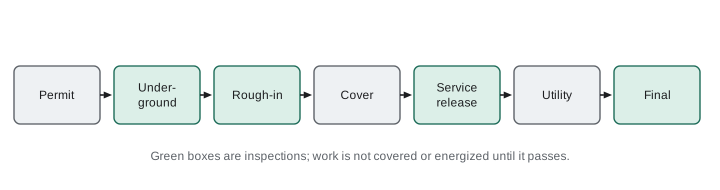
A typical permitted electrical job has several inspections. A temporary power or underground inspection comes first where it applies, covering trenches, conduit and grounding electrodes before they are buried or covered. A rough-in inspection covers boxes, wiring, raceways and grounding before walls are closed. Service and meter release inspections confirm that the service is ready for the utility to energize. A final inspection covers devices, panels, labeling, GFCI and AFCI protection and anything else that could not be seen earlier. Larger projects add inspections for specific systems such as fire alarm, emergency power and solar.
The contractor requests each inspection through the department's system, has the permit card and approved plans on site, and makes the work accessible. Work covered before inspection must be uncovered at the contractor's expense if the inspector asks. When an inspector issues a correction notice, the contractor fixes the items and requests a reinspection; some departments charge a reinspection fee after the first failure.
| Inspection | Typical timing | What is checked |
|---|---|---|
| Underground or trench | Before backfill | Conduit, depth, warning tape, grounding electrode |
| Rough-in | Before insulation and wall cover | Boxes, cable support, raceways, bonding, box fill |
| Service release | Before the utility energizes | Service equipment, grounding, clearances, labeling |
| Final | When work is complete | Devices, panels, GFCI/AFCI, directories, Energy Code items |
State agencies that take over
Some buildings are inspected by state agencies instead of, or in addition to, the local department. Public schools and community college projects are under the Division of the State Architect, which requires DSA-approved plans and a DSA-certified project inspector on site. Hospitals and certain health facilities are under HCAI, which runs its own plan review and inspection. Factory-built and manufactured housing falls under the Department of Housing and Community Development. State-owned buildings may be handled by the state. For a C-10 contractor, these projects mean different procedures, more documentation and sometimes inspectors who are on site every day.
Worked problem
Who inspects the job?
Capitol Valley has four jobs this month: a kitchen remodel in a Sacramento house; tenant improvements in an Elk Grove office; new lighting in a public elementary school classroom wing in the county; and an EV charger installation at a skilled nursing facility. Who is the inspection authority on each?
Show solution
- The Sacramento house: the City of Sacramento building department.
- The Elk Grove office: the City of Elk Grove building department.
- The public school: the Division of the State Architect, with a DSA project inspector, rather than the county.
- The skilled nursing facility: HCAI may have jurisdiction over work in a licensed health facility; Capitol Valley confirms with HCAI and the local department before bidding.
Answer: City, city, DSA and (subject to confirmation) HCAI.
Records and responsibility
The permit, approved plans, inspection records and Energy Code certificates are part of the contractor's job file. Keeping them protects the contractor in disputes and helps with warranty claims. CSLB can discipline a contractor for willful departure from plans and specifications, for building code violations, or for failing to obtain required permits; a pattern of unpermitted work is a common complaint against contractors. Marcus starts a rule at Capitol Valley: no job starts without a permit number in the scheduling system, and no invoice for the final payment goes out until the final inspection is signed.
# Job close-out checklist: a job is ready for final billing only when every item is done
job = {
    "permit issued": True,
    "rough-in inspection passed": True,
    "Energy Code installation certificate signed": True,
    "acceptance tests documented": False,
    "final inspection passed": False,
}
missing = [k for k, done in job.items() if not done]
print("ready to bill final payment" if not missing else "not ready; missing: " + ", ".join(missing))not ready; missing: acceptance tests documented, final inspection passed
Solar, storage and EV permits
California has passed laws to speed up permits for small solar and EV charging projects. A 2014 law required cities and counties to adopt expedited, streamlined permitting for small residential rooftop solar systems, and a 2015 law did the same for electric vehicle charging stations, including checklists and electronic submittal. A later law requires many jurisdictions to offer automated, online permitting for residential solar and storage, using tools such as SolarAPP+, with deadlines that depended on the jurisdiction's population. Confirm what each local department offers; many now issue small solar permits instantly online when the design meets the automated tool's rules.
Interconnection is separate from the building permit. Customers of the large investor-owned utilities interconnect under the California Public Utilities Commission's Rule 21. Customers of municipal utilities follow that utility's own rules. Capitol Valley's home territory is served largely by the Sacramento Municipal Utility District (SMUD), a public utility with its own interconnection process, so Marcus learns both the local building department's permit process and SMUD's interconnection requirements before bidding solar or storage. The building inspection approves the installation; the utility approves the connection and the meter.
| Approval | From | Covers |
|---|---|---|
| Building permit and inspections | City, county or state agency | Code compliance of the installation |
| Interconnection agreement | The serving utility | Connection to the grid, metering, protection settings |
| Permission to operate | The serving utility | Authorization to turn the system on |
Working with inspectors
Inspectors are not adversaries. An inspector who trusts a contractor's work spends less time on its jobs, and that trust is built by having work ready when it is called, the permit card and plans on site, the panel directory filled in, and someone present who knows the job. When an inspector writes a correction, the professional response is to fix it, or, if you believe the inspector is mistaken, to ask politely which section applies and, if needed, take the question to the supervisor or the building official. Arguing on site rarely helps. Marcus asks each department for a short meeting with the chief electrical inspector in his first month. 'I want them to know who is responsible for Capitol Valley's work before they meet me at a failed inspection,' he tells Elena.
Permit fees, expiration and finals
Permit fees are set locally, usually by a fee schedule based on the type and size of the work or the valuation of the project, and plan review may carry its own fee. Permits do not last forever: building codes and local ordinances generally let a permit expire if work does not start, or stops, for a set period, often 180 days, unless the department grants an extension. An expired permit means a new application and, sometimes, the newer code edition. Capitol Valley's scheduling system flags any permit with no inspection in the last 150 days.
Finishing the paperwork is part of finishing the job. A permit that never receives a final inspection stays open in the department's records, which can delay the owner's future permits, complicate a property sale, and reflect badly on the contractor. CSLB complaints sometimes start with a homeowner who discovered years later that the permit for their panel upgrade was never finaled. Marcus adds a monthly report of open permits to Elena's management meeting.
Common mistakes
MistakeAssuming every job is inspected by the city or county.
InsteadPublic schools go through DSA, hospitals and certain health facilities through HCAI, and factory-built housing through HCD.
MistakeCovering work before the rough-in inspection to save time.
InsteadCovered work must be exposed at the contractor's expense if the inspector requires it.
MistakeTreating permit exemptions as the same everywhere.
InsteadExemptions are local administrative rules and vary by jurisdiction.
MistakeForgetting Energy Code paperwork.
InsteadInstallation certificates and acceptance tests are part of the permit; finals can be held up without them.
Summary and key terms
- Local building departments enforce Title 24 and issue electrical permits; the building official is the authority having jurisdiction.
- Permits go to licensed contractors in the right classification or to owner-builders, who must sign disclosures.
- Departments check the contractor's license and require a workers' compensation declaration before issuing a permit.
- Typical inspections are underground, rough-in, service release and final, with system-specific inspections on larger jobs.
- DSA handles public schools, HCAI hospitals and certain health facilities, and HCD factory-built housing.
- Energy Code compliance forms and acceptance tests travel with the permit and are checked at inspection.
- Authority having jurisdiction
- The organization or official responsible for approving installations and enforcing the code.
- Owner-builder
- A property owner who obtains a permit to do work on their own property.
- Correction notice
- An inspector's written list of items that must be fixed before approval.
- DSA
- The Division of the State Architect, which oversees public school construction.
- HCAI
- The Department of Health Care Access and Information, which oversees hospital construction.
Practice problems
Work each problem on paper first, then reveal the answer to check.
Which agency inspects electrical work in a new public elementary school building?
Show answer
The Division of the State Architect, with a DSA project inspector.
What must a contractor show the building department before a permit is issued?
Show answer
A license in the right classification and a declaration of workers' compensation coverage or a valid exemption.
What happens if work is covered before inspection?
Show answer
The inspector can require it to be uncovered at the contractor's expense.
Name two documents besides the permit that the inspector may expect on site.
Show answer
The approved plans and Energy Code compliance forms such as installation certificates.
Lesson quiz · 5 questions
Score 60% or more to complete this lesson.
Create a free account to save your progress, take quizzes and earn a certificate.