
MELU-205 · Lesson 4 of 12 · 17 min
The exam format and the references allowed
▶ Video coming soon A video version of this lesson is on the way.
Marcus's first reaction to California's exams was shock: both CSLB exams are closed book. Everything in the MELU core courses about tabbing, index drills and finding a table fast still helps you learn, but on test day you will not have the book. This lesson describes both exams as CSLB publishes them, explains what 'closed book' means in practice, and builds a study plan around it. It also covers the DIR General Electrician certification exam, which is open book, because many C-10 candidates take both.
Two CSLB exams for every C-10 candidate
A candidate qualifying a C-10 license for the first time takes two exams: the Law and Business exam, which every contractor applicant takes regardless of classification, and the C-10 Electrical trade exam. A candidate who already holds a California license and is adding a classification takes only the trade exam, because the Law and Business exam is a one-time requirement for the qualifier. Each exam is scored and reported separately, and each can be scheduled on a different day.
CSLB's examination FAQ states that all exams are taken on a computer and consist of multiple-choice questions, and that candidates are given three and a half hours to complete each exam. CSLB's study guides describe the format further: each question has four choices with one best answer; some questions require calculations and a calculator is provided; there is no penalty for guessing; and the exam is closed book, with no reference materials allowed in the testing room. CSLB does not publish the passing score on its FAQ page, and a passing report does not show the overall score. Commercial prep schools often quote question counts and passing marks; treat those as unofficial and check CSLB's current study guide and PSI candidate bulletin.
| Feature | Law and Business exam | C-10 Electrical trade exam |
|---|---|---|
| Who takes it | Every first-time qualifier | Every C-10 candidate |
| Format | Computer-based multiple choice, four choices | Computer-based multiple choice, four choices |
| Time allowed | 3.5 hours | 3.5 hours |
| References in the room | None (closed book) | None (closed book) |
| Calculator | Provided | Provided |
| Spanish version | Available | Not on CSLB's list |
| Results | Printed pass or fail report at the end | Printed pass or fail report at the end |
What the Law and Business exam covers
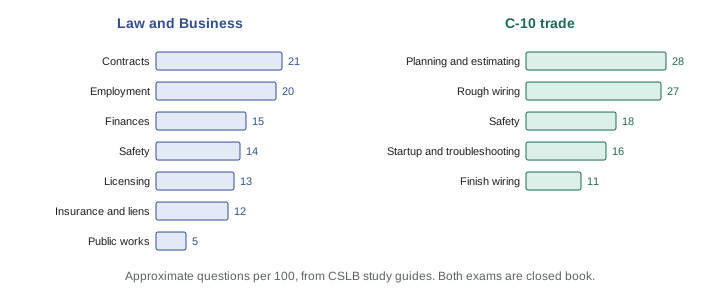
CSLB's Law and Business study guide divides the exam into seven areas with approximate weights. In our own words, rounded as CSLB rounds them: business organization and licensing, about 13 of every 100 questions; business finances, about 15; employment requirements, about 20; insurance and liens, about 12; contract requirements and execution, about 21; public works, about 5; and safety, about 14. Contracts and employment together make up more than four of every ten questions, and they are where California law differs most from other states.
| Area | Approximate share | Covered in |
|---|---|---|
| Business organization and licensing | About 13 in 100 | Lessons 1, 2, 7, 11 |
| Business finances | About 15 in 100 | Lesson 8 and the MELU-107 business course |
| Employment requirements | About 20 in 100 | Lessons 8 and 10 |
| Insurance and liens | About 12 in 100 | Lessons 8 and 9 |
| Contract requirements and execution | About 21 in 100 | Lesson 9 |
| Public works | About 5 in 100 | Lesson 9 |
| Safety | About 14 in 100 | Lesson 10 |
The study guide's reference list tells you where questions come from even though you cannot bring the books: the California Contractors License Law and Reference Book, CSLB's own guides to getting and maintaining a license, the EDD's California Employer's Guide (DE 44), the Labor Code, IRS Publication 15 (the employer's tax guide), DIR's Public Works Manual, the NASCLA Contractors Guide to Business, Law and Project Management, and the Cal/OSHA safety orders. CSLB publishes some of these free, and the License Law book is the backbone of the exam.
What the C-10 trade exam covers
The C-10 study guide divides the trade exam into five areas: planning and estimating, about 28 of every 100 questions; rough wiring, about 27; finish wiring and trim, about 11; startup, troubleshooting and maintenance, about 16; and safety, about 18. Planning and estimating is the biggest single area. It includes reading plans and specifications, load calculations, conductor and conduit sizing, material takeoffs and labor estimating. Rough and finish wiring test installation rules from the California Electrical Code. Safety covers Cal/OSHA's electrical safety orders and safe work practices.
| Area | Approximate share | Where you studied it |
|---|---|---|
| Planning and estimating | About 28 in 100 | MELU-102 load calculations, MELU-103 conductors and raceways |
| Rough wiring | About 27 in 100 | MELU-103, MELU-104 grounding, MELU-106 special occupancies |
| Finish wiring and trim | About 11 in 100 | MELU-103 devices, GFCI and AFCI |
| Startup, troubleshooting and maintenance | About 16 in 100 | MELU-105 motors and transformers |
| Safety | About 18 in 100 | Lesson 10 and Cal/OSHA safety orders |
The study guide's references are the 2025 California Building, Electrical, Energy and Fire Codes, the American Electricians' Handbook, a photovoltaic systems textbook, the Cal/OSHA general industry, construction and electrical safety orders, and Ugly's Electrical References. The inclusion of the Energy Code and a PV textbook is a strong hint: expect questions on lighting controls, solar and storage, not just the classic NEC topics.
Studying for a closed-book code exam
Closed book changes how you study. On an open-book exam you need to know where a rule is; on a closed-book exam you need to know the rule. The good news is that closed-book trade exams test the rules that matter in daily work and the values that come up again and again, not the obscure exceptions. The bad news is that you cannot look up a number you half remember.
Dana and Marcus build a memory list for the trade exam: the values and rules a working electrician should know cold. They include standard overcurrent device ratings; the small-conductor protection limits for 14, 12 and 10 AWG copper; continuous load at 125 of every 100; the general working-space depths, width and headroom; GFCI and AFCI locations for dwellings; box-fill volume allowances by conductor size; the common grounding electrode conductor and equipment grounding conductor sizes; motor branch-circuit sizing at 125 of every 100 of full-load current; and the basic Ohm's law and power formulas for single and three phase. Every one of those topics was covered in the MELU core courses; for California, the task is to move them from your tabs into your head.
# Flash-card drill: shuffle the memory list, track which cards are still weak (deterministic shuffle for the example)
import random
cards = {
    "Small-conductor limit, 12 AWG copper (A)": 20,
    "Continuous load multiplier (per 100)": 125,
    "Motor branch-circuit conductor multiplier (per 100)": 125,
    "Working space width, minimum (in)": 30,
    "Working space headroom, minimum (ft, as 6.5)": 6.5,
    "Standard OCPD just above 100 A (A)": 110,
}
random.seed(205)
order = list(cards)
random.shuffle(order)
for q in order:
print(f"{q:<52} -> {cards[q]}")Working space headroom, minimum (ft, as 6.5) -> 6.5 Continuous load multiplier (per 100) -> 125 Motor branch-circuit conductor multiplier (per 100) -> 125 Small-conductor limit, 12 AWG copper (A) -> 20 Standard OCPD just above 100 A (A) -> 110 Working space width, minimum (in) -> 30
Check every value on that list against your own copy of the 2025 California Electrical Code; the list is a study aid, and the numbers shown are the ones taught in the MELU core courses.
For the Law and Business exam, the memory list is different: deadlines and limits. Home improvement contract thresholds, down payment limits, cancellation periods, lien deadlines, bond amounts, the qualifier's hours, renewal cycles and record-keeping periods all appear on the exam, and all are covered in Lessons 7 through 11.
Time on test day
Three and a half hours is generous. CSLB's guides say plenty of time is provided, and most candidates finish early. The danger is not running out of time but rushing: misreading 'except', or choosing the first plausible answer when the question asks for the best one. With four choices and one best answer, a strong technique is to predict the answer before reading the options, then read all four before choosing. Because there is no penalty for guessing, never leave a question blank; mark it, move on, and come back.
# Time budget for one CSLB exam (CSLB allows 3.5 hours; question count here is an assumption for planning)
minutes = 3.5 * 60
assumed_questions = 120
reserve = 30                      # minutes kept back for review of marked questions
per_q = (minutes - reserve) / assumed_questions
print(f"{per_q:.2f} minutes per question, with {reserve} minutes reserved for review")1.50 minutes per question, with 30 minutes reserved for review
Even with an assumed 120 questions and half an hour kept back, the budget is about a minute and a half per question, which is plenty for most law questions and enough for most calculations.
The DIR certification exam: open book
The DIR Electrician Certification Unit's exam is a different experience. DIR's FAQ, revised in October 2026, describes it as computer-based multiple choice with a minimum passing score of 70 of every 100, based on the NEC code book and the references in the candidate bulletin, with the materials provided at the test site. The General Electrician exam has 100 questions and four hours; the Residential exam has 80 questions and three hours; the Fire/Life Safety, Voice Data Video and Non-residential Lighting exams each have 50 questions and two hours. The application and exam fee is 175 dollars, and a failed exam can be retaken after 60 days for a 100-dollar fee. DIR's pages have named more than one scheduling vendor over the years, so read the current candidate bulletin for scheduling instructions.
For a certification candidate, the MELU-101 index skills apply directly: the book is provided, so finding the rule fast is the skill. Marcus plans to sit the General Electrician exam after his CSLB exams, using the code book provided at the test site.
| Feature | CSLB exams (C-10 and Law and Business) | DIR General Electrician exam |
|---|---|---|
| Book allowed | No | Yes, provided at the test site |
| Time | 3.5 hours each | 4 hours |
| Questions | Not published by CSLB | 100 |
| Pass mark | Not published by CSLB | 70 in 100 |
| Retake wait | 21 days | 60 days |
| Main skill | Knowing rules and values from memory | Finding rules quickly in the provided code book |
Working two practice questions
These original questions show how CSLB-style questions reward careful reading. First: 'A contractor signs a 12,000-dollar home improvement contract at the homeowner's kitchen table. Which is the largest down payment the contractor may lawfully collect?' The choices might be 1,200 dollars, 1,000 dollars, 600 dollars and 120 dollars. The tempting answer is 1,200, ten of every hundred dollars of the price, but the rule is the lesser of 1,000 dollars or that amount, so the best answer is 1,000 dollars. The question tests whether you remember both halves of the rule.
Second: 'Which of the following must be completed before a building is energized by the utility?' with choices such as the final inspection, the rough-in inspection, the service release inspection and the Energy Code acceptance tests. Several are true at some point in a job, but the question asks what must happen before the utility energizes, and the best answer is the service release. Predicting the answer before reading the choices keeps you from grabbing an option that is true but not responsive.
Look at the pattern in both: the wrong choices are not absurd. They are things that are true in other situations, or half of the correct rule. That is why the closed-book exams reward exact recall and close reading rather than general familiarity.
Common mistakes
MistakePlanning to bring tabbed code books to the CSLB exam.
InsteadBoth CSLB exams are closed book; no references are allowed in the testing room.
MistakeQuoting a passing score from a prep school as if it were official.
InsteadCSLB does not publish the passing score in its FAQ; use CSLB's study guides and PSI's bulletin for official details.
MistakeIgnoring the Energy Code and PV references for the trade exam.
InsteadCSLB's C-10 reference list includes the California Energy Code and a photovoltaic systems text.
MistakeLeaving questions blank.
InsteadThere is no penalty for guessing on CSLB exams; answer every question.
Summary and key terms
- First-time C-10 qualifiers take the Law and Business exam and the C-10 trade exam; both are closed book.
- CSLB allows 3.5 hours for each computer-based, four-choice exam, provides a calculator and does not penalize guessing.
- Law and Business weights: contracts about 21, employment about 20, finances about 15, safety about 14, licensing about 13, insurance and liens about 12, public works about 5, per 100.
- C-10 weights: planning and estimating about 28, rough wiring about 27, safety about 18, startup and troubleshooting about 16, finish wiring about 11, per 100.
- Closed-book study means memorizing the rules and values used daily, plus the legal deadlines and limits.
- The DIR General Electrician exam is open book with materials provided: 100 questions, 4 hours, 70 in 100 to pass.
- Closed book
- An exam where no reference materials may be used.
- Best answer
- The single choice that most completely answers the question, even if another choice is partly right.
- Study guide
- CSLB's published outline of exam areas, weights and references for each exam.
Practice problems
Work each problem on paper first, then reveal the answer to check.
What is the largest area on the C-10 trade exam, and about what share does it carry?
Show answer
Planning and estimating, about 28 of every 100 questions.
Which two Law and Business areas together make up about 41 of every 100 questions?
Show answer
Contract requirements and execution (about 21) and employment requirements (about 20).
How long does CSLB allow for each exam?
Show answer
3.5 hours.
How does the DIR General Electrician exam differ from the CSLB exams in the use of references?
Show answer
It is open book with materials provided; the CSLB exams are closed book.
Lesson quiz · 5 questions
Score 60% or more to complete this lesson.
Create a free account to save your progress, take quizzes and earn a certificate.