
MELU-205 · Lesson 11 of 12 · 21 min
Renewal and continuing education
▶ Video coming soon A video version of this lesson is on the way.
Getting the license is a one-time project. Keeping it is a recurring one, and so is keeping the electricians' certifications that the license depends on. This lesson covers CSLB license renewal, inactive status and reactivation, what happens when a license expires or a qualifier leaves, and the renewal and continuing education rules for DIR electrician certifications and trainee registrations. Fees and deadlines are from CSLB's and DIR's published information as of November 2026; confirm them before each renewal, because both agencies adjust fees and procedures.
CSLB license renewal
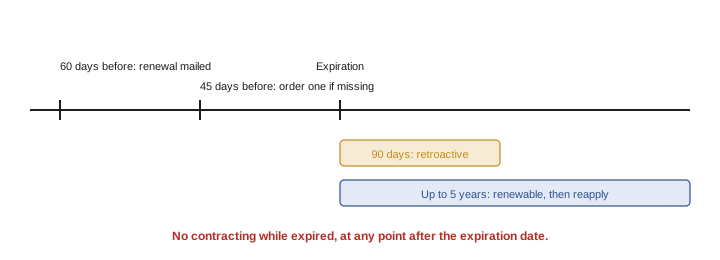
An active California contractor license expires every two years; an inactive license expires every four years. CSLB mails a renewal application about 60 days before expiration, and its renewal page says that if you have not received one within 45 days of the expiration date, you can order one online or by calling CSLB. The completed renewal and fee must reach CSLB before the expiration date to avoid a period of unlicensed status; contracting with an expired license is contracting without a license.
Renewal requires the license to be in good order: the contractor bond and any bond of qualifying individual on file, workers' compensation coverage or an exemption on file, a current qualifier, and, for corporations and LLCs, active status with the California Secretary of State. If the business entity has changed, for example from a sole ownership to a corporation, or a corporation's registration number or ownership has changed, the old license cannot be renewed and the new entity must apply for its own license. CSLB does not currently require continuing education for contractor license renewal.
| Renewal type | Sole owner | Non-sole owner (partnership, corporation, LLC) |
|---|---|---|
| Timely active renewal | 450 dollars | 700 dollars |
| Timely inactive renewal | 300 dollars | 500 dollars |
| Delinquent active renewal | 675 dollars | 1,050 dollars |
| Delinquent inactive renewal | 450 dollars | 750 dollars |
# Renewal cost: timely versus delinquent (CSLB fees, November 2026)
fees = {
    ("sole owner", "active"): (450, 675),
    ("sole owner", "inactive"): (300, 450),
    ("non-sole owner", "active"): (700, 1050),
    ("non-sole owner", "inactive"): (500, 750),
}
for (owner, status), (timely, late) in fees.items():
print(f"{owner:<15} {status:<9} timely {timely:>5} delinquent {late:>5} cost of lateness {late - timely:>4}")sole owner active timely 450 delinquent 675 cost of lateness 225 sole owner inactive timely 300 delinquent 450 cost of lateness 150 non-sole owner active timely 700 delinquent 1050 cost of lateness 350 non-sole owner inactive timely 500 delinquent 750 cost of lateness 250
For a corporation like Capitol Valley, renewing late costs 350 dollars more than renewing on time, and the bigger cost is the risk of contracting while expired.
Expired licenses and reinstatement
If a license expires, CSLB's renewal page describes two relief valves. Under a law known as SB 1474, an expired license can be retroactively reinstated if a completed renewal and the fees are received within 90 days of expiration. A retroactive renewal petition, submitted in writing within 90 days of expiration, must show that the delay was beyond the licensee's control. Beyond that, an expired license can still be renewed within five years of expiration, but after five years the licensee must apply for a new original license. During any period of expiration, the contractor may not contract.
CSLB's renewal page also notes that outstanding Industry Expert Recovery Fees may be due at renewal; those are fees CSLB can recover when it has paid industry experts to investigate a licensee in an enforcement case.
Inactive status and reactivation
A licensee who stops contracting for a while can put the license on inactive status instead of letting it expire. CSLB's renewal page explains that inactive licenses do not require bonds, workers' compensation or a qualifying individual, but the holder cannot actively contract. An inactive license renews every four years at the lower inactive fee. To start contracting again, the licensee files an application for reactivation with the fee, and must have the bonds, workers' compensation proof or exemption, and qualifier in place before the license becomes active.
Worked problem
Walt's own license
Besides qualifying Capitol Valley's license, Walt holds a sole ownership C-10 license in his own name from years ago, which he has kept active with occasional small jobs. After retiring, he wants to keep the license in case he does some work for family. What are his options and costs?
Show solution
- He can keep it active, renewing every two years at 450 dollars as a sole owner, with the contractor bond and workers' compensation proof or exemption on file.
- He can make it inactive, renewing every four years at 300 dollars, with no bond, workers' compensation or qualifier requirement, but he cannot contract while it is inactive.
- If he later wants to work, he files for reactivation and puts the bond and coverage in place first.
- Letting it expire for more than five years would mean starting over with a new application and exams or a waiver.
Answer: Inactive status is the cheapest way to keep the license available without contracting.
When the qualifier leaves
A license cannot remain active without a qualifier. When a qualifier disassociates, the licensee must notify CSLB and replace the qualifier within the period set by Business and Professions Code section 7068.2, commonly cited as 90 days; if it does not, the license is suspended. The departing qualifier also notifies CSLB. As Lesson 3 explained, Capitol Valley's plan avoids relying on that window by having Marcus pass his exams and file to replace Walt before Walt leaves. Personnel changes in general must be reported to CSLB within the time the law sets.
DIR electrician certification renewal
DIR electrician certifications last three years from their effective date. Title 8, section 291.5 requires renewal every three years, with two conditions: proof, under penalty of perjury, of 32 hours of further electrical education from an approved educational provider or a state or federally approved apprenticeship program, relevant to the type of certification; and certification that the electrician worked in the industry for 2,000 hours within the previous three years. The same education hours can count toward more than one certification category. DIR's FAQ lists a renewal fee of 100 dollars per certificate.
Timing matters. The regulation says a renewal application must be postmarked or received at least 30 days before the certification expires to avoid a lapse, and DIR's FAQ says applications can be submitted up to a year before expiration. If a certification lapses, the electrician must retake the certification exam, and DIR's FAQ lists a 200-dollar fee for retaking an expired certification. Continuing education is not required when an electrician retakes the exam.
| Requirement | DIR certification renewal |
|---|---|
| Renewal period | Every 3 years |
| Continuing education | 32 hours from an approved provider or apprenticeship program |
| Work experience | 2,000 hours in the industry in the previous 3 years |
| Fee | 100 dollars per certificate |
| File by | At least 30 days before expiration to avoid a lapse (up to a year early is allowed) |
| If it lapses | Retake the certification exam |
# Continuing education tracker for one certified electrician (hours from approved providers)
courses = [("Code update, 2025 CEC", 8), ("Solar and storage", 8), ("Grounding and bonding review", 4), ("Arc flash safety", 4)]
required = 32
done = sum(h for _, h in courses)
for name, h in courses:
    print(f"{name:<32} {h:>3} hours")
print(f"total {done} of {required}; still needed: {max(0, required - done)} hours")Code update, 2025 CEC 8 hours Solar and storage 8 hours Grounding and bonding review 4 hours Arc flash safety 4 hours total 24 of 32; still needed: 8 hours
Capitol Valley tracks each electrician's expiration date and continuing education hours in its scheduling system, and Elena pays for approved courses. An electrician whose certification lapses cannot work for a C-10 contractor until certified again, so a missed renewal takes a person off the schedule.
Trainee registrations
Registered electrician trainees renew their registration every year until they have the experience hours to sit the certification exam and pass it. DIR's guidance says trainee renewal has no fee and requires proof of continued enrollment in an approved curriculum, such as a transcript, along with employment information; DIR's older guide describes an annual training requirement of 150 hours. A trainee who withdraws from school becomes inactive and may not legally do electrical work for a C-10 contractor. Capitol Valley's two trainees renew each spring, and the office manager collects their transcripts in March.
Apprentices in approved apprenticeship programs follow their program's rules instead of trainee registration, and the program handles their status with the state.
A renewal calendar for Capitol Valley
Marcus builds one calendar for every renewal the business depends on: the corporate C-10 license every two years; the contractor bond and the bond of qualifying individual, which must stay continuously in force; the workers' compensation policy, renewed annually with its certificate filed with CSLB; each electrician's three-year certification and continuing education; the trainees' annual registrations; and the corporation's annual Secretary of State filing. Each item gets a reminder 120 days before it is due. 'The license is only as active as its weakest renewal,' he writes on the whiteboard.
Adding classifications and changing structure
A C-10 license can grow. Capitol Valley is considering adding the C-46 Solar classification, and possibly C-7 Low Voltage Systems, to bid larger solar and structured cabling packages. An existing licensee adds a classification by application, and the qualifier for the new classification must meet its experience requirement and pass its trade exam, unless a waiver applies; the Law and Business exam is not repeated by a qualifier who has already passed it. CSLB's fee schedule lists 230 dollars for an additional classification on an existing license.
Business structure changes are different. A California license belongs to a specific entity. If Elena ever converts Capitol Valley from a corporation to an LLC, or sells the corporation to a new owner whose purchase changes the corporate registration, CSLB's renewal guidance says the old license cannot be renewed and the new entity must apply for its own license. Planning a restructuring therefore includes planning a license application, with enough lead time for the new entity's qualifier and bonds.
Records that keep the license safe
Several records protect the license between renewals. Capitol Valley keeps job files with contracts, change orders, permits, inspection records and lien releases; payroll and certification records for each worker; bond and insurance certificates; safety program records; and copies of every filing with CSLB and DIR. When a complaint arrives, CSLB will ask for documents, and a contractor with complete files can usually resolve a misunderstanding quickly. Marcus also checks Capitol Valley's public license record on CSLB's website every quarter, to confirm that the bond, workers' compensation and qualifier information is correct.
Worked problem
Planning Marcus's own renewals
Marcus will qualify Capitol Valley's license (renewing every two years), hold a General Electrician certification (renewing every three years with 32 hours of education), and the company's workers' compensation policy renews every July. If his certification is issued in August 2027, when must he complete his continuing education?
Show solution
- The certification lasts three years, so it expires in August 2030.
- The renewal must be filed at least 30 days before expiration, so by July 2030.
- The 32 hours must be completed before he files, so he plans to finish by June 2030.
- Spreading the hours over three years, about 11 hours a year, keeps it manageable.
Answer: Complete the 32 hours by about June 2030, ideally spread across the three years.
Common mistakes
MistakeAssuming a CSLB renewal requires continuing education.
InsteadCSLB does not currently require continuing education for contractor renewal; DIR requires 32 hours for certification renewal.
MistakeContracting while a license is expired and planning to reinstate it later.
InsteadContracting during expiration is unlicensed contracting; reinstatement windows do not authorize work while expired.
MistakeKeeping an inactive license and taking a small job.
InsteadAn inactive license cannot be used to contract.
MistakeLetting a certification lapse and expecting to pay a late fee.
InsteadA lapsed DIR certification requires retaking the exam.
Summary and key terms
- Active CSLB licenses renew every two years and inactive licenses every four years; CSLB lists 450 or 700 dollars for timely active renewal.
- Renewal requires bonds, workers' compensation proof or exemption, a qualifier and, for entities, active Secretary of State status.
- An expired license can be retroactively reinstated if the renewal and fees arrive within 90 days, and renewed within five years; after that a new application is needed.
- Inactive licenses need no bond, workers' compensation or qualifier but cannot be used to contract.
- DIR certifications renew every three years with 32 hours of approved education and 2,000 hours of work; lapsed certifications require a new exam.
- Electrician trainees renew registration annually with proof of continued enrollment.
- Inactive license
- A license kept on file without bonds or a qualifier that cannot be used to contract.
- Delinquent renewal
- A renewal received after the expiration date, which carries a higher fee.
- Retroactive reinstatement
- Restoring an expired license back to its expiration date when renewal arrives within 90 days.
- Continuing education
- Approved coursework required to renew a DIR electrician certification.
Practice problems
Work each problem on paper first, then reveal the answer to check.
How often does an active CSLB license renew, and how often does an inactive one?
Show answer
Every two years active; every four years inactive.
What does DIR require to renew a General Electrician certification?
Show answer
32 hours of approved continuing education, 2,000 hours of industry work in the past three years, and the renewal fee.
How much more does a non-sole-owner license pay for a delinquent active renewal than a timely one?
Show answer
1,050 minus 700, which is 350 dollars.
What happens if a DIR certification lapses?
Show answer
The electrician must retake the certification exam.
Lesson quiz · 5 questions
Score 60% or more to complete this lesson.
Create a free account to save your progress, take quizzes and earn a certificate.