
MELU-205 · Lesson 10 of 12 · 19 min
Workplace safety law and OSHA for electrical contractors
▶ Video coming soon A video version of this lesson is on the way.
Safety accounts for about 14 of every 100 questions on the Law and Business exam and about 18 of every 100 on the C-10 trade exam, so a C-10 candidate can expect a substantial share of both exams to test it. In California, workplace safety means Cal/OSHA. This lesson explains how California's state plan relates to federal OSHA, the written programs every employer needs, the rules for reporting serious injuries, the safety orders that matter most to electrical contractors, heat illness and workplace violence requirements, and the employer's duties when an employee is hurt. Title 8 sections are cited by number; confirm current requirements with Cal/OSHA, the Division of Occupational Safety and Health in DIR.
California's state plan
Federal law allows states to run their own occupational safety and health programs if they are at least as effective as federal OSHA. California does, through the Division of Occupational Safety and Health, known as Cal/OSHA, within the Department of Industrial Relations. Its standards are the safety orders in Title 8 of the California Code of Regulations, adopted by the Occupational Safety and Health Standards Board. Many Cal/OSHA rules are stricter than or different from federal rules, so a contractor working in California follows Title 8, not federal 29 CFR, for private-sector work. Marcus has worked under federal OSHA his whole career. 'Same idea, different book,' Dana tells him, 'and the book is stricter.'
| Item | California |
|---|---|
| Agency | Cal/OSHA (Division of Occupational Safety and Health, DIR) |
| Standards | Title 8 safety orders, adopted by the Standards Board |
| Written safety program | Injury and Illness Prevention Program required of every employer (section 3203) |
| Serious injury report | To Cal/OSHA within 8 hours (section 342) |
| Electrical rules | Electrical Safety Orders (low voltage and high voltage) |
| Construction rules | Construction Safety Orders, including a code of safe practices |
The Injury and Illness Prevention Program
Every California employer must establish, implement and maintain a written Injury and Illness Prevention Program (IIPP) under Title 8, section 3203. The IIPP must identify the person responsible for it, include a system for ensuring employees comply with safe work practices, provide for communication with employees on safety matters in a form they readily understand, include procedures for identifying and evaluating hazards through scheduled inspections, procedures for investigating injuries and illnesses, methods for correcting unsafe conditions promptly, and training for employees when they are hired, when they get new assignments, and when new hazards are introduced. Records of inspections and training must be kept. An IIPP that exists only on paper is a common Cal/OSHA citation; inspectors ask employees whether they know it and look for evidence it is followed.
Construction employers have an additional requirement under the Construction Safety Orders: a written code of safe practices relating to the employer's operations, posted at each job site office or provided to each supervisor, and regular toolbox or tailgate safety meetings, generally at least every ten working days. Capitol Valley's foremen hold a fifteen-minute tailgate meeting every other Monday and record attendance, topics and questions on a form that goes into the job file.
# Tailgate meeting schedule: at least every 10 working days (Monday to Friday) on a 6-week job
from datetime import date, timedelta
start = date(2027, 3, 1)               # a Monday
workdays = []
d = start
while len(workdays) < 30:
    if d.weekday() < 5:
        workdays.append(d)
    d += timedelta(days=1)
meetings = workdays[::10]
for m in meetings:
print("tailgate meeting on", m, m.strftime("%A"))tailgate meeting on 2027-03-01 Monday tailgate meeting on 2027-03-15 Monday tailgate meeting on 2027-03-29 Monday
Holding the meeting on the first of every ten working days keeps the job inside the requirement even if a holiday shifts the calendar.
Reporting serious injuries
Title 8, section 342 requires an employer to report every work-related death and every serious injury or illness to Cal/OSHA by telephone or through the designated online method no later than 8 hours after the employer knows, or with diligent inquiry would have known, of it. If the employer can show exigent circumstances, the deadline extends to 24 hours. The report should include the time and date, the employer and reporter, the location, the injured employee's name, the nature of the injury, where the employee was taken and a description of the accident, including whether the scene was altered. 'Serious injury or illness' is defined in Title 8, section 330, and includes things such as inpatient hospitalization for other than medical observation or diagnostic testing, amputation, loss of an eye, and serious permanent disfigurement; read the current definition.
This 8-hour rule is stricter than the federal rule, and it is one of the most testable safety facts on the Law and Business exam.
Worked problem
A fall from a ladder
At 2:15 p.m. on a Thursday, a Capitol Valley electrician falls from a ladder while installing a luminaire and is taken to the hospital, where he is admitted overnight with a broken leg for surgery. The foreman calls Marcus at 2:30 p.m. By what time must Capitol Valley report to Cal/OSHA, and what else must happen?
Show solution
- Inpatient hospitalization for surgery is a serious injury under Title 8's definition.
- Capitol Valley learned of it at about 2:30 p.m.; the report is due no later than 8 hours later, by about 10:30 p.m.
- Unless exigent circumstances can be shown, the 24-hour extension does not apply.
- Capitol Valley must also give the employee a workers' compensation claim form, notify its insurer, investigate the incident under its IIPP, and correct any hazard found.
Answer: Report to Cal/OSHA by about 10:30 p.m. that night, and start the workers' compensation and investigation steps.
The Electrical Safety Orders
Title 8's Electrical Safety Orders are the core electrical safety rules for California workplaces. They are divided into low-voltage rules, for systems up to 600 volts, and high-voltage rules, for systems above that. They cover safe work practices on and near energized equipment, de-energizing and lockout before work, the qualifications and training of workers who may work on energized parts, approach distances, personal protective equipment, temporary wiring, and the condition of electrical equipment. Cal/OSHA also has general lockout and blocking rules in its General Industry Safety Orders that apply to machinery maintenance.
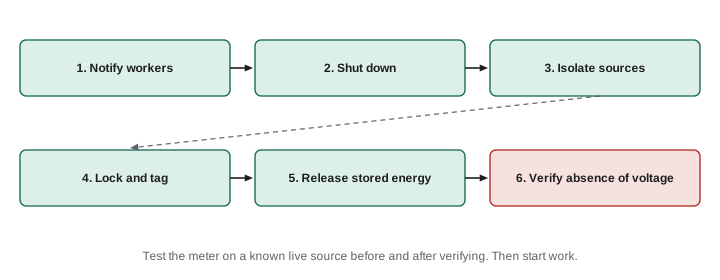
The key principle matches what you learned in the core courses and NFPA 70E: work on electrical equipment should be done de-energized, with lockout and tagout and verification of absence of voltage, unless de-energizing would create a greater hazard or is infeasible. When energized work is justified, only qualified workers with appropriate training, procedures and protective equipment may do it. CSLB's C-10 study guide lists the Cal/OSHA electrical and construction safety orders as references, so expect trade exam questions on lockout steps, testing for absence of voltage, approach to energized parts and temporary power on job sites.
Construction hazards beyond electricity
Electricians are injured more often by falls, ladders, lifting and cuts than by shock. The Construction Safety Orders cover ladders, scaffolds, aerial lifts, fall protection, excavations and trenching, and housekeeping, and electrical contractors are cited under them regularly. Trenches for underground conduit deserve particular attention: Cal/OSHA requires a permit for certain excavations and trenches five feet or deeper that employees will enter, and protective systems such as shoring or sloping are required at depths set by the rules. Check the current excavation rules before digging.
Heat illness and workplace violence
California has specific rules for heat illness prevention. The outdoor heat illness standard, Title 8 section 3395, requires employers with outdoor workers to provide enough fresh water, access to shade when temperatures reach the trigger set in the rule, cool-down rest periods, high-heat procedures above a higher trigger, emergency response procedures, acclimatization for new workers, training and a written heat illness prevention plan. An indoor heat illness standard was adopted in 2024 for indoor workplaces above specified temperatures. For electricians working in attics, on rooftops installing solar, or in summer trenches around Sacramento, these rules are part of daily work.
Since July 1, 2024, most California employers must also have a written workplace violence prevention plan under Labor Code section 6401.9, with training, a violent incident log and hazard correction. The requirement grew out of a 2023 law and is enforced by Cal/OSHA. Construction employers are generally covered unless an exemption applies; check the statute and Cal/OSHA's guidance.
| Program | Source | Applies to Capitol Valley? |
|---|---|---|
| Injury and Illness Prevention Program | Title 8, section 3203 | Yes, every employer |
| Code of safe practices and toolbox meetings | Construction Safety Orders | Yes, construction employer |
| Heat illness prevention plan | Title 8, section 3395 (outdoor) | Yes, outdoor work |
| Workplace violence prevention plan | Labor Code section 6401.9 | Yes, unless an exemption applies |
Records and rates
Cal/OSHA's recordkeeping rules require many employers to keep a log of work-related injuries and illnesses, an annual summary posted for employees, and incident reports, with exemptions for very small and certain low-hazard employers; construction is not a low-hazard industry. Customers and general contractors often ask for a contractor's injury rate and workers' compensation experience modifier when prequalifying bidders. The standard incidence rate formula used by federal and state agencies expresses injuries per 100 full-time workers by multiplying the number of recordable cases by 200,000 hours (100 workers times 40 hours times 50 weeks) and dividing by total hours worked.
# Recordable incidence rate per 100 full-time workers
def incidence_rate(cases, hours_worked):
    return cases * 200_000 / hours_worked

hours = 9 * 2_000          # nine full-time field workers
for cases in [0, 1, 2]:
print(f"{cases} recordable cases in {hours:,} hours -> rate {incidence_rate(cases, hours):.2f}")0 recordable cases in 18,000 hours -> rate 0.00 1 recordable cases in 18,000 hours -> rate 11.11 2 recordable cases in 18,000 hours -> rate 22.22
One recordable case in a nine-person crew gives a rate above 11, which looks alarming on a prequalification form. Small companies' rates swing widely, which is why many customers also look at the experience modifier.
When an employee is hurt: workers' compensation steps
When an employer learns of a work injury, California's workers' compensation system requires prompt action. The employer must give the employee a workers' compensation claim form, commonly within one working day of learning of the injury, and report the injury to its insurer, which files the official report. Medical treatment must be provided through the employer's insurer, and the employer must not retaliate against an employee for filing a claim. These steps run in parallel with the Cal/OSHA report, not instead of it. CSLB can discipline a licensee that fails to carry required workers' compensation coverage, as Lesson 8 explained.
Hazard communication and solar work
Electrical contractors handle chemicals too: cable pulling lubricants, PVC cements and primers, cleaners, sealants and battery electrolytes. Cal/OSHA's hazard communication standard requires employers to keep safety data sheets for hazardous chemicals, label containers, and train employees on the hazards, as part of a written hazard communication program. Battery energy storage adds its own risks: stored energy that cannot be fully switched off, arc flash at DC busbars, and thermal runaway in some chemistries. Manufacturers' installation instructions and the code's storage articles set many requirements, and Capitol Valley trains its crews on each new battery product before the first installation.
Rooftop solar work combines electrical, fall and heat hazards. PV modules produce voltage whenever light falls on them, so module strings cannot be de-energized by a switch the way an AC circuit can; work practices such as covering modules, using rapid shutdown where installed and treating conductors as energized are essential. Fall protection, ladder safety and heat illness rules all apply on the same roof.
Cal/OSHA inspections
Cal/OSHA inspects workplaces after serious injuries, in response to complaints and referrals, and through targeted programs, including construction sites. An inspector may ask to see the IIPP, training records, the code of safe practices, toolbox meeting records, heat illness and workplace violence plans, and the injury log, and will walk the site and talk to employees. Citations can carry civil penalties and require abatement by a set date, and employers have appeal rights. The best preparation is a program that is actually followed: Marcus asks each foreman to keep the job's safety binder in the truck, current and complete.
Common mistakes
MistakeFollowing federal OSHA's reporting timeline in California.
InsteadCal/OSHA requires serious injury and death reports within 8 hours (24 only with exigent circumstances).
MistakeKeeping an IIPP binder nobody reads.
InsteadThe IIPP must be implemented: inspections, training, communication and hazard correction, with records.
MistakeWorking energized because shutting down is inconvenient.
InsteadEnergized work is justified only when de-energizing creates a greater hazard or is infeasible, and only by qualified workers with proper procedures and PPE.
MistakeForgetting heat rules for attic and rooftop work.
InsteadCalifornia's heat illness rules require water, shade, rest, training and a written plan.
Summary and key terms
- California runs its own state plan; Cal/OSHA enforces the Title 8 safety orders.
- Every employer needs a written, implemented Injury and Illness Prevention Program under section 3203.
- Construction employers also need a code of safe practices and regular toolbox meetings.
- Serious injuries and deaths must be reported to Cal/OSHA within 8 hours, or 24 with exigent circumstances (section 342).
- The Electrical Safety Orders require de-energized work with lockout unless energized work is justified and done by qualified workers.
- Heat illness prevention and workplace violence prevention plans are required for most California contractors.
- Cal/OSHA
- California's Division of Occupational Safety and Health, which enforces Title 8 safety orders.
- IIPP
- Injury and Illness Prevention Program, the written safety program required of every California employer.
- Serious injury
- An injury meeting the Title 8 definition that triggers the 8-hour report, such as an amputation or inpatient hospitalization.
- Incidence rate
- Recordable cases per 100 full-time workers, calculated with a 200,000-hour base.
Practice problems
Work each problem on paper first, then reveal the answer to check.
Within how many hours must a California employer report a serious injury to Cal/OSHA?
Show answer
8 hours, or 24 hours if exigent circumstances can be shown.
Which Title 8 section requires the Injury and Illness Prevention Program?
Show answer
Section 3203.
A crew works 18,000 hours with 2 recordable cases. What is the incidence rate?
Show answer
2 x 200,000 / 18,000 = about 22.2.
Since what date have most California employers needed a workplace violence prevention plan?
Show answer
July 1, 2024.
Lesson quiz · 5 questions
Score 60% or more to complete this lesson.
Create a free account to save your progress, take quizzes and earn a certificate.