
MELU-204 · Lesson 9 of 12 · 19 min
Contracts and mechanics' liens in Arkansas
▶ Video coming soon A video version of this lesson is on the way.
The Lake Hamilton job started well. A couple from Dallas had bought a 1970s lake house in Garland County and hired Ouachita Bend directly to replace the 100-ampere service, rewire most of the house and add a boathouse feeder. Dale's contract was four pages long, and the last half page was a block of text in bold capital letters that the couple had to initial before the crew started: the residential notice of lien rights required by Arkansas law. The work passed final inspection in September. The final invoice, 18,400 dollars, went unpaid through October and November while the owners argued about a change order for the boathouse. In early December Linda Kay put a sticky note on Tanisha's desk with one number on it: 120.
This lesson covers the contract and payment side of electrical work in Arkansas: what a good electrical contract includes, how change orders and payment terms protect both sides, and how Arkansas mechanics' lien law works, including the residential notice before work begins, the commercial subcontractor's notice of nonpayment, the notice of intent, the 120-day filing deadline, enforcement within 15 months and payment bond claims on public projects. Lien law is technical and unforgiving, and this lesson is a study summary, not legal advice. Talk to a construction lawyer about any real claim.
The contract comes first
Most payment problems start with a vague contract. A good electrical contract, whether a short residential agreement or a subcontract on a commercial project, describes the scope of work clearly, including what is excluded; names the plans, specifications and code edition the work is based on; sets the price and the payment schedule; explains how change orders are requested, priced and approved; addresses permits, inspections and utility fees; sets warranty terms; states who carries which insurance; and explains how disputes are handled. On residential work in Arkansas, it also includes the statutory notice of lien rights, discussed below.
Change orders deserve special care. The Lake Hamilton dispute began when the owners asked the foreman to move the boathouse feeder to a new route along the seawall, which added trenching, conduit and a day of labor. The foreman agreed on the spot and the crew did the work, but no one wrote a change order. When the invoice arrived, the owners said the change was part of the original price. A one-page change order, signed before the work, would have prevented the dispute. Ouachita Bend's rule since then is simple: no change without a signed change order, even for a friendly owner, even for small amounts.
| Contract term | Why it matters |
|---|---|
| Scope and exclusions | Defines what the price covers and what is extra |
| Plans, specifications and code edition | Sets the standard the work is measured against |
| Price and payment schedule | Sets when money is due, including any retainage |
| Change order procedure | Requires written approval of price and scope before extra work |
| Permits, inspections and utility fees | Assigns costs and responsibility for approvals |
| Warranty and insurance | Defines post-completion duties and risk |
| Residential notice of lien rights | Preserves lien rights on residential work in Arkansas |
How a mechanics' lien works
A mechanics' lien is a claim against real property that secures payment for labor, materials or services furnished to improve it. Under Arkansas law, contractors, subcontractors, suppliers and certain others who improve private property under a contract with the owner or the owner's contractor may have a lien on the building and the land it sits on, up to the amount owed, if they follow the statute. The lien does not depend on a court judgment at first; it is created by following the notice and filing steps, and then it must be enforced in court if the debt is not paid. Arkansas liens generally relate back to the start of construction for priority purposes, which can matter when a lender also claims the property.
Liens are powerful because they put the property itself at stake. An owner who wants to sell or refinance usually must clear the lien first. That power comes with strict rules. A missed notice, a late filing or a defective lien statement can defeat the lien entirely, and a contractor who files a lien for more than is owed can face liability. Every step should be dated, documented and, where the statute requires, delivered in the way it specifies.
Residential work: the notice before work begins
A.C.A. 18-44-115 requires a residential contractor to give the owner a notice of lien rights before work begins. The statute prescribes the wording, which explains in plain terms that the contractor and others who furnish labor or materials may have lien rights against the property, and it requires the notice to be conspicuous, in the type and format the statute describes. The notice can be included in the contract, as Dale's was, and must be signed or acknowledged by the owner as the statute provides. A residential contractor who fails to give the notice loses lien rights, and courts have read the statute to limit other payment claims against the owner as well. For residential work, the notice is not optional paperwork; it is the foundation of the right to collect.
The residential rules differ for subcontractors and suppliers, and they depend on the size and type of the project and on whether another party has already given notice. An electrical subcontractor working for a home builder should ask a lawyer how the residential notice applies to its own work, and should not assume that the builder's notice protects it. When Ouachita Bend works directly for homeowners, it uses the statutory notice in every contract, with the owner's initials next to it and a copy in the job file.
Commercial work: the notice of nonpayment
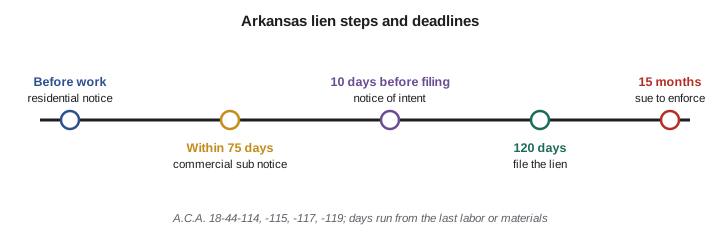
Commercial projects follow different rules. The statute does not require a notice of lien rights before work begins on commercial work in the way it does for residential work. Instead, a subcontractor or supplier who has not been paid must generally deliver a notice of nonpayment to the owner within 75 days after last furnishing labor or materials, as A.C.A. 18-44-115 describes, to preserve its lien against an owner who may otherwise have paid the general contractor in full. Owners on commercial projects can also take steps under the statute to limit their exposure, such as a bond, so a subcontractor should read the project's notices and bonds carefully at the start of the job.
The notice of intent and the filing
Before filing a lien, a claimant must serve a notice of intent to file a lien on the owner at least 10 days before filing, under A.C.A. 18-44-114. The notice gives the owner a last chance to pay. The lien itself must be filed with the circuit clerk of the county where the property sits within 120 days after the last day the claimant furnished labor or materials, under A.C.A. 18-44-117. The filing is a sworn statement of the account, with a description of the property and the amount due. All the notices must fit inside the 120-day window, so a claimant who waits until day 115 cannot fit in a 10-day notice of intent.
# Arkansas lien deadline planner (simplified study aid; dates from the statute as summarized)
from datetime import date, timedelta
last_work = date(2026, 9, 18)
file_by = last_work + timedelta(days=120)
intent_by = file_by - timedelta(days=10)
nonpayment_by = last_work + timedelta(days=75)
print("last labor or materials:", last_work)
print("commercial sub notice of nonpayment by:", nonpayment_by)
print("serve notice of intent no later than:", intent_by)
print("file lien with circuit clerk by:", file_by)
print("enforcement suit within 15 months after filing")last labor or materials: 2026-09-18 commercial sub notice of nonpayment by: 2026-12-02 serve notice of intent no later than: 2027-01-06 file lien with circuit clerk by: 2027-01-16 enforcement suit within 15 months after filing
Linda Kay's sticky note made sense once the dates were on paper. The last work at Lake Hamilton was September 18, the day of the final inspection punch-list visit, so the lien had to be filed by mid-January. Working backward, the notice of intent had to be served no later than early January, and earlier was better, because service can take time and the owners lived out of state. Tanisha called the company's lawyer the same day.
Enforcing the lien
Filing a lien does not collect money by itself. If the owner does not pay, the claimant must sue to enforce the lien within 15 months after filing, under A.C.A. 18-44-119, or the lien expires. In the suit, the court decides the amount owed and can order the property sold to pay it. Most liens never reach a sale; the owner pays or settles, often when a sale or refinance is pending. A claimant should also preserve its contract claim against the party it contracted with, because the lien is security for a debt, not a replacement for the debt.
Owners have defenses and remedies too. An owner may challenge a lien that was filed late, without the required notices, for more than was owed or for work not performed. An owner may also bond off a lien, substituting a bond for the property as security, so the property can be sold or refinanced. A claimant who files a lien knowing it is false or overstated may face liability. Accurate records, including the contract, change orders, invoices and proof of the last day of work, protect both sides.
Public projects: bond claims instead of liens
Liens generally cannot attach to public property, such as a state building, a city hall or a public school. Instead, Arkansas law requires contractors on many public construction projects to furnish payment bonds, and unpaid subcontractors and suppliers make claims against the bond. The notice and suit deadlines for bond claims differ from lien deadlines and depend on the statute and the bond. A subcontractor on a public project should get a copy of the payment bond at the start of the job, note the surety and the claim procedure, and calendar the deadlines from the first day of work.
Worked problem
Working the Lake Hamilton timeline
Ouachita Bend contracted directly with the Lake Hamilton owners, included the statutory residential notice in its contract with the owners' initials, and last furnished labor on September 18, 2026. The owners owe 18,400 dollars, of which 1,900 dollars is the disputed boathouse change, done without a written change order. What should the company do?
Show solution
- Confirm that the residential notice was given before work began and keep the signed contract as proof.
- Calculate the filing deadline: 120 days after September 18 is January 16, 2027.
- Serve the notice of intent at least 10 days before filing, which means no later than about January 6, and earlier because the owners live out of state.
- Consider claiming the undisputed 16,500 dollars and discuss with the lawyer whether the 1,900-dollar change can be proven without a written change order.
- If the owners do not pay, file the lien by January 16 and calendar the 15-month enforcement deadline from the filing date.
Answer: Serve the notice of intent promptly, file by January 16, 2027, claim only what can be proven and calendar enforcement; next time, write the change order before the work.
Common mistakes
MistakeSkipping the residential notice on a friendly job.
InsteadWithout the notice before work begins, a residential contractor loses lien rights.
MistakeCounting the 120 days from the invoice date.
InsteadThe deadline runs from the last day labor or materials were furnished.
MistakeWaiting until day 118 to serve the notice of intent.
InsteadThe notice must be served at least 10 days before filing, inside the 120 days.
MistakeAssuming the lien collects automatically.
InsteadThe claimant must sue to enforce within 15 months after filing.
MistakeFiling a lien on a public school.
InsteadPublic property generally cannot be liened; use the payment bond claim.
Summary and key terms
- A clear contract with written change orders prevents most payment disputes.
- Residential contractors must give the statutory notice of lien rights before work begins.
- Commercial subcontractors generally give a notice of nonpayment within 75 days after last furnishing labor or materials.
- A notice of intent must be served at least 10 days before filing.
- The lien must be filed with the circuit clerk within 120 days after the last labor or materials and enforced within 15 months.
- Public projects use payment bond claims instead of liens.
- Mechanics' lien
- A claim against improved property that secures payment for labor and materials.
- Notice of lien rights
- The statutory notice a residential contractor must give before work begins.
- Notice of nonpayment
- A commercial subcontractor's notice to the owner of unpaid amounts.
- Notice of intent
- Notice to the owner at least 10 days before a lien is filed.
- Change order
- A written agreement changing scope, price or time, signed before the work.
Practice problems
Work each problem on paper first, then reveal the answer to check.
When must the residential notice of lien rights be given?
Show answer
Before work begins.
Within how many days after the last work must a lien be filed?
Show answer
120 days.
How long before filing must the notice of intent be served?
Show answer
At least 10 days.
What happens if the lien is not enforced within 15 months after filing?
Show answer
It expires.
Lesson quiz · 5 questions
Score 60% or more to complete this lesson.
Create a free account to save your progress, take quizzes and earn a certificate.