
MELU-204 · Lesson 3 of 12 · 19 min
Applying, approval and booking the exam
▶ Video coming soon A video version of this lesson is on the way.
Tanisha mailed her master application on a Thursday in early February, two weeks before the deadline for the March board meeting, and then tried not to think about it. Linda Kay had a calendar taped inside the cabinet door with every board meeting for the year circled in red and the filing deadline five business days earlier circled in blue. "Miss the blue circle and you wait two months," she said. "Miss a signature and you wait two months. The board meets six times a year, and every month you lose is a month Dale is still carrying the company." Three weeks later a letter arrived with a candidate identification number, a testing window and instructions for scheduling with the testing company.
This lesson follows a master application from the first form to the license card. It covers the application packet, filing deadlines tied to board meetings, the approval letter, scheduling with the testing vendor, exam fees, what happens on a failed attempt, how long a candidate has to obtain the license after passing, and the related steps for apprentices and out-of-state applicants. The exact fees, forms and vendor details change; the department's website and the current candidate bulletin are the sources to check.
The application packet
The board's application for the master electrician exam asks for identifying information, the license class sought, the route to eligibility and a history of employment and licenses, with the supporting proof described in Lesson 2. It also asks about prior discipline and criminal convictions and requires the application fee. The rules list an examination fee for the master and journeyman classes of 80 dollars and a lower fee for some narrower classes; the testing vendor's own seat fee and any license issuance fee are described separately in the bulletin and the fee schedule. Read every page of the current form, because the board can return an incomplete packet without placing it on the agenda.
| Item | What to check |
|---|---|
| Application form | Current version from labor.arkansas.gov; every section completed and signed |
| Experience proof | Letters from masters or employers, payroll records, apprenticeship records, as the form requires |
| License history | Journeyman license number and dates; out-of-state licenses with verification |
| Background questions | Answered fully and honestly; explanations attached where needed |
| Fees | The board's application or exam fee, paid in the form the department accepts |
| Copies | A full copy of everything kept in the candidate's own file |
Deadlines and board meetings
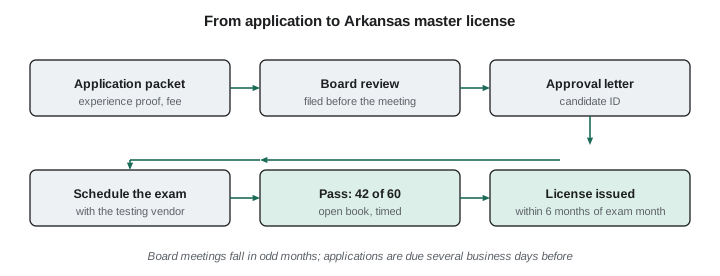
The board meets on a regular schedule, which the rules set as the third Tuesday of January, March, May, July, September and November, with a quorum of five members. Applications must be received a set number of business days before the meeting, which the current rule lists as five, so the staff can review files and prepare the agenda. An application that arrives after the deadline, or that staff find incomplete, waits for the next meeting. For a working candidate, that two-month gap is the main reason to file early and to call the office a week after mailing to confirm the packet is complete.
Approval and the candidate letter
When the board approves an application, the candidate receives a letter or email with a candidate identification number, the exam approved and the window in which to test. The November 2023 bulletin for the Arkansas electrical exams described a six-month eligibility window after approval and instructions to schedule online or by phone with the vendor, using the candidate ID from the board's letter. Check your own letter and the current bulletin for the exact window and retake rules, because they are set by the board's contract and can change.
If the board denies an application, the letter should explain why, such as missing licensed journeyman time or missing proof. A denial for lack of time is usually solved by waiting and reapplying. A denial for missing documents is solved by supplying them. A denial based on character or a conviction can be appealed under the board's hearing procedures and the Arkansas Administrative Procedure Act; a lawyer can help with that process.
Scheduling with the testing vendor
The board contracts with a testing company to develop and administer its exams. The November 2023 bulletin named Prov, Inc. and offered computer-based testing at its sites, with a paper-and-pencil option at some sessions and different fees for each. A candidate schedules through the vendor's website or phone line, chooses a date, time and site, and receives a confirmation with arrival instructions and identification requirements. Book early in the window. Popular dates fill quickly, especially near the end of a window, and a candidate who runs out of time may have to start over with the board.
Read the vendor's rules on rescheduling, cancellations and late arrival. Most testing vendors require notice a set number of business days before a rescheduled appointment and forfeit the fee for no-shows or late arrivals. Identification must usually be current, government-issued, include a photo and signature, and match the name on the registration exactly. Tanisha's journeyman license used her full middle name, but her driver's license had only an initial, so she called the vendor a week before the exam to confirm the match would be accepted.
After the exam
The open-book master exam is scored against a fixed cut score, described in the bulletin as 70 out of 100, which on a 60-question exam means 42 correct answers. Results are typically reported at the end of a computer-based session, with official scores sent to the board. A candidate who fails may retake the exam during the eligibility period, paying a new vendor fee for each attempt; after the eligibility period ends, the bulletin directs candidates back to the board with a retake form and fee. The score report usually breaks results down by content area, which is the most useful study tool a failed candidate has.
Passing the exam is not the same as holding the license. Under the rules, a candidate who passes must obtain the license within six months after the month in which the exam was taken, by applying and paying the license fee. A candidate who passes and then forgets this step can lose the passing result. The license is issued for one year and renewed annually, as Lesson 11 explains.
# Planning an application around Arkansas board meetings (simplified study aid)
from datetime import date, timedelta
meetings = [date(2026, m, 1) for m in (1, 3, 5, 7, 9, 11)]
def third_tuesday(d):
    first_tue = d + timedelta(days=(1 - d.weekday()) % 7)
    return first_tue + timedelta(days=14)
def five_business_days_before(d):
    n = 0
    while n < 5:
        d -= timedelta(days=1)
        if d.weekday() < 5: n += 1
    return d
for m in meetings:
    mt = third_tuesday(m)
print(mt.strftime("%b %d"), " file by", five_business_days_before(mt).strftime("%b %d"))Jan 20 file by Jan 13 Mar 17 file by Mar 10 May 19 file by May 12 Jul 21 file by Jul 14 Sep 15 file by Sep 08 Nov 17 file by Nov 10
The calendar shows why timing matters. A packet that misses the early March deadline waits until May, and the approval letter arrives after the May meeting. A candidate who passes in June then has until the end of December to obtain the license. Linda Kay puts every one of those dates on the office calendar the day the packet goes out.
Apprentices and other applicants
The same department handles apprentice registration. A company that hires an apprentice must register the apprentice with the board within 30 days of employment, and the apprentice must work under the supervision of a licensed journeyman or master. A master who runs a company should treat apprentice registration as part of onboarding, along with tax forms and safety training, because unregistered apprentices are doing unlicensed work. Applicants licensed in another state follow the reciprocity procedure, where an agreement exists, and supply license verification from the other state. Temporary licenses, where the rules allow them, have their own forms and conditions.
Fees and costs to budget
A master candidate should budget for more than the board's application fee. The rules list the exam fee for the master and journeyman classes; the testing vendor charges for each seat, with different amounts for computer-based and paper sessions in the November 2023 bulletin; and the license itself has an annual fee, which the rules set at 50 dollars for a master. A new code book in the edition named in the bulletin, tabs, a practice exam package or prep class and a day or two away from work add to the total. A failed attempt adds another vendor fee and another day. Many Arkansas contractors pay these costs for a foreman they want to promote, as Dale did for Tanisha, sometimes with an agreement that the employee will stay for a period after licensing. Any such agreement should be in writing and reviewed for fairness, because a license belongs to the person, not the company.
Reading the approval letter
The approval letter is short, but every line matters. It names the exam the candidate is approved for, which should match the class applied for; a candidate approved for the residential master exam by mistake should call the office before scheduling. It gives the candidate ID, which the vendor uses to find the registration. It states the eligibility window or refers to the bulletin for it. It may list conditions, such as a document still due. Tanisha photographed the letter, saved the candidate ID in her phone and put the window's last day on the office calendar, then booked her seat that same evening.
Worked problem
Building an application timeline
A candidate's packet is complete on April 20, 2026. The board meets on the third Tuesday of May, and applications are due five business days before. The approval letter gives six months to test. She passes on August 14. When must she obtain her license?
Show solution
- The third Tuesday of May 2026 is May 19, and five business days before is May 12, so an April 20 filing is in time.
- If approved on May 19, she has until about mid-November to test.
- She passes on August 14, well within the window.
- The license must be obtained within six months after the month in which she tested.
- The month of the exam is August, so the deadline runs to the end of February 2027.
Answer: She should apply for and pay for the license by the end of February 2027, and sooner is better.
Common delays and how to avoid them
Most delays come from paperwork rather than the exam. Missing employer signatures, unexplained gaps in employment, old forms, unpaid fees, unreadable copies and names that do not match identification all push an application to a later meeting. Candidates who work for several employers should collect letters early. Candidates who changed names should include the documents that connect the names. Candidates who have been out of the trade for a while should explain the gap. Each fix is easy before filing and slow after.
Tanisha's packet went smoothly because Linda Kay treated it like a bid: a checklist, a deadline, a copy of everything and a follow-up call. Her approval letter came after the March meeting with a candidate ID and instructions, and she booked a Saturday morning seat at the Little Rock testing site six weeks out.
Common mistakes
MistakeFiling on the board meeting date.
InsteadApplications are due several business days before the meeting; late or incomplete files wait for the next meeting.
MistakeTreating a passing score as a license.
InsteadThe license must be obtained within six months after the exam month.
MistakeWaiting until the end of the eligibility window to schedule.
InsteadBook early; seats near the end of a window fill and the window can expire.
MistakeIgnoring the name on identification.
InsteadThe name on the identification must match the registration exactly.
MistakeHiring an apprentice without registering him or her.
InsteadApprentices must be registered within 30 days and supervised by licensed electricians.
Summary and key terms
- The master application needs a complete form, experience proof, license history, background answers and fees.
- The board meets in odd-numbered months, and applications are due a few business days before each meeting.
- Approval brings a candidate ID and a window to schedule with the testing vendor.
- The bulletin describes scheduling, identification, fees, retakes and scoring; check the current version.
- A passing candidate must obtain the license within six months after the exam month.
- Apprentices must be registered within 30 days of employment.
- Candidate ID
- The number in the board's approval letter used to schedule with the testing vendor.
- Eligibility window
- The period after approval during which a candidate may schedule and take the exam.
- Cut score
- The fixed score a candidate must reach to pass, 70 in the bulletin described here.
- Quorum
- The number of board members needed to act, five under the rules.
- Retake
- A new attempt after a failed exam, with a new fee and the eligibility rules in the bulletin.
Practice problems
Work each problem on paper first, then reveal the answer to check.
When does the board meet?
Show answer
On the third Tuesday of January, March, May, July, September and November.
How many correct answers does a passing score of 70 require on a 60-question exam?
Show answer
42.
How long does a passing candidate have to obtain the license?
Show answer
Six months after the month of the exam.
When must a new apprentice be registered?
Show answer
Within 30 days of employment.
Lesson quiz · 5 questions
Score 60% or more to complete this lesson.
Create a free account to save your progress, take quizzes and earn a certificate.