
MELU-204 · Lesson 7 of 12 · 19 min
Duties and responsibilities of the Master Electrician License holder
▶ Video coming soon A video version of this lesson is on the way.
The week after Tanisha's license arrived, Dale handed her a key ring with eleven keys on it and a manila envelope. The keys opened the shop, the wire cage, the vans and the file cabinet. The envelope held a single sheet of paper headed "What the master answers for," in Dale's handwriting. It listed six things: plan the work, supervise the people, watch the apprentices, follow the code, put your name where people can see it, and fix what the inspector finds without arguing first. "That list took me twenty-nine years," he said. "You get it on day one." Over the next month, Tanisha learned that each line on the sheet was backed by a statute or a rule.
This lesson describes the legal and practical duties of an Arkansas master electrician who plans and supervises work for a company. It covers the statutory definition of the master's role, supervision of journeymen and apprentices, the apprentice registration and ratio rules, code and workmanship duties, license display and the job sign, cooperation with inspectors, responsibility when things go wrong, and how a master builds a system that lets one person answer for dozens of jobs. The rules summarized here come from A.C.A. 17-28 and 17 CAR Part 210.
What the license means
The statute defines a master electrician as a person qualified to plan, lay out and supervise the installation, maintenance and extension of electrical conductors and equipment. Each of those verbs is a duty. Planning means deciding how the work will meet the code and the owner's needs: service size, load calculations, circuit layouts, equipment choices and wiring methods. Layout means turning the plan into the details the crew installs from. Supervision means directing and checking the work of journeymen and apprentices while it is done. The master does not have to touch every wire, but must know enough about every job to answer for it.
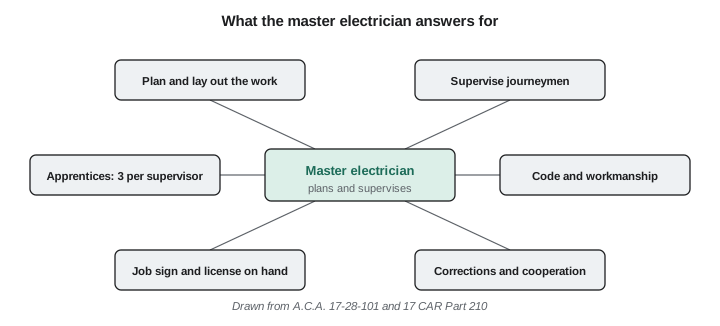
The journeyman's license, by contrast, covers installation from plans and specifications that someone else furnishes. That is why the rules bar a journeyman from contracting to plan, lay out or supervise unless he or she employs a full-time master. On a typical Ouachita Bend job, the master plans and prices the work, a journeyman foreman runs the crew from that plan, journeymen install and apprentices learn under supervision. The master visits, reviews and answers questions, and steps in whenever the plan changes.
Supervising journeymen
Supervision is not the same as presence. A master who runs ten jobs cannot stand on all of them, and the law does not require it for licensed journeymen, who are qualified to install from plans. What it does require is that the master's planning and supervision be real. In practice, that means clear plans and scopes for every job, regular site visits, a foreman on each job who knows when to call, a review of every change order, and a check of the work before each inspection. A master whose name is on a job he or she has never seen, planned or reviewed is not supervising it.
Tanisha built her own routine from Dale's. Every Monday she reviews each active job's plan and schedule with the foremen. She visits each job at least once a week, more often during rough-in, and keeps short notes in the job file. She signs off on every change that adds a circuit, moves a panel or changes a service. She reviews every correction notice with the foreman and the crew. When she is out of town, another master employed by the company covers for her, and the foremen know who that is.
Apprentices: registration, ratio and supervision
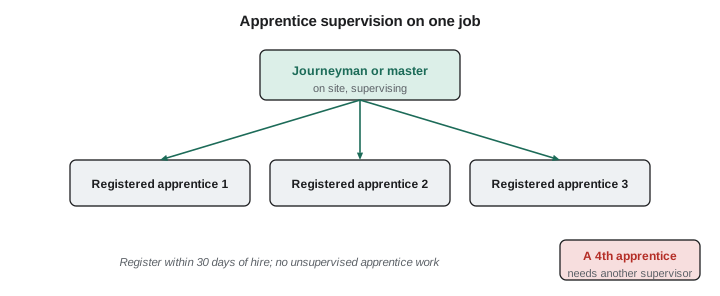
Apprentices are where the rules are most specific. A company must register each apprentice with the board within 30 days of employment. An apprentice may not do electrical work without supervision by a licensed journeyman or master on the job, and the rules cap the ratio at three apprentices for each journeyman or master on a job site. The master responsible for the work answers for the supervision of the apprentices on it. An apprentice working alone, or a crew of five apprentices under one journeyman, puts the company and the master at risk of penalties.
# Apprentice ratio check for a day's crew assignments (simplified study aid)
crews = {
    "Bryant dental office": {"masters": 0, "journeymen": 1, "apprentices": 2},
    "Conway church addition": {"masters": 1, "journeymen": 2, "apprentices": 7},
    "Grant County farm shop": {"masters": 0, "journeymen": 1, "apprentices": 4},
    "Benton service call": {"masters": 0, "journeymen": 0, "apprentices": 1},
}
RATIO = 3
for job, c in crews.items():
    sup = c["masters"] + c["journeymen"]
    ok = sup > 0 and c["apprentices"] <= RATIO * sup
print(f"{job:24s} supervisors {sup} apprentices {c['apprentices']} ->", "OK" if ok else "FIX")Bryant dental office supervisors 1 apprentices 2 -> OK Conway church addition supervisors 3 apprentices 7 -> OK Grant County farm shop supervisors 1 apprentices 4 -> FIX Benton service call supervisors 0 apprentices 1 -> FIX
The study aid flags two problems. The farm shop has four apprentices for one journeyman, one more than the ratio allows, and the service call has an apprentice with no licensed supervisor at all. Ouachita Bend's dispatcher runs this check every morning before the vans leave, and Tanisha reviews any job that fails it.
Registration also protects the apprentice. A registered apprentice's hours count toward the journeyman license, and the registration record helps prove them. An unregistered apprentice may lose credit for months of work and is, legally, an unlicensed person doing electrical work. Linda Kay files the registration with the new-hire paperwork, before the apprentice's first full week ends.
Code and workmanship
The master answers for code compliance on the work he or she plans and supervises. That means the NEC as adopted and amended in Arkansas, the local program's requirements, the manufacturer's installation instructions for listed equipment, which the code itself requires to be followed, and the workmanship standard the board's rule names, ANSI/NECA 1. It also means the contract documents, which often require more than the code. A master who discovers that a design does not meet the code has a duty to raise it before installing it, usually by writing to the engineer, architect or owner and keeping a copy.
Good workmanship has a practical meaning for inspectors and owners. Neatly dressed panels, labeled circuits, secured cables, proper box support and clean terminations are easier to inspect, easier to service and less likely to fail. They also signal a company that checks its work. Tanisha uses the panel schedule as her first test on every final walk-through: if the schedule is incomplete or wrong, she assumes there are other problems and looks harder.
Identification on the job
Licensed electricians must carry their license and photo identification on the job, and the department's inspectors may ask to see them. Where no city or county permit is issued, the job sign must show the company name, the responsible master's license number and a phone number. Where a permit is issued, the permit records the responsible master. Either way, the master's name is attached to the work in a way that anyone can find. A master who leaves a company should make sure his or her name comes off its permits and signs, and a company that loses its master must stop work that needs a master's planning and supervision until it has another one.
Cooperating with inspectors and correcting violations
A master must allow inspectors access to the work and must correct violations. The board's rules give state inspectors authority to require finish materials removed where work was never inspected by a city or county, and they do not treat disconnection or abandonment as a correction. When a violation is cited, the master should review it, correct it promptly and request reinspection. Arguing with an inspector on site rarely helps. When a master believes a citation is wrong, the better path is a written explanation with the code reference and, if needed, the local appeal or a question to the department.
When things go wrong
The department may assess civil penalties of up to 1,000 dollars per violation, with each day counted separately, after notice and an opportunity for a hearing, and the board may suspend or revoke a license for cause. The rules give a person cited for a violation a chance to correct it in many cases, and penalties must be assessed within two years. Beyond board discipline, a master's work can be the subject of a lawsuit by an owner, a claim by an injured person or a dispute with a general contractor. Good records are the master's best defense: plans, change approvals, inspection results, correction records, apprentice assignments and daily notes.
Side jobs, lending and leaving
Three situations test a master's judgment more than any code question. The first is the side job. A journeyman who wires a friend's garage on a Saturday is installing without a master's planning and supervision unless a master actually plans and supervises it, and an apprentice who does it is doing unlicensed work. Tanisha tells her crews plainly that weekend jobs are either Ouachita Bend jobs, with a plan, a permit or sign and a supervisor, or they are not jobs at all. The second is lending. A master who lets another company use his or her license number for permits, bids or signs, without actually planning and supervising that work, is answering for work he or she has never seen, and both parties risk discipline. The third is leaving. When a master leaves a company, he or she should notify the local programs where open permits carry that name, make sure signs come down and give the company time to put another master in place. A company that loses its only master must stop work that needs a master's planning and supervision until another master is employed.
Worked problem
Responding to a state citation
A state inspector visits Ouachita Bend's Grant County farm shop job, where no county permit is issued. He finds four apprentices working with one journeyman, no job sign posted and a feeder installed with an undersized equipment grounding conductor. What should Tanisha do?
Show solution
- Assign a second journeyman or move an apprentice immediately so no more than three apprentices work under each licensed supervisor.
- Post a 12-inch by 12-inch sign with the company name, her master license number and the company phone number, and photograph it for the file.
- Replace the equipment grounding conductor with one sized for the feeder's overcurrent device, rather than disconnecting the feeder.
- Write a short response to the inspector describing each correction with dates and photos.
- Review the dispatch check and the job-start checklist so the same problems do not happen on the next rural job.
Answer: Correct each violation promptly and document it: fix the ratio, post the sign, replace the grounding conductor and send a written response, then fix the systems that allowed the problems.
Building a system
One master answering for many jobs needs systems more than effort. Ouachita Bend's system has five parts: a job-start checklist, which confirms the permit or sign, the plan, the crew and the apprentice ratio; a weekly job review; a change approval rule; a pre-inspection checklist; and a correction log that turns every citation into a training topic. The system does not replace the master's judgment, but it lets the master spend that judgment where it matters most.
Common mistakes
MistakeThinking supervision requires the master to be on every job all day.
InsteadSupervision requires real planning, review and direction; the master need not install every wire, but must answer for the work.
MistakeLetting an apprentice work alone on a small service call.
InsteadApprentices must work under a licensed journeyman or master on the job.
MistakeAssigning four apprentices to one journeyman.
InsteadThe rules cap the ratio at three apprentices per licensed supervisor on a job.
MistakeLeaving the job sign in the truck.
InsteadWhere no permit is issued, the sign must be posted on the site.
MistakeArguing with the inspector on site.
InsteadCorrect the violation or raise a disagreement in writing with the code reference.
Summary and key terms
- The master plans, lays out and supervises electrical work and answers for it.
- Supervision means real planning, review and direction, backed by a system and records.
- Apprentices must be registered within 30 days and supervised on the job, at no more than three per licensed supervisor.
- The master answers for the code as adopted and amended, manufacturer instructions and workmanship.
- Licenses and identification must be carried; the job sign is required where no permit is issued.
- Violations must be corrected, not disconnected; penalties of up to 1,000 dollars per violation per day are possible.
- Supervision
- Directing and checking the work of others while it is done.
- Apprentice ratio
- The cap of three apprentices per licensed journeyman or master on a job.
- Registration
- Recording an apprentice with the board within 30 days of employment.
- Layout
- Turning a plan into the details the crew installs from.
- Correction log
- A company record of citations and how each was fixed.
Practice problems
Work each problem on paper first, then reveal the answer to check.
How many apprentices may one journeyman supervise on a job?
Show answer
Three.
Within how many days must an apprentice be registered?
Show answer
Thirty days of employment.
What must a licensed electrician carry on the job?
Show answer
The license and photo identification.
Who answers for apprentice supervision on a job?
Show answer
The master responsible for the work.
Lesson quiz · 5 questions
Score 60% or more to complete this lesson.
Create a free account to save your progress, take quizzes and earn a certificate.