
MELU-204 · Lesson 1 of 12 · 25 min
How electrical licensing works in Arkansas
▶ Video coming soon A video version of this lesson is on the way.
Dale Whitfield pulled his first permit in Saline County in 1988 and founded Ouachita Bend Electric, Inc., in Benton in 1997 with one bucket truck, a borrowed trencher and the Arkansas master electrician license he had earned the year before. Twenty-nine years later the company has sixteen electricians and apprentices, seven service vans and a shop on the frontage road off Interstate 30. Its work is a steady mix: tenant finishes in strip centers in Bryant, lake houses on Lake Hamilton in Garland County, a church addition in Conway, service upgrades and generator transfer switches around Little Rock, a grocery remodel on the west side of the city and a growing number of poultry houses and farm shops in rural Grant County. On a cold Monday in January, Dale asked his lead journeyman, Tanisha Brooks, to stay after the morning safety meeting. "I turn sixty-six this spring," he said. "Every job we run is planned and supervised under my master license. When I step back, this company needs another master electrician who works here full time and runs the electrical work. I want that to be you." He slid a copy of the board's master application across the table, along with the testing company's candidate bulletin.
Tanisha started at Ouachita Bend as a registered apprentice in 2014, finished a four-year registered apprenticeship, passed the journeyman exam in 2018 and has run crews as a foreman since 2021. She has already worked through the master-level core courses on the National Electrical Code, load calculations, grounding and bonding, motors and transformers, special occupancies, and business and law. This course applies that preparation to Arkansas: who licenses electricians, how the master license is earned, how the exam works and which book is allowed in the room, how the state adopts and amends the NEC, how permits and inspections work at the city, county and state level, and the Arkansas law on supervision, contractor licensing, mechanics' liens, workplace safety, workers' compensation and renewal that a master electrician needs to know.
The board and its law
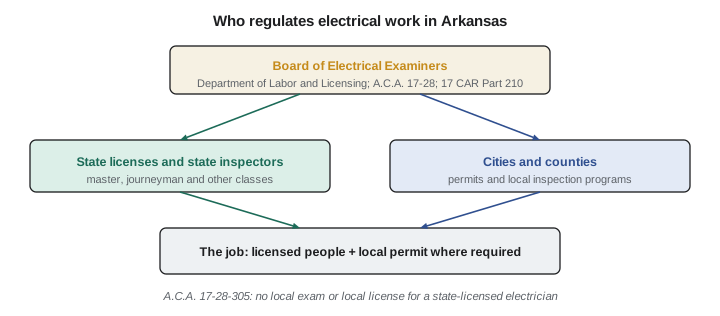
Arkansas licenses electricians through the Board of Electrical Examiners, which works inside the Arkansas Department of Labor and Licensing. The department's electrical section has the staff that processes applications, renewals, apprentice registrations and continuing education records, and it employs the state electrical inspectors who work across Arkansas. The board itself is a group of appointed members, most of them from the electrical trade and the industries that use it, along with the Secretary of Labor and Licensing. It adopts rules, approves applicants to take exams, sets fees within the statute, approves continuing education courses and hears disciplinary cases. The rules list a regular meeting schedule on the third Tuesday of every other month, starting in January, so many licensing steps line up with those meetings.
The licensing law is Chapter 28 of Title 17 of the Arkansas Code, written as A.C.A. 17-28-101 and following sections. The statute defines the license classes, creates the board, sets up examinations and renewals, lists the exemptions, limits what cities and counties may require and authorizes penalties. The board's rules, now published as 17 CAR Part 210, fill in the details: the experience each license needs, the exam and fee schedule, how apprentices are registered and supervised, how continuing education works, which edition of the NEC applies statewide and which Arkansas amendments change it. When you read an older study guide, check its dates. The rules were recodified into the new Code of Arkansas Rules format and updated again during the 2026 code adoption, so older section numbers in prep books may not match.
The license classes
Arkansas licenses individual electricians rather than electrical companies. The statute defines a master electrician as a person qualified to plan, lay out and supervise the installation, maintenance and extension of electrical conductors and equipment. It defines a journeyman electrician as a person qualified to install, maintain and extend that wiring from plans and specifications that someone else furnishes. An electrical apprentice is a person whose main job is learning the trade while assisting licensed electricians under direct supervision. Those three words, plan, install and learn, describe the main ladder, and most exam questions about Arkansas licensing come back to them.
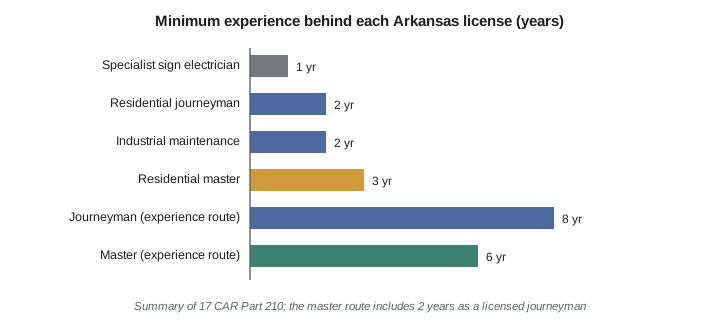
Beside the main ladder, the rules set up narrower classes. A residential master and a residential journeyman are limited to dwellings, which the rules define as one- to four-family buildings. An industrial maintenance electrician maintains equipment in an industrial plant. A specialist sign electrician installs and services electric signs. A restricted lifetime master license is available to long-serving masters who meet age and experience conditions, and the board can issue a temporary license for a limited time in defined situations. Each class has its own experience requirement, exam and fee.
| License class | What it allows | Minimum experience (summary) |
|---|---|---|
| Registered apprentice | Learning and assisting under on-site supervision by a journeyman or master | Registration, no exam |
| Journeyman electrician | Installing and maintaining wiring from furnished plans and specifications | Four-year registered apprenticeship, or about eight years of documented experience |
| Master electrician | Planning, laying out and supervising electrical work of any size or type | Six years, including two as a licensed journeyman, or an engineering degree route |
| Residential journeyman and master | The same roles, limited to one- to four-family dwellings | Two years; three years with one as residential journeyman |
| Industrial maintenance | Maintenance work inside an industrial plant | Two years |
| Specialist sign electrician | Electric sign installation and service | One year |
The journeyman license is a working license. A journeyman installs from plans that someone else prepared and does not, on that license alone, contract to plan, lay out or supervise electrical work. The rules say a journeyman may not contract to do that unless he or she employs a full-time master electrician. The master license is the one that covers the planning and supervision. That is why Ouachita Bend needs a master who works there: the company's estimates, layouts and supervision all rely on a master electrician being in charge of the work.
The master license and the company
Because Arkansas licenses people, a company does electrical work through the licensed people it employs. The statute defines an electrical contractor as a person, or an employee of a firm, partnership or corporation, engaged in the business of installing, erecting or repairing electrical wiring and equipment. The board's rules then tie the business to a master: work that needs planning and supervision has to be under a licensed master. On jobs where no city or county issues a permit, the rules also require a job sign showing the company name, the license number of the master responsible for the work and a phone number, so anyone can see who answers for it. Lesson 7 covers those duties in detail.
A separate state agency, the Arkansas Contractors Licensing Board, licenses contractors by the size and type of project. Commercial projects at or above the board's dollar threshold and certain residential work need a contractor license or registration from that board, in addition to the electrical licenses held by the people doing the work. Lesson 8 explains how the two systems fit together. For now, remember the split: the Board of Electrical Examiners licenses electricians, and the Contractors Licensing Board licenses contracting businesses by project value and type.
Statewide license, local programs
A.C.A. 17-28-305 protects the state license. A city or county may not require an electrician who holds a state license to pass a local exam or hold a local license to do electrical work. Cities and counties may still adopt rules on materials, construction, installation and inspection as long as those rules do not conflict with the state standards, and they may run their own permit and inspection programs with inspectors licensed by the board. In practice, Tanisha's master license will let Ouachita Bend work in Benton, Bryant, Little Rock, Conway, Hot Springs and Grant County without a separate city exam. The company still pulls each city's permit, pays its fees and calls for its inspections where a local program exists.
Where no local program exists, the state program still applies. State electrical inspectors employed by the department have statewide authority and can inspect work in any city or county, while local inspectors work only inside their own jurisdiction. Lesson 6 explains how to tell which inspector has a given address and what happens when no one issues a permit. The core idea is simple: the state decides who may do and supervise electrical work and which code applies statewide, and local programs decide how each job inside their borders is permitted and inspected.
Exemptions
A.C.A. 17-28-102 lists work that does not need a state electrical license. The list includes public utilities, electric cooperatives and municipal utilities working on their transmission and distribution systems; employees of industrial plants doing their own maintenance where other safety standards apply; low-voltage communication work such as telephone, data, fire alarm and security systems that falls within the statutory description; nonresidential farm buildings; manufactured homes built under the federal standards; and a homeowner doing work on his or her own primary residence. The statute also lets licensed HVACR and water well contractors run limited wiring for their own equipment and lets hospital employees make minor repairs.
Each exemption has limits written into the statute. The homeowner exemption covers the owner's own primary residence and does not let the owner hire an unlicensed person; a city or county may also require the homeowner to show technical competence before doing the work. The farm building exemption covers nonresidential farm buildings, not the farmhouse. Some low-voltage work exempt from the electrical license is licensed by a different state agency. Exempt work is not exempt from good practice, and many lenders, insurers and owners still require the work to meet the code. When a client says a job is exempt, read the exemption before relying on it.
Ouachita Bend's farm work shows why the details matter. On a Grant County farm, Dale's crews wired three new poultry houses and a feed-storage building, which were nonresidential farm buildings. The same farmer also wanted a new 200-ampere service and a remodeled kitchen in the family home. Dale treated the house as ordinary licensed work, with a master planning it and the job sign posted, because the farm building exemption did not reach the dwelling.
Unlicensed work and discipline
Doing electrical work, advertising as an electrician or using an electrician's title without a license or an exemption violates A.C.A. 17-28-304. The department may ask a court to stop unlicensed work. After notice and a chance for a hearing, it may assess civil penalties of up to 1,000 dollars per violation, with each day of a continuing violation counted separately, and it must assess them within two years. The board may suspend or revoke a license for cause and may refuse to renew it. An unlicensed contractor can also have trouble enforcing payment and lien rights. Dale tells new hires about a Lake Hamilton boathouse feeder that a seller's handyman had installed without a license or permit. The buyer's home inspector flagged it, the buyer paid Ouachita Bend to tear it out and replace it, and the seller faced a claim worth far more than the original job.
# Which Arkansas license covers each role? (simplified study aid)
roles = [
    ("Pull wire under a foreman on a commercial job", "registered apprentice"),
    ("Install a 400 A service from plans someone else prepared", "journeyman"),
    ("Plan, lay out and supervise a church addition", "master"),
    ("Wire a new poultry house on a working farm", "exempt (nonresidential farm building)"),
    ("Plan and supervise a duplex service upgrade", "master or residential master"),
]
basis = {"registered apprentice": "register within 30 days, work supervised",
         "journeyman": "journeyman exam",
         "master": "master exam",
         "master or residential master": "residential classes cover 1 to 4 family dwellings",
         "exempt (nonresidential farm building)": "A.C.A. 17-28-102 exemption"}
for role, lic in roles:
    print(role)
print(" license:", lic, "-", basis[lic])Pull wire under a foreman on a commercial job license: registered apprentice - register within 30 days, work supervised Install a 400 A service from plans someone else prepared license: journeyman - journeyman exam Plan, lay out and supervise a church addition license: master - master exam Wire a new poultry house on a working farm license: exempt (nonresidential farm building) - A.C.A. 17-28-102 exemption Plan and supervise a duplex service upgrade license: master or residential master - residential classes cover 1 to 4 family dwellings
The output shows the main point of the Arkansas structure. The license follows the role a person plays on the job. Installation needs at least a journeyman; planning and supervision need a master; learners register and work under supervision; and exempt work is defined narrowly by the statute.
Worked problem
Mapping a company to the state rules
Two investors in Jonesboro want to start a commercial electrical company. Neither holds an electrical license. They plan to hire a journeyman with fifteen years of experience as their only licensed electrician, have him plan and supervise their jobs and start bidding next month on commercial projects worth 60,000 to 200,000 dollars. What problems does this plan have?
Show solution
- The investors do not need electrical licenses to own the company, but the people doing the work do.
- A journeyman may install from furnished plans but may not contract to plan, lay out or supervise unless a full-time master is employed.
- The company needs a licensed master electrician working for it to plan and supervise the electrical work.
- The journeyman may qualify to apply for the master exam, but must be approved, pass and be licensed first.
- Commercial projects of that size also need a license from the Contractors Licensing Board.
Answer: The plan fails because the company has no master electrician and no contractor license; it must hire a master or wait until its journeyman passes the master exam, and it must obtain the Contractors Licensing Board license before bidding work at that size.
One career, several offices
Tanisha's own path shows how the pieces connect. Ouachita Bend registered her as an apprentice with the board within weeks of hiring her. Her apprenticeship program tracked classroom and on-the-job hours and gave her a completion record and the release form she needed for the journeyman exam. The company kept payroll records and W-2 forms proving she worked full time. The board approved her application, the testing company ran the exam and the department issued her license. Since then she has worked on jobs permitted by more than a dozen cities and inspected by both local and state inspectors. Now she is preparing her master application, which needs proof of six years of construction experience, two of them as a licensed journeyman. At every step a different office touched her file, and a master is expected to understand that whole chain.
A master also becomes the person others call. An owner's lender wants to know who is responsible for the electrical work. A city permit clerk wants the master's license number on the permit. A general contractor wants a copy of the license and a certificate of insurance with the bid. A new apprentice wants to know whether a weekend side job is allowed. Tanisha will answer those questions for her company, so she needs the structure clear before she sits for the exam.
Where the rules live
Arkansas electricians work under several layers of law, and the exam and daily practice both expect a master to know which layer answers which question. A.C.A. 17-28 and 17 CAR Part 210 set licensing, supervision, renewal, continuing education, the statewide code and discipline. The NEC, as adopted and amended by the board's rules, sets installation requirements. Local ordinances add permit and inspection procedures. The Contractors Licensing Board statute and rules cover contractor licensing by project size. The mechanics' lien statutes in A.C.A. 18-44 govern liens on private property. Federal OSHA standards cover workplace safety, and the Arkansas workers' compensation law covers injured workers. The candidate bulletin explains exam logistics. When a question comes up, start by asking which layer it belongs to, because that tells you which office can give a reliable answer.
Common mistakes
MistakeAssuming a journeyman license lets a person contract to plan and supervise work.
InsteadA journeyman installs from furnished plans; planning, layout and supervision belong to a master, and a journeyman may not contract for them without employing a full-time master.
MistakeBelieving each city can require its own electrical exam.
InsteadA.C.A. 17-28-305 bars cities and counties from requiring a local exam or license from a state-licensed electrician.
MistakeThinking only local inspectors can inspect.
InsteadState electrical inspectors have statewide authority; local inspectors work only inside their own city or county.
MistakeTreating the farm exemption as covering the farmhouse.
InsteadThe exemption covers nonresidential farm buildings, not dwellings.
MistakeAssuming the electrical license is the only license a company needs.
InsteadProjects at the Contractors Licensing Board's thresholds also need a contractor license or registration.
Summary and key terms
- The Board of Electrical Examiners in the Department of Labor and Licensing licenses electricians under A.C.A. 17-28 and 17 CAR Part 210.
- The master plans, lays out and supervises; the journeyman installs from furnished plans; apprentices register and work under supervision.
- Residential, industrial maintenance, sign and restricted lifetime classes have narrower scopes and their own requirements.
- Cities and counties may not require a local exam or license from a state licensee, but may run permit and inspection programs.
- State inspectors work statewide; the statute lists exemptions, each with limits.
- The Contractors Licensing Board separately licenses contracting businesses by project value and type.
- Board of Electrical Examiners
- The Arkansas board that licenses electricians and adopts the electrical rules.
- Master electrician
- A licensed electrician qualified to plan, lay out and supervise electrical work.
- Journeyman electrician
- A licensed electrician qualified to install and maintain wiring from furnished plans.
- 17 CAR Part 210
- The part of the Code of Arkansas Rules that holds the board's rules.
- A.C.A. 17-28
- The chapter of the Arkansas Code that governs electricians.
Practice problems
Work each problem on paper first, then reveal the answer to check.
Which state body licenses electricians in Arkansas?
Show answer
The Board of Electrical Examiners in the Department of Labor and Licensing, under A.C.A. 17-28.
Can a city require a state-licensed master to pass a city exam?
Show answer
No. A.C.A. 17-28-305 bars a local exam or license requirement for state licensees.
Can a journeyman contract to plan and supervise a job?
Show answer
Not unless he or she employs a full-time master electrician.
Does the farm building exemption cover the farmer's house?
Show answer
No. It covers nonresidential farm buildings only.
Lesson quiz · 5 questions
Score 60% or more to complete this lesson.
Create a free account to save your progress, take quizzes and earn a certificate.