
MELU-204 · Lesson 4 of 12 · 19 min
The exam format and the references allowed
▶ Video coming soon A video version of this lesson is on the way.
Six weeks before her exam date, Tanisha sat down at the kitchen table with a new copy of the NEC, a pack of permanent tabs, a yellow highlighter and a kitchen timer. Dale had told her the story of his own master exam in 1996, when he carried in a milk crate of books and spent half the morning hunting for a table he had never used. "The book is allowed," he said, "but the clock is the test. You need to know where everything is before you walk in." Tanisha set the timer for three minutes, opened the candidate bulletin's content outline and tried to find the article for each topic before the bell rang. She missed a third of them on the first round. By the end of the week she missed almost none.
This lesson describes the Arkansas master electrician exam as the testing vendor's candidate bulletin presents it: the number of questions, the time limit, the passing score, the content outline, the single permitted reference, the rules for marking it, calculators and the testing room, and a pacing plan. The figures come from the November 2023 Arkansas electrical bulletin from Prov, Inc., which tied the exam to the 2023 NEC. Bulletins are revised when the code edition or the vendor changes, so use the bulletin attached to your own approval letter.
The exam at a glance
The master exam in that bulletin has 60 questions and a three-hour time limit. It is open book and timed. Each exam is scored against a fixed cut score of 70, which on 60 questions means 42 correct answers; a candidate can miss up to 18 and still pass. The content outline in that bulletin did not include a business and law section, so the Arkansas law in this course is mostly knowledge a master needs in practice rather than a scored section of the exam; check the current outline, because outlines change. Questions are multiple choice with one best answer.
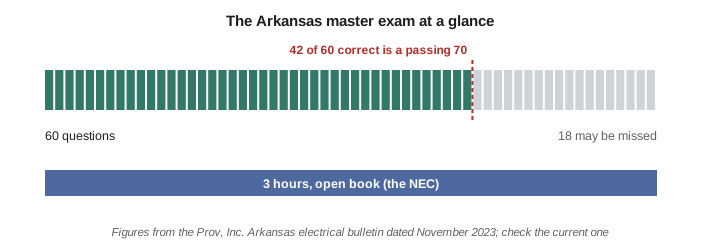
Three hours for 60 questions is three minutes a question on average. That is generous for a question that needs one lookup and short for a question that needs a load calculation with several lookups. The candidate who passes comfortably is the one who answers the quick questions in a minute or less and banks time for the calculations.
The content outline
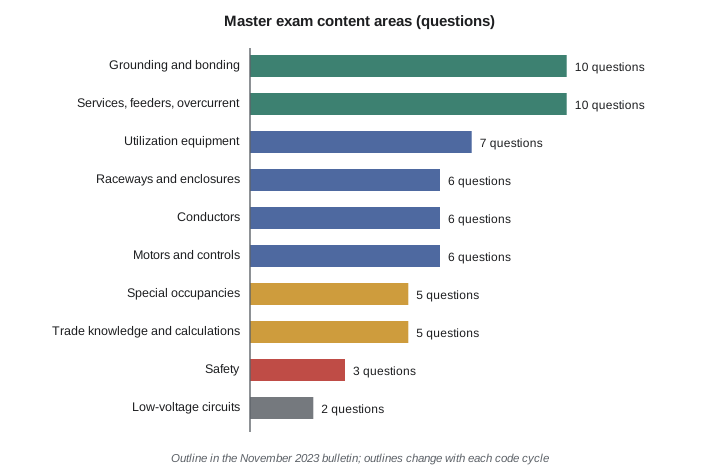
The bulletin breaks the 60 questions into content areas. Grounding and bonding and services, feeders, branch circuits and overcurrent protection each carry ten questions, so together they are a third of the exam. Utilization and general use equipment carries seven. Raceways and enclosures, conductors, and motors and controls carry six each. Special occupancies and equipment carries five, general knowledge of the trade and calculations five, safety three, and low-voltage circuits, including alarms and communications, two.
| Content area | Questions | Where to look first in the NEC |
|---|---|---|
| Grounding and bonding | 10 | Article 250 and the grounding rules in specific articles |
| Services, feeders, branch circuits, overcurrent | 10 | Articles 210, 215, 220, 230 and 240 |
| Utilization and general use equipment | 7 | Chapter 4 |
| Raceways and enclosures | 6 | Chapter 3 wiring method articles and Chapter 9 tables |
| Conductors | 6 | Article 310 and Chapter 9 |
| Motors and controls | 6 | Article 430 |
| Special occupancies and equipment | 5 | Chapters 5 and 6 |
| Trade knowledge and calculations | 5 | Article 220 and general practice |
| Safety | 3 | Article 110 and workplace safety practice |
| Low-voltage circuits, alarms and communications | 2 | Chapters 7 and 8 |
The outline is a study plan. A candidate with limited time should spend it in proportion to the questions: grounding and services first, then equipment, wiring methods, conductors and motors, then the smaller areas. Do not skip the small ones, because five or six questions out of 60 can decide a close result, but do not let them take a week that grounding needs.
The reference allowed
The November 2023 bulletin lists one reference for the master exam: the National Electrical Code, NFPA 70, in the edition named in the bulletin, which was the 2023 edition. Candidates bring their own bound copy. The bulletin's rules on what may be in the book matter. Testing vendors commonly allow permanent tabs and highlighting, and prohibit loose papers, sticky notes that can be removed, handwritten notes, photocopies and books with pages added. Some vendors inspect each book at check-in and refuse books that do not meet the rules. Read the current bulletin's rules on the book before you tab it, not after.
The exam edition may not match the edition enforced on jobs. When the bulletin was issued, Arkansas enforced an earlier edition statewide, and in 2026 the board adopted the 2026 NEC with Arkansas amendments, as Lesson 5 explains. An exam written to one edition and a job inspected under another is normal in many states. Study the edition the bulletin names, and use the adopted edition and amendments on the job.
Tabbing and marking the code book
Tabs are worth the time only if they are planned. A good tab set marks each article that appears in the content outline, plus the tables used most often in calculations: conductor ampacity, conductor properties, raceway fill, box fill, grounding conductor sizing, motor full-load currents and dwelling load calculation steps. More tabs are not better. A book with two hundred tabs is as slow as a book with none. Most candidates do well with a set of article tabs on the edge and a smaller set of table tabs on the top.
Highlighting should mark the words that change an answer: exceptions, the word not, minimum and maximum values and conditions such as dwelling units or wet locations. Highlighting whole paragraphs defeats the purpose. Tanisha used yellow for requirements and orange for exceptions, and she highlighted the index entries for topics she kept missing, so that her second search was faster than her first.
Calculators and the testing room
Testing vendors usually allow a basic, silent, nonprogrammable calculator and prohibit phones, smart watches, calculators with text storage and anything that communicates. The bulletin states the calculator rule and the items allowed in the room. Personal items go into a locker. Arrive early enough to check in, show identification and have the book inspected. If the exam is computer based, the session usually begins with a short tutorial on the testing software, including how to mark a question for review.
Pacing the exam
A simple two-pass method works well. On the first pass, answer every question that you can answer from memory or with one quick lookup, and mark the rest. On the second pass, work the marked questions, starting with those you think are closest. Leave no question blank, because an unanswered question is always wrong and a guess may be right. Check the time at the end of each quarter of the exam: after 45 minutes you should be past question 15, after 90 minutes past question 30, and so on.
# Pacing check for a 60-question, 180-minute open-book exam (simplified study aid)
questions, minutes = 60, 180
per_q = minutes / questions
print(f"average time per question: {per_q:.1f} minutes")
plan = [("quick recall", 25, 1.0), ("one lookup", 20, 2.5), ("calculation", 15, 5.0)]
used = 0
for kind, n, t in plan:
    used += n * t
    print(f"{kind:13s} {n:2d} questions x {t:.1f} min = {n * t:5.1f} min")
print(f"planned time: {used:.0f} min; left for review: {minutes - used:.0f} min")
need = round(0.70 * questions)
print("correct answers needed to pass:", need, "of", questions)average time per question: 3.0 minutes quick recall 25 questions x 1.0 min = 25.0 min one lookup 20 questions x 2.5 min = 50.0 min calculation 15 questions x 5.0 min = 75.0 min planned time: 150 min; left for review: 30 min correct answers needed to pass: 42 of 60
The plan in the example leaves about 30 minutes for review, which is enough to revisit marked questions and check a calculation or two. If your practice exams show you need more time for calculations, practice those until you are faster, rather than counting on extra time at the end.
Practicing with the book
Open-book exams reward practice with the book itself, not just knowledge of the code. Practice the three kinds of lookups the exam uses most. The first is the index lookup: given a topic in plain words, find the right article and section through the index in under a minute. The second is the article lookup: given an article number, go straight to the right part of it using the tabs. The third is the table lookup: given a calculation, find the table, read the right row and column and apply any notes or adjustment factors. Time each kind separately, then mix them. Most candidates find that the index is their slowest tool at first, and that a week of daily practice cuts their index time in half.
Keep a lookup log during practice. Each time a search takes longer than a minute, write down the topic, the word you searched under in the index and the word that finally worked. After a week the log shows a pattern: most slow searches come from a handful of index habits, such as searching under a general word instead of the equipment or occupancy named in the question. Fix those habits and add tabs where the log shows repeated slow searches.
Practice under real conditions at least twice before the exam. Sit at a table with only the code book, a basic calculator, scratch paper and a timer, and work a full 60-question practice exam in three hours. Do not stop to look things up in other books or online. Afterward, review every miss and every lucky guess, and sort them by cause: did not know the rule, could not find it, misread the question or made an arithmetic error. Each cause has a different fix. Rules you did not know call for study; rules you could not find call for tabs and index practice; misreads call for slower reading of the question stem; arithmetic errors call for writing each step down. Tanisha's first full practice exam scored 38 of 60, and her review showed that half her misses were lookups she knew but could not find in time. Her third practice exam, two weeks later, scored 49.
Worked problem
Reading a question carefully
A practice question asks for the minimum size copper equipment grounding conductor for a branch circuit protected by a 60-ampere overcurrent device. A candidate looks up the grounding electrode conductor table and picks an answer. What went wrong, and how should the lookup go?
Show solution
- The question asks about an equipment grounding conductor, not a grounding electrode conductor.
- The two conductors are sized from different tables in Article 250.
- Equipment grounding conductors are sized by the rating of the overcurrent device ahead of the circuit.
- The candidate should go to the equipment grounding conductor table and read the row for a 60-ampere device.
- Highlighting the table titles in the book helps prevent this mix-up on test day.
Answer: The candidate used the wrong table; the answer comes from the equipment grounding conductor table, read at the 60-ampere device rating.
Common mistakes
MistakeBringing a heavily annotated code book.
InsteadFollow the bulletin's rules; handwritten notes and loose papers are usually prohibited.
MistakeStudying only the edition enforced on jobs.
InsteadStudy the edition named in the bulletin; job editions can differ.
MistakeSpending equal time on every content area.
InsteadWeight study by the outline; grounding and services carry a third of the questions.
MistakeWorking every question in order without marking.
InsteadUse two passes; answer quick questions first and come back to the hard ones.
MistakeLeaving questions blank.
InsteadAnswer every question; a blank is always wrong.
Summary and key terms
- The master exam in the November 2023 bulletin had 60 questions, three hours, open book, with a cut score of 70.
- Grounding and bonding and services, feeders and overcurrent each carried ten questions.
- The only listed reference was the NEC in the edition named in the bulletin.
- Tabs and highlighting help only if planned; follow the bulletin's rules on marking the book.
- Calculators and personal items follow the vendor's rules; check them before test day.
- A two-pass method and quarter-time checks keep the pace on track.
- Candidate bulletin
- The testing vendor's document describing the exam, rules and logistics.
- Content outline
- The list of exam topics and the number of questions in each.
- Open book
- An exam in which the listed reference may be used.
- Two-pass method
- Answering quick questions first and returning to marked questions on a second pass.
- Cut score
- The fixed passing score.
Practice problems
Work each problem on paper first, then reveal the answer to check.
How many questions and how much time did the master exam have in the November 2023 bulletin?
Show answer
60 questions in three hours.
Which two content areas carried the most questions?
Show answer
Grounding and bonding, and services, feeders, branch circuits and overcurrent protection, with ten each.
What reference did the bulletin allow?
Show answer
The NEC, NFPA 70, in the edition named in the bulletin.
What should you do with a question you cannot answer quickly?
Show answer
Mark it, move on and come back on the second pass.
Lesson quiz · 5 questions
Score 60% or more to complete this lesson.
Create a free account to save your progress, take quizzes and earn a certificate.