
MELU-204 · Lesson 12 of 12 · 19 min
Practice exam review and test-day strategy
▶ Video coming soon A video version of this lesson is on the way.
Tanisha took her first full practice exam on a Sunday afternoon in March, at the kitchen table, with the timer set for three hours and her phone in another room. She scored 38 of 60, four short of passing. Her first reaction was to buy another practice book. Dale suggested something else. "Don't take another test yet," he said. "Take this one apart. Every question you missed is telling you something. Find out what." She spent the next evening sorting her 22 misses into piles, and the piles changed her study plan. Six weeks later, at the Little Rock testing site, she finished the real exam with twenty minutes to spare and walked out with 47 of 60.
This final lesson turns the course into a plan for passing the Arkansas master exam. It covers diagnostic practice exams, analyzing misses by content area and by cause, a six-week study plan weighted to the content outline, lookup and calculation routines, the two-pass method on test day, managing time and stress, what to do after the exam and how the rest of this course fits in once the license is issued. Practice questions in this lesson are written for study and are not taken from the real exam.
Start with a diagnostic
A diagnostic practice exam measures where you are, not how smart you are. Take it under real conditions: 60 questions, three hours, the code book in the edition named in the bulletin, a basic calculator, nothing else. Do not stop to study in the middle. Mark every question you guessed on, even if you got it right, because a lucky guess is a weakness that has not cost you yet. Score the exam, then set it aside for a day before you analyze it, so you look at it with fresh eyes.
Analyze misses two ways
First, sort misses and guesses by content area using the outline from Lesson 4. That shows where your knowledge is thin. Second, sort the same questions by cause. Four causes cover most misses: did not know the rule, knew the rule but could not find it in time, misread the question, and made a calculation error. That shows what kind of work will fix the problem. A candidate whose misses are mostly lookups needs tab and index practice, not more reading. A candidate whose misses are mostly misreads needs to slow down on the question stem. A candidate whose misses are mostly calculations needs to write each step and check units.
# Analyzing a diagnostic exam by content area and by cause (simplified study aid)
outline = {"grounding": 10, "services/OCP": 10, "equipment": 7, "raceways": 6, "conductors": 6,
           "motors": 6, "special occ": 5, "calcs/trade": 5, "safety": 3, "low voltage": 2}
misses = [("grounding", "lookup"), ("grounding", "rule"), ("grounding", "lookup"), ("grounding", "misread"),
          ("services/OCP", "calc"), ("services/OCP", "lookup"), ("services/OCP", "rule"),
          ("motors", "calc"), ("motors", "calc"), ("motors", "lookup"), ("conductors", "lookup"),
          ("conductors", "calc"), ("raceways", "lookup"), ("raceways", "lookup"), ("equipment", "rule"),
          ("equipment", "misread"), ("special occ", "rule"), ("special occ", "lookup"), ("calcs/trade", "calc"),
          ("calcs/trade", "calc"), ("safety", "rule"), ("low voltage", "lookup")]
print("score:", 60 - len(misses), "of 60 (pass at 42)")
by_area = {a: sum(1 for m, _ in misses if m == a) for a in outline}
for a, n in sorted(by_area.items(), key=lambda x: -x[1] / outline[x[0]]):
    print(f"{a:13s} missed {n} of {outline[a]}")
causes = {}
for _, c in misses: causes[c] = causes.get(c, 0) + 1
print("by cause:", causes)score: 38 of 60 (pass at 42)
motors missed 3 of 6
low voltage missed 1 of 2
grounding missed 4 of 10
special occ missed 2 of 5
calcs/trade missed 2 of 5
raceways missed 2 of 6
conductors missed 2 of 6
safety missed 1 of 3
services/OCP missed 3 of 10
equipment missed 2 of 7
by cause: {'lookup': 9, 'rule': 5, 'misread': 2, 'calc': 6}The example matches Tanisha's first diagnostic. She missed 22 questions. The largest cause was lookups, nine misses, which meant she often knew the rule but could not find it in time. Calculations came second with six, mostly motor and feeder questions. Grounding and motors were her weakest areas by share of questions. That told her to spend the first two weeks on tabs and index practice in grounding and services, and the third week on motor and feeder calculations.
A six-week plan
Six weeks is enough for a candidate who has finished the master-level core courses and works full time. The plan below assumes about seven to nine hours a week, more in the full-exam week and less in the last week. Adjust the weeks to your own diagnostic: the weakest areas go first, while there is time to fix them, and full-length exams come late, when they measure progress rather than teach.
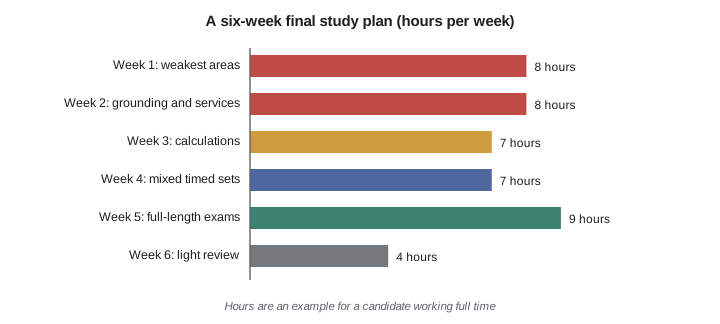
| Week | Focus | Measure |
|---|---|---|
| 1 | Weakest areas from the diagnostic; tab and index practice | Lookup times by kind |
| 2 | Grounding and bonding; services, feeders and overcurrent protection | Topic quizzes of 15 to 20 questions |
| 3 | Calculations: dwelling and commercial loads, motors, conductors and raceways | Timed calculation sets |
| 4 | Mixed timed sets across the outline; special occupancies and low voltage | 30-question sets in 90 minutes |
| 5 | Two full-length practice exams with full analysis | Scores and cause sorting |
| 6 | Light review of tabs, highlights and weak spots; logistics | Confidence, not cramming |
Lookup and calculation routines
On test day, routines save time because they remove decisions. For a lookup question, Tanisha's routine was: read the stem twice; underline the key words, such as the occupancy, the location and the equipment; decide whether she knew the article; if yes, go straight to the tab; if not, go to the index with the most specific key word; read the section, including exceptions; then answer. For a calculation question, her routine was: write the given values with units; name the rule or table that applies; do one step per line; check that the units make sense; compare the result to the answer choices; and if no choice matches, recheck the first step rather than picking the nearest number.
The answer choices themselves give clues. On a calculation, choices often include the right answer, the answer from a common mistake, such as forgetting a demand factor or using the wrong table, and two distractors. If your result matches a choice exactly, check that you did not make the common mistake. If it matches nothing, recheck your setup. On a lookup, choices often include the value for the wrong condition, such as a dwelling value when the question asks about another occupancy. Read the condition in the stem again before answering.
Worked problem
Working a practice calculation with the routine
A practice question: a single-family dwelling has a general lighting and receptacle load based on 2,400 square feet, two small-appliance circuits, one laundry circuit, a 12-kilowatt range and a 5-kilowatt dryer. Using the standard method for dwelling loads, a candidate must find the service load in amperes at 240 volts. How should the candidate approach it under the routine, without reproducing the code's tables here?
Show solution
- Write the givens with units: area, number of small-appliance and laundry circuits, range rating and dryer rating, and 240 volts.
- Name the rules: the general lighting load per square foot for dwellings, the small-appliance and laundry allowances, the lighting demand factors, the range demand table and the dryer rule, all in the dwelling load calculation article.
- Compute each part on its own line, applying the demand factors to the combined lighting, small-appliance and laundry load before adding the range and dryer.
- Add the parts for the total volt-amperes, then divide by 240 volts for amperes.
- Compare to the choices; if a choice matches a total without demand factors, that is the common-mistake distractor.
Answer: Follow the routine: givens, rules, one step per line, units, then compare; the right answer applies the demand factors before the range and dryer are added.
Test-day routine
The day before the exam, stop studying by early evening. Pack the code book, checked against the bulletin's rules on tabs and highlighting, the approved calculator with a fresh battery, two forms of identification if the bulletin asks for them, the confirmation and directions. Know where to park. Sleep. On the morning of the exam, eat a normal breakfast, arrive early and use the restroom before check-in. During check-in, the proctor may inspect the book; let it happen calmly. In the room, use the tutorial time to settle in and note the time remaining display.
Use the two-pass method from Lesson 4. On the first pass, answer quick questions and mark the rest. Check the clock at the quarter marks: about 15 questions answered or marked by 45 minutes, 30 by 90 minutes, 45 by 135 minutes. On the second pass, work the marked questions from easiest to hardest. With ten minutes left, make sure every question has an answer. Change an answer only when you find a specific reason, such as a misread condition or a calculation error, not because of a vague feeling.
| Time used | Target | If behind |
|---|---|---|
| 45 minutes | About 15 questions answered or marked | Mark long questions sooner |
| 90 minutes | About 30 | Skip calculations on the first pass |
| 135 minutes | About 45 and first pass finishing | Finish the first pass before any second-pass work |
| 170 minutes | All questions answered | Answer every remaining question now |
Using practice questions well
Practice question sources vary in quality. Some are written to the right edition and mirror the content outline; others are old, written to a different edition or built around trivia. Before relying on a practice set, check its edition against the bulletin and check a few answers against your own code book. When an explanation and the book disagree, the book wins. Write your own questions too: after studying a section, write two questions about it, with one right answer and three plausible wrong ones. Writing distractors forces you to understand the conditions and exceptions that real exam questions test. Tanisha and another Ouachita Bend journeyman preparing for the exam traded ten self-written questions every Friday during the six weeks, and both said those sets taught them more than any printed book.
Keep a short error log. For every missed question, write one line: the topic, the cause, the section where the answer lives and a short rule in your own words. Review the log at the start of each study session. By week five, the log becomes the most valuable review sheet you have, because it is made entirely of your own weak spots. Read it once more the evening before the exam, then put it away.
Managing stress
Most candidates hit a stretch of hard questions in the middle of the exam and start to worry. Expect it. A string of three hard questions does not mean you are failing; it means you are in a hard part of the exam. Mark them, breathe and keep moving. Short physical resets help: sit back, drop your shoulders, take three slow breaths, then read the next question. Remember the arithmetic: you can miss 18 and still pass. Tanisha wrote "18" at the top of her scratch paper as a reminder.
After the exam
If you pass, finish the job: apply for the license and pay the fee within the six months after the exam month, as Lesson 3 explains, and do not do work that requires the master license until it is issued. Tell your company so it can update permits, signs and contractor license records. If you fail, read the score report by content area, rest for a few days, then repeat the analysis from this lesson on your weakest areas and schedule a retake within the eligibility period. Many good masters passed on the second attempt.
Tanisha's license arrived in May. The week after, Dale handed her the key ring and the sheet of paper described in Lesson 7. By summer she was planning the grocery remodel, signing change orders, reviewing apprentice ratios every morning and scheduling the company's continuing education for the new code cycle. The exam was the gate. The rest of this course, from supervision and inspections to liens, safety and renewal, describes the work on the other side of it.
Common mistakes
MistakeTaking practice exam after practice exam without analyzing misses.
InsteadAnalyze each exam by area and by cause, then study the causes.
MistakeStudying all areas equally.
InsteadWeight study to the outline and to your diagnostic results.
MistakeCramming the night before.
InsteadStop by early evening, pack, rest and arrive early.
MistakeChanging answers on a hunch.
InsteadChange an answer only for a specific reason.
MistakeForgetting to obtain the license after passing.
InsteadApply and pay within six months after the exam month.
Summary and key terms
- Start with a timed diagnostic and mark every guess.
- Analyze misses by content area and by cause: rule, lookup, misread or calculation.
- Follow a six-week plan with weak areas first and full exams in week five.
- Use fixed routines for lookups and calculations, and read answer choices for clues.
- On test day, use two passes, check the quarter marks and answer every question.
- After passing, obtain the license within six months after the exam month.
- Diagnostic exam
- A timed practice exam used to measure strengths and weaknesses.
- Cause sorting
- Grouping misses by why they happened.
- Distractor
- A wrong answer choice designed to catch a common mistake.
- Quarter marks
- Time checkpoints at each quarter of the exam.
- Score report
- The result report, usually broken down by content area.
Practice problems
Work each problem on paper first, then reveal the answer to check.
What should you do right after a diagnostic exam?
Show answer
Score it, then analyze misses and guesses by area and by cause.
How many questions can you miss on a 60-question exam with a 70 cut score?
Show answer
Eighteen.
Where should you be after 90 minutes?
Show answer
About 30 questions answered or marked.
When should you change an answer?
Show answer
Only when you find a specific reason.
Lesson quiz · 5 questions
Score 60% or more to complete this lesson.
Create a free account to save your progress, take quizzes and earn a certificate.