
MELU-204 · Lesson 11 of 12 · 19 min
Renewal and continuing education
▶ Video coming soon A video version of this lesson is on the way.
Every January, Linda Kay prints a list of every license at Ouachita Bend Electric, sorted by expiration month: two masters, nine journeymen, the apprentice registrations, the company's Contractors Licensing Board license, the insurance policies, the surety bond and the business registrations. Next to each electrical license she writes the date the holder's continuing education was completed for the current code cycle. The list fits on two pages, and it has saved the company twice: once when a journeyman's license would have lapsed while he was on a two-week hunting trip, and once when Dale himself forgot that the new code cycle had started and that his continuing education hours from the old cycle no longer counted.
This lesson explains how Arkansas electrical licenses are renewed, how continuing education works under the board's rules, what happens when a license lapses and how a master sets up a company-wide system so that no one's license, including his or her own, expires by accident. It summarizes 17 CAR 210-504 and the continuing education rules in 17 CAR 210-1001 and following. Fees and course approvals change, so check the current rules and the board's approved course list before relying on any figure.
Annual renewal
Arkansas electrical licenses are issued for one year. Under the rules, a license expires on the last day of the month one year after it was issued, so a license issued on May 9 expires on the last day of May the following year. Each licensee renews individually, usually through the department's online system, by confirming his or her information, showing that the continuing education requirement is met and paying the renewal fee. The rules list a renewal fee of 50 dollars for a master and 25 dollars for a journeyman, with other amounts for other classes. Renewal notices are a courtesy; the licensee is responsible for renewing on time whether or not a notice arrives.
Some licensees can renew for more than one year at a time, depending on where they are in the code cycle and on what the department's system allows. A master who renews for multiple years still needs to meet the continuing education requirement for each code cycle that the renewal period covers. When in doubt, ask the department how the system handles a multi-year renewal before paying for one.
| Item | Rule (summary) |
|---|---|
| License term | One year, expiring the last day of the month one year after issue |
| Renewal fee | 50 dollars for a master and 25 dollars for a journeyman under the rules summarized here |
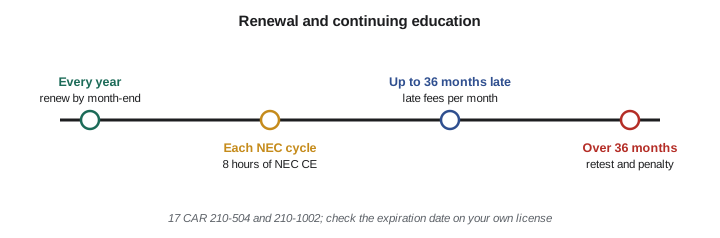
| Continuing education | 8 hours of board-approved NEC instruction per NEC code cycle |
| Late renewal up to 36 months | Late fee plus 10 dollars for each month late, with CE still required |
| Lapsed more than 36 months | Reexamination and a 1,000-dollar penalty |
| Restricted lifetime master | Separate class for long-serving masters meeting age and experience conditions |
Continuing education: 8 hours per code cycle
The board's continuing education rule requires master and journeyman licensees, and some other classes, to complete 8 hours of board-approved instruction on the NEC during each code cycle. The rules tie the cycle to the NEC, beginning a new cycle on January 1 of the year a new edition is published, so the requirement is tied to learning each new edition rather than to a fixed number of hours each year. A licensee who has not completed the hours for the current cycle cannot renew. Courses must be approved by the board for the cycle in which they are taken; the board publishes a list of approved courses and providers, each with a course number.
The approved course list shows how the cycle works in practice. The board's 2026 list described its courses on the 2026 NEC as approved for license renewal after January 1, 2026, and its earlier list described courses on the 2023 NEC as approved for renewals from January 1, 2024, through December 31, 2025. A licensee who took a 2023 NEC course in 2025 met the requirement for that cycle but needs a 2026 NEC course for the new one. Dale's mistake, years ago, was taking a course from the old cycle in the first month of the new one; the hours did not count, and he had to take another class before he could renew.
| Question | How to check |
|---|---|
| Is the course approved? | Find its course number on the board's current approved list |
| Is it for the right code cycle? | Check the edition and the renewal dates the list shows for it |
| Does it give 8 hours? | Check the hours shown on the list and the certificate |
| Will the board receive the record? | Ask the provider how completions are reported and keep the certificate |
| Does it match the license class? | Confirm the course is accepted for masters and journeymen |
# Which NEC code cycle does a course date fall in, and does it count? (simplified study aid;
# the board's approved list controls each course)
cycles = {2020: (2020, 2022), 2023: (2023, 2025), 2026: (2026, 2028)}   # example cycle years
def cycle_for(year):
    for ed, (start, end) in cycles.items():
        if start <= year <= end:
            return ed
courses = [("2023 NEC update", 2023, 2025), ("2023 NEC update", 2023, 2026), ("2026 NEC changes", 2026, 2026)]
for title, edition, taken in courses:
    c = cycle_for(taken)
print(f"{title} taken {taken}: cycle {c} ->", "counts" if edition == c else "does not count for this cycle")2023 NEC update taken 2025: cycle 2023 -> counts 2023 NEC update taken 2026: cycle 2026 -> does not count for this cycle 2026 NEC changes taken 2026: cycle 2026 -> counts
The study aid uses example cycle years to show the idea. A course on the 2023 NEC taken in 2025 counts for the 2023 cycle, but the same course taken in 2026 does not count for the 2026 cycle. In real life, use the dates the board prints on its approved list.
Choosing good courses
Eight hours is not much time to learn a new edition of the NEC, so choose courses that teach what changed and why. The board's list includes classroom courses, online courses and courses offered by trade associations, community colleges, apprenticeship programs and manufacturers. A good course covers the major changes by article, the Arkansas amendments and the practical effect on installations. Tanisha schedules the whole company for the same classroom course early in each new cycle, so that the crews hear the same explanations of the changes and the Arkansas amendments at the same time, and she adds a short internal session on how the changes affect Ouachita Bend's standard details and estimates.
Late renewal and lapsed licenses
A license that is not renewed by the end of its expiration month is expired, and the holder may not do work that requires it until it is renewed. The rules allow late renewal for up to 36 months after expiration, with the regular fee, a late fee and an additional 10 dollars for each month late, and with the continuing education requirement still applying. After 36 months, the license cannot simply be renewed; the holder must pass the exam again and pay a 1,000-dollar penalty. A master whose license expires also creates a problem for the company, which may not have a master to plan and supervise work during the lapse.
Inactive status and similar options, where the rules provide them, can help a licensee who leaves the trade for a while. A master who expects to be away, for military service, illness or a career change, should ask the department how to keep the license from lapsing beyond the 36-month limit. The cost of reexamination, in time and fees, is much higher than the cost of renewing on time.
Other renewals a master tracks
An electrical license is only one of the dates a company must track. The Contractors Licensing Board license has its own renewal, usually with updated financial statements and proof of insurance. Insurance policies renew annually, and certificates must be reissued to general contractors and owners. Surety relationships require annual financial statements. Secretary of State franchise tax reports are due on their own schedule. Local business or privilege licenses, where cities require them, renew at the city's schedule. Apprentice registrations must stay current. A master who runs the electrical side of a company should know where each date lives and who in the office is responsible for it.
Keeping records of continuing education
Providers report completions in different ways, and the licensee is the one who must prove the hours if the department asks. Keep the certificate for every course, with the course number, the provider, the date, the hours and the code edition, for at least the current cycle and the one before it. Linda Kay scans each certificate into the employee's folder the day it arrives and notes the date on her renewal list. When a journeyman moves to another company, he takes copies with him, because the hours belong to the licensee. A master who teaches courses or serves on code panels should ask the board in advance whether that work counts toward the requirement; do not assume it does.
Renewal and the company's work
An expired license is not just a personal problem. A journeyman whose license has expired may not install electrical work, so a foreman with an expired license must be pulled off the job until he renews. A master whose license has expired may not plan and supervise, so permits and job signs that carry that master's number are no longer backed by a current license, and the company may have to stop work that needs a master. General contractors and owners sometimes check license status on the department's online lookup before releasing payment. For all those reasons, Ouachita Bend treats license renewal as a company deadline, not a personal one. Each license holder renews his or her own license, but the office confirms the renewal on the department's lookup by the twentieth of the expiration month and calls anyone who has not renewed by then.
The same habit protects the license holder. A master who changes companies should update his or her contact information with the department so renewal notices arrive, and should confirm that the new company's permit and sign records carry the correct license number. A master who retires should decide whether to keep the license active, renew in a restricted class if eligible or let it expire, knowing that after 36 months the exam must be taken again.
Worked problem
Building a renewal calendar
Ouachita Bend has two masters, nine journeymen and six apprentices. Tanisha's master license was issued on May 9, 2026. A journeyman's license expires at the end of August 2027, and he has not yet taken a 2026 NEC course. The company's commercial contractor license renews in October. Build the key entries for the next renewal season.
Show solution
- Tanisha's license expires on May 31, 2027; put a reminder on April 1 to confirm her CE and renew.
- The journeyman needs an approved 2026 NEC course of 8 hours before he renews in August 2027; enroll him in the company's spring class.
- Put the commercial contractor license renewal in the calendar for September, with a reminder to update financial statements and insurance certificates.
- Add the insurance renewal dates and the surety's financial statement date.
- Review the list every January and every time someone is hired, licensed or leaves.
Answer: Track each license by its own expiration month, link each electrical renewal to the CE needed for the current code cycle, and review the calendar at least every January.
Common mistakes
MistakeAssuming the license renews on the issue date.
InsteadIt expires on the last day of the month one year after issue.
MistakeTaking any 8-hour course.
InsteadThe course must be board-approved for the current code cycle and the license class.
MistakeUsing last cycle's hours for this cycle's renewal.
InsteadThe 8 hours must be completed for the current NEC code cycle.
MistakeWaiting for the renewal notice.
InsteadThe licensee must renew on time even without a notice.
MistakeLetting a license lapse for more than 36 months.
InsteadAfter 36 months, reexamination and a 1,000-dollar penalty are required.
Summary and key terms
- Arkansas electrical licenses are issued for one year and expire on the last day of the month one year after issue.
- The rules list renewal fees of 50 dollars for a master and 25 dollars for a journeyman.
- Masters and journeymen must complete 8 hours of board-approved NEC instruction for each code cycle.
- Missing continuing education blocks renewal.
- Late renewal is possible for up to 36 months with late fees; after that, reexamination and a 1,000-dollar penalty apply.
- A master tracks electrical licenses, CE, contractor licenses, insurance, bonds and registrations on one calendar.
- Code cycle
- The period tied to an NEC edition during which the 8 hours of CE must be completed.
- Approved course
- A course on the board's list, with a course number, for a specific cycle.
- Late renewal
- Renewal after expiration, within 36 months, with late fees.
- Reexamination
- Passing the exam again, required after a lapse of more than 36 months.
- Renewal calendar
- A company list of every license and policy with its expiration date and owner.
Practice problems
Work each problem on paper first, then reveal the answer to check.
When does a license issued on May 9 expire?
Show answer
On the last day of May the following year.
How many hours of continuing education does a master need per code cycle?
Show answer
Eight hours of board-approved NEC instruction.
Can a licensee renew without the required CE?
Show answer
No. Missing CE blocks renewal.
What is required after a lapse of more than 36 months?
Show answer
Reexamination and a 1,000-dollar penalty.
Lesson quiz · 5 questions
Score 60% or more to complete this lesson.
Create a free account to save your progress, take quizzes and earn a certificate.