
MELU-204 · Lesson 10 of 12 · 19 min
Workplace safety law and OSHA for electrical contractors
▶ Video coming soon A video version of this lesson is on the way.
The incident at the Conway church addition lasted less than a second. A second-year apprentice was helping a journeyman tie new circuits into an existing 208-volt panel in the old fellowship hall. The panel's main breaker had been opened, but the journeyman had not tested the bus because the panel was fed from a separate subpanel that he believed was the only source. A second feeder, added years earlier by another company and not shown on any drawing, kept half of the bus energized. The apprentice's screwdriver slipped across two terminals. There was a flash, a bang and a burned glove; the apprentice was shaken but uninjured because he was wearing the arc-rated face shield and gloves the company required. Tanisha drove to Conway that afternoon, stopped the job and spent two hours with the crew. That night she rewrote the company's lockout procedure.
This lesson covers the workplace safety law that applies to Arkansas electrical contractors: federal OSHA jurisdiction, the construction and general industry standards that apply to electrical work, the general duty clause, NFPA 70E as the industry standard for electrical safety, lockout and tagout, multi-employer job sites, injury recordkeeping and reporting, inspections and citations, and how a master builds a safety program that works on real jobs. It summarizes federal requirements and points to the standards themselves; it does not reproduce them.
Federal OSHA in Arkansas
Arkansas does not operate its own OSHA state plan for private employers, so private-sector workplaces in Arkansas, including electrical contractors, fall under federal OSHA. Federal OSHA enforces its standards through its area office serving Arkansas, conducts inspections, issues citations and proposes penalties. State and local government employers in Arkansas are not covered by federal OSHA in the same way, but private contractors working on public projects still are. The Arkansas Department of Labor and Licensing offers a free, confidential safety consultation program for small employers, separate from enforcement, which can help a company review its program without the risk of a citation from the visit.
The standards that apply
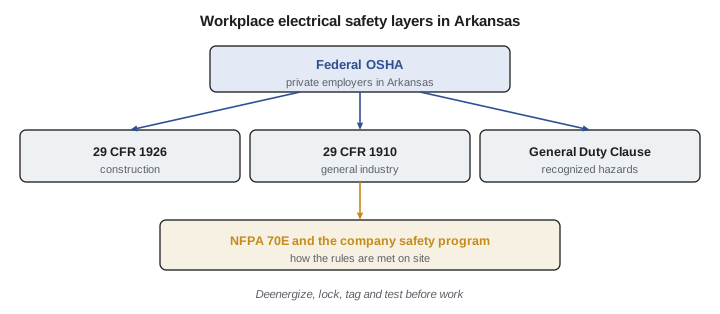
Electrical contractors work under two sets of OSHA standards. The construction standards in 29 CFR Part 1926 apply to construction, alteration and repair work, including new installations and remodels; Subpart K covers electrical safety in construction, and other subparts cover ladders, scaffolds, fall protection, excavations and personal protective equipment. The general industry standards in 29 CFR Part 1910 apply to maintenance and service work in existing facilities; Subpart S covers electrical safety, and 1910.147 covers the control of hazardous energy, often called lockout and tagout. Many electrical jobs mix both kinds of work, and OSHA looks at the nature of the task to decide which standard applies.
Where no specific standard addresses a recognized hazard, the general duty clause in section 5(a)(1) of the Occupational Safety and Health Act requires employers to provide a workplace free from recognized hazards that are causing or likely to cause death or serious physical harm. OSHA has used the general duty clause, along with its own standards, to address arc flash hazards, and it often looks to NFPA 70E as evidence of what the industry recognizes as hazards and feasible ways to reduce them.
| Rule or standard | What it covers | Typical electrical topics |
|---|---|---|
| 29 CFR 1926 (construction) | New work, alterations and repairs | Subpart K electrical safety, ground-fault protection on site, ladders, fall protection |
| 29 CFR 1910 (general industry) | Maintenance and service in existing facilities | Subpart S electrical safety work practices, 1910.147 lockout and tagout |
| General duty clause | Recognized hazards without a specific standard | Arc flash, heat and other hazards |
| NFPA 70E | Industry consensus standard for electrical safety in the workplace | Electrically safe work condition, risk assessment, PPE |
| 29 CFR 1904 | Recordkeeping and reporting | Injury logs and reports of severe injuries |
The electrically safe work condition
The safest way to work on electrical equipment is to make it deenergized and keep it that way. NFPA 70E describes the steps to establish an electrically safe work condition: identify all possible sources of supply, using up-to-date drawings and a field check; properly interrupt the load and open the disconnecting devices for each source; visually verify, where possible, that the disconnect has opened; apply lockout and tagout devices under a written procedure; test each phase conductor or circuit part with a properly rated test instrument, checking the instrument on a known source before and after the test; and ground the conductors where induced voltage or stored energy could be present. Energized work is justified only in limited cases, such as when deenergizing introduces greater hazards or is infeasible, and it requires a documented risk assessment, an energized work permit where 70E calls for one and appropriate protective equipment.
The Conway incident broke the first and fifth steps. The journeyman identified one source and missed the second, and he did not test before touching. The arc-rated equipment did its job as the last line of defense, but the company's procedure should have stopped the work before it reached that line. Tanisha's revised procedure now requires a field check of every panel for additional feeders, a test of every bus section with a verified meter and a second person's sign-off on the lockout before work begins in any existing panel.
# Checklist for establishing an electrically safe work condition (simplified study aid)
steps = [
    "identify every source (drawings plus field check)",
    "interrupt load and open each disconnect",
    "visually verify open blades or contacts where possible",
    "apply locks and tags under the written procedure",
    "verify the tester on a known source",
    "test every phase and circuit part for absence of voltage",
    "re-verify the tester on the known source",
    "ground where induced voltage or stored energy is possible",
]
done = {s: True for s in steps}
done["identify every source (drawings plus field check)"] = False   # the Conway miss
done["test every phase and circuit part for absence of voltage"] = False
for i, s in enumerate(steps, 1):
    print(f"{i}. [{'x' if done[s] else ' '}] {s}")
print("safe to work:", all(done.values()))1. [ ] identify every source (drawings plus field check) 2. [x] interrupt load and open each disconnect 3. [x] visually verify open blades or contacts where possible 4. [x] apply locks and tags under the written procedure 5. [x] verify the tester on a known source 6. [ ] test every phase and circuit part for absence of voltage 7. [x] re-verify the tester on the known source 8. [x] ground where induced voltage or stored energy is possible safe to work: False
Lockout and tagout
OSHA's lockout and tagout rules require employers to have a written energy control program, specific procedures for the equipment workers service, locks and tags that are durable and identifiable, training for authorized and affected employees, and periodic inspection of the procedures. On construction sites, Subpart K has its own lockout and tagging requirements for deenergized circuits. The key principle is the same: each worker who could be exposed applies his or her own lock, keeps the key and removes the lock only when his or her work is done. Group lockout procedures are allowed for complex jobs, but they must give each worker the same protection as a personal lock.
Multi-employer job sites
Most electrical work happens on sites shared with other trades. OSHA's multi-employer citation policy recognizes four roles: the creating employer that caused a hazard, the exposing employer whose workers are exposed, the correcting employer responsible for fixing the hazard and the controlling employer with general supervisory authority over the site, usually the general contractor. More than one employer can be cited for the same hazard. For an electrical contractor, that means it must protect its own workers from hazards created by others, avoid creating hazards for other trades, such as open panels or temporary wiring without protection, and report hazards it cannot correct to the controlling employer.
Temporary power is a common multi-employer hazard. The construction standards require ground-fault protection for receptacles that workers use on construction sites, either by ground-fault circuit interrupters or by an assured equipment grounding conductor program where allowed. Because the electrical contractor usually installs the temporary service, other trades rely on it. Ouachita Bend tests the ground-fault protection on its temporary panels weekly and logs the result, and it replaces damaged cords it finds on site, whoever owns them.
Recordkeeping and reporting
Employers covered by OSHA's recordkeeping rule must keep a log of recordable work-related injuries and illnesses, complete an incident report for each and post an annual summary. Some small employers and some industries are partially exempt from keeping the logs, but every employer must report severe injuries. Under 29 CFR 1904.39, an employer must report a work-related fatality to OSHA within 8 hours and an inpatient hospitalization, amputation or loss of an eye within 24 hours. Work injuries must also be reported to the workers' compensation carrier and, as required, to the Arkansas Workers' Compensation Commission. The Conway incident was not recordable, because the apprentice was not injured, but Tanisha recorded it as a near miss in the company's own log and used it in training.
Inspections and citations
OSHA inspections are triggered by imminent danger, fatalities and severe injuries, complaints, referrals, targeted programs and follow-ups. A compliance officer presents credentials, holds an opening conference, walks the site and interviews workers, and holds a closing conference. Citations describe the violation, the standard, the proposed penalty and the date by which the hazard must be abated. An employer may request an informal conference and may contest a citation within the time OSHA sets, which is 15 working days after receipt. A master should know who in the company handles an inspection, keep training and program records ready and never interfere with a compliance officer's access to workers.
Building a safety program that works
A written safety program is required by several OSHA standards, but paper alone protects no one. A program that works on real jobs has a few plain parts: a written energy control procedure that crews actually follow; training that is documented and repeated, including who is a qualified person for each kind of work; arc-rated clothing and protective equipment that fits and is replaced when damaged; test instruments that are rated for the work and checked; job hazard reviews before unusual tasks; and a way for any worker, including an apprentice, to stop a task he or she believes is unsafe without being punished. Heat is a real hazard on Arkansas summer jobs, in attics and on rooftops, and a program should cover water, rest, shade and acclimatization for new workers. The master's role is to make the program part of the work, not an extra. Tanisha opens every Monday job review with one safety topic drawn from the company's near-miss log, and she walks one job a week with the specific purpose of watching how lockouts are done.
Worked problem
Rewriting a procedure after a near miss
After the Conway incident, Tanisha reviews what happened: one source identified, no test before touch, PPE worn, no injury. Which changes address the causes, and what records should the company keep?
Show solution
- Require a field check of every existing panel for additional feeders before planning a lockout.
- Require testing of every bus section and conductor with a meter verified on a known source before and after the test.
- Require a second qualified person to review the lockout before work begins in existing equipment.
- Retrain the crews on the revised procedure and document the training with dates and signatures.
- Record the event as a near miss, keep the revised procedure and training records, and review the program at the next annual inspection.
Answer: Fix the causes, not just the symptom: find all sources, test before touch, add a second-person check, retrain and keep records of each change.
Common mistakes
MistakeAssuming Arkansas has a state OSHA plan for private employers.
InsteadPrivate employers in Arkansas fall under federal OSHA.
MistakeTreating NFPA 70E as optional because it is not an OSHA standard.
InsteadOSHA uses 70E as evidence of recognized hazards and feasible protections.
MistakeOpening the main and starting work without testing.
InsteadEvery conductor and circuit part must be tested for absence of voltage with a verified meter.
MistakeIgnoring hazards created by another trade.
InsteadUnder the multi-employer policy, an exposing employer must protect its workers and report the hazard.
MistakeReporting a hospitalization a week later.
InsteadInpatient hospitalizations must be reported to OSHA within 24 hours; fatalities within 8 hours.
Summary and key terms
- Private employers in Arkansas fall under federal OSHA.
- 29 CFR 1926 covers construction and 29 CFR 1910 covers general industry, including lockout and tagout.
- The general duty clause and NFPA 70E address arc flash and other recognized hazards.
- An electrically safe work condition requires identifying all sources, opening, locking, testing and grounding where needed.
- On multi-employer sites, more than one employer can be cited for the same hazard.
- Fatalities must be reported within 8 hours and hospitalizations, amputations or eye losses within 24 hours.
- General duty clause
- The requirement to keep a workplace free of recognized serious hazards.
- Electrically safe work condition
- A state in which equipment is deenergized, locked out, tested and grounded as needed.
- Lockout and tagout
- Procedures that keep equipment deenergized while workers service it.
- Controlling employer
- The employer with general supervisory authority over a site.
- Near miss
- An event that could have caused injury but did not.
Practice problems
Work each problem on paper first, then reveal the answer to check.
Does Arkansas run a state OSHA plan for private employers?
Show answer
No. Federal OSHA covers private employers in Arkansas.
Which OSHA standard covers lockout and tagout in general industry?
Show answer
29 CFR 1910.147.
How soon must a work-related fatality be reported to OSHA?
Show answer
Within 8 hours.
What must be done before touching a deenergized conductor?
Show answer
Test it for absence of voltage with a meter verified on a known source.
Lesson quiz · 5 questions
Score 60% or more to complete this lesson.
Create a free account to save your progress, take quizzes and earn a certificate.