
MELU-204 · Lesson 2 of 12 · 19 min
Eligibility for the Master Electrician License
▶ Video coming soon A video version of this lesson is on the way.
Linda Kay Hollis has managed the office at Ouachita Bend Electric since 2009, and she keeps every employee's file in a gray cabinet behind her desk: W-2 forms, apprenticeship records, license copies and a running log of who worked on which jobs. When Tanisha said she was applying for the master exam, Linda Kay pulled her folder and spread it across the break room table. "The board wants to see the years," she said, "and they want to see that you were licensed for the part that counts as journeyman time. Let's make sure every year has paper behind it before you mail anything." Tanisha had assumed that twelve years in the trade would speak for itself. By the end of the afternoon she understood that eligibility is a question of proof, not just time.
This lesson explains who may sit for the Arkansas master electrician exam. It covers the routes in 17 CAR 210-404, how construction experience and licensed journeyman experience are counted, the engineering degree route, how the board treats combinations of education and experience, the records that prove experience, and the related requirements for the journeyman and residential classes that often shape a candidate's path. Fees and exact wording change, so treat the numbers here as the current summary and confirm them against the rules and the application form before you apply.
The master routes
The board's rules give three ways to qualify for the unlimited master electrician exam. The first is the engineering route: a degree in electrical engineering plus two years of experience in electrical construction. The second is the experience route: six years of experience in the electrical construction industry, at least two of which were spent as a licensed journeyman electrician. The third is a combination of education and experience that the board approves as equivalent. Most candidates in the field, like Tanisha, use the experience route, because they come up through apprenticeship and the journeyman license.
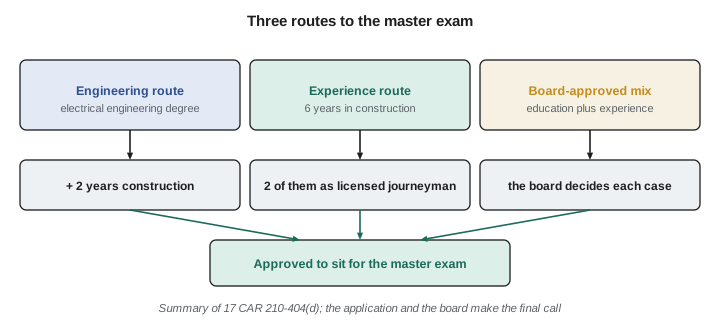
The two years of licensed journeyman time are the piece that trips people up. A worker who has spent ten years doing electrical work but held the journeyman license for only one of them does not yet meet the experience route. The rule looks for time during which the person held the license, not just time doing journeyman-level work. A candidate with a residential journeyman license should read the rule carefully and ask the board office whether that time counts toward the unlimited master route, because the residential classes form their own ladder.
| Route | Education | Experience | Licensed journeyman time |
|---|---|---|---|
| Engineering | Degree in electrical engineering | Two years in electrical construction | Not required by this route |
| Experience | None required | Six years in electrical construction | At least two of the six years |
| Combination | Board-approved education | As the board approves | As the board approves |
What counts as experience
The rules speak of experience in the electrical construction industry. In practice the board looks for work installing, altering, maintaining and supervising electrical systems under the supervision of licensed electricians, documented by employers. Time as a registered apprentice counts as construction experience for the six years, though it is not licensed journeyman time. Time doing low-voltage work under an exemption, sales, estimating without field work or work unrelated to electrical installation may not count, or may count only in part. When in doubt, describe the work honestly and let the board decide; an inflated description is a much bigger problem than a short year.
Full-time work is the usual basis. The journeyman rule uses a standard of 2,000 hours a year and limits how many hours can be credited in one year, which shows how the board thinks about time. A worker who worked half time for four years does not have four years of experience under that approach. Overtime does not stretch a year beyond the cap. Candidates who had breaks, seasonal work or several employers should total their documented hours year by year rather than counting calendar years from hire date to today.
# Does a candidate meet the six-year experience route? (simplified study aid)
YEAR_HOURS = 2000          # full-time year used for counting
years = [  # (year, documented hours, held journeyman license all year?)
    (2014, 1850, False), (2015, 2000, False), (2016, 2000, False), (2017, 2000, False),
    (2018, 2000, True), (2019, 2000, True), (2020, 1700, True),
]
total_years = sum(min(h, YEAR_HOURS) for _, h, _ in years) / YEAR_HOURS
licensed = sum(min(h, YEAR_HOURS) for _, h, lic in years if lic) / YEAR_HOURS
print(f"construction experience: {total_years:.2f} years (need 6)")
print(f"licensed journeyman time: {licensed:.2f} years (need 2)")
print("meets experience route:", total_years >= 6 and licensed >= 2)construction experience: 6.78 years (need 6) licensed journeyman time: 2.85 years (need 2) meets experience route: True
The example candidate has about 6.8 years of documented construction experience and about 2.85 years as a licensed journeyman, so the totals meet both parts of the route. The same arithmetic run on a candidate who held the journeyman license for only eighteen months would fail the second test no matter how long the first total was. Run the numbers on your own file before you apply, and keep the worksheet with your records.
Proving the years
The application asks the candidate to list employers and dates and to provide proof. Typical proof includes letters or affidavits from licensed masters or employers describing the work, W-2 forms or other payroll records, apprenticeship completion records and the candidate's license history, which the board can confirm from its own files. The application form tells you exactly which documents are required and whether signatures must be notarized. Read it line by line. Missing signatures and unexplained gaps are common reasons an application waits for another board meeting.
Linda Kay's method works for any candidate. She makes a table with one row per year and columns for employer, hours, license held, proof in the file and the master who supervised the work. Every row must have proof. For the years Tanisha worked at another company before Ouachita Bend, she calls that company's office for a letter and W-2 copies early, because old employers can take weeks to respond. For years when Tanisha was an apprentice, the apprenticeship completion record and payroll records back up the hours.
| Year | Employer | Role | Proof |
|---|---|---|---|
| 2014 | Ouachita Bend Electric | Registered apprentice | Registration record, W-2, apprenticeship log |
| 2015 to 2017 | Ouachita Bend Electric | Registered apprentice | W-2s, apprenticeship completion record |
| 2018 to 2020 | Ouachita Bend Electric | Licensed journeyman | W-2s, license history, master's letter |
| 2021 to 2025 | Ouachita Bend Electric | Licensed journeyman and foreman | W-2s, license history, master's letter, job logs |
The engineering route
An electrical engineering graduate who has two years of electrical construction experience may qualify for the master exam without first holding the journeyman license. The board expects the degree to be in electrical engineering, documented with a transcript, and the two years to be construction experience rather than design office time alone. A graduate who has spent two years in a design office and wants to sit for the master exam should ask the board how it will treat that time, because the rule's wording emphasizes construction. A degree in electrical engineering technology or a related field may fall under the combination route instead, which the board decides case by case.
Combinations of education and experience
The combination route exists for candidates whose background does not fit neatly into the first two, such as a military electrician with formal training and years of service, a graduate of a two-year electrical program or a person licensed in another state. The board weighs the education and experience and decides whether together they equal the other routes. There is no fixed formula in the summary of the rule, so a candidate using this route should provide complete documentation, including course transcripts, military training records and detailed descriptions of field work. A short phone call to the board office before filing can save a meeting cycle.
Candidates licensed in other states may also look at reciprocity. A.C.A. 17-28-306 allows the board to license a person who holds an equivalent license in another state, after proof and fees, where Arkansas has an agreement with that state. The list of states and the conditions change, so check with the board before assuming an out-of-state license transfers.
The journeyman and residential classes
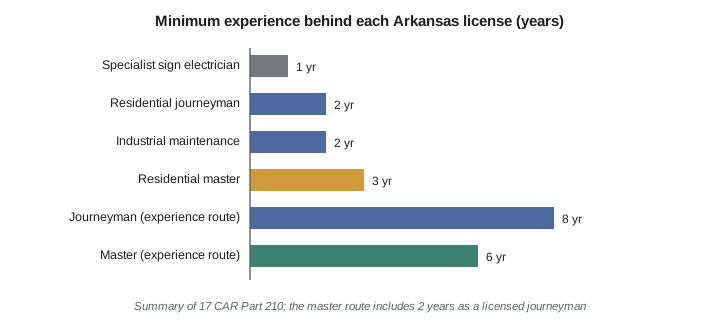
Because the master route depends on journeyman time, a candidate's earlier path matters. The journeyman license requires either completion of a four-year registered apprenticeship program, documented with the program's release for testing, or eight years of documented experience, counted at no more than 2,000 hours credited per year. The residential journeyman needs two years of experience, and the residential master needs three years, one of them as a licensed residential journeyman. The industrial maintenance license needs two years in plant maintenance, and the specialist sign license needs one year. A worker planning a master career usually aims for the unlimited journeyman license early, because the master clock does not start counting licensed time until it is issued.
Character, age and other conditions
The application asks about past license discipline and criminal convictions. Arkansas law, at A.C.A. 17-1-103, limits how licensing boards may use criminal records: most convictions are not an automatic bar, the board must consider them under defined standards, and a denial based on a conviction must be explained. Candidates with a record should answer honestly and may ask the board for a preliminary determination. The restricted lifetime master license has its own conditions, including many years as a master and a minimum age, and it is not a route for new candidates.
Planning the path early
The best time to plan for the master exam is the day a worker earns the journeyman license, because that date starts the two-year clock. Tanisha's advice to Ouachita Bend's newer journeymen is simple: put the license issue date in your phone, keep a copy of every W-2, ask your foreman for a short letter each January describing the jobs you ran the year before, and keep your apprenticeship records in a folder that does not live in a truck. Workers who change employers should ask for a letter on the way out, while the people who supervised them still remember the work. A master candidate who has done this for years can assemble an application in an evening. One who has not may spend months tracking down old supervisors, some of whom have retired, moved or closed their companies. The board cannot accept memories in place of records, so the paper trail is part of the career.
Worked problem
Checking eligibility before filing
Marcus has worked for electrical contractors in Arkansas since 2017, full time except for a six-month layoff in 2020. He passed the journeyman exam in March 2024. In January 2026 he wants to apply for the master exam. Does he meet the experience route?
Show solution
- Total construction experience from 2017 through 2025 is about nine years minus six months, or about eight and a half years, so the six-year part is met if documented.
- Licensed journeyman time runs from March 2024 to January 2026, which is about one year and ten months.
- The route needs at least two years as a licensed journeyman.
- He is about two months short of the licensed journeyman requirement.
- He should finish his records now and file once he reaches two full years, timing the filing for the next board meeting.
Answer: Not yet; he has enough total experience but needs about two more months of licensed journeyman time before he meets the experience route.
Common mistakes
MistakeCounting all years in the trade as journeyman time.
InsteadOnly time while holding the journeyman license counts toward the two-year part of the experience route.
MistakeCounting calendar years from hire date.
InsteadCount documented full-time hours year by year, allowing for layoffs and part-time periods.
MistakeAssuming any degree satisfies the engineering route.
InsteadThe route names an electrical engineering degree plus two years of construction experience; other degrees go to the combination route.
MistakeFiling without proof for each year.
InsteadEach year needs employer letters, payroll records or apprenticeship records, as the form requires.
MistakeAssuming an out-of-state license transfers automatically.
InsteadReciprocity depends on an agreement with that state and the board's conditions.
Summary and key terms
- The master exam routes are an electrical engineering degree plus two years of construction experience, six years of construction experience with two as a licensed journeyman, or a board-approved combination.
- Licensed journeyman time means time while holding the license, not just journeyman-level work.
- Count documented full-time hours year by year and keep proof for every year.
- The journeyman license needs a four-year registered apprenticeship or eight documented years.
- Residential, industrial maintenance and sign classes have shorter requirements and narrower scopes.
- Reciprocity and criminal-record rules exist but depend on agreements and board review.
- Experience route
- Six years of electrical construction experience, two of them as a licensed journeyman.
- Engineering route
- An electrical engineering degree plus two years of electrical construction experience.
- Combination route
- Education and experience that the board approves as equivalent.
- Release for testing
- The apprenticeship program's record that an apprentice has completed the program and may take the journeyman exam.
- Reciprocity
- Licensing based on an equivalent license from a state with which Arkansas has an agreement.
Practice problems
Work each problem on paper first, then reveal the answer to check.
How much licensed journeyman time does the experience route need?
Show answer
At least two of the six years.
Does apprentice time count toward the six years?
Show answer
It counts as construction experience but not as licensed journeyman time.
What does the engineering route require besides the degree?
Show answer
Two years of electrical construction experience.
What is the journeyman experience route?
Show answer
Eight years of documented experience, with no more than 2,000 hours credited per year.
Lesson quiz · 5 questions
Score 60% or more to complete this lesson.
Create a free account to save your progress, take quizzes and earn a certificate.