
MELU-204 · Lesson 6 of 12 · 20 min
Permits, inspections and the inspection authority
▶ Video coming soon A video version of this lesson is on the way.
The Bryant tenant finish was routine until the rough-in inspection. Ouachita Bend had pulled the city permit, the crew had run the branch circuits for a new dental office in a strip center, and the city inspector, Gil Navarro, arrived on time on a Wednesday morning. He passed the rough-in with one correction: two boxes above the reception desk were overfilled. The surprise came a week later, when a state electrical inspector stopped at the same strip center to look at a sign circuit another company had installed for the tenant next door without a permit. "Two inspectors, one building," said Jace Thornton, the senior apprentice who was finishing the dental office. "Who is the boss?" Tanisha used the question as a lesson for the whole crew that afternoon.
This lesson explains who issues permits and who inspects electrical work in Arkansas: city and county programs, state electrical inspectors, and what happens in places with no local permit system. It covers who may obtain permits, the common inspection stages, corrections and reinspection, the state inspector's authority to require uncovering of work, the job sign rule where no permit is issued, the role of utilities and how a master plans inspections on a schedule. Local procedures vary, so the details of any one city's program come from that city's ordinance and inspection office.
Three kinds of inspection authority
Arkansas has two layers of electrical inspection. Cities and counties may run their own permit and inspection programs under A.C.A. 17-28-305, using electrical inspectors licensed by the board. Their inspectors work only inside the boundaries of the city or county that employs them. The Department of Labor and Licensing employs state electrical inspectors, who have statewide authority and can inspect electrical work anywhere in Arkansas. Between those two layers lie many places, especially in rural counties, where no local program issues permits for private work. Those places are not unregulated; the state code still applies, the work still requires licensed electricians, and state inspectors may still inspect.
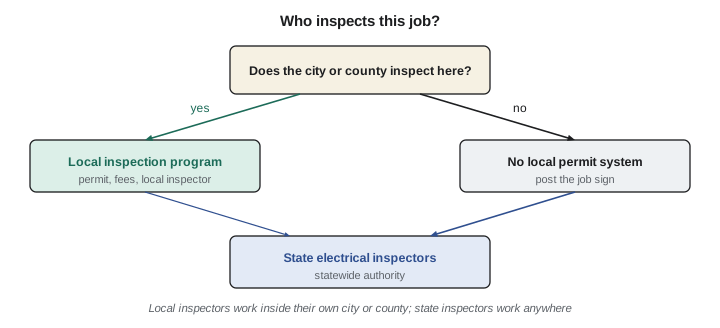
In the Bryant case, both inspectors had authority. The city inspector inspected the dental office because the city's program covered it and the company had pulled a city permit. The state inspector was there because the department had received a complaint about unpermitted sign work, and state inspectors may inspect anywhere. Neither was the other's boss. The company answering to both had a simple duty: do code-compliant work, cooperate with each inspector and correct whatever either one cites.
| Inspection authority | Where it works | How it is triggered |
|---|---|---|
| City inspection program | Inside city limits, and sometimes a defined area outside them | Permit application and inspection requests by the permit holder |
| County inspection program | Unincorporated areas of that county, where the county runs one | Permit application and inspection requests |
| State electrical inspector | Anywhere in Arkansas | Department programs, complaints, requests and the inspector's own initiative |
| No local program | Places where no city or county issues electrical permits | Job sign posted; state inspection still possible |
Finding the authority for an address
Before bidding a job in a new place, find out who issues permits for that address. The city limits on a map do not always match the inspection boundary, because some cities inspect within a planning area outside their limits and some counties contract with a city. Call the city building or inspection office first. If the address is outside any city program, call the county judge's office or the county planning office and ask whether the county issues electrical permits. Ask which code edition and amendments are enforced, what the permit fees are, whether plan review is required and how inspections are scheduled. Write the answers in the job file.
Ouachita Bend's estimators keep a short list for every place the company works: Benton, Bryant, Little Rock, Conway, Hot Springs and Sheridan, with the office phone number, the permit portal, the inspection request method, typical lead times and the names of the inspectors. For rural Grant County farm jobs, the list notes that the county does not issue electrical permits for private work and that the job sign rule applies. The list is updated every time someone learns something new, which is most weeks.
Who may obtain a permit
Local programs set their own rules on who may obtain an electrical permit, consistent with state licensing law. Most require the permit to be obtained by or under a licensed master electrician, with the master's license number on the application, because the master is the person responsible for planning and supervising the work. Many also accept permits from homeowners for work on their own primary residence under the statutory exemption, sometimes after a competency test as A.C.A. 17-28-305 allows. A journeyman usually may not obtain a permit for contracting work in his or her own name. Read each program's permit rules, because some require a company registration, proof of insurance or a local business license with the application.
A permit is a promise. The master whose number is on it is saying that the work will be planned and supervised by a licensed master and installed by licensed electricians and supervised apprentices, under the code, and that it will be inspected before it is covered or energized. A master who lets another company use his or her license number to pull permits is lending the license, which can lead to discipline for both.
Common inspection stages
Programs differ, but most follow a similar sequence. A temporary power inspection comes first on new construction, so the builder can use power on site. An underground or slab inspection checks conduits, grounding electrodes and other work before concrete is poured or trenches are backfilled. A rough-in inspection checks boxes, wiring methods, conductor sizes, grounding and bonding before walls and ceilings are covered. A service inspection may be separate, especially where the utility needs the inspector's release before it sets a meter. A final inspection checks devices, panels, labeling, protection and the finished installation before the owner occupies the building.
| Stage | What the inspector checks | What must not happen first |
|---|---|---|
| Temporary power | Temporary service, grounding, ground-fault protection for receptacles | Using the temporary service before release |
| Underground or slab | Conduits, burial depth, electrodes, bonding in footings | Pouring concrete or backfilling |
| Rough-in | Boxes, wiring methods, conductor sizing, grounding paths | Insulation, drywall or ceiling cover |
| Service | Service equipment, grounding electrode system, clearances | Utility energizing without release |
| Final | Devices, panels, labeling, protection, finished work | Occupancy before approval |
Corrections and reinspection
When an inspector finds a violation, the inspection fails or passes with corrections, and the inspector leaves a correction notice or enters it in the program's online system. The permit holder corrects the work and requests a reinspection, often with a fee. A master should review every correction with the crew that did the work, because the same mistake on the next job is a second fee and a delay. If a master disagrees with a correction, the first step is a calm conversation with the inspector, using the code section and the facts. If that fails, the local program usually has an appeal to the building official or a board of appeals, and questions about the state code can be raised with the department.
Gil Navarro's correction on the dental office, overfilled boxes above the reception desk, came from a change the owner made after the layout: two extra data circuits had been added to boxes sized for the original plan. Tanisha had the crew replace the boxes with deeper ones, recalculated box fill on every box the change touched and called for reinspection the next day. She also added box fill to the list of things she checks after any owner change.
# Box fill check after an owner change (simplified study aid with example values;
# use the volume allowances and box volumes in your own code book)
allow = {14: 2.00, 12: 2.25}   # cubic inches per conductor (example values)
def required(conductors_by_size, devices_size, clamps=False, egc_size=12):
    vol = sum(n * allow[s] for s, n in conductors_by_size.items())
    vol += 2 * allow[devices_size]                   # one device yoke
    vol += allow[egc_size]                           # all equipment grounding conductors
    if clamps: vol += allow[max(conductors_by_size)]
    return vol
box_volume = 18.0
before = required({12: 4}, 12)
after = required({12: 6}, 12)
print(f"before change: {before:.2f} in3 needed, box {box_volume} in3 ->", "OK" if before <= box_volume else "overfilled")
print(f"after change: {after:.2f} in3 needed, box {box_volume} in3 ->", "OK" if after <= box_volume else "overfilled")before change: 15.75 in3 needed, box 18.0 in3 -> OK after change: 20.25 in3 needed, box 18.0 in3 -> overfilled
The study aid uses example values, not code text, but the lesson is real: adding one two-wire circuit to a box that was right before the change can push it past its volume. A master's job is to catch that before the inspector does.
The state inspector's authority
The board's rules give state inspectors broad authority. A state inspector can inspect work anywhere in the state, including work in cities with their own programs. Where a state inspector finds electrical work that was never inspected by a city or county, the inspector can require that finish materials be removed so the work can be seen. Disconnecting or abandoning equipment is not treated as a correction of a violation; the work must be brought into compliance or properly removed. State inspectors can also cite unlicensed work and refer violations for civil penalties, and they cooperate with local inspectors when both have an interest in a job.
This authority makes the job sign and the permit two sides of the same rule. Where a permit is issued, the local program has a record of who is responsible. Where no permit is issued, the sign gives that record to anyone who drives by, including a state inspector. In either case, a company that covers work without an inspection where one is required, or that does work without licensed people, takes the risk that the work will have to be opened up later at its own cost.
Where no permit is issued
On a job where no city or county permit is issued, the rules require the company to post a sign on the job site. The sign must be at least 12 inches by 12 inches and must show the company name, the license number of the master responsible for the work and a phone number. Licensed electricians on the job must also carry their license and photo identification. These rules let a state inspector, an owner or a neighbor identify who is doing and supervising the work. On Ouachita Bend's Grant County farm jobs, the crew leader puts the sign up on the first day and takes a photo of it for the job file.
Utilities and inspections
Electric utilities and cooperatives set their own service requirements, such as meter base types, service entrance locations and clearances, and most will not connect a new or upgraded service without a release from the inspection authority where one exists. Where no local program exists, the utility's own requirements and its contact with the department govern connection. Utility rules are not part of the NEC, but a master who ignores them can pass inspection and still have no power. Call the utility early on any service job, especially for commercial services, three-phase services and services that need a new transformer.
Worked problem
Planning inspections on a schedule
The Conway church addition has a slab, framed walls with a new 400-ampere service and a planned occupancy date six weeks out. The city requires underground, rough-in, service and final inspections, each requested at least one business day ahead. The drywall contractor is booked for week 3, and the utility needs the service release ten days before it will set the meter. Plan the inspections.
Show solution
- Request the underground inspection before the slab pour in week 1 and do not let the concrete contractor pour until it passes.
- Schedule rough-in for the end of week 2 so corrections can be made before drywall begins in week 3.
- Request the service inspection early enough that the release reaches the utility at least ten days before power is needed.
- Leave time in week 5 for final inspection and possible reinspection before occupancy in week 6.
- Put every date in the schedule shared with the general contractor.
Answer: Underground in week 1 before the pour, rough-in at the end of week 2, the service inspection early enough to release the meter ten days ahead, and final in week 5 with time for corrections.
Common mistakes
MistakeAssuming a city inspector and a state inspector cannot both inspect the same building.
InsteadLocal inspectors work inside their jurisdiction; state inspectors work statewide; both may inspect.
MistakeTreating rural jobs without permits as unregulated.
InsteadThe state code and licensing law apply, the job sign rule applies and state inspectors may inspect.
MistakeCovering work before inspection.
InsteadCovered work may have to be opened at the company's cost, and state inspectors can require finish removal for uninspected work.
MistakeDisconnecting equipment to resolve a violation.
InsteadDisconnecting is not a correction; the work must be brought into compliance or removed.
MistakeLending a license number for another company's permit.
InsteadThe master on the permit answers for the work; lending a license risks discipline.
Summary and key terms
- Cities and counties may run permit and inspection programs with board-licensed inspectors who work only inside their jurisdiction.
- State electrical inspectors have statewide authority.
- Find the authority for each address before bidding and record its rules.
- Permits are usually obtained by or under a master; homeowners may obtain them under the exemption where the program allows.
- Common stages are temporary power, underground, rough-in, service and final.
- Where no permit is issued, post a 12-inch by 12-inch sign with the company name, master license number and phone number.
- Inspection authority
- The government office with power to permit and inspect work at an address.
- Correction notice
- An inspector's written list of violations to fix before approval.
- Rough-in
- The inspection of wiring before walls and ceilings are covered.
- Job sign
- The sign required where no city or county permit is issued.
- Release
- The inspection authority's approval that allows the utility to connect service.
Practice problems
Work each problem on paper first, then reveal the answer to check.
Where may a local inspector inspect?
Show answer
Only inside the city or county that employs him or her.
Where may a state electrical inspector inspect?
Show answer
Anywhere in Arkansas.
What must the job sign show?
Show answer
The company name, the license number of the responsible master and a phone number.
Is disconnecting equipment a correction of a violation?
Show answer
No. The work must be corrected or properly removed.
Lesson quiz · 5 questions
Score 60% or more to complete this lesson.
Create a free account to save your progress, take quizzes and earn a certificate.