
MELU-204 · Lesson 5 of 12 · 19 min
The NEC as adopted in Arkansas and state amendments
▶ Video coming soon A video version of this lesson is on the way.
In April 2026 Dale drove to North Little Rock to sit in on the board's public hearing on the new electrical code. He was not there to speak; he wanted to hear what the inspectors and the other contractors said about kitchen islands and ground-fault protection, because those two topics had caused more callbacks at Ouachita Bend than anything else in the last code cycle. When he came back, he gathered the foremen in the shop. "The state is moving to the 2026 code with its own amendments," he said. "Some of them change what we price into every house. Tanisha, you are studying one edition for the exam and you will be installing under another. Learn both, and learn where Arkansas changes the book."
This lesson explains how Arkansas adopts the National Electrical Code, which edition applies, how the board amends it, how the amendments differ from the model code, how local governments fit in and how the exam edition relates to the job edition. It summarizes the board's rules in 17 CAR 210-401 and the 2026 rulemaking. It does not reproduce code text. Use your own copy of the NEC and the current rule for the exact requirements.
One code statewide
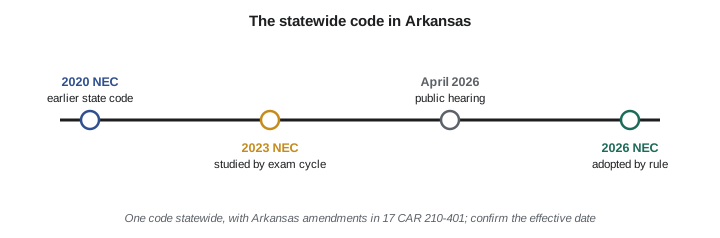
Arkansas adopts the NEC statewide by rule of the Board of Electrical Examiners. That is different from states where each city chooses its own edition. The board's rule names the edition of NFPA 70 that applies across the state, lists the Arkansas amendments and adds a workmanship standard. Under the 2026 rule, the adopted code is the 2026 edition of NFPA 70, the National Electrical Code, with Arkansas amendments, and the board also names ANSI/NECA 1, the standard for good workmanship in electrical construction, in its 2023 edition, as a guide for neat and workmanlike installation.
The rule also controls how the state moves to a newer edition. Later editions of the NEC do not take effect automatically when NFPA publishes them; the board must give public notice and hold a hearing before it adopts one. That is why Arkansas has often enforced an edition that is one or two cycles behind the newest one. Before the 2026 rule, the state code was the 2020 NEC. An earlier proposal had sought to move to the 2023 edition while keeping parts of the 2020 branch circuit rules, and the 2026 hearing notice proposed moving from the 2020 edition to the 2026 edition and updating the rule to reflect a 2025 act of the legislature.
Why the state amends the code
Every model code is written for the whole country. A state board adopts it with amendments where its members, after public comment, decide that a requirement adds cost without enough benefit in that state, conflicts with another law or needs clarification. Arkansas's amendments have focused on dwelling branch circuits, especially arc-fault and ground-fault protection, and on kitchen receptacle layouts. Contractors, inspectors, manufacturers, home builders and utilities often comment on these issues during the hearing, and the final rule reflects a balance of those views.
For a master, the practical point is that the amendments are as binding as the code itself. An inspector enforces the code as amended. A contractor who installs to the unamended NEC may install more protection than the state requires, which is allowed, while a contractor who assumes an amendment exists when it does not will fail inspection. Owners and specifications may also require more than the state minimum, and a contract can require full NEC compliance without the amendments.
The main Arkansas amendments
The 2026 rule's amendments, as summarized here, adjust arc-fault and ground-fault requirements for dwelling units in several ways. Branch circuits in dwellings rated over 130 volts to ground or between conductors, depending on the wording of the rule, are relieved of the arc-fault and ground-fault requirements that the model code applies to some higher-voltage circuits, except for pools, spas and similar installations under Article 680 and floating buildings under Article 682. Laundry areas are relieved of the ground-fault requirement for all receptacles, except receptacles within six feet of a laundry sink, which keep it. Circuits for refrigerators and microwave ovens are relieved of arc-fault and ground-fault requirements; nuisance tripping that can spoil food or disable an appliance is the reason commonly given for this kind of amendment.
| Topic | Model 2026 NEC direction | Arkansas amendment (summary) |
|---|---|---|
| Dwelling circuits over 130 volts | Extends AFCI or GFCI protection to some higher-voltage circuits | Not required, except for Article 680 and 682 installations |
| Laundry areas | GFCI protection for receptacles in the area | Required only for receptacles within six feet of a sink |
| Refrigerator and microwave circuits | Covered by general AFCI and GFCI rules | Not required on those dedicated circuits |
| Kitchen islands and peninsulas | Revised receptacle rules | A count based on counter area and a receptacle near a peninsula end |
| Workmanship | Neat and workmanlike manner | ANSI/NECA 1-2023 named as the workmanship guide |
The kitchen island and peninsula amendment sets a receptacle count based on counter area. As summarized from the rule, it calls for one receptacle for the first nine square feet of island or peninsula countertop, one more for each additional 18 square feet, and a receptacle within two feet of the outer end of a peninsula. That approach is close to the receptacle rules in earlier editions and differs from the newer model code, which changed island receptacle requirements. Ouachita Bend prices kitchen work from the plan's counter dimensions, so the count matters to every residential bid.
# Island or peninsula receptacle count under the Arkansas amendment as summarized
# (simplified study aid: assumes any part of an additional 18 sq ft adds one;
#  confirm the rule's wording before relying on it)
import math
def island_receptacles(length_in, depth_in, peninsula=False):
    area = length_in * depth_in / 144
    n = 1
    if area > 9:
        n += math.ceil((area - 9) / 18)
    return area, n, ("plus one within 2 ft of the peninsula end" if peninsula else "")
for L, D, p in [(72, 36, False), (96, 42, False), (120, 30, True)]:
    area, n, note = island_receptacles(L, D, p)
print(f"{L} x {D} in: {area:.1f} sq ft -> {n} receptacles {note}")72 x 36 in: 18.0 sq ft -> 2 receptacles 96 x 42 in: 28.0 sq ft -> 3 receptacles 120 x 30 in: 25.0 sq ft -> 2 receptacles plus one within 2 ft of the peninsula end
The output shows how quickly the count grows on a large island. A six-foot by three-foot island at 18 square feet needs two receptacles under this approach; an eight-foot by three-and-a-half-foot island at 28 square feet needs three; a ten-foot peninsula 30 inches deep, at 25 square feet, needs two plus the receptacle near its end, depending on how the rule treats the end. Because these numbers depend on the exact wording, Tanisha checks each layout against the rule text and the local inspector's reading before finishing a bid.
Local governments and the state code
Cities and counties in Arkansas may adopt rules on materials, construction, installation and inspection as long as they do not conflict with the state standards, under A.C.A. 17-28-305. A city with its own program usually adopts the state electrical code by reference and adds administrative provisions for permits, fees and inspections. Some cities add requirements of their own, such as rules for temporary services or service equipment locations, where their attorneys conclude the rules do not conflict with state law. Utilities also have service requirements, such as meter locations and service entrance details, that are not part of the code but must be met for the utility to connect.
The practical rule is to ask. Before a job in a new city, call the inspection office and ask which code edition and amendments it enforces, whether it has local requirements and how it handles plan review. The answer is usually the state code. When it is not, or when a city is still enforcing a previous edition during a transition, the inspector's answer and the permit determine what the job must meet.
The exam edition and the job edition
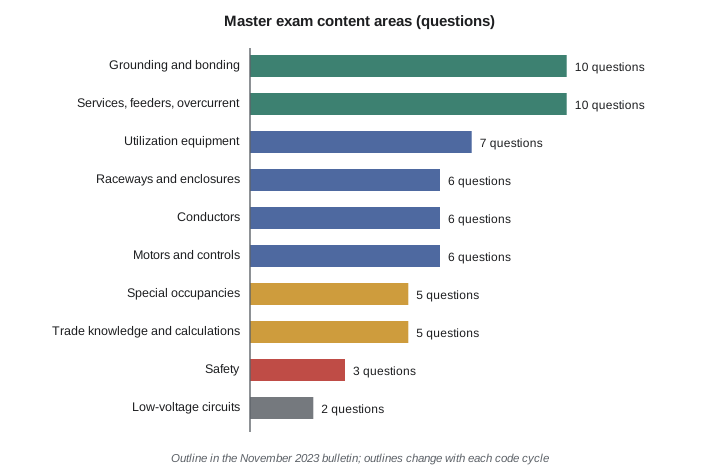
The candidate bulletin names the edition of the NEC that the exam is written to, and that edition does not always match the edition enforced on jobs. The November 2023 bulletin used the 2023 NEC while the state enforced the 2020 edition, and the state has now adopted the 2026 edition. Exam questions are usually written to the model code without state amendments, because the exam tests code knowledge, not Arkansas amendments. A candidate should therefore study the model code in the edition named, answer questions from that book, and save the Arkansas amendments for job work and for any questions that clearly ask about Arkansas.
Specifications, plan review and the amendments
Commercial and public projects often come with specifications written by an engineer who may practice in several states. A specification that says the work shall comply with the latest edition of the NEC, or with all applicable codes, can be read more than one way when the state has adopted an amendment. Some specifications require full compliance with the model code, which makes the amendment irrelevant for that job because the contract requires more than the state minimum. Others defer to the code as adopted. Before bidding, read the codes section of the specification, note any conflict with the Arkansas amendments and send a written question to the engineer or architect during the bid period. The answer becomes part of the contract documents.
Plan review, where a city or the state requires it, is the other place the amendments surface. A plan reviewer reviewing a commercial job in Little Rock will apply the code the city enforces, which is normally the state code as amended. A plan reviewer for a project with a federal or institutional owner may apply that owner's own standards on top of the code. Ouachita Bend's estimators keep a one-page list of the Arkansas amendments taped inside the estimating binder, with a note about how each one affects pricing, so that bids on similar houses do not swing because one estimator assumed full NEC compliance and another assumed the amendments.
Worked problem
Applying the amendments on a house
Ouachita Bend is wiring a new house in Benton under the 2026 Arkansas code. The plan shows a 240-volt dryer circuit, a laundry room with a sink and three receptacles, one of them within four feet of the sink, a dedicated refrigerator circuit and a 6-foot by 3-foot island. Using the amendments as summarized, which items need GFCI protection under the state code, and how many island receptacles are needed?
Show solution
- The 240-volt dryer circuit is a dwelling circuit over 130 volts, so the amendment relieves it of the GFCI and AFCI requirements unless it falls under Article 680 or 682.
- In the laundry, only receptacles within six feet of the sink need GFCI protection, so the receptacle four feet from the sink needs it and the others do not under the amendment.
- The dedicated refrigerator circuit is relieved of AFCI and GFCI requirements under the amendment.
- The island is 18 square feet: one receptacle for the first nine square feet and one for the next nine, which is part of an additional 18.
- Check each conclusion against the rule text and the local inspector, and remember that an owner's specification may require more.
Answer: Under the amendments as summarized, the laundry receptacle within six feet of the sink needs GFCI protection, the dryer and refrigerator circuits do not, and the island needs two receptacles.
Common mistakes
MistakeAssuming each city picks its own NEC edition.
InsteadThe board adopts one statewide code by rule; local rules may add administrative provisions but may not conflict.
MistakeInstalling to the newest NEC edition the day NFPA publishes it.
InsteadA new edition applies in Arkansas only after the board adopts it by rule after notice and a hearing.
MistakeAnswering exam questions with Arkansas amendments.
InsteadThe exam is written to the model code edition in the bulletin unless a question asks about Arkansas.
MistakeTreating amendments as optional.
InsteadInspectors enforce the code as amended; the amendments are binding minimums.
MistakeIgnoring ANSI/NECA 1.
InsteadThe rule names it as the workmanship guide.
Summary and key terms
- Arkansas adopts the NEC statewide by rule of the Board of Electrical Examiners.
- The 2026 rule adopts the 2026 NEC with Arkansas amendments and names ANSI/NECA 1-2023 for workmanship.
- New editions apply only after notice and a hearing; the previous state code was the 2020 NEC.
- The amendments adjust AFCI and GFCI rules for dwelling circuits over 130 volts, laundry areas and refrigerator and microwave circuits, and set an island receptacle count.
- Local governments may add rules that do not conflict with the state code.
- The exam follows the edition in the bulletin, usually without state amendments.
- Adoption
- The legal act that makes a code edition enforceable.
- Amendment
- A change to the model code made by the adopting authority.
- ANSI/NECA 1
- The national standard for good workmanship in electrical construction.
- 17 CAR 210-401
- The section of the board's rules that adopts and amends the NEC.
- Model code
- The NEC as published by NFPA, before any state amendments.
Practice problems
Work each problem on paper first, then reveal the answer to check.
Who adopts the NEC for Arkansas?
Show answer
The Board of Electrical Examiners, by rule, statewide.
Which edition does the 2026 rule adopt?
Show answer
The 2026 NEC with Arkansas amendments.
What did the laundry amendment keep?
Show answer
GFCI protection for receptacles within six feet of a laundry sink.
Which edition should you use to answer exam questions?
Show answer
The edition named in the candidate bulletin.
Lesson quiz · 5 questions
Score 60% or more to complete this lesson.
Create a free account to save your progress, take quizzes and earn a certificate.