
MELU-204 · Lesson 8 of 12 · 19 min
Contractor licensing, insurance and bonding
▶ Video coming soon A video version of this lesson is on the way.
The grocery remodel on the west side of Little Rock was the biggest job Ouachita Bend had bid in three years: new lighting, a new 1,200-ampere switchboard, refrigerated case circuits and a generator for the store's coolers. The electrical package came to a little over 400,000 dollars. The general contractor's bid form asked for five things besides the price: the electrical license numbers of the master and the foreman, the company's Contractors Licensing Board license number and classification, a certificate of insurance naming the owner and general contractor as additional insureds, a workers' compensation certificate and a bid bond. Linda Kay had every item in a folder before Tanisha finished the takeoff. "The price wins the job," she said. "The paperwork keeps you in the room."
This lesson explains the business side of being an Arkansas electrical company: how the Contractors Licensing Board system fits with the electrical licenses, when a contractor license or registration is needed, how a company is organized and registered, what the workers' compensation law requires, how general liability and other insurance work, and what bid, performance and payment bonds do. Thresholds, classifications and requirements change, so treat the figures here as a summary to confirm with each agency.
Two licensing systems
Arkansas regulates electrical companies through two systems that answer different questions. The Board of Electrical Examiners asks whether the people doing and supervising the work are qualified electricians; it licenses masters, journeymen and the other classes and registers apprentices. The Arkansas Contractors Licensing Board asks whether the business taking on a construction contract of a certain size has the experience, financial strength and business knowledge to complete it; it licenses commercial contractors and, through its residential committee, residential builders and remodelers. An electrical company working on larger projects needs both: licensed electricians for the work and a contractor license for the contract.
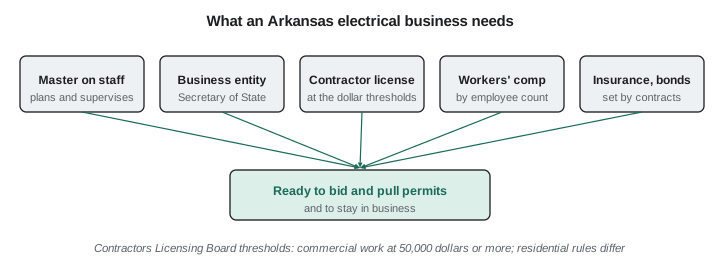
Contractor licensing thresholds
The Contractors Licensing Board's best-known threshold is for commercial work. A contractor who bids or performs a commercial project, meaning one other than single-family residential, with a value of 50,000 dollars or more, including labor and materials, generally needs a commercial contractor license with a classification that covers the work. Electrical work has its own specialty classification. Residential work falls under the board's residential committee: a residential builder license for new homes, and a remodeler or home improvement license or registration for work on existing homes above a much lower threshold, which secondary sources list at 2,000 dollars for some categories. Read the current statute and rules before relying on any figure, because the residential categories have changed several times.
| Work | Typical requirement (summary) | Check |
|---|---|---|
| Commercial project at 50,000 dollars or more | Commercial contractor license with an electrical or other suitable classification | Classification, bid limit and whether subcontract value counts |
| Commercial project under 50,000 dollars | No contractor license from the board, but electrical licenses still required | Local business rules and contract requirements |
| New single-family home | Residential builder license for the builder | Whether the electrical subcontractor needs its own registration |
| Remodeling or home improvement | Remodeler or home improvement license or registration above a low dollar threshold | Current threshold and category |
| Any electrical work | Licensed electricians and a master for planning and supervision | 17 CAR Part 210 |
The commercial license has a bid limit tied to the company's financial statement and experience, so a company that grows may need to raise its limit before bidding a larger job. The application asks for a qualifying party, financial statements, proof of insurance and, for some classifications, passing a business and law exam. A specialty electrical classification typically requires the company to show that it employs licensed electricians qualified for the work. Ouachita Bend carries a commercial license with an electrical classification and a bid limit high enough for the grocery job, and Linda Kay checks the limit every time a bid comes in above it.
Subcontractors raise a common question. Whether an electrical subcontractor on a commercial project of 50,000 dollars or more needs its own commercial license depends on the value of the subcontract and the board's current rules. Many general contractors require their electrical subcontractors to hold one regardless, because an owner or lender asks for it. When the answer matters, ask the board in writing and keep the answer.
Organizing the business
Most Arkansas electrical companies are corporations or limited liability companies registered with the Arkansas Secretary of State, which also handles annual franchise tax reports. An entity separates the company's debts from the owners' personal assets in many situations, though not for the owners' own wrongful acts or personal guarantees. The company also needs a federal employer identification number, state tax registrations, and any local business or privilege license a city requires. Sole proprietors can do electrical work if licensed, but most companies that bid commercial work prefer an entity for liability and bonding reasons. An accountant and a lawyer should help choose the structure.
The entity and the master are separate things. The entity holds the contracts, the contractor license, the insurance and the bonds. The master holds the electrical license, which belongs to that person. If the master leaves, the license leaves with him or her, and the company must have another master for work that needs planning and supervision. Ouachita Bend plans for that by employing two masters, Dale and now Tanisha, and by paying for another foreman to prepare for the master exam next year.
Workers' compensation
The Arkansas Workers' Compensation Law in A.C.A. 11-9 requires most employers with three or more employees to carry workers' compensation coverage or qualify as self-insured. The threshold is lower for construction. Under the law as commonly summarized, an employer engaged in building or building repair work must carry coverage with two or more employees, and a contractor that subcontracts part of its work, or a subcontractor, must carry coverage with even one employee. A general contractor can be liable for compensation to the employees of an uninsured subcontractor, which is why general contractors ask every subcontractor for a certificate of coverage. The Arkansas Workers' Compensation Commission administers the system and checks coverage.
In practice, every Arkansas electrical contractor with employees should assume it must carry coverage. The policy pays medical costs and lost wages for work-related injuries, and in most cases workers' compensation is the employee's exclusive remedy against the employer. Employers must post notices, report injuries to the carrier and the commission as required, and cooperate with claims. Classifying workers as independent contractors to avoid coverage is risky: the label on a form does not control if the company directs the work, and an electrician doing licensed work under a master's supervision is very likely an employee.
# Does a company need workers' compensation coverage? (simplified study aid
# based on the thresholds as commonly summarized; confirm with the commission)
def needs_coverage(employees, building_work, subcontracting):
    if subcontracting and employees >= 1:
        return True, "contractor or subcontractor with 1 or more employees"
    if building_work and employees >= 2:
        return True, "building or building repair with 2 or more employees"
    if employees >= 3:
        return True, "3 or more employees"
    return False, "below the thresholds summarized here"
cases = [(2, True, False), (1, True, True), (2, False, False), (16, True, True)]
for e, b, s in cases:
print(e, "employees, building work" if b else "employees, other work", "/ subcontracting" if s else "", "->", needs_coverage(e, b, s))2 employees, building work -> (True, 'building or building repair with 2 or more employees') 1 employees, building work / subcontracting -> (True, 'contractor or subcontractor with 1 or more employees') 2 employees, other work -> (False, 'below the thresholds summarized here') 16 employees, building work / subcontracting -> (True, 'contractor or subcontractor with 1 or more employees')
Liability and other insurance
Arkansas does not set a single statewide general liability minimum for every electrical contractor in the electrical rules summarized here, but the Contractors Licensing Board, local programs and nearly every contract do require insurance. Commercial general liability covers bodily injury and property damage to others, including damage from completed work. Commercial auto covers the vans. An umbrella or excess policy adds limits above the others. Equipment and tools coverage protects the company's own property. Some owners also require professional liability for design-build work, pollution coverage for certain jobs or builder's risk on the project itself.
Contracts usually specify the limits and the form of coverage, require the owner and general contractor to be named as additional insureds and require a waiver of subrogation. The grocery contract required general liability limits of 1 million dollars per occurrence and 2 million in aggregate, an umbrella of 5 million, additional insured status on an ongoing and completed operations basis and a 30-day notice of cancellation. Linda Kay sent the insurance requirements to the company's agent before the bid, because some endorsements take days to issue and some cost extra.
Bid, performance and payment bonds
A surety bond is a three-party promise: the contractor, called the principal, promises to perform; the surety company guarantees the promise; and the owner or another party, called the obligee, can claim on the bond if the contractor fails. A bid bond guarantees that the bidder will sign the contract and provide the required performance and payment bonds if awarded the job; on public work it is often set at 5 dollars for every 100 dollars bid, though the amount is set by the bid documents. A performance bond guarantees that the contractor will complete the work under the contract. A payment bond guarantees that the contractor will pay its subcontractors and suppliers. Arkansas law requires performance and payment bonds on many public construction contracts, and many private owners require them on large jobs as well.
A surety underwrites the contractor much as a bank underwrites a borrower, looking at financial statements, work in progress, experience and character, and it usually requires the owners to sign a personal indemnity agreement. A contractor's bonding capacity, the total amount of bonded work the surety will support, can limit growth as much as its bid limit. Ouachita Bend's surety asked for year-end financial statements reviewed by an accountant, a work-in-progress schedule and a meeting with Dale and Tanisha before it raised the company's capacity for the grocery job.
Worked problem
Assembling a commercial bid package
Ouachita Bend is bidding the 400,000-dollar electrical package on the Little Rock grocery remodel as a subcontractor. The bid form requires license numbers, the Contractors Licensing Board license, insurance certificates, workers' compensation proof and a bid bond of 5 dollars for every 100 dollars bid. List what Linda Kay needs and one check for each.
Show solution
- Electrical licenses: Tanisha's master license number and the foreman's journeyman license number, both current.
- Contractor license: the company's commercial license number, with an electrical classification and a bid limit above 400,000 dollars.
- Insurance: a certificate showing the required limits, with additional insured endorsements for the owner and general contractor.
- Workers' compensation: a certificate of coverage, which the general contractor needs to avoid liability for an uninsured subcontractor.
- Bid bond: 5 dollars for every 100 dollars of 400,000 dollars is 20,000 dollars, issued by the surety on its form or the bid form's form.
Answer: The package needs the two electrical license numbers, the commercial license with a sufficient bid limit, the insurance certificate and endorsements, the workers' compensation certificate and a 20,000-dollar bid bond.
Common mistakes
MistakeAssuming the electrical license is the only license a company needs.
InsteadCommercial projects of 50,000 dollars or more and certain residential work also need Contractors Licensing Board licensing.
MistakeBidding above the company's bid limit.
InsteadThe commercial license's bid limit must cover the bid; raise it first.
MistakeTreating employees as independent contractors to avoid workers' compensation.
InsteadThe law looks at the actual relationship; electricians working under a master's direction are usually employees.
MistakeWaiting until award to call the insurance agent.
InsteadContract insurance requirements and endorsements should be checked before the bid.
MistakeConfusing a performance bond with a payment bond.
InsteadA performance bond guarantees completion; a payment bond guarantees payment to subcontractors and suppliers.
Summary and key terms
- Electrical licenses cover the people; the Contractors Licensing Board licenses the business for contracts at its thresholds.
- Commercial projects of 50,000 dollars or more generally need a commercial license with a suitable classification and bid limit.
- Residential builder and remodeler licensing applies to home work above the board's thresholds.
- Workers' compensation is required at three employees generally, and at lower counts for building work and subcontracting.
- Contracts set insurance limits, additional insured status and waivers.
- Bid, performance and payment bonds guarantee signing, completion and payment.
- Contractors Licensing Board
- The Arkansas board that licenses contractors by project type and value.
- Bid limit
- The largest single job a commercial license allows the contractor to bid.
- Additional insured
- A party added to a contractor's liability policy by endorsement.
- Surety
- The company that guarantees a contractor's bonded promises.
- Payment bond
- A bond guaranteeing payment to subcontractors and suppliers.
Practice problems
Work each problem on paper first, then reveal the answer to check.
What commercial project value generally triggers a Contractors Licensing Board license?
Show answer
50,000 dollars or more.
How many employees trigger workers' compensation for most employers?
Show answer
Three, with lower counts for building work and subcontracting.
What does a bid bond guarantee?
Show answer
That the bidder will sign the contract and provide the required bonds if awarded the job.
Who owns the electrical license, the company or the master?
Show answer
The master.
Lesson quiz · 5 questions
Score 60% or more to complete this lesson.
Create a free account to save your progress, take quizzes and earn a certificate.