
MELU-203 · Lesson 9 of 12 · 18 min
Contracts and mechanics' liens in Arizona
▶ Video coming soon A video version of this lesson is on the way.
The Chandler dental office job taught Lupe more about Arizona lien law than any book. Sonoran Line was a subcontractor to a general contractor that ran into money trouble halfway through the build-out. The company had finished its rough-in and set the switchgear when the general contractor stopped paying. Because Brenda had sent the company's preliminary twenty-day notice in the first week of the job, Sonoran Line still had lien rights, and the threat of a lien brought the owner and the general contractor to the table. Another subcontractor on the same job had skipped the notice and lost most of its lien rights. This lesson covers contracts and Arizona's mechanics' lien law as they apply to an electrical contractor.
Contracts
Every job should start with a written contract that sets out the scope of work, the price or pricing method, the payment schedule, how changes will be handled, the schedule and the parties' responsibilities. For residential work, Arizona's contractor statute and the ROC's rules add specific requirements for contracts with homeowners, including information that identifies the licensee and its license number and explains the owner's rights. A contractor who does residential work should use a contract form that has been reviewed against the current statute and rules.
On commercial jobs, the electrical contractor usually signs a subcontract written by the general contractor. Those subcontracts often contain clauses that shift risk to the subcontractor: pay-when-paid or pay-if-paid terms, broad indemnity, waivers of claims, and requirements to keep working during disputes. Lupe's rule, learned from Gil, was to read every subcontract and mark the payment, indemnity, insurance, change-order and dispute sections before anyone signed. Arizona also has prompt payment provisions for construction contracts, in A.R.S. 32-1129 and the sections that follow, which set time limits for approving and paying billings and for passing payment down to subcontractors; read the current text for the deadlines and the conditions that apply.
Change orders
Most disputes on electrical jobs begin with changed work. An owner or general contractor asks for something extra, the crew does it, and no one agrees on the price until the end. A written change order signed before the work is done prevents most of these disputes. When the urgency of the job makes that impossible, at least confirm the instruction in writing the same day, with a description of the work and a note that it will be priced as a change. Sonoran Line's foremen carry a one-page change authorization form for exactly that purpose.
Who can claim a lien
Arizona's mechanics' lien law allows people who furnish labor, materials, machinery, fixtures or tools for a construction project to claim a lien on the property improved, securing payment for what they provided. That includes general contractors, subcontractors, suppliers and, with limits, laborers. A recorded lien is a cloud on the owner's title: the owner cannot easily sell or refinance until it is resolved, which is why the threat of a lien carries weight. The lien itself must be enforced by a lawsuit within a strict time, or it expires.
The preliminary twenty-day notice
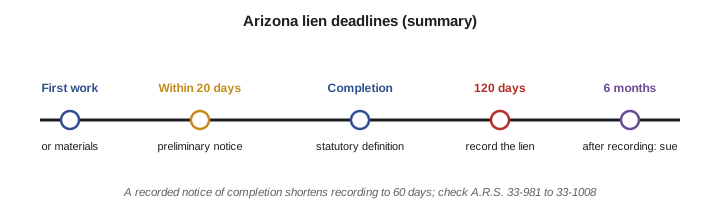
The most important step in Arizona lien law happens at the start of the job. To preserve lien rights, a claimant generally must serve a preliminary twenty-day notice, described in A.R.S. 33-992.01, within twenty days after first furnishing labor or materials to the job. The notice goes to the owner, the original contractor, the construction lender if any, and the person who hired the claimant. If the notice is served late, the claimant can generally claim a lien only for labor and materials furnished from twenty days before the notice was served onward. If it is never served, lien rights are generally lost. Laborers working for wages are treated differently.
Arizona practice is to serve the notice on every job, early, as routine. Brenda uses the job information sheet the general contractor or owner provides, which identifies the owner, lender and other parties, and sends the notice by a method that provides proof of delivery. A.R.S. 33-992.02 covers proof of service. "The notice isn't a threat," Brenda tells nervous customers. "It's a form the law asks every supplier and subcontractor to send. It just keeps our rights."
Recording the lien
If payment does not come, a claimant records a notice and claim of lien with the county recorder where the property is located. Under Arizona law the general deadline is 120 days after completion of the work of improvement. Completion has a statutory meaning: when a permit was issued, it is generally the earlier of thirty days after the final inspection and written acceptance by the owner, or sixty days after labor stops; when there was no permit or no final inspection, it is generally the last date labor or materials were furnished. If the owner records a notice of completion, the deadline is shortened to sixty days after that notice is recorded. The lien must contain the information the statute requires and be signed under oath, and a copy must be served on the owner within a reasonable time after recording.
Enforcing the lien
A recorded lien does not last indefinitely. The claimant must file a lawsuit to foreclose it within six months after recording, in the superior court for the county where the property is located, and record a notice of the pending action. Public summaries of Arizona practice say the notice should be recorded within five days after the suit is filed. If the suit is not filed in time, the lien is lost. When a claim is paid, the claimant must release the lien; A.R.S. 33-1006 addresses releases.
| Step | Time limit (summary) | Statute area |
|---|---|---|
| Preliminary twenty-day notice | Within 20 days after first furnishing | A.R.S. 33-992.01 |
| Record the claim of lien | 120 days after completion, or 60 days after a recorded notice of completion | A.R.S. 33-993 |
| Serve a copy on the owner | Within a reasonable time after recording | A.R.S. 33-993 |
| Foreclosure lawsuit | Within 6 months after recording | A.R.S. 33-998 |
| Release after payment | As the statute requires | A.R.S. 33-1006 |
# Lien deadlines from key dates (study aid; confirm the statute and dates with a lawyer)
from datetime import date, timedelta

first_work = date(2026, 2, 9)
final_inspection_and_acceptance = date(2026, 6, 1)
labor_stopped = date(2026, 5, 20)

notice_due = first_work + timedelta(days=20)
completion = min(final_inspection_and_acceptance + timedelta(days=30),
                 labor_stopped + timedelta(days=60))
lien_due = completion + timedelta(days=120)
print("Preliminary notice due by:", notice_due)
print("Completion (permit issued):", completion)
print("Record the lien by:", lien_due)
print("Then sue within 6 months of recording.")Preliminary notice due by: 2026-03-01 Completion (permit issued): 2026-07-01 Record the lien by: 2026-10-29 Then sue within 6 months of recording.
For the Chandler job, the calculator puts completion at July 1, thirty days after the final inspection and acceptance, which comes before sixty days after labor stopped. The lien deadline follows 120 days later. If the owner had recorded a notice of completion, the deadline would have been sixty days after that recording, which is why a contractor must watch the county records once a job winds down.
Homes, waivers and public projects
Arizona strongly limits liens on an owner-occupied home. As a general rule, a claimant who did not contract directly with the homeowner cannot lien the owner's occupied residence; check A.R.S. 33-1002 for the exact conditions and exceptions before relying on lien rights in residential work. A subcontractor on a house should therefore look to the general contractor, its bond and its contract rights for payment, and make sure it knows who it is working for.
Lien waivers and releases are exchanged with payments on most projects. Arizona's statute addresses waivers and releases, including the forms they must follow; use the forms the current statute requires and read each waiver before signing, because an unconditional waiver signed before the money clears can give up rights for nothing. On public projects, mechanics' liens are generally not available against public property, and payment bonds take their place; claims against those bonds have their own notice and timing rules under A.R.S. 34-222 and related sections.
Payment practices that prevent lien fights
The best lien is the one never recorded. Good payment practice starts with a clear schedule of values and billing dates, monthly billings submitted on time with the backup the customer requires, and prompt follow-up when a payment is late. Many commercial contracts hold back a part of each payment as retention until the job is complete; know the contract terms and the statute's rules for releasing it. When a general contractor is slow to pay, a polite reminder that cites the contract and the job's preliminary notice often works better than an angry call.
Exchange waivers carefully. A conditional waiver given with a billing becomes effective only when the payment is received; an unconditional waiver gives up rights whether or not the check clears. Sonoran Line never signed an unconditional waiver until the money was in its bank account. Joint checks, payable to a subcontractor and its supplier together, are common on larger jobs and help ensure suppliers are paid, which reduces the risk of their liens.
| Record | Use |
|---|---|
| Job information sheet with owner, lender and general contractor | Serving the preliminary notice |
| Preliminary notice and proof of service | Showing lien rights were preserved |
| First and last dates of work and deliveries | Calculating deadlines |
| Inspection and acceptance dates | Determining completion |
| Billings, payments and waivers | Proving the amount owed |
Worked problem
Did the other subcontractor lose its rights?
On the Chandler job, a drywall subcontractor began work on February 16 and served its preliminary notice on April 6. It was not paid for work done between February 16 and April 6, or for May work. What lien rights does it likely have?
Show solution
- The notice was due within twenty days of first furnishing, by about March 8, so it was late.
- A late notice generally preserves lien rights only for work furnished from twenty days before it was served, that is, from about March 17 onward.
- Work between February 16 and about March 16 is generally outside the lien.
- Work from about March 17 through May remains lienable if the lien is recorded and enforced on time.
Answer: It likely lost lien rights for work before about March 17 but kept them for later work.
When to call a lawyer
Lien law rewards early action. Call a construction lawyer as soon as a significant payment is seriously late, when a customer disputes a large change order, when a notice of completion is recorded on a job with an unpaid balance, or when a lien deadline is approaching. A lawyer can confirm the deadlines, prepare the lien so that it meets the statute, serve it correctly and advise whether a bond claim, a contract claim or negotiation is the better route. A lien that is overstated or improperly prepared can expose the claimant to liability, so it is not a form to fill out casually. Sonoran Line's lawyer prepared the company's lien on the Chandler job, and the general contractor's lender, seeing a properly recorded claim on its borrower's property, insisted that the general contractor pay the subcontractors before the next draw.
Common mistakes
MistakeSkipping the preliminary notice to avoid upsetting the customer.
InsteadServe the twenty-day notice on every job; it is routine and preserves your rights.
MistakeCounting the lien deadline from the last day on the job without checking completion rules.
InsteadApply the statutory definition of completion and watch for a recorded notice of completion.
MistakeRecording a lien and then waiting.
InsteadFile the foreclosure suit within six months of recording or the lien is lost.
MistakeExpecting to lien a public building.
InsteadUse the payment bond and its notice rules on public projects.
Summary and key terms
- Use written contracts and signed change orders; read subcontract payment, indemnity and insurance clauses.
- Serve the preliminary twenty-day notice within twenty days of first furnishing to preserve lien rights.
- Record the lien within 120 days after completion, or 60 days after a recorded notice of completion.
- Sue to foreclose within six months of recording.
- Liens on owner-occupied homes are strongly limited; public projects use payment bonds instead of liens.
- Preliminary twenty-day notice
- The notice a claimant serves within twenty days of first furnishing to preserve lien rights.
- Claim of lien
- The notice and claim of lien recorded with the county recorder to claim a lien.
- Recorded notice of completion
- A notice an owner may record that shortens the lien recording period to sixty days.
- Foreclosure
- The lawsuit that enforces a lien.
- Change order
- A written agreement changing the scope, price or time of a contract.
Practice problems
Work each problem on paper first, then reveal the answer to check.
Sonoran Line first delivered gear to a job on March 2. By when should its preliminary notice be served?
Show answer
By March 22, twenty days after first furnishing.
An owner records a notice of completion on August 10. What is the general lien recording deadline?
Show answer
Sixty days after recording, about October 9.
A lien was recorded on January 15. By when must the foreclosure suit be filed?
Show answer
Within six months, by about July 15.
Lesson quiz · 5 questions
Score 60% or more to complete this lesson.
Create a free account to save your progress, take quizzes and earn a certificate.