
MELU-203 · Lesson 7 of 12 · 18 min
Duties and responsibilities of the Electrical Contractor License (ROC) holder
▶ Video coming soon A video version of this lesson is on the way.
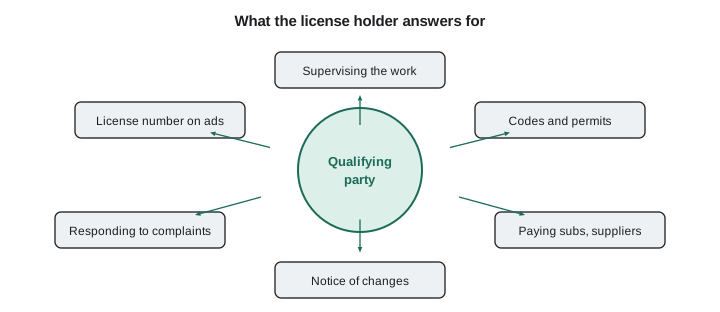
Passing the exams would put Lupe's name on Sonoran Line's license, and with it a set of responsibilities that Gil had carried for twenty-eight years. One evening after work, Gil sat down with her and went through what the job really meant. "The license is the company's," he said, "but the ROC looks to two people when something goes wrong: the people who own and run the company, and the qualifying party. Once you're on that license, you are the one who answers for the electrical work." This lesson covers the duties that come with an Arizona license: supervision, compliance with codes and contracts, honest business practices, record-keeping, advertising and notice requirements, and the grounds on which the ROC can discipline a licensee.
Supervising the work
The qualifying party's experience is the reason the ROC trusts the license, so the qualifying party is expected to be involved in the work, not merely to lend a name to it. That does not mean standing on every job. It means setting the standards the company works to, making sure the electricians and foremen are competent, overseeing the work through the company's supervisors, and being available when problems arise. A qualifying party who never sees the work, never meets the crews and cannot answer for the company's installations is exactly what the regular-employment requirement is meant to prevent.
For Lupe, supervision meant formalizing what she already did as superintendent: weekly job walks, a checklist for each inspection stage, a review of every set of plans before the company bid, and a rule that any code question a foreman could not settle came to her before the work was covered. Gil added one more piece of advice. "Write down the hard calls," he said. "When you tell a foreman how to handle something unusual, put it in an email. If the question ever comes back, you want to show what you decided and why."
Following codes, permits and plans
A licensee must do the work in compliance with the building codes adopted where the work is located, obtain the permits required, and build according to the plans and specifications agreed with the owner unless the owner agrees in writing to a change. The statute treats a material departure from approved plans, a failure to follow the applicable codes, and doing work without a required permit as grounds for discipline. Lessons 5 and 6 covered how to find the code and permit requirements; this lesson is a reminder that ignoring them is not only a code violation but a licensing matter.
Contracts, payment and money held in trust
Arizona's statute disciplines contractors who abandon a job without good reason, who divert money received for a project to other purposes, who fail to pay subcontractors, workers or suppliers money due on a project, or who fail to perform work in a workmanlike manner. For an electrical contractor those duties have everyday meaning: pay the supply house for the gear on a job out of the money received for that job, pay the crew on time, finish what you start, and do not leave an owner with liens because the company used one customer's payment to cover another job.
Residential contracts carry additional requirements under the statute and rules, including written contracts that set out the work, the price and payment terms, and information about the licensee and the owner's rights. Lesson 9 covers contracts and mechanics' liens. For now, the point is that the business practices of the company are part of what the license holder answers for.
License number, advertising and identification
The statute requires a licensee's license number to appear on bids, contracts and advertising, so that owners can check the license. That includes trucks, websites, social media pages, business cards and proposals where the law requires it. Advertising for work outside the license's classification, or advertising in a name that does not match the license, can itself be a violation. Brenda keeps the license number on every template the company uses, and when Theo's crew got new truck wraps, she checked the proof before it went to the printer.
Keeping the ROC informed
A licensee must keep its information current with the ROC: addresses, owners and officers, the business name, and above all the qualifying party. When a qualifying party leaves or is disassociated from the license, the licensee must notify the ROC and replace the qualifying party within the time the statute allows, or the license may be suspended. The qualifying party may also notify the ROC personally when leaving, which protects him or her from responsibility for work done after the departure. Gil's plan was to remain on the license until Lupe was approved, so there would be no gap.
| Event | What the licensee should do (summary) |
|---|---|
| Qualifying party leaves | Notify the ROC and name a qualified replacement within the time allowed |
| Change of address or business name | Update the ROC records (and the Corporation Commission where applicable) |
| Change in owners or officers | Report the change as the ROC requires |
| Bond cancellation notice | Replace the bond before it lapses, or the license may be suspended |
| Complaint received | Respond to the ROC within the deadline and attend any inspection |
Complaints and corrective work
Owners, contractors and others can file complaints with the ROC. For workmanship complaints, the ROC typically sends an inspector to look at the work. If the work is found to be poor or not up to code, the ROC can issue a directive requiring the licensee to correct it within a set time. A licensee who corrects the work as directed may resolve the matter; one who does not may face a citation, a hearing and discipline. For residential work, an owner who suffers an actual loss from a licensee's violation may also be able to recover from the Residential Contractors' Recovery Fund, and payments from the fund lead to consequences for the licensee.
Lupe had seen one complaint during her years at Sonoran Line, over an exhaust fan circuit in a Chandler remodel that tripped repeatedly. The ROC inspector found a shared neutral problem on a circuit an earlier contractor had installed, not Sonoran Line's work, but the company fixed it anyway at cost and documented everything. "Answer every complaint quickly and politely," Gil said. "Even when you're right."
Solar work
Solar is a large share of Arizona electrical work, and the ROC has requirements specific to it. The ROC's classification table notes that a solar warranty is required for the electrical classifications if any solar work is performed, and the application includes a solar warranty form where it applies. Residential solar sales are also subject to consumer protection rules on disclosures and contracts. Theo's solar crew used a standard disclosure and warranty package that Brenda kept current, and any change to it went past Lupe first.
# A monthly compliance check for the license (illustrative data)
from datetime import date

today = date(2026, 10, 1)
items = {
    "Bond expiration": date(2027, 1, 15),
    "License expiration": date(2027, 6, 30),
    "Corporation Commission annual report due": date(2026, 11, 30),
    "General liability policy renewal": date(2026, 10, 20),
}
for name, due in sorted(items.items(), key=lambda kv: kv[1]):
    days = (due - today).days
    flag = "ACT NOW" if days <= 30 else ("plan" if days <= 90 else "ok")
print(f"{name:<45} {due.isoformat()} {days:4d} days {flag}")General liability policy renewal 2026-10-20 19 days ACT NOW Corporation Commission annual report due 2026-11-30 60 days plan Bond expiration 2027-01-15 106 days ok License expiration 2027-06-30 272 days ok
The check is simple, but missing any of these dates can suspend the license or stop the permit desk. Brenda ran the same check on the first of every month and sent the list to Gil and, once she was approved, to Lupe.
Working with subcontractors
An electrical contractor that hires subcontractors, such as a low-voltage installer, an excavation contractor or a solar mounting crew, should confirm that each one holds the license the work requires. The ROC's website lets anyone look up a license by name or number, and the search takes a minute. Contracting with an unlicensed contractor for work that requires a license can itself be treated as a violation, and it leaves the electrical contractor responsible for the unlicensed work. Sonoran Line's subcontract checklist began with a printout of the subcontractor's license record, its bond status and its insurance certificate.
Records the license holder should keep
Good records are the best defense when a complaint arrives or a question about old work comes back. They also make renewals and qualifying party changes simple. Lupe adopted Gil's rule that every job file should be complete enough for someone else to understand the job without asking her.
| Record | Why it matters |
|---|---|
| Signed contracts and change orders | Show what was agreed and what changed |
| Permits, inspection results and final approvals | Prove the work was inspected and accepted |
| Payment records and lien waivers | Show subcontractors and suppliers were paid |
| Daily reports and photographs | Document conditions and work before it was covered |
| Correspondence on code questions and hard calls | Shows what was decided and why |
Keep records for at least as long as claims about the work could be brought, and ask a lawyer how long that is for the kinds of work the company does. Digital records are fine if they are organized and backed up. A file that cannot be found is no better than a file that was never kept.
Worked problem
Who answers for the work?
Six months after Lupe becomes qualifying party, a foreman installs a feeder for a Tempe warehouse without waiting for the rough-in inspection and covers it with a ceiling. The city finds out and the owner complains to the ROC. Who is responsible, and what should the company do?
Show solution
- Covering work before inspection violates the city's requirements and can be treated as a failure to follow codes and permit requirements.
- The license belongs to the company, and the qualifying party answers for the electrical work done under it, so both the company and Lupe are accountable to the ROC.
- The company should open the ceiling as the city requires, pass the inspection and respond promptly to the ROC.
- Lupe should document the corrective action and retrain the foreman on the inspection checklist.
Answer: The company and its qualifying party are accountable; open the work, pass inspection, respond to the ROC and document the fix.
Ethics and reputation
The statute sets the minimum. Most of the conduct that keeps an electrical contractor out of trouble with the ROC is the same conduct that keeps customers coming back: telling the truth about schedules and prices, putting agreements in writing, finishing what was promised, paying bills on time and standing behind the work. A contractor that discovers a mistake in its own work should fix it, even when the inspector passed it. Gil's reputation in Mesa had been built over decades on exactly that, and Lupe knew that the license number on the trucks would now carry her name as well as his. She told the foremen that the question to ask on every hard call was simple: would we be comfortable explaining this decision to the owner, the inspector and the ROC?
Common mistakes
MistakeTreating the qualifying party role as a name on paper.
InsteadThe qualifying party must be regularly employed and involved in overseeing the work.
MistakeUsing one job's payments to cover another job's bills.
InsteadDiverting project funds and failing to pay subcontractors or suppliers are grounds for discipline.
MistakeLeaving the license number off advertising.
InsteadPut the license number on bids, contracts and advertising as the statute requires.
MistakeIgnoring a complaint because the work was right.
InsteadRespond promptly and cooperate with any ROC inspection.
Summary and key terms
- The qualifying party answers for the electrical work done under the license and must be involved in overseeing it.
- Licensees must follow adopted codes, obtain permits and build to the agreed plans.
- Abandoning jobs, diverting funds and failing to pay subcontractors or suppliers are grounds for discipline.
- The license number must appear on bids, contracts and advertising; information with the ROC must be kept current.
- The ROC investigates complaints and can direct corrective work; residential owners may recover from the recovery fund.
- Disassociation
- The departure of a qualifying party from a license, which must be reported and remedied.
- Corrective work directive
- An order from the ROC requiring a licensee to correct poor or non-compliant work.
- Diversion of funds
- Using money received for one project for unrelated purposes, leaving that project's bills unpaid.
- Solar warranty
- The warranty the ROC requires from licensees who perform solar work.
- Workmanlike manner
- Work performed to the standards of the trade and the applicable codes.
Practice problems
Work each problem on paper first, then reveal the answer to check.
What should a licensee do when its qualifying party leaves?
Show answer
Notify the ROC and name a qualified replacement within the time the statute allows.
Name two money-related grounds for discipline.
Show answer
Diverting project funds and failing to pay subcontractors, workers or suppliers money due.
What can the ROC require after finding poor workmanship?
Show answer
Corrective work within a set time, with discipline if the licensee does not comply.
Lesson quiz · 5 questions
Score 60% or more to complete this lesson.
Create a free account to save your progress, take quizzes and earn a certificate.